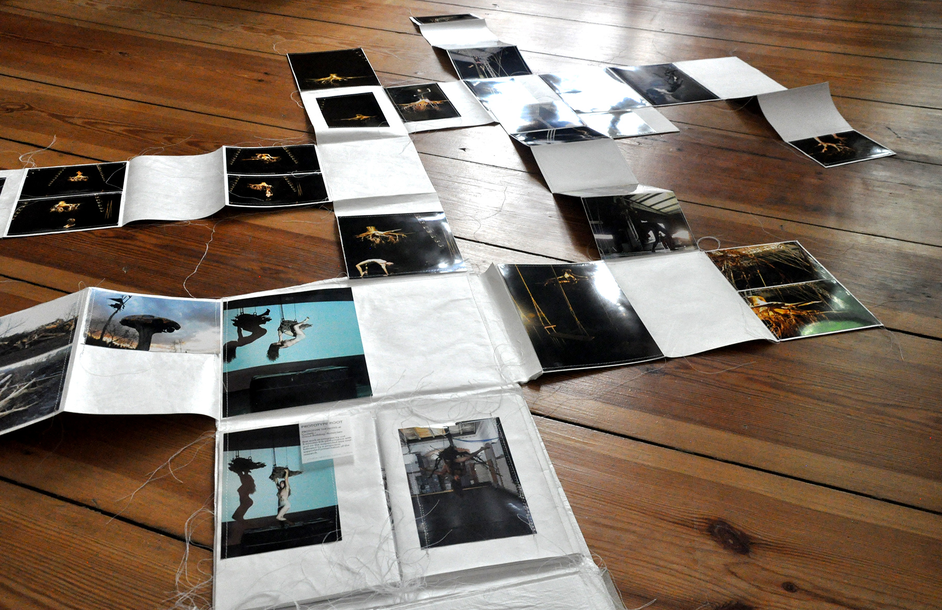
The fruit you can discover on this page are the most concrete outcomes of the research practice.
In their metaphorical nature the fruit can be enjoyed immediately as products (best example the book object) or planted again as seeds for further evolution (most applicable for the method development fruit).
In my understanding of artistic research, when you go to the unknown, you can not predict the outcomes. In contrast to proving a preformulated thesis of traditional research, where you therefore can not find something truely new, artistic research outcomes are rather abstract but therefore allow for a manifold application. There are concrete relations to the intial research question ‘how to strike roots into the void?’ – each fruit including this exposition itself is a possible answer, though I do not believe that there is only one single true answer that could be presented here.
Some formats have emerged in the process, also if I was not explicitely searching for them – such as the PCE (Pre-Choreographic Elements), as a by-product. They still can be considered as a sort of answer to the researchs objective (link back to SEED objectives) – in this case to find new application of the permaculture philosophy, especially the practice of observation. Combined with my declared aim to ‘question, develop and deepen my aerial acrobatic practice’ (see SEED/objectives) this new tool for my movement practice in suspension appeared.
Similar applies to the Aerial Rooting method, as another outcome of the research in a form of an effort, to develop a new method embodying the ‘submission lead’ concept to re-interpret aerial acrobatic practices. The series of experiments called Tree Encounters later became a research project on its own by the way, so here the original research aims developed into another new sort of seed.
The actual performance creation is mainly referring to the research objective to ‘give impulses for reflection and dialogue’, share with audiences as withnesses and ‘explore and experience myself and with others’ the topics and content of this research in movement and in performative context. It met the aims to the extend that I conducted a fruitful group research (that inspired the creation process, but is not represented here in order to keep this exposition in a reasonable size) and presented the performance in various formats of showings with audience feedbacks and discussion. However due to technical limitations and also Corona measurements for interactions with audiences I had to let go of some ideas and aims to create a true immersive experience. I had to change and adapt for the final staging of the piece, making an effort to keep the essential qualities and content I wanted to bring across and share with withnesses.
Finally the book object is also reflecting my strong belief in the inseparability of form & content. For me its design reflects the content in beautiful ways. It met the objectives around sharing, finding my way to research and giving impulses in a way. Though of course there is a limitation for sharing with bigger audiences as it is a single copy.
This was a reason also to come up with another form for meeting more fully the objectives of sharing and giving impuls – which finally resulted in this RC exposition – which is in itself an important outcome. Especially the sections ‘How’ & ‘Striking Roots’ are fruits itself, and have grown from the seed research objectives of ‘finding my own definition and standing in Artistic Research’. Also the creation of a suitable frame to nourish my need for a coherent form & content entwinement is resonating with the objectives declared in the seed. Last but not least the contexts section is referring back to the initial sprout/seedling of the motivation around a ‘re-definition of body & object relationships in multilayered nature’.
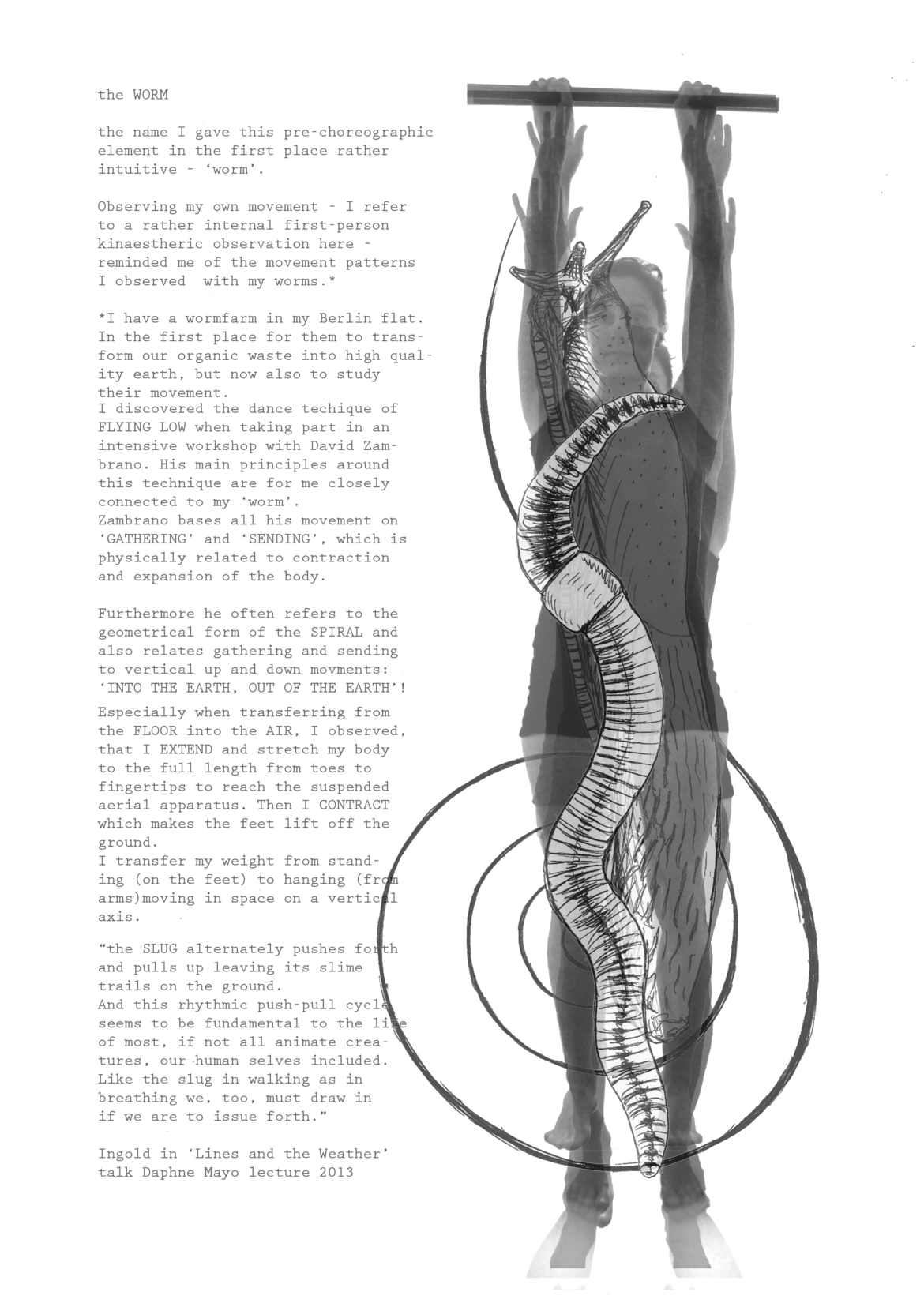
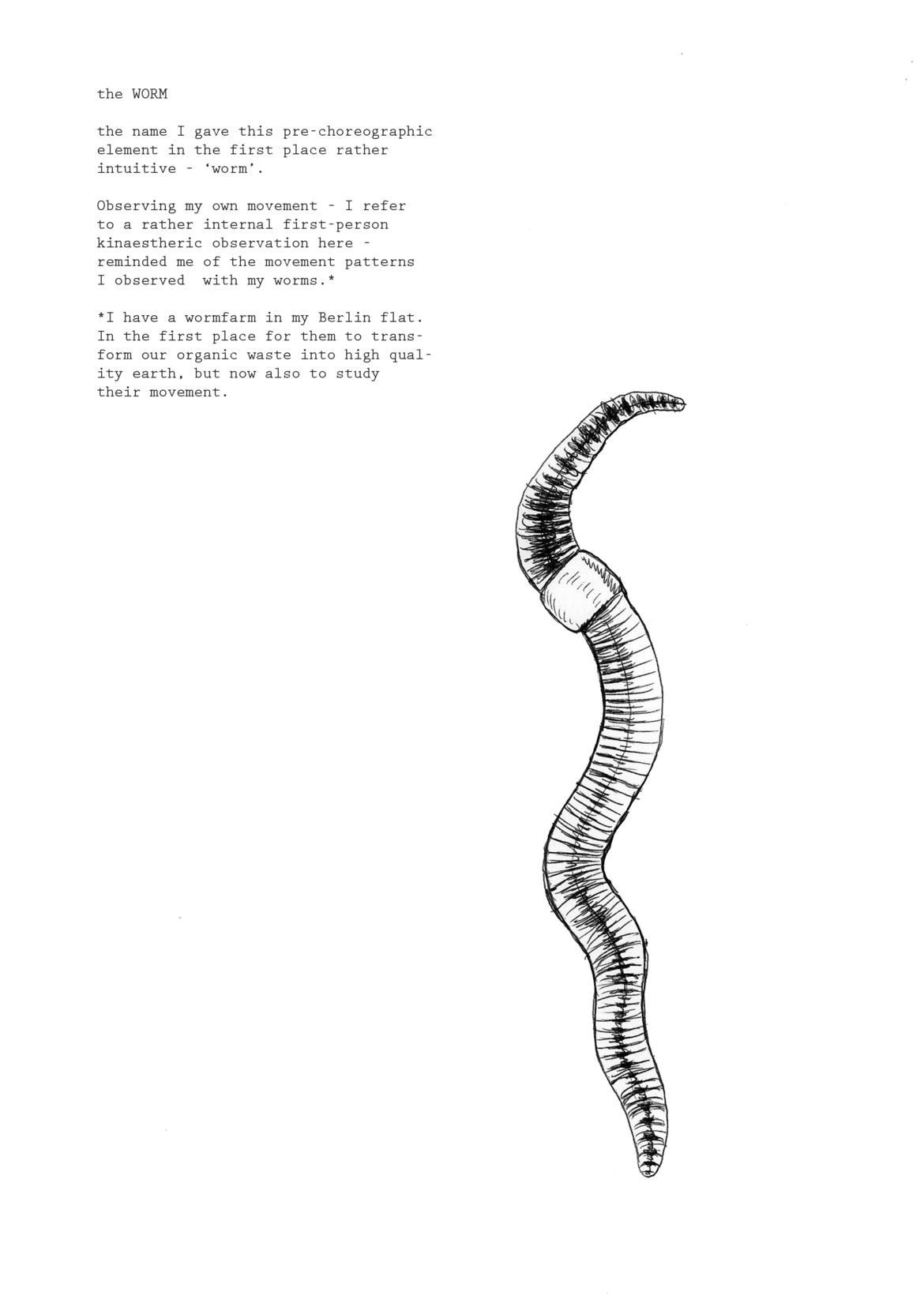
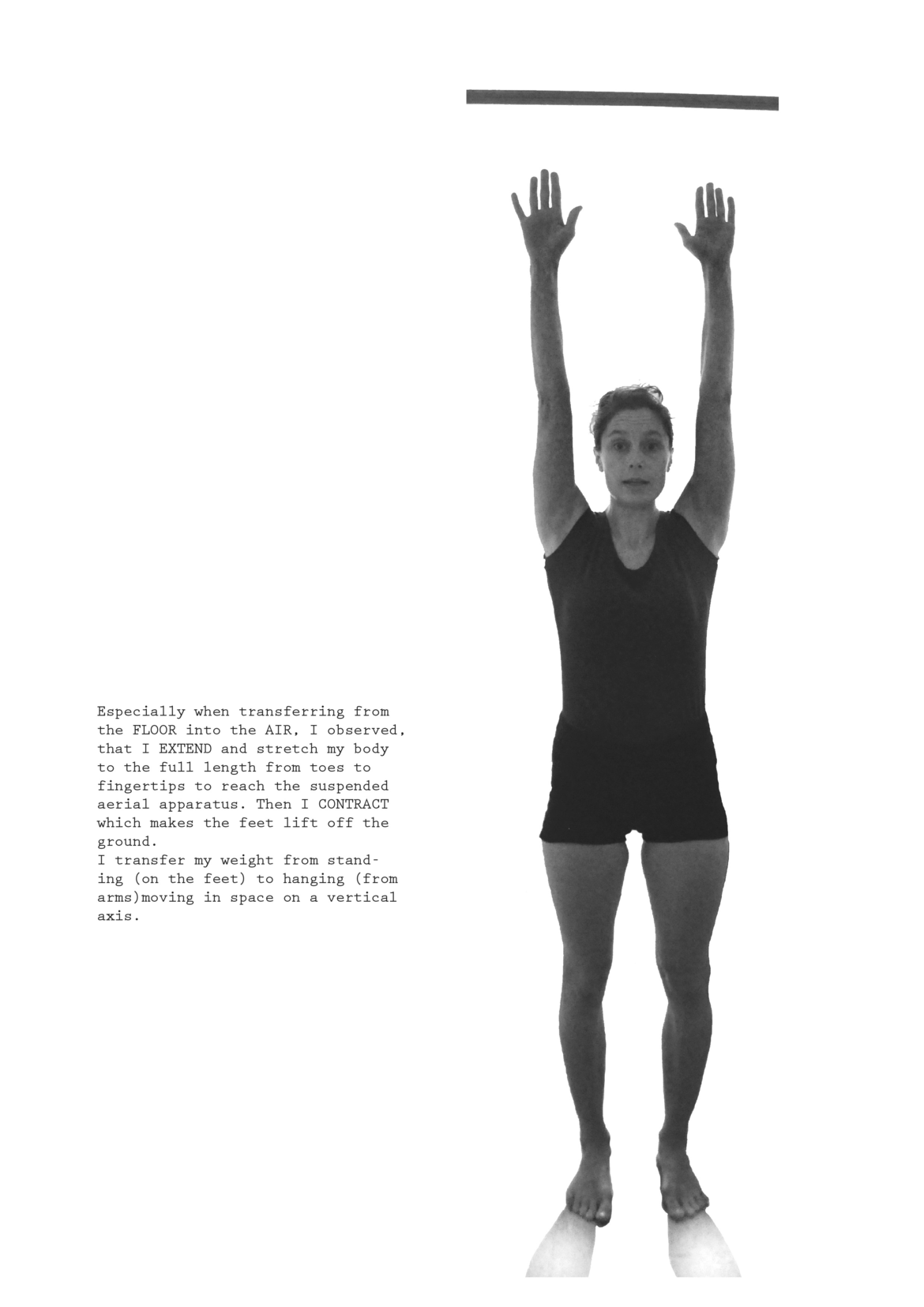
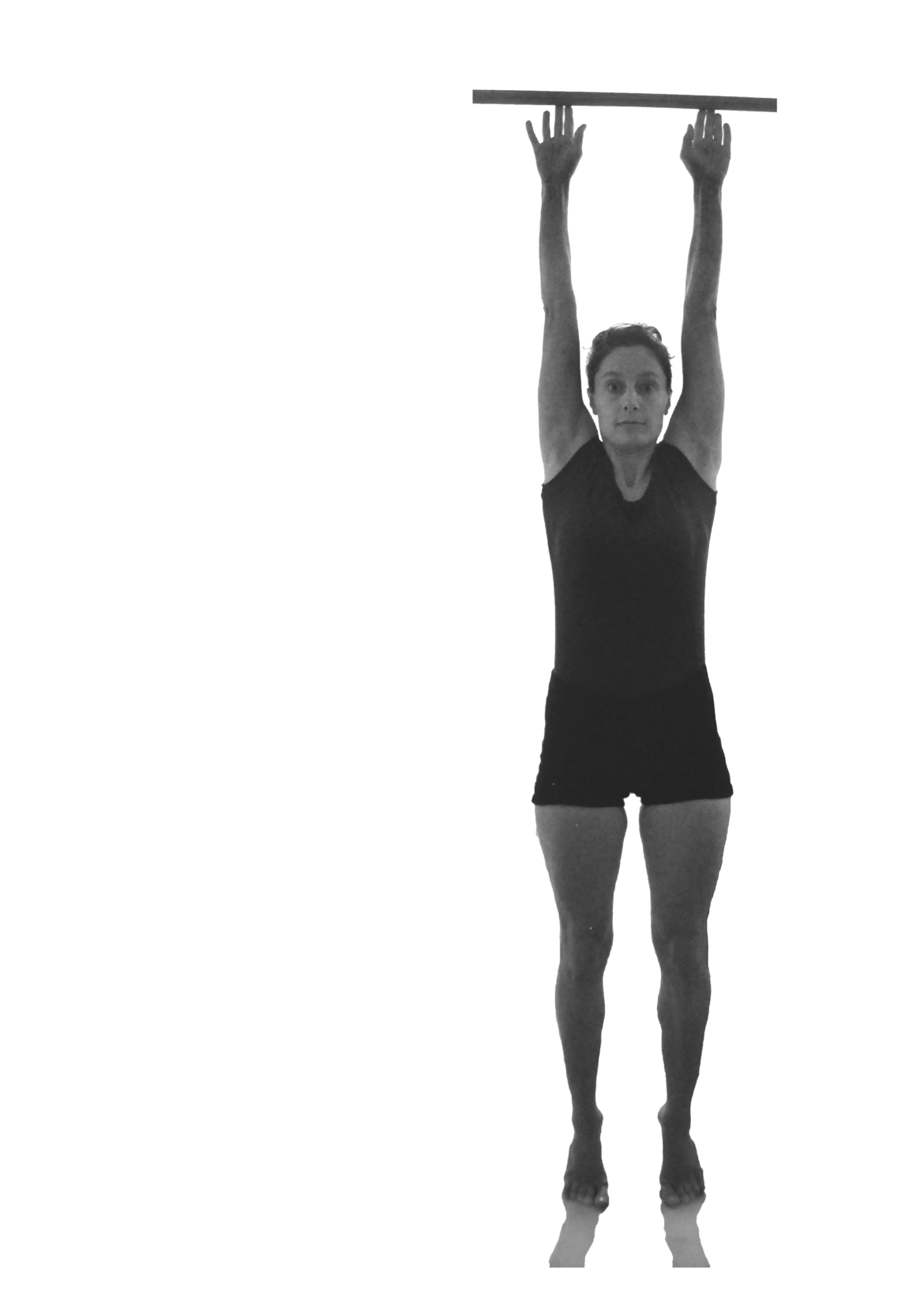
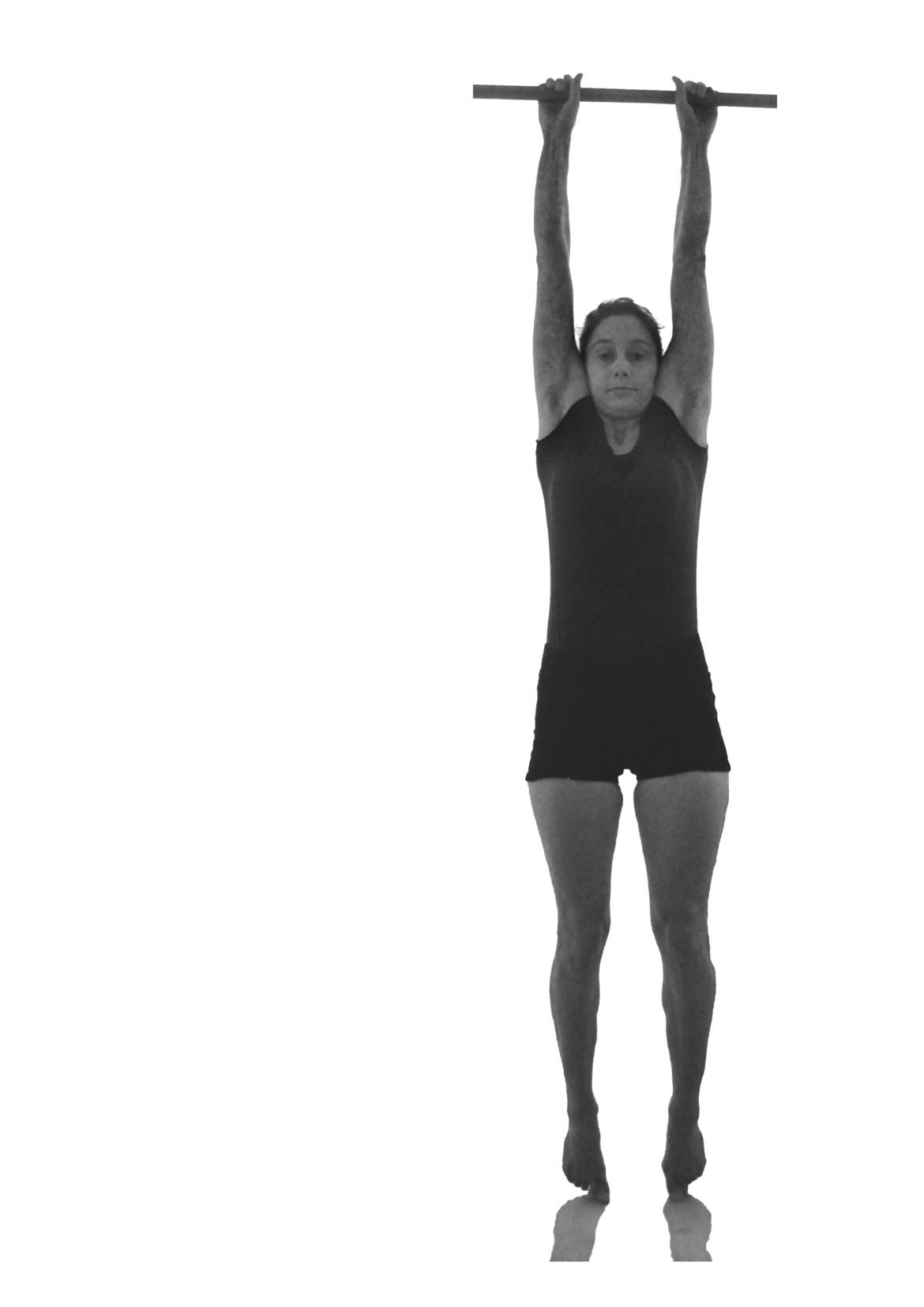
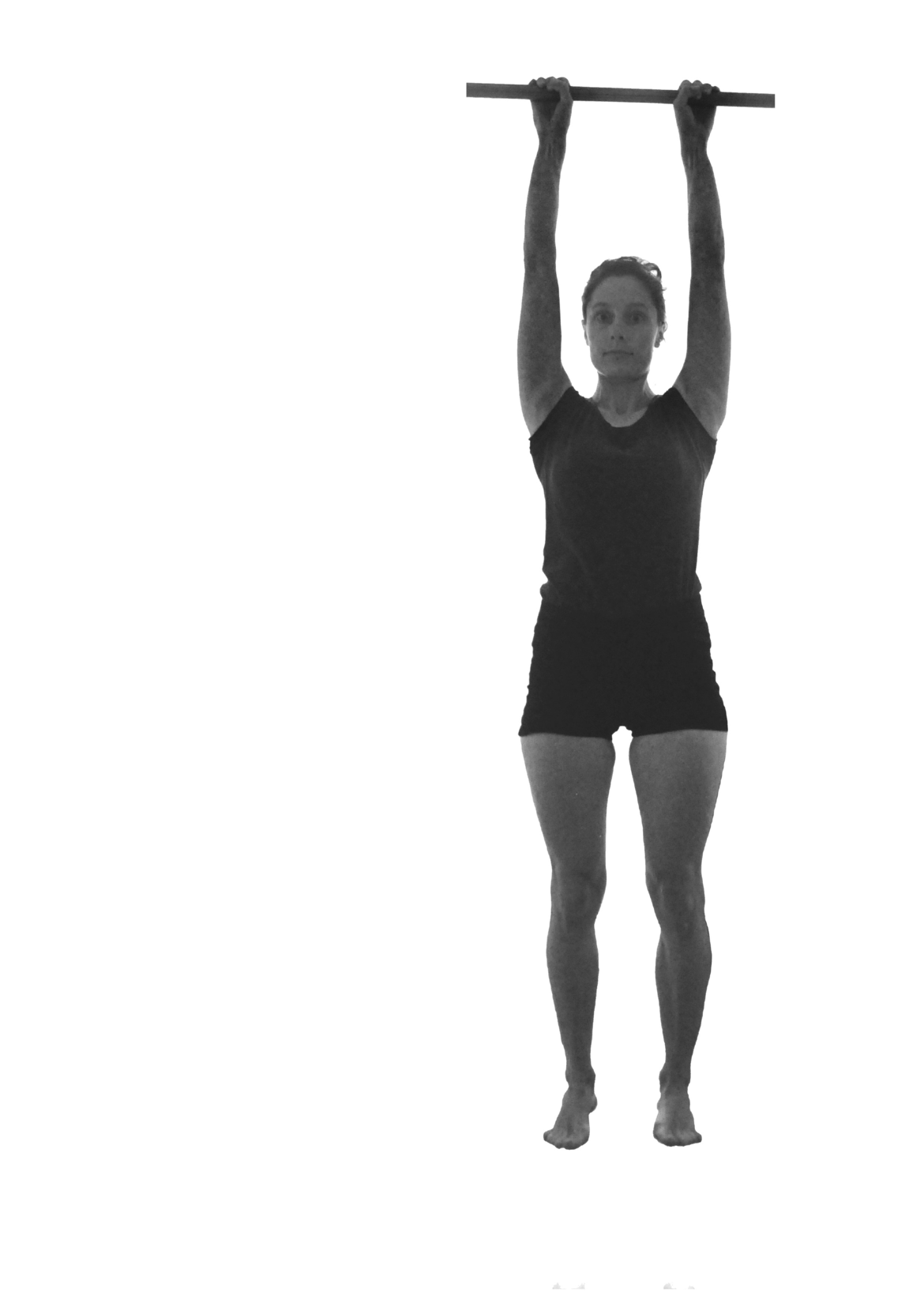
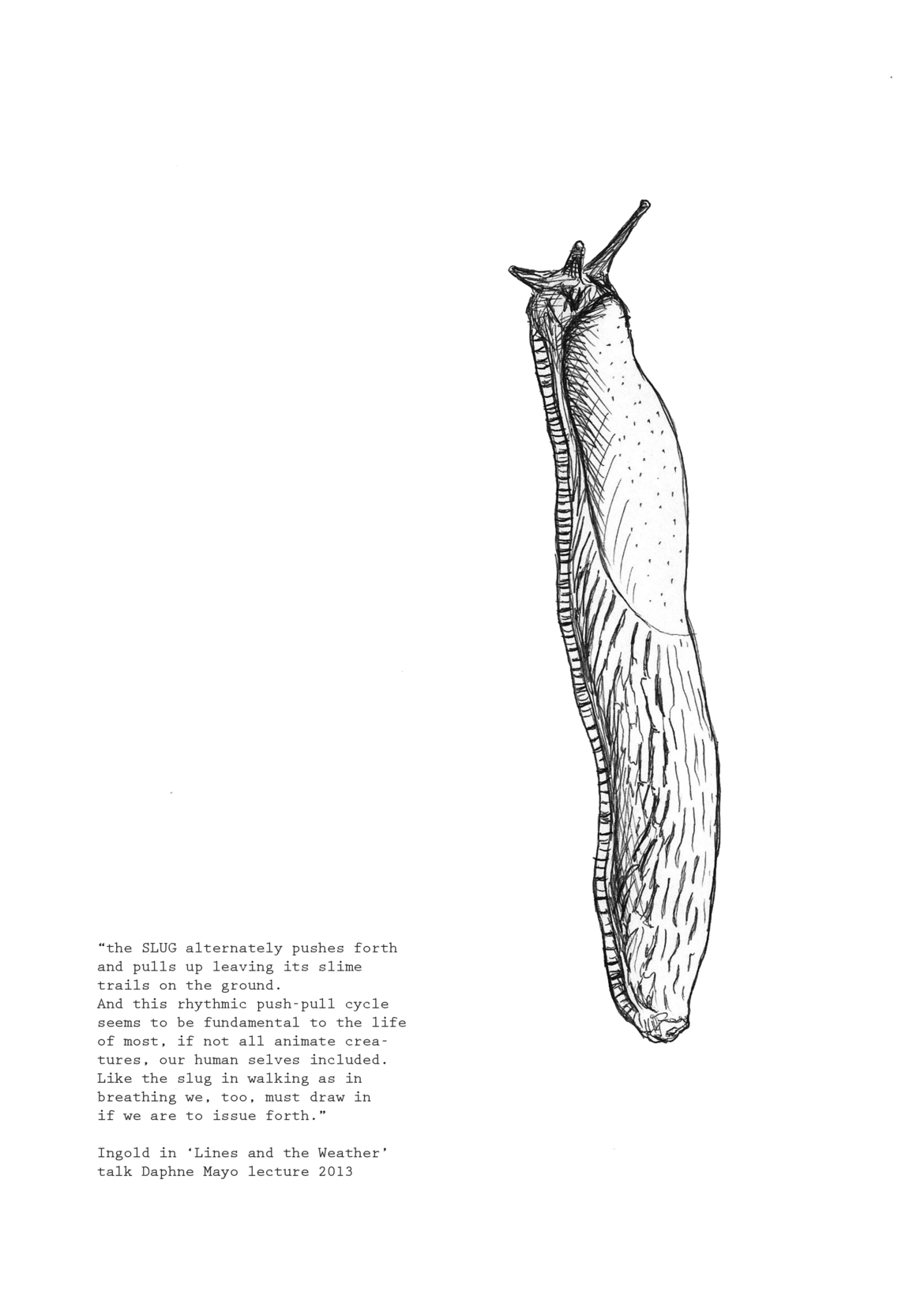
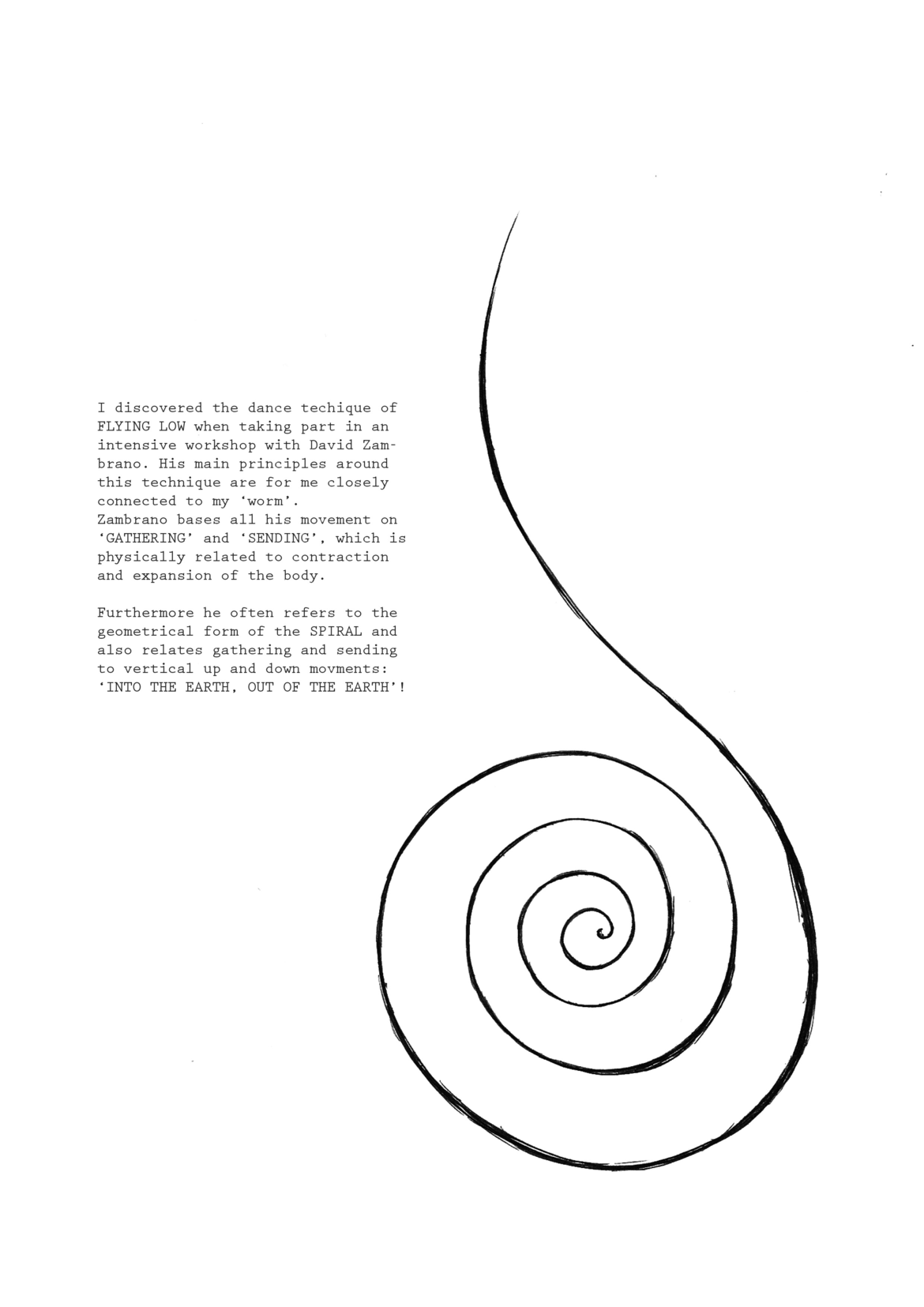
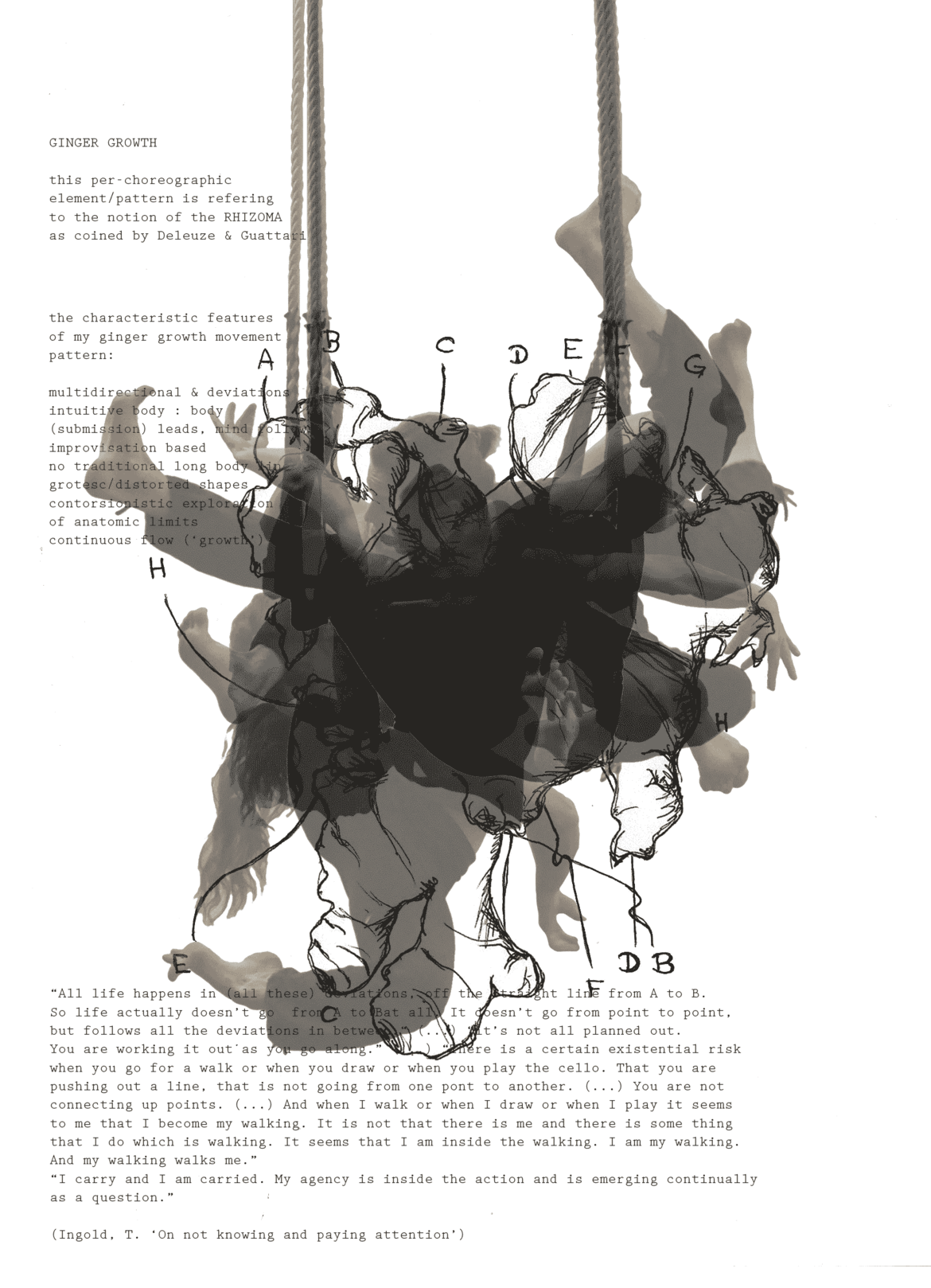
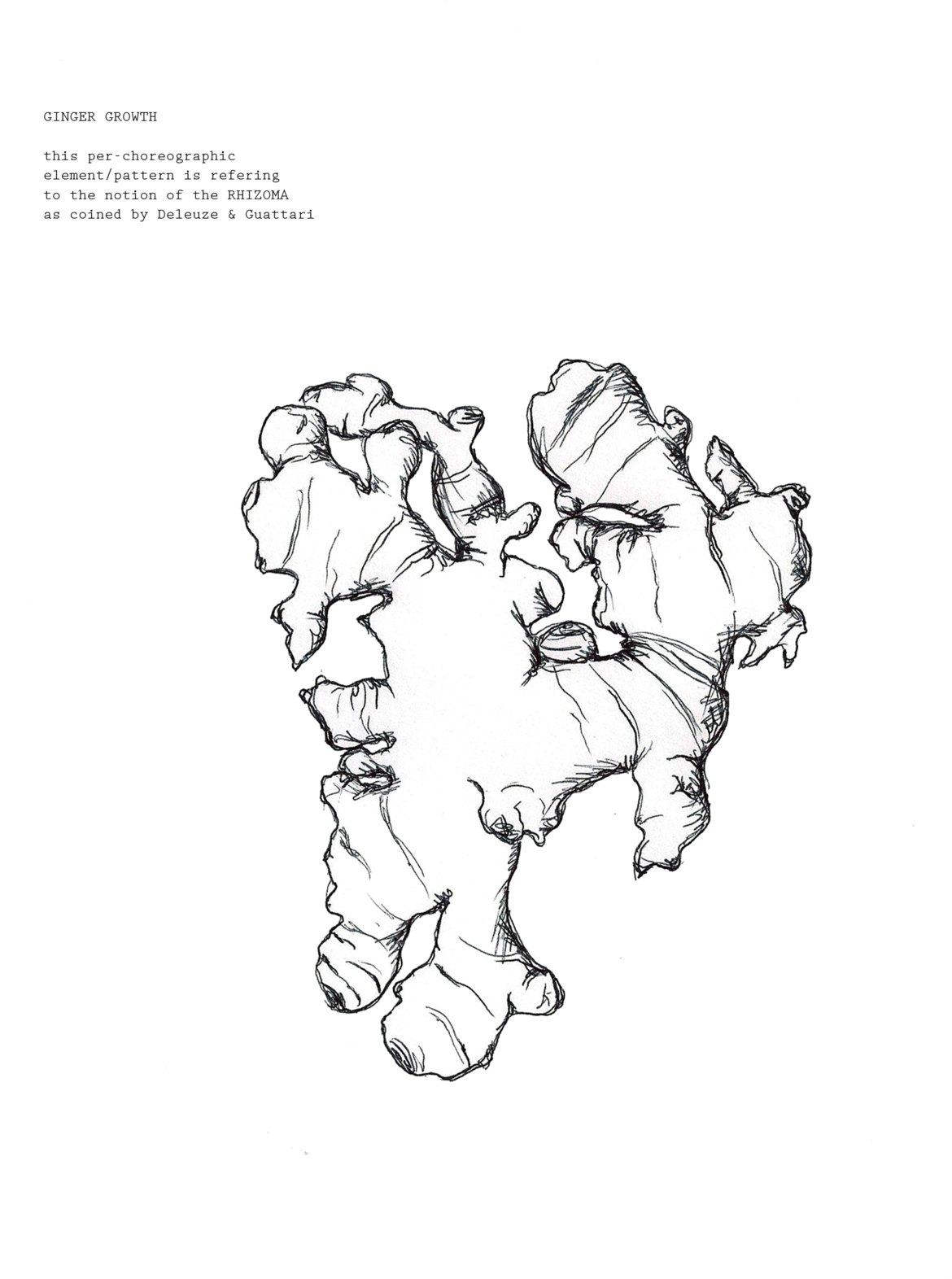
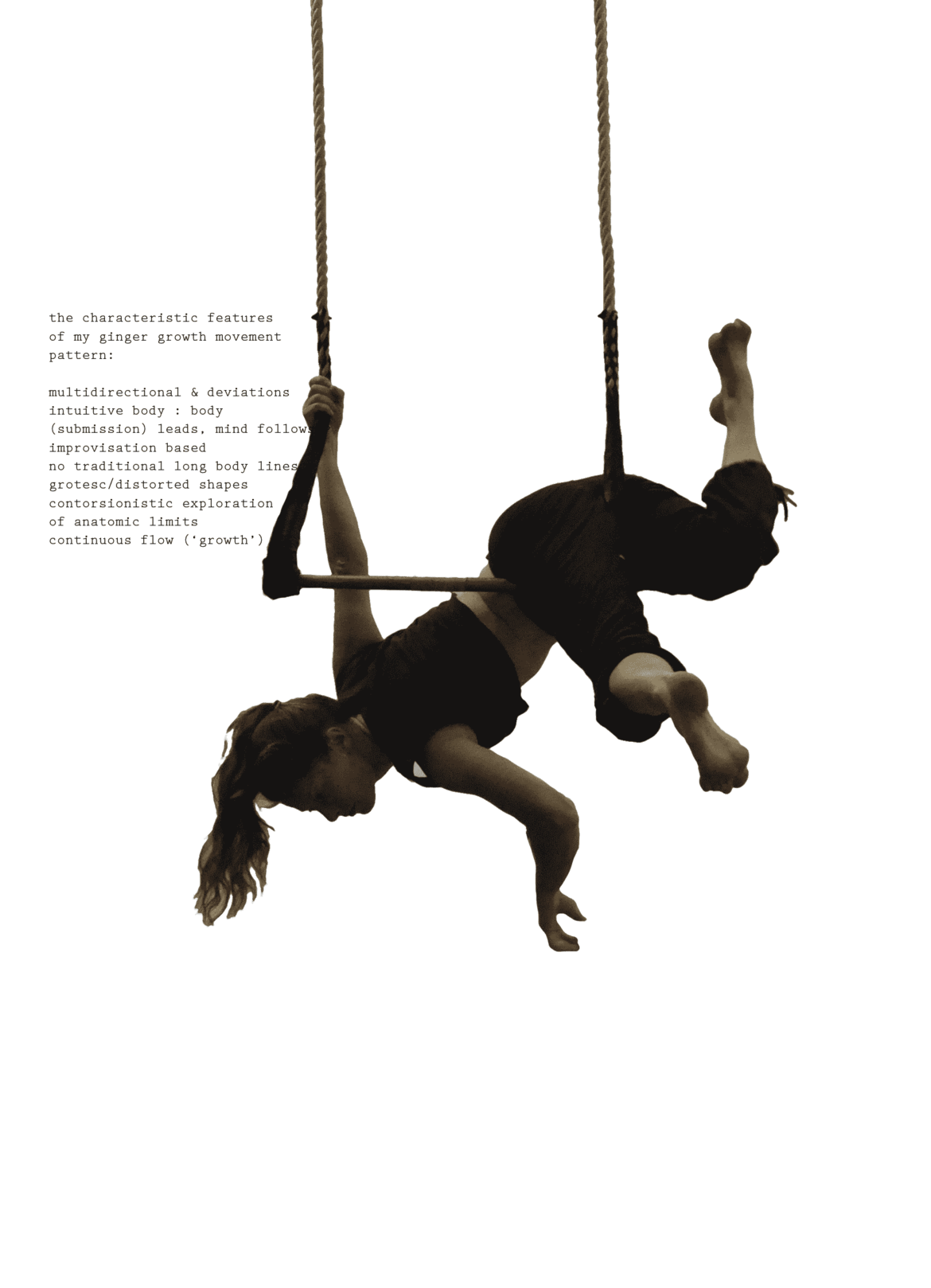
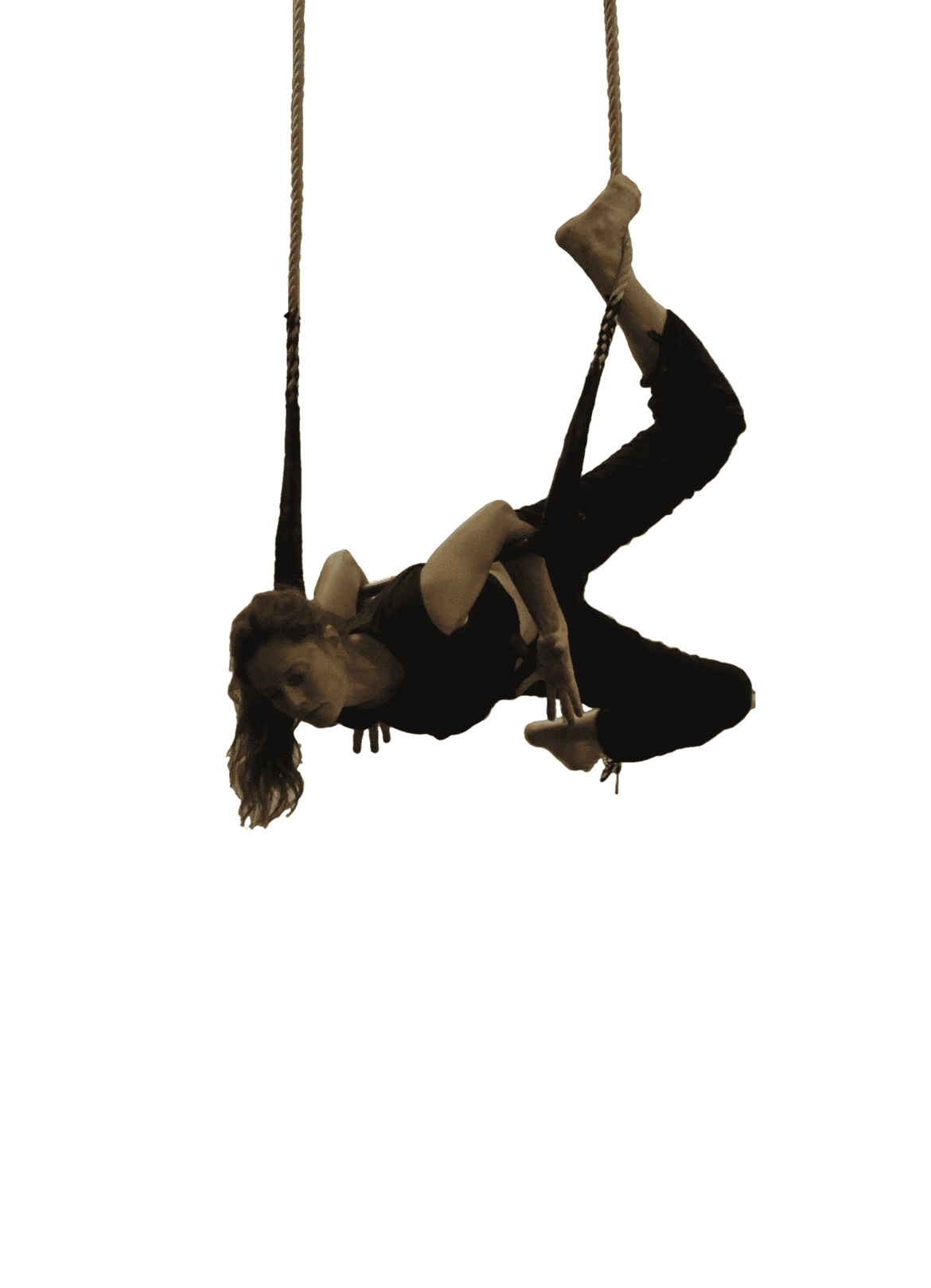
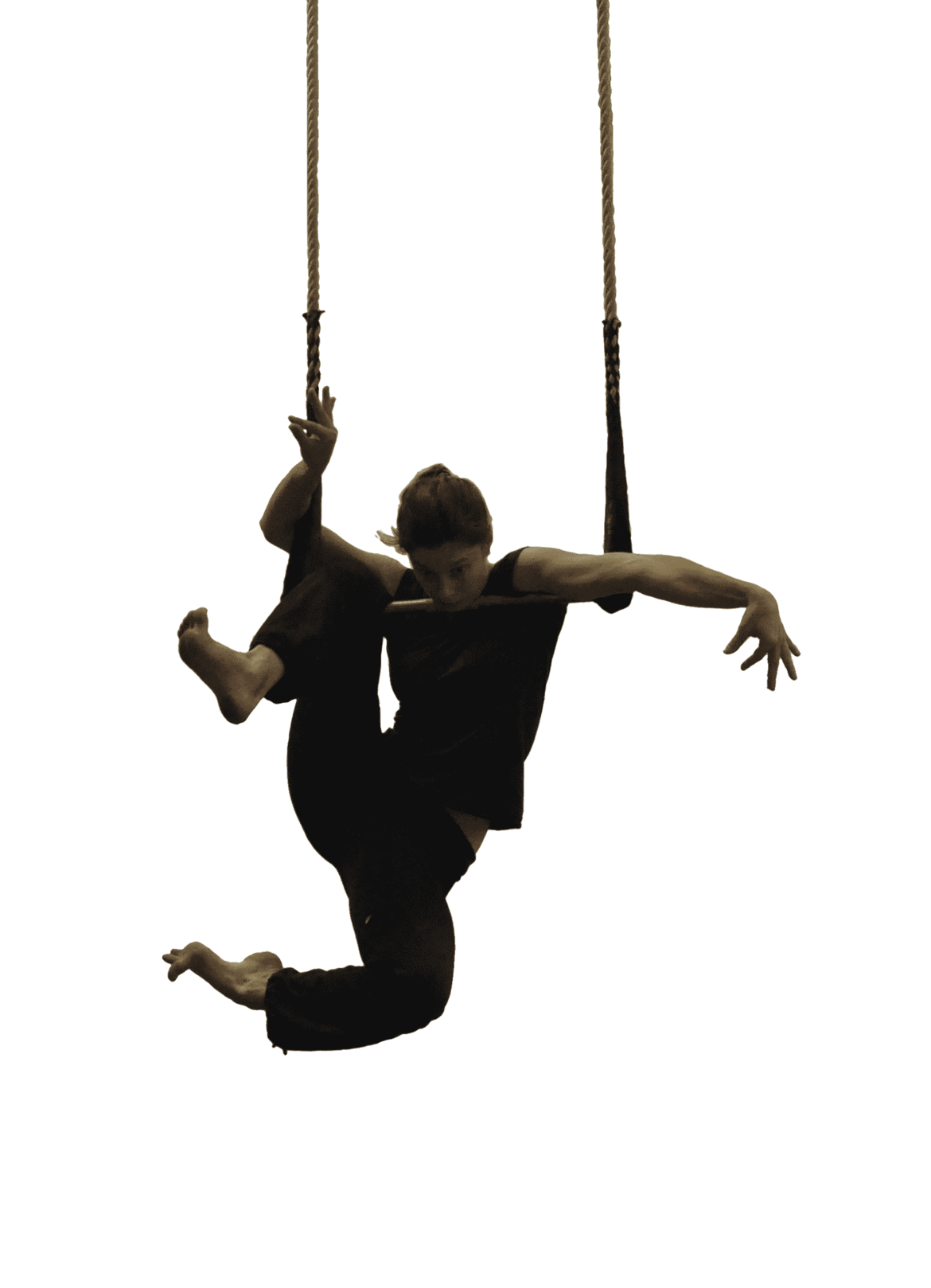
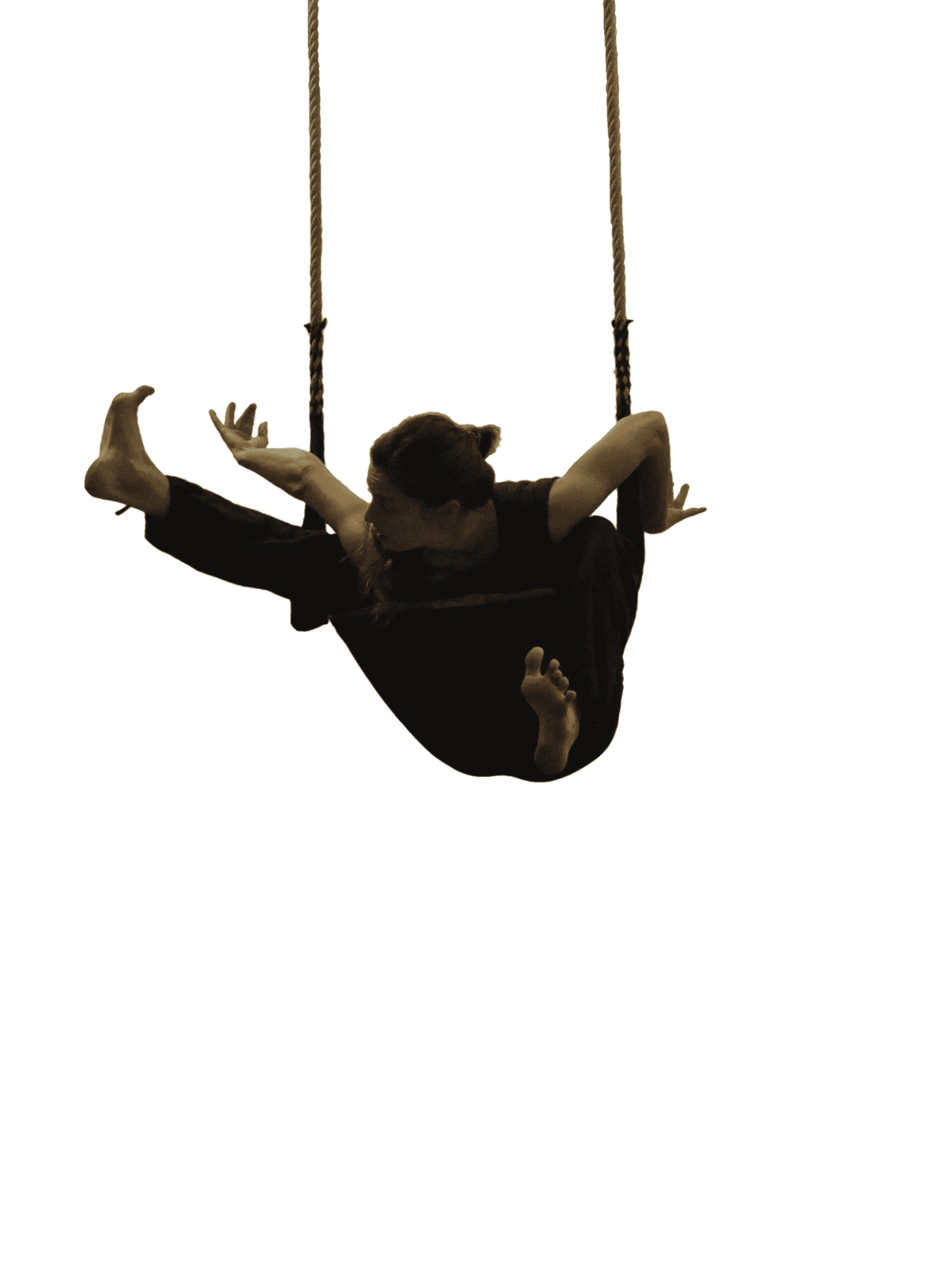
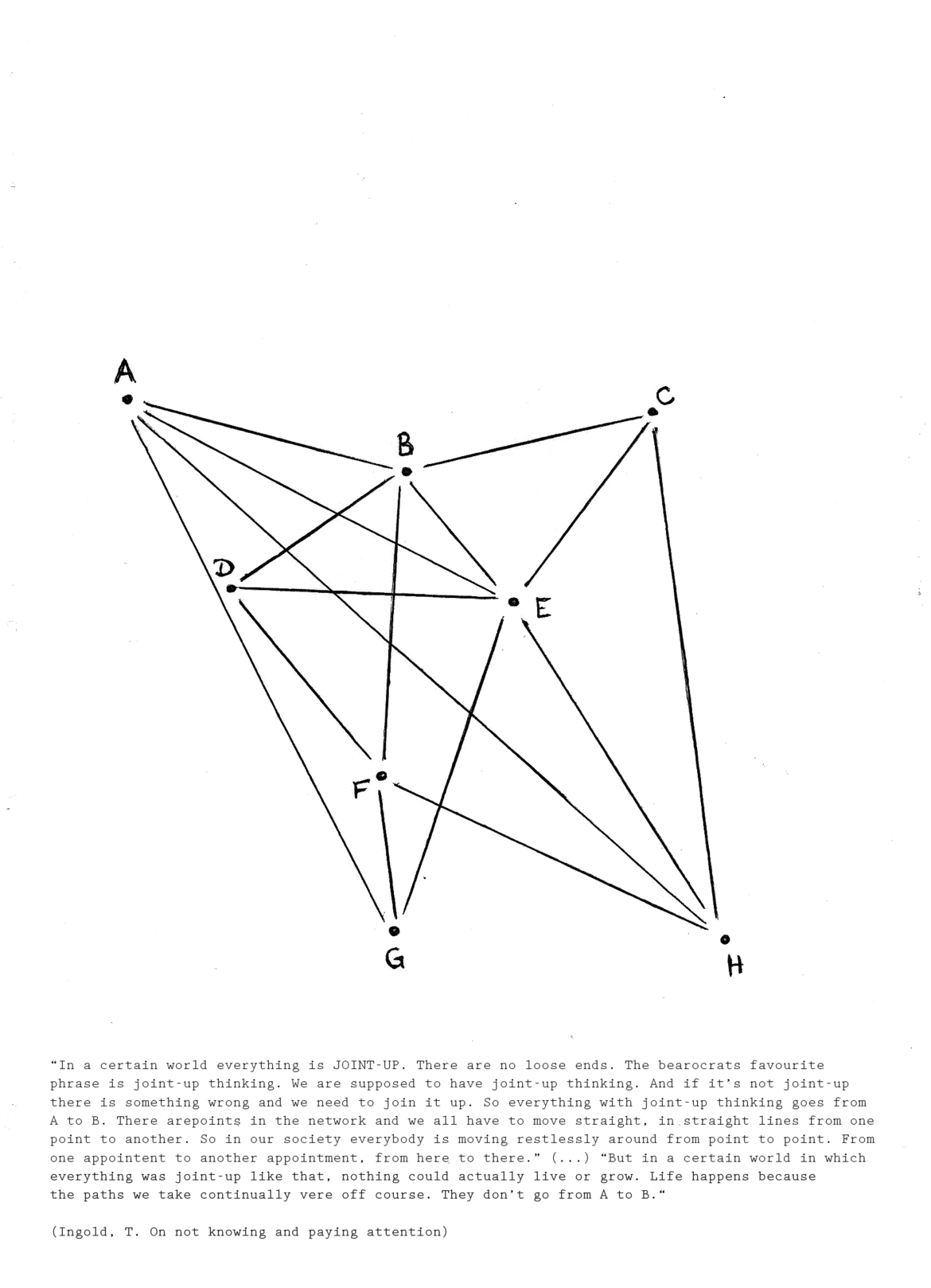
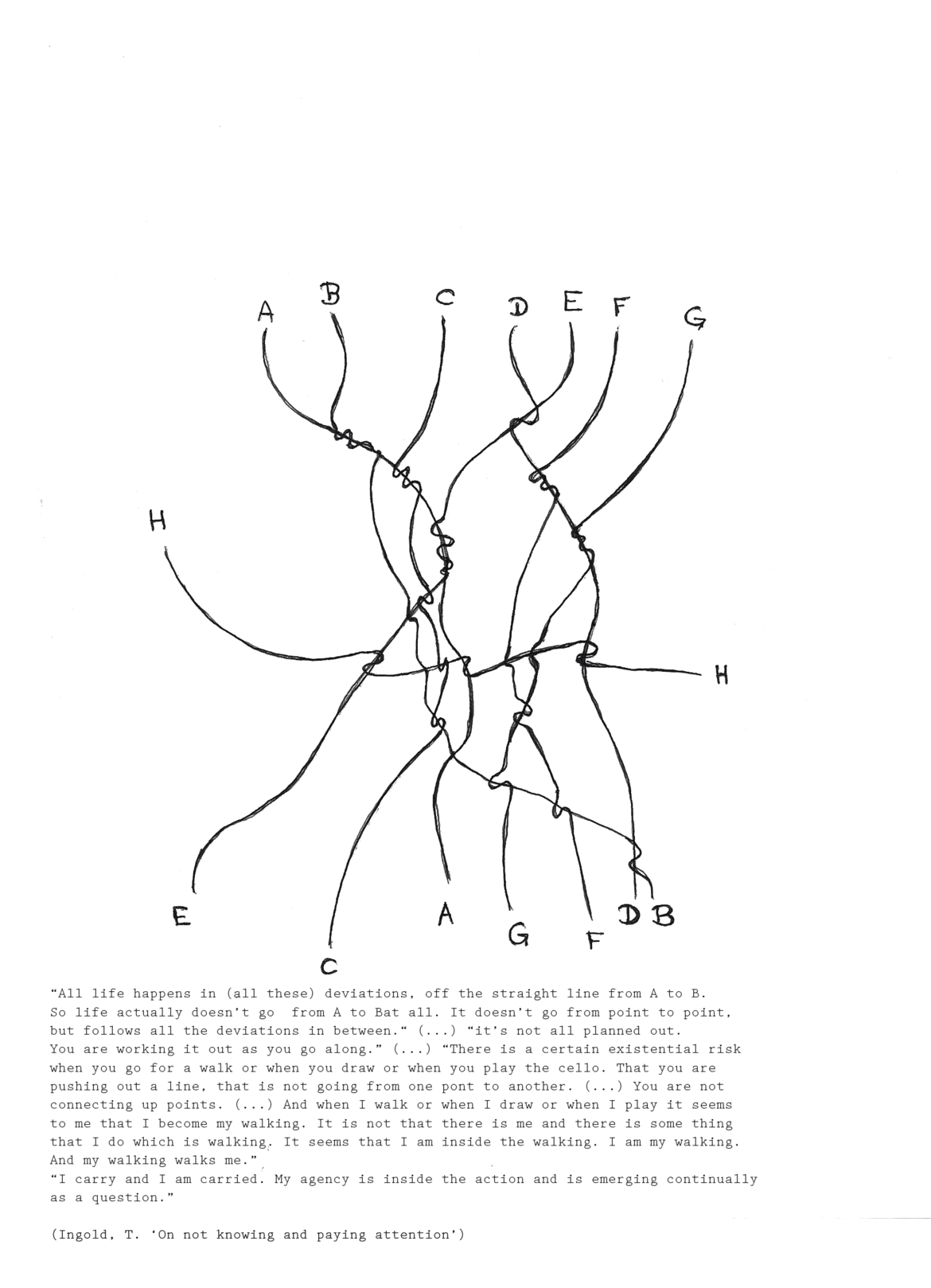
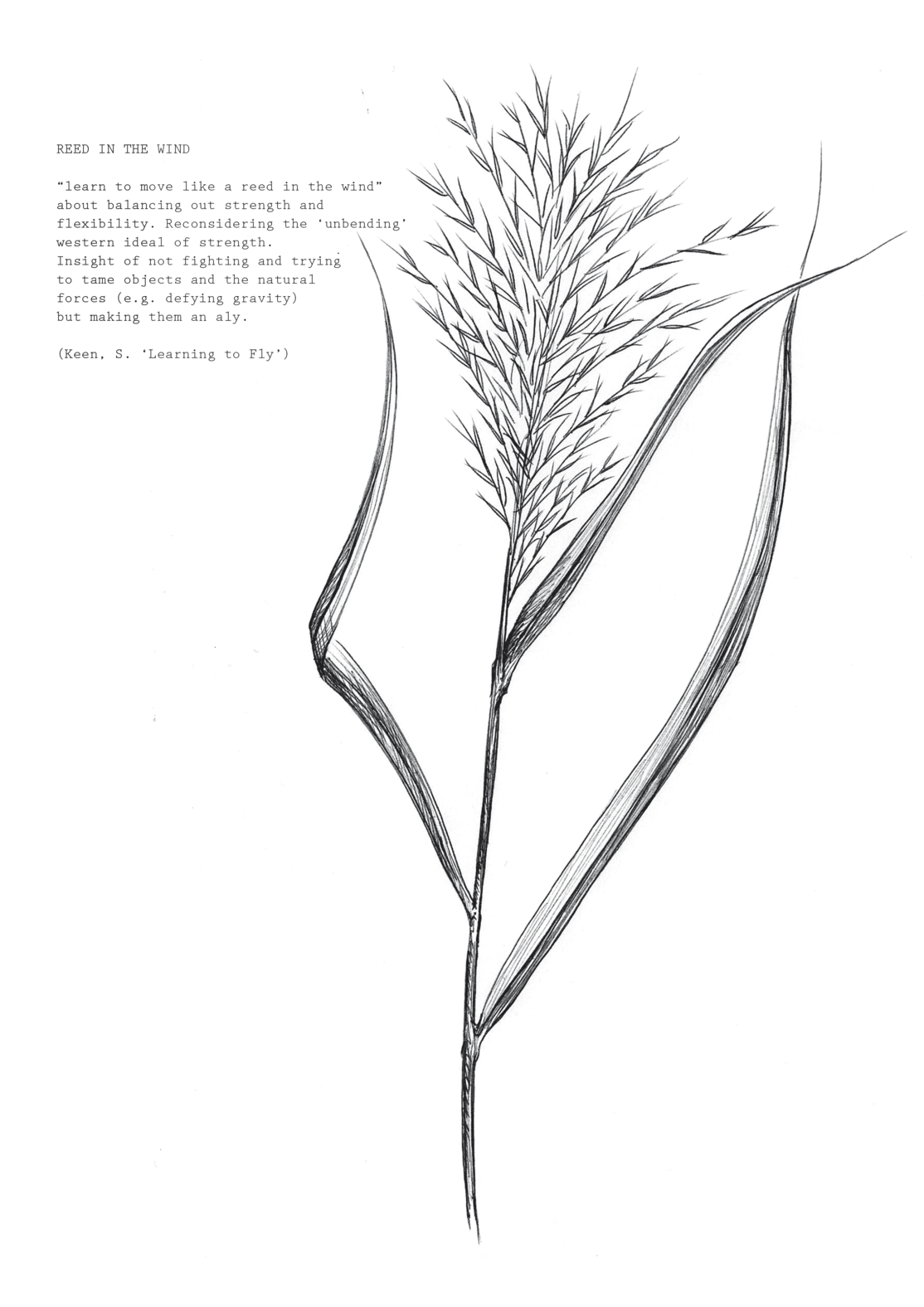
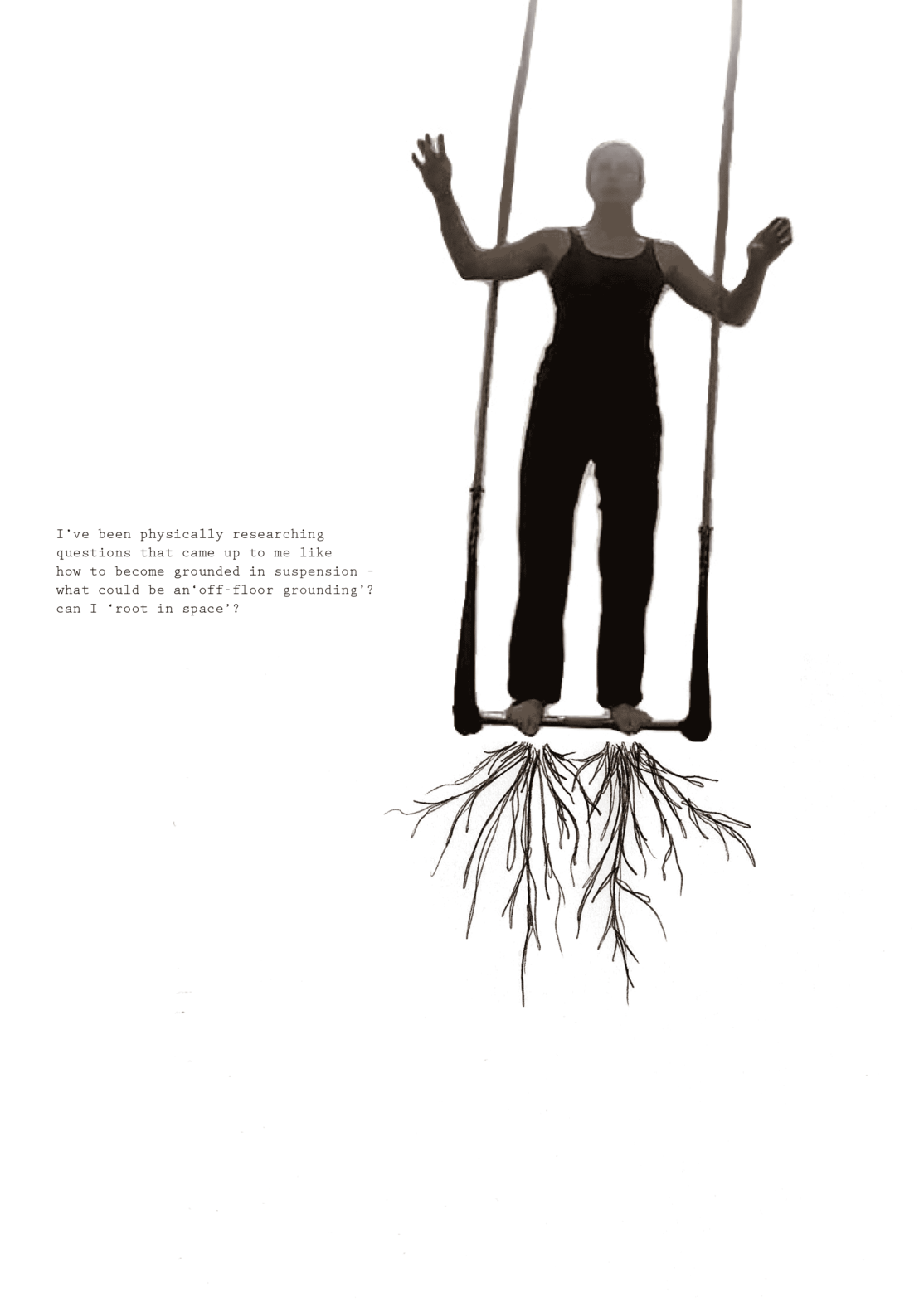
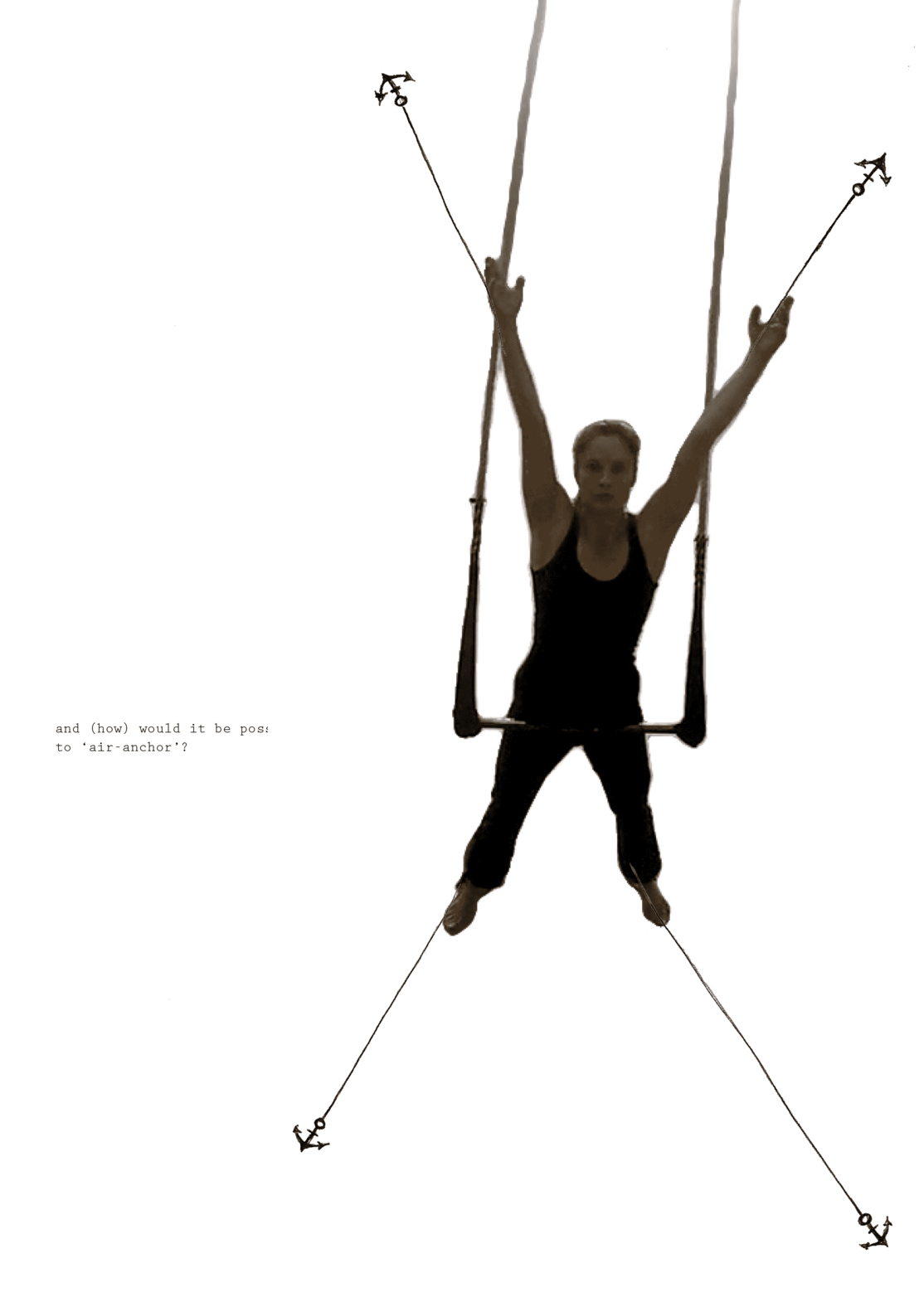
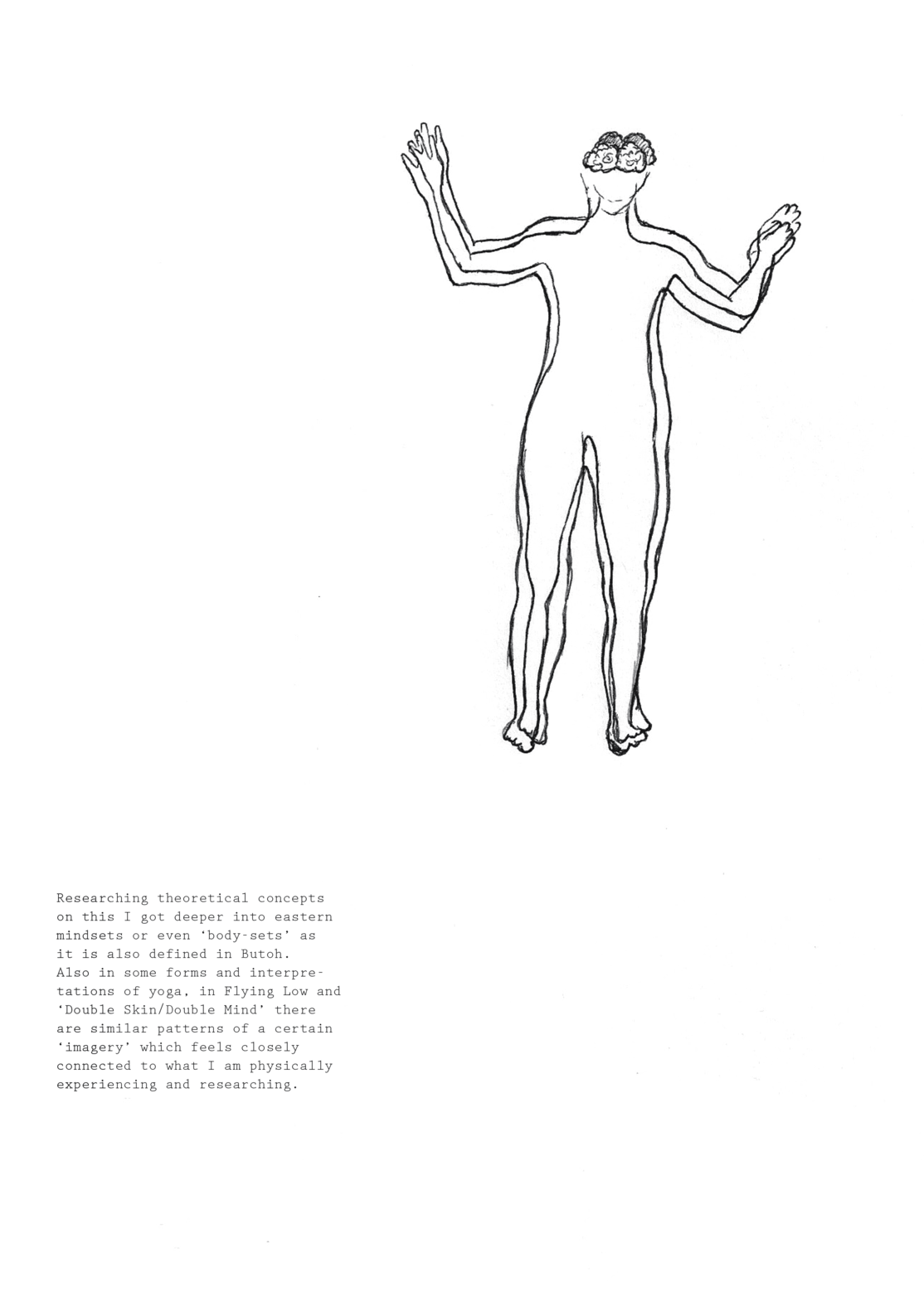
The term and basic idea of the Pre-Choreographic Elements (PCE) I borrowed from the research of the same title, led by ICK/Emio Greco, Pieter C.Scholten and Bertha Bermúdez. In their definition ‘Pre-Choreographic Elements’ refers to the ‘pre-phase of choreography, where the content is being created, shaped and tested but not yet part of the selection and ordering process choreography implies’ (Bermúdez, 2014)
In synergy with my (non) methodology of permaculture design this inspired the development of my own PCE.
The Pre- Choreographic Elements (PCE) of this research emerged from the creative transfer of the permaculture principles, foremost the practice of attentive observation and pattern recognition.
Since patterns in permaculture are interpreted as embodied knowledge I discovered in my PCE the accumulated knowledge embodied in my movements in over 20 years of aerial acrobatic practice.
In a way these PCE are also representing my vision & signature as an aerial artist. They also embody certain beliefs and philosophical concepts that I share with professionals of other fields. In their layered nature – they were designed as prints on transparent paper – they reflect the intertwined nature of theory and practice. You can find pages with quotes and drawings relating to philosophical or also dance-specific concepts, which resonate with the respective movement pattern I identified.
In the frame of my research trajectory this extraction of embodied patterns of knowledge became an important stepping-stone on the way to developing a method for 'submission lead' in aerials, a certain form of body-set to give the embodied knowledge more agency in the practice – 'Aerial Rooting'.
Reference:
Bermudez, B. & deLahunta, S. (2014) Pre-choreographic elements: Scott deLahunta in conversation with Bertha Bermúdez. Retrieved from: https://www.tandfonline.com/doi/abs/10.1386/padm.9.1.52_1
'AERIAL-ROOTING'
DEVELOPING A METHOD
for ‘SUBMISSION LEAD’ in AERIALS
MOTIVATION
Traditionally aerial acrobatics (as many circus disciplines) based on ‘tricks’. In training acrobats would aim to perfectionize a certain body shape like striking a pose, which might be challenging to get into or to hold statically. Or they practice a specific set of movements, that form a so called 'trick'.
In performances, like the act format these successions of trick-elements mostly prevent the movement from merging into a coherent whole, interrupting the flow. The trick is a cognitive concept, a perfectionistic idea of a pre-planned shape constructed by the mind to form and discipline the body into a sort of mould.
In this way the traditional methods and structuring system of the circensic trick dogma submits the body and promotes its objectification – by moulding and squeezing it into a mentally idealised shape. As well does the technique, that defines the relationship between the artists body and the nonhuman object by asking to perform fitful attacks in the attempt of each trick to discipline the body and tame the object – a relationship staged in a ‘relentless fight’ (see also the virtuoso body in the circus).
This concept of a staged struggle between performer and ‘apparatus’, the objectification of the acrobatic body, the some associated ideas like "defying gravity" – all these images do not at all reflect what I feel and do when practicing trapeze acrobatics.
I want to see body and apparatus as partners on stage, and strongly believe that the natural laws like gravity should be my alies, I want to work with and never fight against.
So this was the source of my motivation, the why I want to develop another approach for an aerial acrobatic practice, that resonates with my personal idea of the aerial arts and which also reflects contemporary paradigm shifts of socio-political and philosophical thoughts in the world today.
MAINTAINING OPENNESS AS ONLY CONSTANT
What if we would develop further the thought of re-defining the body-mind-object relationships in circus?
Reflections on this already provoked certain shifts in the representations of bodies, objects and their relationships in circus recently. Yet I will propose another one, stretching further the long-time established and hardend concepts related to circus practice and performance.
As contemporary interdisciplinary approaches already try to overcome this choppy assemblage of tricks, and took inspiration for example from the more connected flow of movement in dance, I will also make an attempt of turning the and, and, and of trick presentations, into a more integrated with, with, with – of an aerial acrobatic movement method based on Ingolds concept of ‘Correspondence’.
»Response is literally built into responsibility. A responsive body can adapt to and generate change. She (Ann Cooper Albright) discusses improvisation as a practice that holds immeasurable potential, not for specific things, but for maintaining openness as a constant.« (Kloppenberg, 2010, p203). These lines of Annie Kloppenberg in her article Improvisation in Process: “Post-Control” Choreography, are resonating on many layers with my question of ‘How to strike roots into the void?’, that I can only relegate and invite the reader to further explore the connections and links on the page ‘Striking ROOTS’.
Concerning the specific case of the development of my method the crucial point is ‘maintaining openness as a constant’. It is basically about improvisation – however as this is a very broad term used in many contexts, as for example in the respective case of aerial acrobatics it is even referred to when acrobats improvise, like literally just shuffeling the chronological order of their perfected tricks.
The specific form of improvisation as ‘maintaining openness as a constant’ is asking us to take far more ‘risk’ so to say to deviate from the traditional patterns.
In a first step through analysing my intuitive practice on the trapeze I defined some Pre-Choreographic Elements – movement patterns that have been inscribing as embodied knowledge in my body over more than 20 years of practice. As it becomes evident in the ‘ginger growth’ but also in the ‘worm’ PCEs the concept of trick does not play any role. Rather the movement is characterized by a certain continuity, a flow of movement, that not even has a pre-planned pathway, but is emerging in the process, and can even suddenly change direction.
Yet I do not want to neglect the fact of having a trained acrobatic body. In my twenty years experience in aerial acrobatic practice a certain skill and mastery of the technique is firmly inscribed in my circus body. My mind had disciplined the body and subjected it to execute certain idealised moves. Though in most of my practice there was a prevailing joy and physical eagerness to express the tacit knowledge embodied in this acrobats flesh and blood.
And this is actually the point I want to emphasize: that in any intensively trained aerial acrobatic body there is so much embodied knowledge, that is only showing as a tip of the iceberg in trick-based physical molding. This physical ‘intelligence’ I would love to give a stronger voice, a way to unfold and blossom as a certain bodyset in interplay on eyelevel with a certain mindset.
AERIAL-ROOTING PRACTICE | MIND-BODY SET
Regarding this objective of exploring mind and body relationships I found some exciting concepts in the Butoh Dance Method, that resonate deeply with my ideas for this method development:
Toshiharu Kasai’ in his essay ‘A Note on Butoh Body’ also refers to the »non-objectification of the body« that is also a key feature of Butoh. The ‘butoh-tai’ in Japanese the Butoh body, »meaning a physical and mental attitude so as to integrate the dichotomized elements such as consciousness vs. unconsciousness, and subject vs. object. The former is related to the multiplicity of our consciousness, and the latter to our ‘objectifying’ mental function.« (Kasai’, 2000)
This is for me just a sort of a translation, a different phrasing of what I referred to as ‘the objectification by moulding the body in an aerial acrobatic shape or trick’ earlier in this writing.
Furthermore my idea of an correspondent interplay between body and mind seems to come quite close to the concept of ‘butoh-tai’, Kasai’ further specifies as »understood as a mental-physical attitude by Japanese Butoh performers. We are a physical-mental entity and both aspects of ourselves are deeply interconnected.« (Kasai’, 2000)
The challenge to develop this kind of mutual interplay of mind and body in aerial acrobatics was though, that within the practice on my trapeze it was very hard to let go of the idea of shapes and tricks, because of our long intense relationship and the patterns that have manifested through this. Often I could not figure out if a certain movement pattern was initiated by the mind or the body, there was just too much habitual patterns associated with the trapeze specific practice.
So the idea to work with a tree root as an aerial ‘apparatus’ for my performance creation became also a key aspect for the development of this method of Aerial-Rooting as aerial acrobatic practice.
Unlike the man-made technical object of a trapeze, that comes in more or less standardized forms, the natural object of the tree root has a much more individual shape. In a way you could say each tree root has its own character even. In its naturally grown form a tree root proposes a much more complex and unique sort of ‘architecture’, resembling a labyrinth. A very specific space to move in, and a unique form and texture for the body to relate to.
TREE ENCOUNTERS
In order to challenge myself to deal with a greater variety of forms and characteristics I made a series of Tree Encounters in a parc. The one-on-one meetings with still alive tree organisms happened spontaneously, so as I did not study a tree but just met it one time only, entering directly in a physical meeting of bodies. That way I made experiences that challenged my openess and that overwhelmed my trapeze mind, because many trapeze specific patterns could not directly be transferred to this every-day-new environments. Each day I would meet another tree individual in an immediate physical encounter, without thinking and analysing the ‘architectural’ shape before, without any plan despite the one to move with it, on it and around it.
These confrontations with an always new dance partner made it indeed more evident when and how the embodied knowledge was taking the lead. Since the mind had no previous knowledge it was easier to keep it calm. This experience made it clear that to a certain extent the practice of Aerial Rooting is related to meditation practices that silence the rushing thoughts and judgemental comments of the mind that wants to maintain control.
BAMBOO FLOW/INTEGRAL BAMBU MOVEMENT
During an intensive phase experimenting with the Tree Encounters I happened to get introduced to Bamboo Flow, a movement practice by Willian Lopez. It is based on the brasilian ‘Integral Bambu Movement’ – »a method for acquiring Sensitive Knowledge and indicates several paths towards Choreographic Art by employing a wide array of techniques that range from its particular style of body conditioning and perceptual awakening to poetic construction.« (Martins, R.)
Core element of these movement practices is a certain pyramidal structure made of bamboo. The free standing bamboo-sculpturess are based on the human measurements, and are build for individual body types. It is constructed geometrical shapes, however moving in this ‘bamboo architecture’ I realised that it has a certain complexity, that resembles the strucures of trees, less organic obviously, but with this rich complexity that I could not instantly grasp it mentally at once.
In this way maybe this exploration could be considered a first step of transferring the new knowledge of working with organic tree partners back into more ‘technical structures’, to finally come back and re-apply the method to the trapeze and other aerial objects.
After one session that Willian watched from outside he shared his observations with me: ‘I see much skin contact’. In a way he thereby confirmed my thoughts about the central theme of weight shifiting in my Aerial Rooting method, of connecting physically with the supporting structure and giving the weight of the body in order to safely find the pathway as the body goes along.
CONCLUSION
Especially the dealing with natural objects with individual characteristics, such as the trees in the encounters and my suspended root, rendered much more present the idea of the dance partner rather than an object in the traditional sense of an aerial apparatus. Also in this regard I found an inspiring note related to Butoh: » To consider your limbs and parts of your body as separate objects and tools, and in reverse to love objects as if they were your own body, here lies the great secret of the origin of Butoh« (Heardter & Kawai, 1986, p.39)
In the work with the tree root I first applied the concept of ‘no-impact’ movement, to later realize, that it was at least as much about caring for my bodys physical integrity as about a gentle attitude towards the root as a dance partner, or extension of my own body. (link)
In another step I transferred the Pre-Choreographic Elements to the practice with the suspended root. With this specific focus, that I would never actively try to cognitively map out the shape of the tree root. I did not study its form or tried to memorise good grips, I never planned a route, but always made an effort to loosen the mental control and enter into physical experiences by moving with and around the tree root as open-minded as possible to any ‘physical propositions’. With ‘physical propositions’ I refer to the moments when I could witness my body initiating a move that was not present as a mental idea or concept in my head before it was executed.
I can not claim that I immediately managed to enter this state from the beginning of a session and managed to stay in this correspondend body-mind set all way through. Actually it is more about the effort to stay open for a constant shifting of the leading roles. Especially for not pre-planned movement in heights, improvisation in aerial acrobatics, I would always advice to keep a healthy level of mental control and rational checking to avoid heightened risk of major injury. The method I propose is not about totally surrendering rational control. It is about letting appear the embodied knowledge next to it – promoting a fusion of the dualistic idea of body and mind into a whole.
For the Aerial-Rooting Practice I imagine body and mind in a sort of inner conversation. I ascribe the physical its own ‘wisdom’ that I want to give a certain amount of agency. However it is never about totally random physical movement and loss of any control. It is just a shift of perspective to make ‘audible’ another voice (the tacit, embodied one), who is well-aware about what it is doing.
The feeling of loosing orientation to a certain extent – the getting lost – once more does not refer to a loss of control which could end up in highly dangerous situations. As the name of Aerial-Rooting alludes to, the practitioneer should always be ‘rooted’ in a way and maintain a stabilising connection to something (even untangible, inner balance) – this can be the relation to the object, a proprioceptive sense, or a spatial reference, as well as a combination between those. By breaking the habitual patterns though, through this getting lost (of control) – I hope to reach this state of radical openness (as airy freedom of suspension) for a more integrated physical voice.
For me this research outcome revealed a great potential for a new movement method. Like I found a new seed to grow a further research from – Aerial Rooting might become something in between (‘post-control’-) improvisation and (contemporary) aerial acrobatic technique. Based on a psychosomatic exploration I see this movement approach as a useful tool for experienced aerialist, that dare to deconstruct their (traditional) technique and go on the search around the central question: how to get lost again? in order to gain new knowlegde.
By linking some thoughts and concepts of a body-mind set from Butoh and having some inspiration from Integral Bambu Movement, and for sure influences of many other perspectives of movement art Aerial Rooting integrates various aspects confronting the trick paradigm. This ‘fruit’ of the research is less to be consumed at once, but rather considerd a new seed to grow – as it is just the beginning of another adventurous research journey to make it an actual method.
REFERENCES
Haerdter, M., & Kawai, S. (1986). Butoh: die Rebellion des Körpers; ein Tanz aus Japan. Publisher: Künstlerhaus Bethanien, Berlin.
Ingold, T. (2016) On not knowing and paying attention: How to live in a world of uncertainty. Conférence à la Délégation en France de la Fondation Calouste Gulbenkian. 30th November 2016 Festival de l’incertitude. Retrieved from: https://soundcloud.com/gulbenkian-paris/tim-ingold-on-not-knowing-and-paying-attention-how-to-live-in-a-world-of-uncertainty.
Kasai', T. (2000) A Note on Butoh Body. Memoir of Hokaido Institute of Technology, Vol. 28 (2000) pp. 353-360
Kasai, T. (1999) A Butoh Dance Method for Psychosomatic Exploration. Memoirs of Hokaido Institute of Technology, Vol. 27 (1999) pp. 309-316
Noguchi, M. (1979). Noguchi Taiso, Omosa ni Kiku (Noguchi physical exercise, ask the gravity) Hakujusha, 1979.
Kloppenberg, A. (2010) Improvisation in Process: “Post-Control”
Choreography, Dance Chronicle, 33:2, 180-207, DOI: 10.1080/01472526.2010.485867
Martins, R. Integral Bambu – papa a arte coreografica relato de um corpo vivente. Retrieved from: https://docplayer.com.br/4251989-Intergral-bambu-para-a-arte-coreografica-relato-de-um-corpo-vivente-roberta-martins.html
PRE-CHOREOGRAPHIC ELEMENTS
Tying up to another ‘loose end’, Ingolds concept of ‘submission leads and mastery follows’ I want to propose an aerial acrobatic practice, in which the leading and following roles of body and mind would constantly switch in a continuous pathway of movement, that is figured out as the practitioneer is going along.
> find the PCEs on this FRUIT page, to your left. The stop-motion-animation on the right documents a ginger growth movement research >
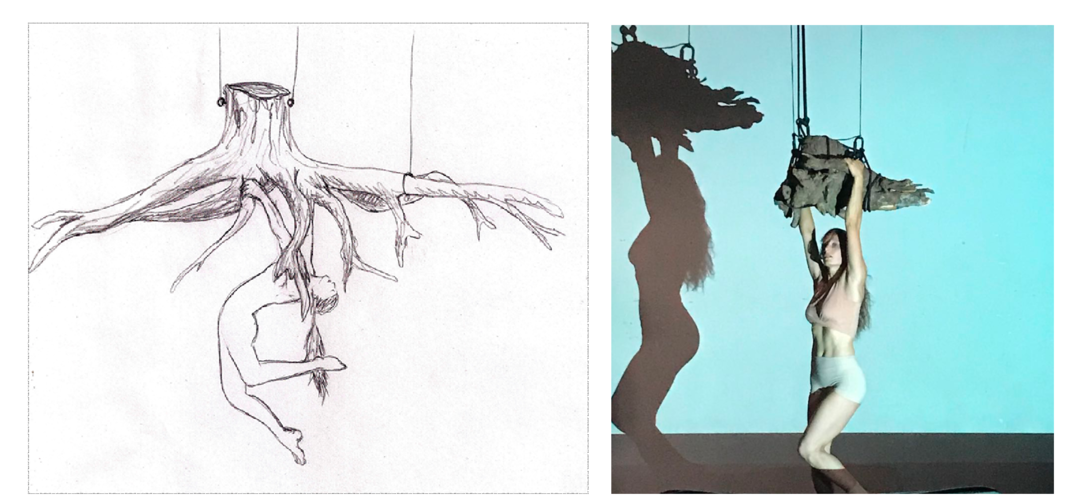
In the following I want to give you some insights and background information about the most significant features of the creation:
THE ‘ROPE FOREST INSTALLATION’
In order to make the topic of INTERCONNECTIVITY physically perceivable for the audience one main aspect in the concept for the performance was the creation of an IMMERSIVE EXPERIENCE.
The statement that ‘everything is connected with everything else’ should be present as materialised, experienceable idea, instead of an only abstract and distant concept. As an act of making graspable an otherwise rather tacit, invisible and embodied wisdom of this, creative solutions were researched how to realise this in a performance context.
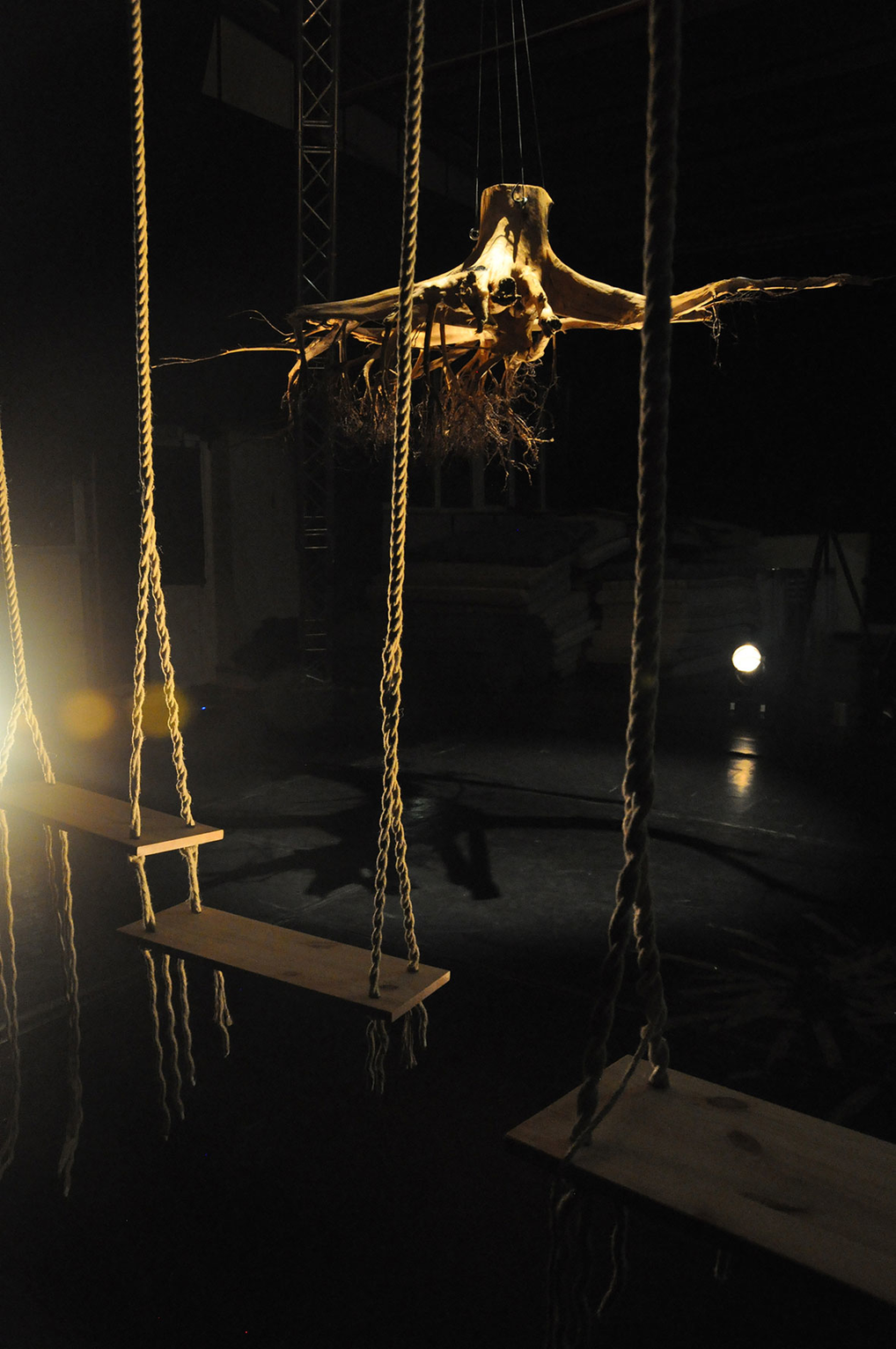
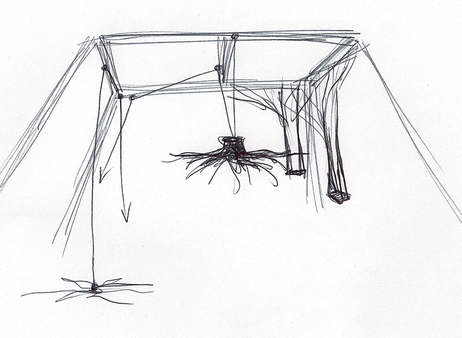
At one stage in the work-in-progress for a showing in Rotterdam the swing installation included 20 wooden swings for audience members. Multiple options were still left to be tested to finally include more people into the meshwork of actual, physical connection, and evaluate the live experiences of the audience. Finally however, due to technical and spatial limitations as well as restrictions around the Covid-crisis we finally decided to minimalize this feature and also had to let go of the idea to make the audience part of the swing installation.
MOST SIGNIFICANT FEATURES of the design
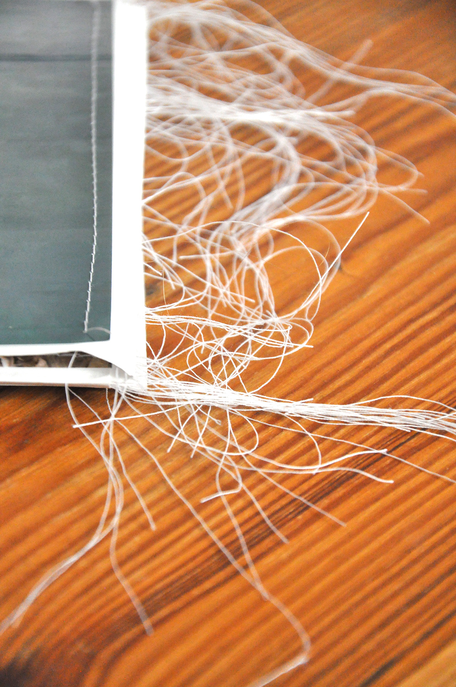
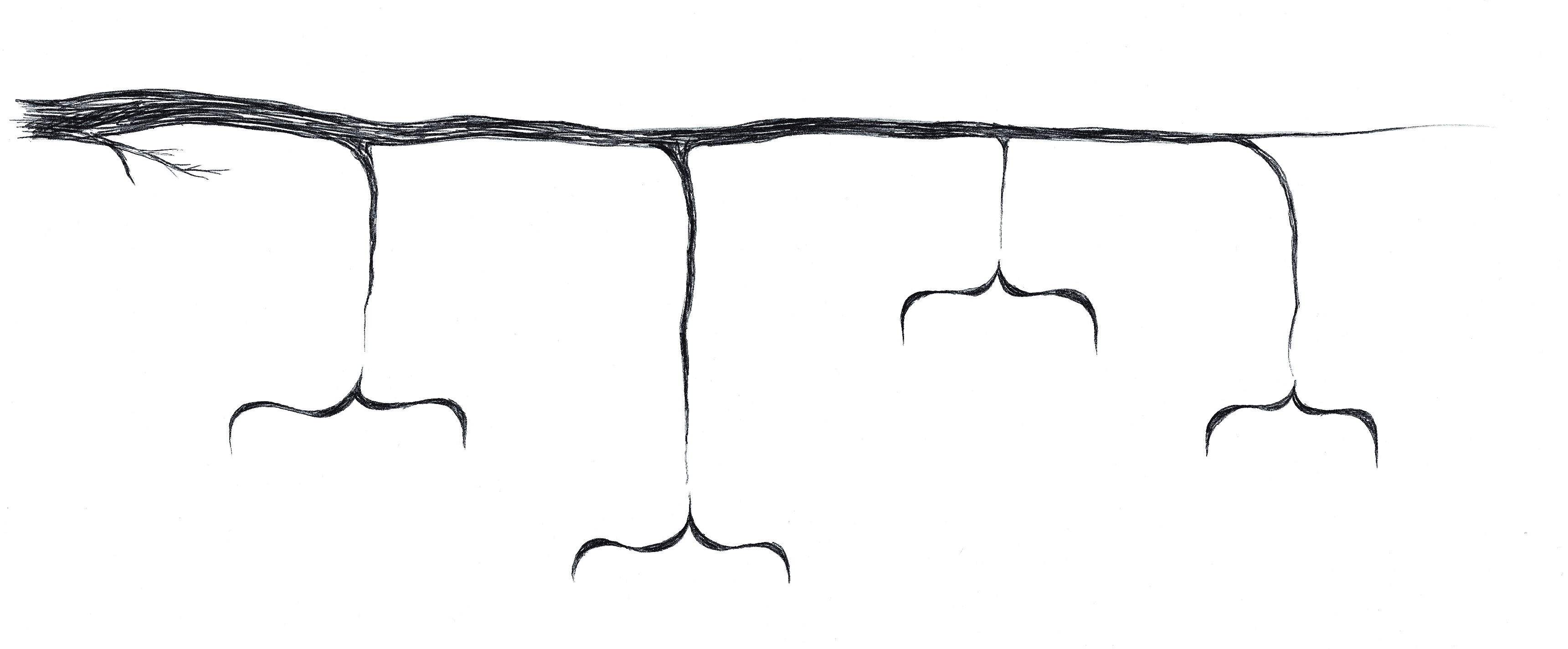
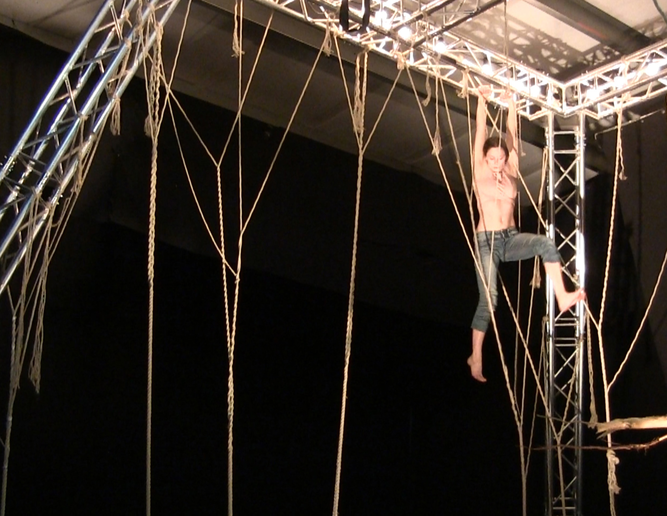
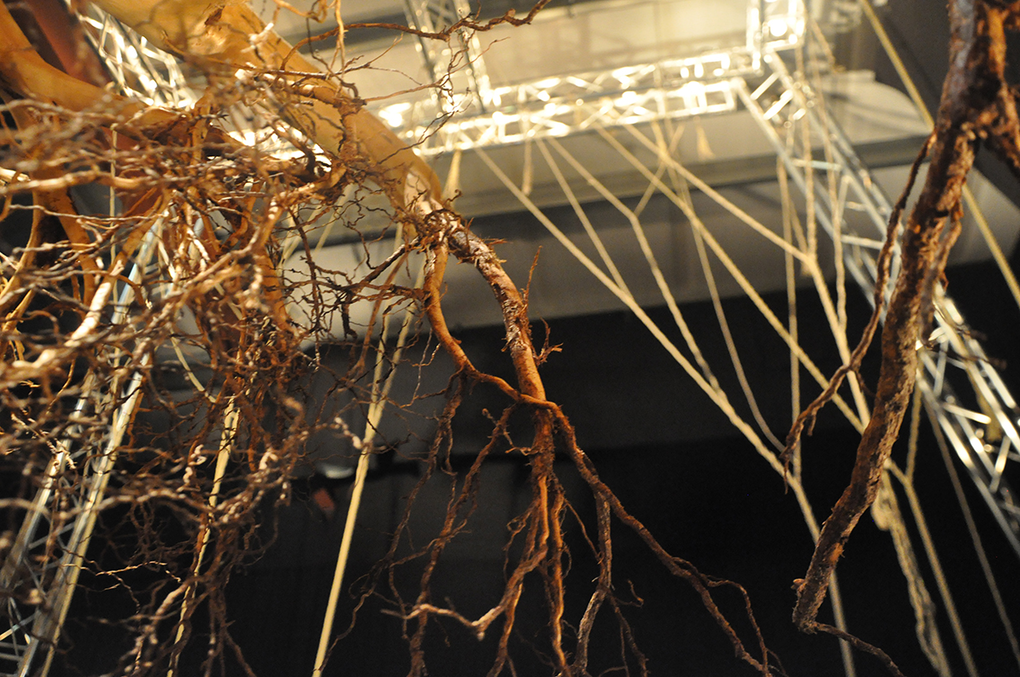
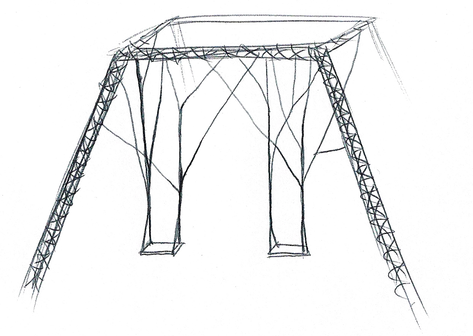
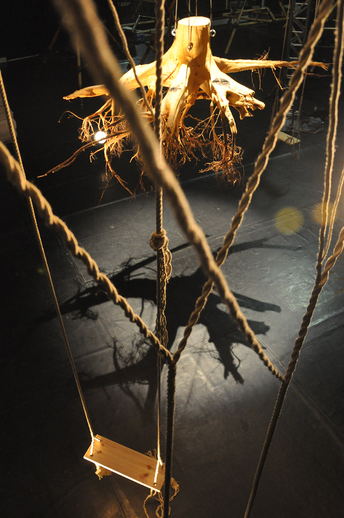
The unraveled rope ramificating into thin threads reflects the structure
of a root system. In consequence of this way of hanging, the movement of the swings have each a unique specific dynamic, they do not swing back and forth in straight ways, but deviate in slightly twisting and turning pathways.
The installation and thus the process of setting up the architecture of the hanging is not put down in a fixed plan, but emerges in the making, so each new build-up in a new location has a unique design. This conscious choice is confronting the performer with a slightly different situation, challenging to find her pathway brachiating through the rope forest each time anew, in the present moment.
...enough of text, 2D visuals and talking about a 'real experience' I guess you just have to come and see the show and experience it yourself!
For more information about the production go to the credits page, or contact me directly!
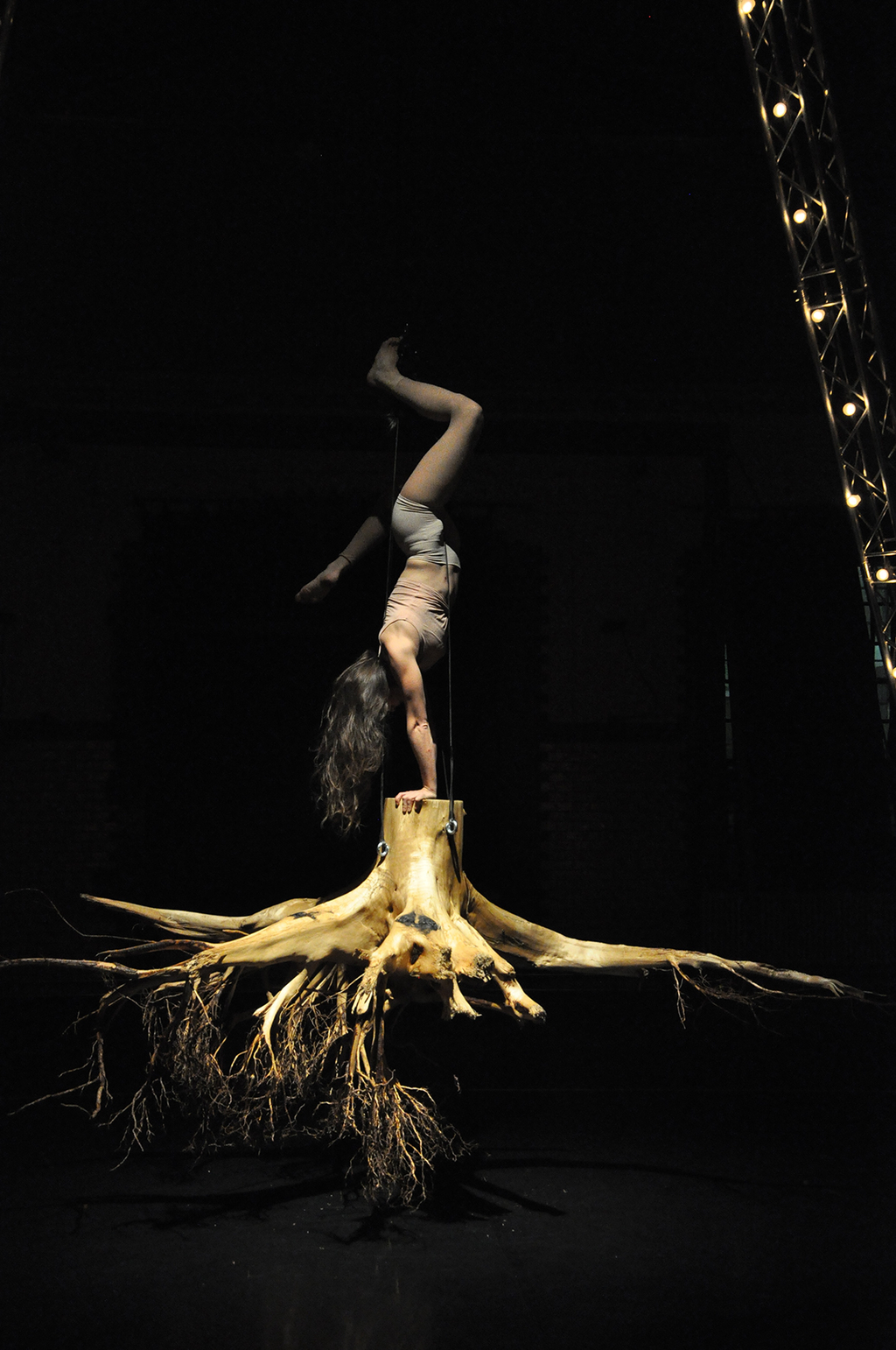
Although I shared a lot of my work in this Artistic Research Exposition in various interdisciplinary media of written language, video, photographs and drawings, my main means of artistic expression remains the physical live performance.
I believe that as 'a picture says more than thousand words' a performance experience can communicate the content of a whole library. There are so many layers of expression that can address all the human senses, so that more or less consciously we can learn a lot in a real physical live experience.
Especially this is very present in circus, where there is traditionally very few knowledge conserved in written words, but it has always been passed on physically, through teaching the acrobatic techniques or sharing the outcomes by creating and performing shows.
I am a creator and a physical performer, so a huge part of my work is about the process of creating – in this context the creation of the piece Striking Roots into the Void described in the following.
For me this project was about creating a performance beyond traditional circus content of prowess and virtuosity. I did not want to talk about the obvious – the risk, heroism and these ideas of 'defying gravity' and making difficult movements look easy (as one possible understanding of virtuosity). Actually I do feel ‘at home’ on the unstable suspended objects ("apparatus"). This is my playground, the position from which I want to ‘talk’ more profoundly about what is inherent in this ‘discipline’ of aerial acrobatics. To reveal the full power and potential of its expressivity, to dig deeper into what it means to find trust and stability in a world of uncertainty, hanging in mid-air.
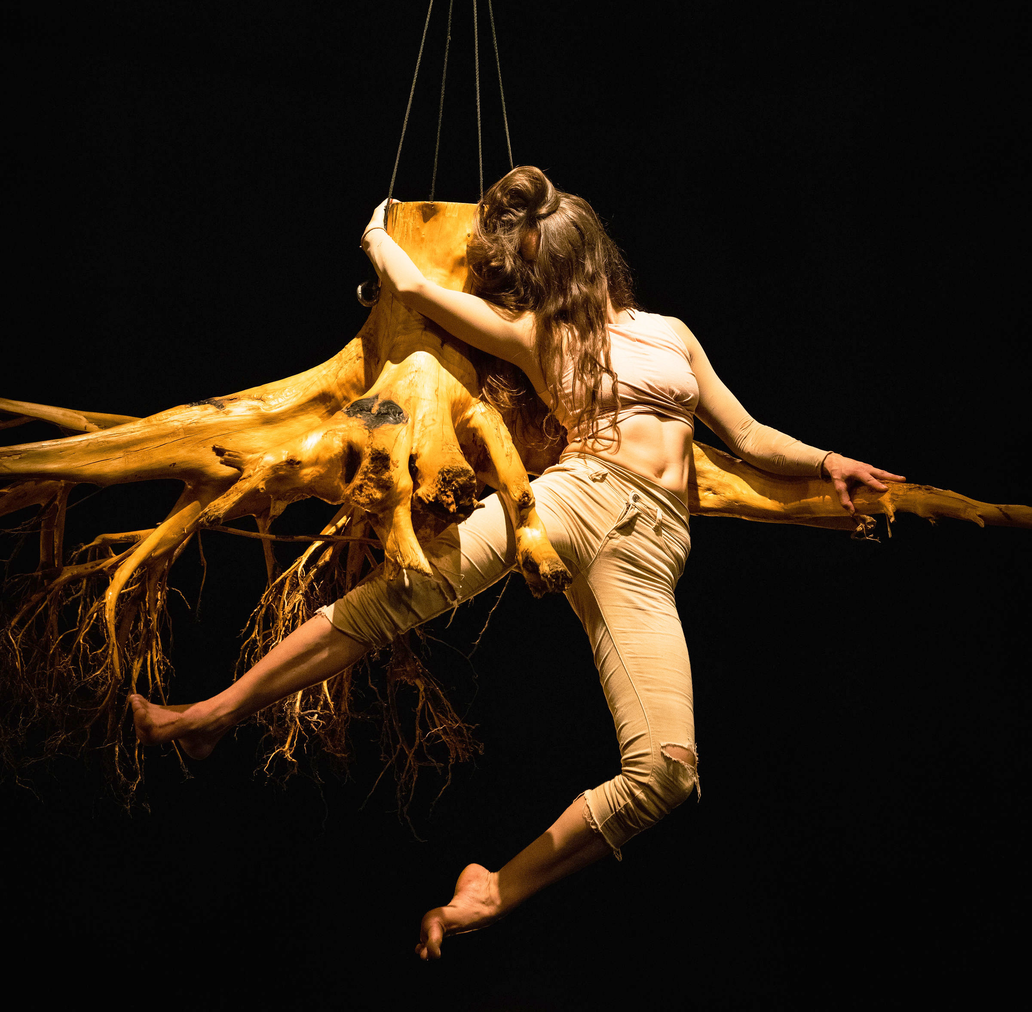
STRIKING ROOTS INTO THE VOID is an interdisciplinary performance piece, merging circus, dance, live music, performance and installation art featuring beyond-tricks aerial acrobatic movement on a suspended natural pine tree root.
The creation is closely related to this Artistic Research around the question ‘how to strike roots into the void?’, that originated from a need to re-define body and object relationships in circus.
However, though the performance is in many aspects inspired by the research, and the processes of creation and research informed each other, the performance piece is not a mere conceptual representation of the research content. It follows the demands of a performance and is edited and designed as such. The researched ‘submission lead’-method, the Aerial Rooting, played a crucial role in creating the material, but might not explicitly be visible as such in the performance.
The performance, which is much-more-than-a-solo, questions body & object relationships, and the distinction between human and non-human beings. The body is merging into an interwoven meshwork of rope, wood, metal, movement, voice and sound, exploring layered interconnectivities of the visible and physical correlations, as well as less tangible bonds, resonances and associations – a lot around the notions of being rooted, uprouting as well as finding hold and nourishing connections.
On the search for a possible suggestion for how to move in a world of uncertainty, the total work of art invites the audience into an immersive multi-layered experience, broadening one’s horizon, to finally see the trees for the wood, and vice-versa.
scene: ‘brachiating through the rope forest’ | view from the crown through the rope forest on the tree root
The initial idea went through many stages in the process. A first prototype root showed practical and artistic issues to be solved for choosing the right final version:
– it wasn’t visually clearly recognizable as a root (too much of a unidentifiable chunk) – the bark gave very good hold, but also easily burned and cut the performers skin
(also the visual merging wasn’t that easy due to different coloring)
– luckily I found (generously gifted by Kulturinsel Einsiedel) a naturally grown root, that had a horizontal ‘bar-like’ root like a trapeze, to provide a natural grip and hanging option.
stage set sketch of first work-in-progress-showing moment & final idea sketch for the audience swings, set up in unraveled ramificated ropes in the current set up there are 6 wooden swings for audience!
SUSPENDED natural PINE TREE ROOT
Though the work is meant to construct an immersive interconnected meshwork in the sense of a total piece of art, there is something that could be considered as centerpiece of the stage set design: the natural pine tree root.
Staged as a piece of object art in itself, it unfolds its meanings on many layers:
– very unusual, innovative and experiemental form of an aerial ‘apparatus’ (special
importance of the individuality! > less an object than a partner with own character) – alluding to metaphorical paradox: symbol of groundedness floating in suspension – peeled off bark and oiled it resembles the color of the performers skin to visually merge the bodies
– beauty of the nature, impressive, fascinating form, but at the same time strong presence of violence through the splintered, shattered parts where the roots are broken off. – this is the root of a pine tree fallen in a storm, one of the few ways to get the roots out of the earth preserving all the fragile ramifications into the smallest detail to best represent the metaphorical values of the root, foremost: hold, nutrition & connection/ communication.
»we should not joint the world up (that) we should have lots of LOOSE ENDS, in which everything is a knot with ends trailing off in all sorts of directions, that can then be followed and taken further. And that is why I like to think of the world not as a network, where everything is a particular node, and we draw the lines connecting them all up, but as a meshwork, where everything is a line, and the lines all get tangled up together, but no line has an beginning or an end. There is room for life and imagination, because the meshwork is a tangle in which every line has a loose end... that we then can follow and take further.«
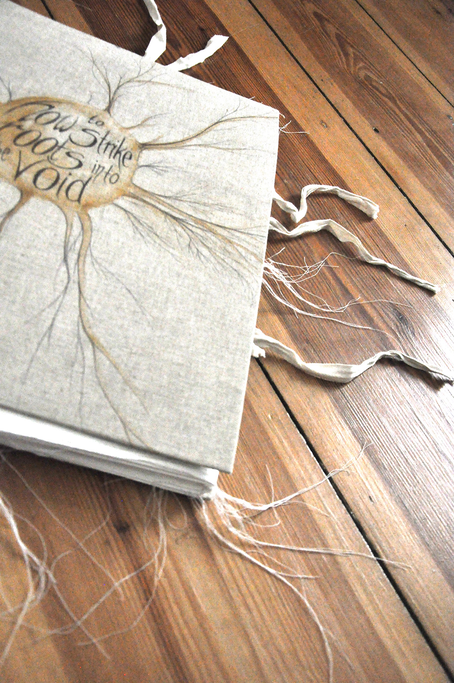
As mentioned in 'Striking Roots' I strongly believe in the inseparability of form & content. During the research process I experimented with different ways of documentation, which would resonate the content immanent in the research itself.
I am a very visual person, so from early stages on I started collecting images. Together with readings, notes and my own drawings and photos I made an analogue 'mindmap' arranging all these impressions on my wall. I needed the materiality to physically engage with the content, to re-arrange and make new connections and also to get an overview of it as a whole.
Right from the start of this research I had a vague idea of not having a linear format of documentation, but a rather multi-directional one. In many aspects this reflected the content and topic and resonated with the philosophical concept by Deleuze – the ‘rhizome’.
This concept in mind I developed the visionary idea of making a book object, that has no linear reading structure, but is rather to be understood as multi-directional, reflecting the rhizoma structure. Furthermore its design echoes other related concepts of Ingolds ‘not-joined up thinking’ and his call for ‘loose ends’ and allows for an actual physical experience of a processual unfolding in analogy to my artistic research process: