Memory in Practice unfolded across two encounters, ECER2025 (Belgrado) and Mira Fórum (Porto), each approaching memory not as a recollection of the past, but as something that acts within artistic research. In both situations, memory operated as a material and relational force, shaping how attention, perception, and connection emerged in practice.
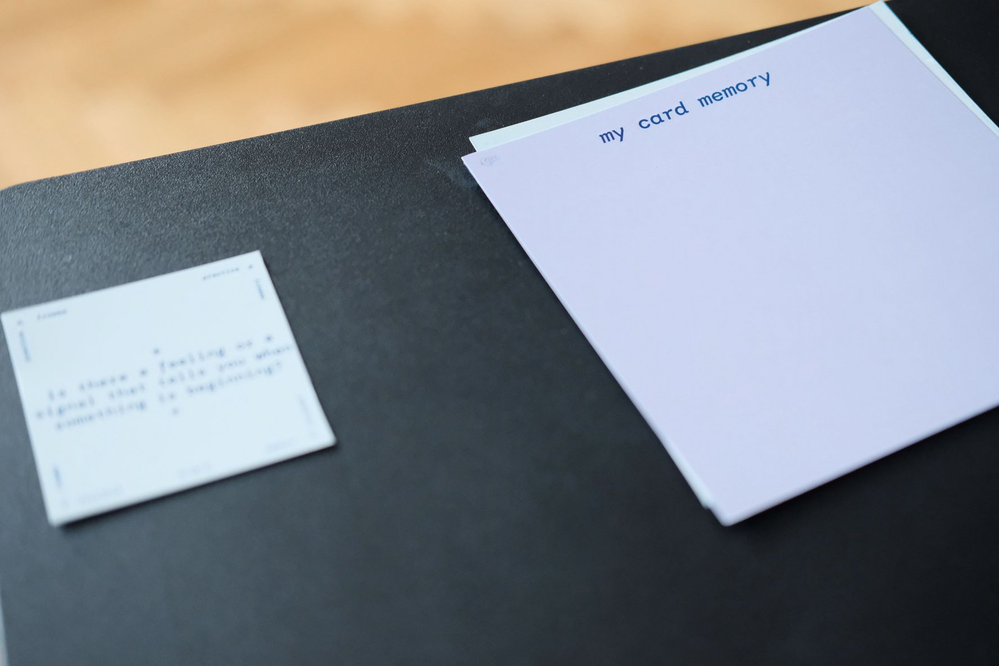
We began by selecting random questions that invited us to revisit gestures, traces, and recurrences within our practice. Through drawing and writing on what we call my card memory, we were asked to work with affective, sensory, and fragmentary content. Each attempt to give form to memory functioned as an inscription or translation, revealing how remembering shifts as it becomes material. The impossibility of repeating the same marks, even when using carbon paper, made visible how memory resists reproduction, always reappearing altered, embodied, and renewed.
The second encounter expanded this inquiry into memory as a relational gesture. Remembering was approached as something that unfolds between people, objects, images, and contexts. After asking "what you remember", we shifted the focus to how remembering happens between us, asking what echoes, contaminations, inheritances and shared forms of forgetting shape artistic practice.
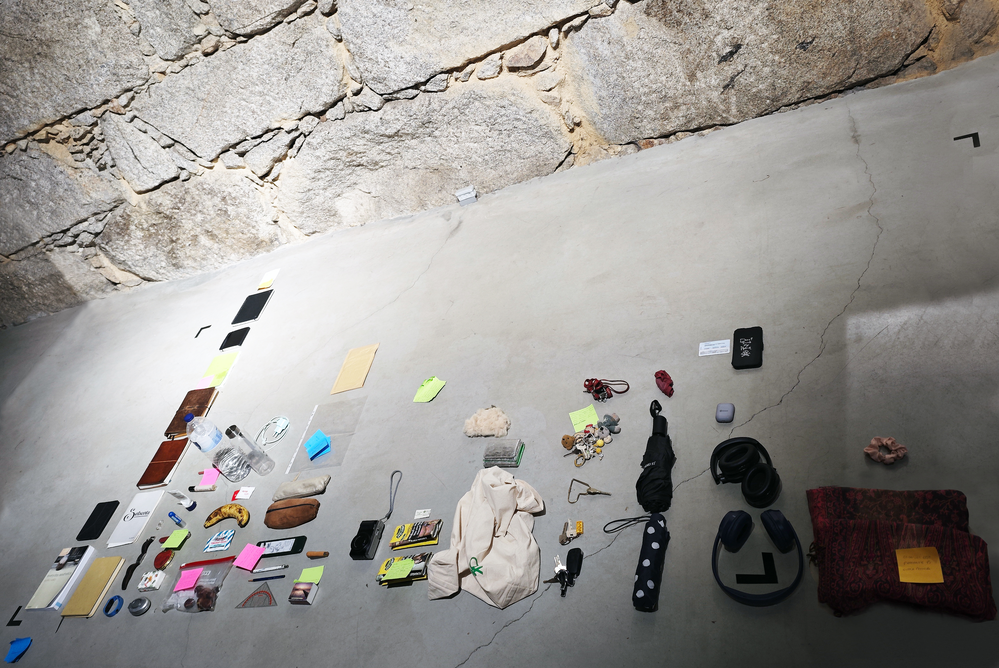
After working with the memory cards, we each selected five objects we had brought with us. Placed together on the floor, these objects acted as mediators, revealing uses, histories, and temporalities that extend the body and the practice. Handling them collectively foregrounded how memory circulates through things, holding forms of knowledge inseparable from touch, presence, and proximity. Memory became a lens through which the personal and the collective, the lived and the imagined, the carried and the inherited could meet.
Later, Melina Scheuermann's anonymous photo album activated recognition, projection and resonance through shared looking. Composed of old photographs of everyday life — family albums, unnamed portraits, ordinary places and minor situations — the images did not function as illustrations, but as catalysts. They triggered movements of memory that unfolded in the space between us, making perceptible the dominant temporal structures through which memory operates.
Across both encounters, refraining from defining memory in advance became a way of keeping the process open to what exceeded intention. Rather than fixing what remembering should produce, memory was allowed to unfold through action, shaped by the bodies present, the materials handled, the invisible structures, and the interferences that emerged in relation. This was not an absence of structure, but a commitment to remaining responsive, allowing memory to move, shift, and reconfigure itself in practice.
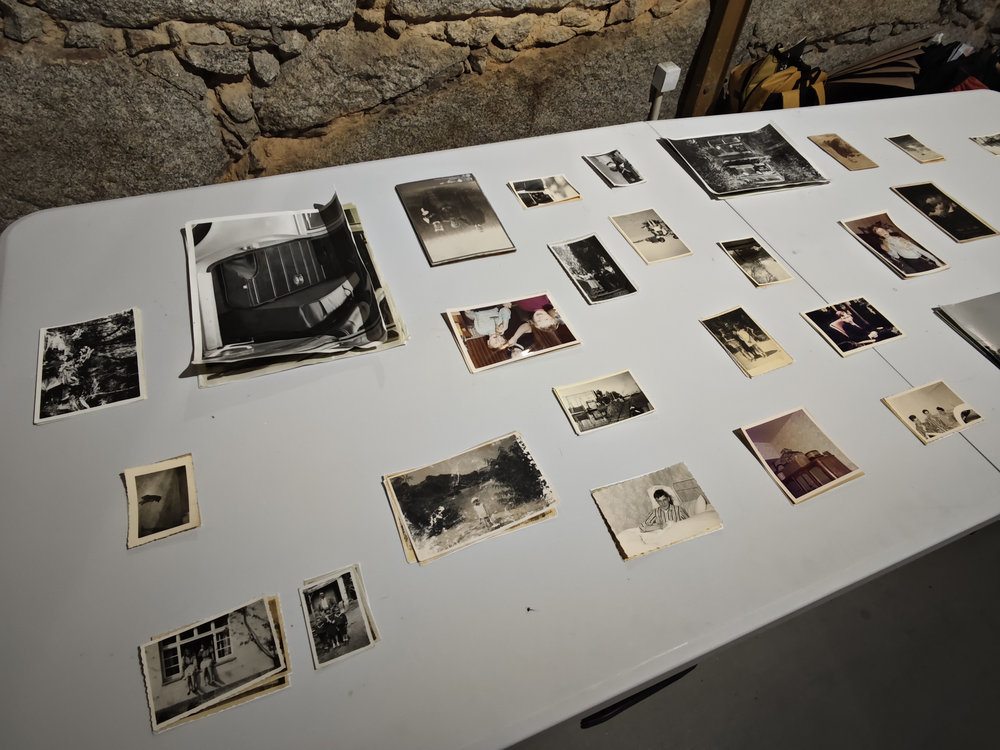
Melina Scheuermann's anonymous photo album
From the collection of unnamed, everyday photographs, each of us selected two images and brought them into relation. Possible narratives, visual affinities, and temporal displacements emerged through comparison and shared looking, foregrounding memory as a relational process shaped by projection, resonance, and interpretation.
My card memory and one question
The multiplicity of questions, the use of carbon paper, and the act of representation itself operated as thinking devices, shaping how memory was perceived and enacted. Each attempt produced variation rather than repetition, making visible the impossibility of an identical copy and foregrounding memory as a process of continual transformation.
Composition of five accompanying objects
The objects we brought into relation revealed both affinities and irreducible differences. Placed together, they articulated distinct histories, uses, and temporalities, allowing memory to circulate through material proximity, touch, and comparison rather than through narrative coherence.