--- My task is to respond to a problem or preoccupation by a colleague who wants to, if I simplify, who wants to somehow use artistic research more actively, not only to represent the problems, ecological problems, technological problems and political problems that we are surrounded by, but how artistic research could more directly tackle such problems, if I understood him correctly. And especially he seems interested in the sort of mixed ecosystems of technology and biology. And that made me think that why not ask you directly. Of course, the problem is in a way, I mean he's not interested in junipers but in ecosystems and ecosystems, although any system can be called ecosystem nowadays, they often involve living beings like junipers and microbes and plants and animals and fungi and what not, humans. But as Teresa Brennan said already in her book in 2000 Exhausting Modernity: Grounds for a New Economy we humans tend to spend so much time in environments created by ourselves, so man made environments, that we lose track of the environment that has actually made us. So, we, by sort of spending too much time indoors and on social media and in all kinds of artificial environments we lose track of sort of where we come from, which is from places like this here with you. And that's why I thought you might be able to remind me of that. But I, more concretely, because it's also a question of how do we represent nature or junipers or how do we sort of bring in contributions by junipers, by nature, into our creations. And of course, the classical way is what I am doing now, recording an image of you, a video image. A visual artist might draw or paint you; a film animator would make or well a comic-book writer could make you into an old man or woman with your prickly needles, grumpy maybe, create you into a character. An old-school traditional handicraft-artists would take your berries and make colour of them and use that. And in contemporary performance we might put you in a giant pot and put you on stage to represent yourself as you are. Although normally or usually the juniper-like things in pots are made of plastic in lounges and restaurants and cafeterias. So, representation is one possibility but not so satisfying. But what about other modes; how could you somehow contribute directly in a more creative manner? And that's of course something that's very interesting for me as well because how could you contribute to this conversation. And of course, things that people have tried is like tying a pen or pencil to a branch of yours and then put a paper or some material so the wind could draw, your branches could draw with the help of wind. That’s of course an active contribution. Or as many musicians do, we could try to attach some sort of electric things on your branches to catch the electric impulses that move through your electrobiome as it is called. So, to catch those signals and transform them into music, that could be one way of sort of translating your feelings or opinions or needs into something that we could understand. Or why not to use the technique also used by artists to somehow collect your breath; so, your out-breath of oxygen and other chemicals and to let those chemicals, the level of those chemicals somehow direct some, let them be transcribed in some manner. But then we would have to put some sort of plastic bags on your branches or something like that. So, it's not so easy, it's very; it becomes very artificial that too. ---
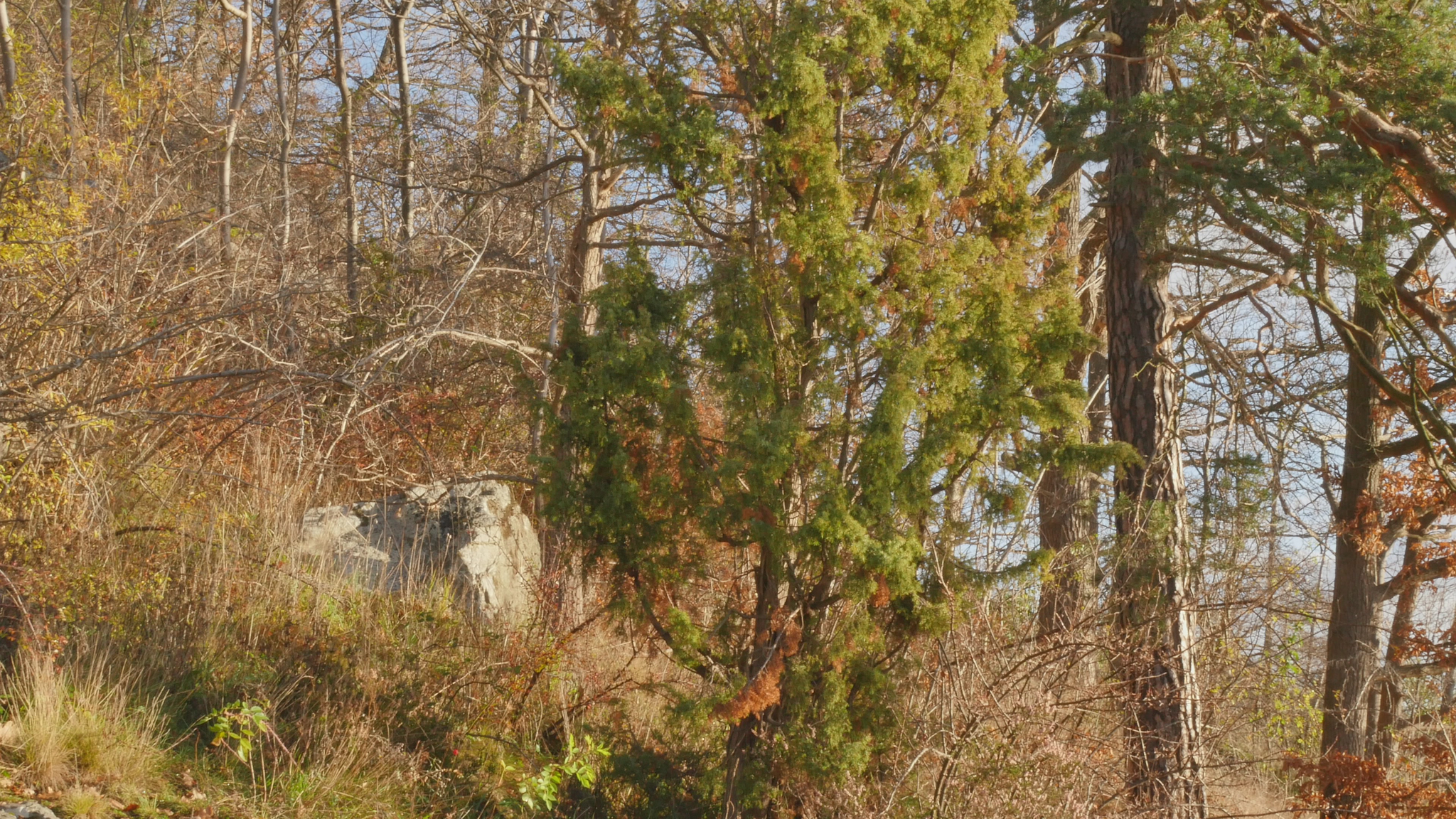
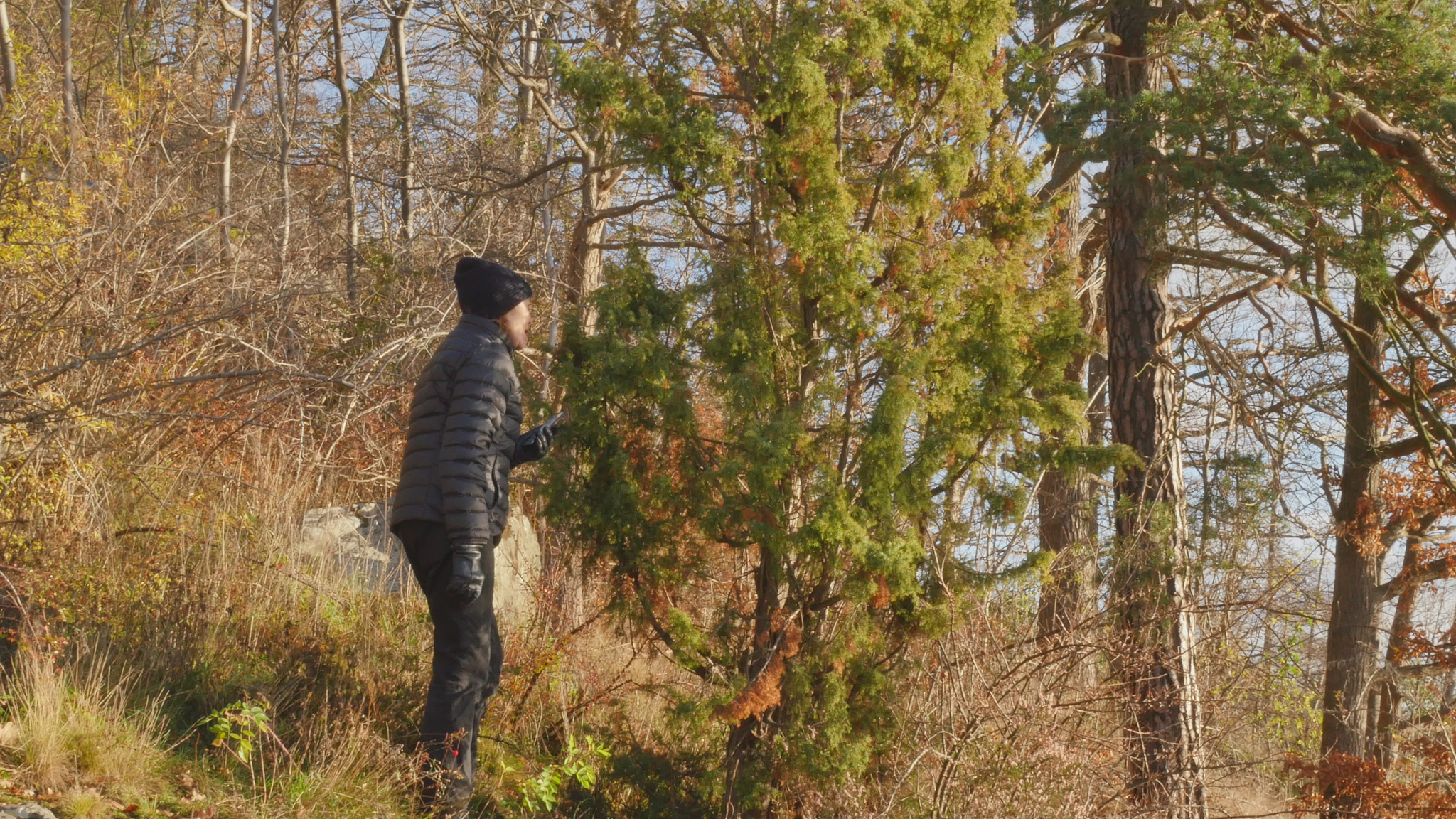
Hello Pine [Juniper], the sun makes you look good, fresh and green, it's good to see you like this. If you wonder why I'm speaking English to you suddenly, because normally I speak to you in Swedish, is because I'm going to show this video clip to some colleagues, and they would not understand the Swedish. And the reason I come to you now is actually because I want to ask for your advice or your help. I also asked Chat GPT, the AI app for advice but I thought you might give me better advice, to put it simply. Or, I don't know, more reliable advice, of course not expressed so clearly. So I don't expect you to start to speak to me or wave your branches or something like that, but I trust that the volatile chemicals that you breath out or spread around you will influence my thinking. Or not my thinking directly, but they will influence my, neurochemical processing of impressions and thoughts and my whole, yeah chemistry in a way. So, in that sense they might help me in producing a more relevant response. My task is to respond to a problem or preoccupation by a colleague who wants to, if I simplify, who wants to somehow use artistic research more actively, not only to represent the problems, ecological problems, technological problems and political problems that we are surrounded by, but how artistic research could more directly tackle such problems, if I understood him correctly. And especially he seems interested in the sort of mixed ecosystems of technology and biology. And that made me think that why not ask you directly. Of course, the problem is in a way, I mean he's not interested in junipers but in ecosystems and ecosystems, although any system can be called ecosystem nowadays, they often involve living beings like junipers and microbes and plants and animals and fungi and what not, humans. But as Teresa Brennan said already in her book in 2000 Exhausting Modernity: Grounds for a New Economy we humans tend to spend so much time in environments created by ourselves, so man made environments, that we lose track of the environment that has actually made us. So, we, by sort of spending too much time indoors and on social media and in all kinds of artificial environments we lose track of sort of where we come from, which is from places like this here with you. And that's why I thought you might be able to remind me of that. But I, more concretely, because it's also a question of how do we represent nature or junipers or how do we sort of bring in contributions by junipers, by nature, into our creations. And of course, the classical way is what I am doing now, recording an image of you, a video image. A visual artist might draw or paint you; a film animator would make or well a comic-book writer could make you into an old man or woman with your prickly needles, grumpy maybe, create you into a character. An old-school traditional handicraft-artists would take your berries and make colour of them and use that. And in contemporary performance we might put you in a giant pot and put you on stage to represent yourself as you are. Although normally or usually the juniper-like things in pots are made of plastic in lounges and restaurants and cafeterias. So, representation is one possibility but not so satisfying. But what about other modes; how could you somehow contribute directly in a more creative manner? And that's of course something that's very interesting for me as well because how could you contribute to this conversation. And of course, things that people have tried is like tying a pen or pencil to a branch of yours and then put a paper or some material so the wind could draw, your branches could draw with the help of wind. That’s of course an active contribution. Or as many musicians do, we could try to attach some sort of electric things on your branches to catch the electric impulses that move through your electrobiome as it is called. So, to catch those signals and transform them into music, that could be one way of sort of translating your feelings or opinions or needs into something that we could understand. Or why not to use the technique also used by artists to somehow collect your breath; so, your out-breath of oxygen and other chemicals and to let those chemicals, the level of those chemicals somehow direct some, let them be transcribed in some manner. But then we would have to put some sort of plastic bags on your branches or something like that. So, it's not so easy, it's very; it becomes very artificial that too. I know I've been using too much time with you already but thank you for listening to me at least and I have to think about this how you could, how with the help of technology or why not AI we could develop some way of understanding what you need, how you feel, what you like and what you don't like. But as it is now, I only hope that everything is fine with you and wish you a nice sunny afternoon. So, thank you again and take care.