This exposition presents a practice-based research project that reimagines electronic music performance through the participatory and ritualistic ethos of Capoeira. Originating in a critique of audience passivity within contemporary electronic performance, the project gradually shifted from an initial idea of “translating” Capoeira into the context of electronic music performance toward constructing ritual-based frameworks that enable shared authorship, presence, and collective agency.
Across its phases, the research developed through iterative processes of design, testing, and reflection. In its early phase, the work established ritual as a central conceptual foundation, situating the project within discourses on participation, spectacle, and cultural belonging. In the next phase, instrument-making was explored as both technical and symbolic practice, producing DIY electroacoustic objects (Lua and Mar) that embody accessibility, agency, and transparency. Later, attention shifted to the orchestration of the ritual performance itself, testing spatial, temporal, and sensory structures that redistribute power and unsettle the artist–audience divide. The final stage culminated in a full-scale public performance, integrating instruments, structure, and reflection while raising new questions around documentation, cultural belonging, and the fragility of agency.
From these iterations emerged the framework of ritual as multi-dimensional architecture: a compositional and perceptual field in which time, space, materials, and social dynamics interweave to sustain collective creativity. The exposition combines documentation of instruments and performances with reflective writing, offering both a record of process and a proposition for future development.
This project was developed during the one-year Creative Production (Music) Master’s program at Catalyst, Berlin. Within the program, each research project was divided into five modules, referred to as CPM1–5. The overview below retraces the project’s evolution across these five phases. While the main exposition is structured thematically, this timeline highlights how the research questions, methods, and practices unfolded in sequence, gradually shaping the final ritual performance.Each phase brought new insights and refinements, gradually shaping the project’s conceptual framework and practical direction.This overview serves as a contextual grounding while also tracing how the project gradually took shape over time.
Initial Motivation and Early Vision
CPM1 established the foundational motivation for the project: to address the imbalance of energy and power between audience and artist in conventional music performances. Drawing from firsthand experiences in Capoeira, the project began with an aspiration to create a performance model in which audiences could become co-creators rather than passive observers. While Capoeira’s participatory “Roda ” structure was identified as a potential source of inspiration, how it might relate to electronic music performance remained undefined. This phase also explored possible connections with electroacoustic music and DIY culture, recognizing shared values of freedom, resistance, and egalitarianism. Key practical questions— such as whether to build instruments or utilize existing tools, and how to structure real-time interaction—were still unresolved. Overall, CPM1 marked the project’s embryonic phase: conceptually curious and politically aware, yet deliberately open-ended to allow space for further development.
Contextual Grounding and Conceptual Shift
CPM2 marked a major conceptual turning point in the project: the idea of ritual, previously
peripheral, became a central structural and theoretical foundation. Drawing from Capoeira’s
ritualistic and participatory framework(Almeida 1986; Assunção 2005), the project redefined itself not as a reinterpretation of Capoeira’s musical elements, but as a ritual-based performance in which collective presence and co-creation are essential. This phase situated the project within broader discourses on spectacle versus participation, drawing on theorists like Debord(1967) and Bourriaud(1998) to critique passivity in mainstream performance formats. It also introduced key frameworks from ritual theory, participatory art, and fractal structures—each contributing to a rethinking of music as a communal, embodied, and recursive process. Notably, fractal structures were identified not only in traditional practices but also as a compositional strategy for structuring participatory performance design(Eglash 1999). Technological considerations were approached philosophically, highlighting the tension between access and control, and favoring emerging preferences for DIY instruments made from found materials. Additionally, this stage initiated a critical self-reflection on cultural appropriation and belonging. While acknowledging the complexities of drawing from Afro-Brazilian traditions, the reflection also emphasized the lived reality of being accepted within the Capoeira community—a reciprocal relationship that helped reshape the artist’s understanding of cultural identity. In short, CPM2 provided the project with its first integrated conceptual grounding, allowing future decisions to emerge from a clearly articulated set of values.
Design, Production, and Live Testing
CPM3 and CPM4 were developed in parallel, marking a highly practice-oriented phase of the
project. Together, they encompassed the full design, construction, and testing of the final ritual performance, during which the conceptual framework of ritual as multi-dimensional architecture first began to take shape. Later, as I prepared for a presentation at the symposium Multipli-cities – Exploring Artistic Research Across Places and Practices at Catalyst, I further clarified and articulated this framework, presenting it publicly for the first time.
CPM3 focused on instrument design and making, not merely as technical development, but as a material extension of the project’s core values—agency, accessibility, and embodied
participation. This phase established why creating new instruments was not only a practical but also a symbolic and philosophical choice. The instruments were conceived as ritual objects, shaped by everyday materials, intuitive electronics, and a resistance to the “black-box” logic of much electronic music technology—a stance inspired by the ethos of hardware hacking as articulated by Collins (2006). Inspired by how Capoeira practitioners often craft their own instruments as part of ritual preparation, this act of making became a way to take responsibility for the sonic, spatial, and symbolic dimensions of the performance. The making process involved a series of exploratory failures and material negotiations, through which the final instruments—Lua and Mar—gradually emerged. These instruments embodied contrasting but complementary logics: one electronic and unstable, the other resonant and tactile, both deeply responsive to the performer’s body. Through this process, the act of making itself became a form of listening—an unfolding relational practice that reshaped the designer’s sense of authorship, and pointed toward a collective and situated performance ecology. The instruments laid the groundwork for the ritual performance tested in CPM4, where they would be activated in a participatory setting.
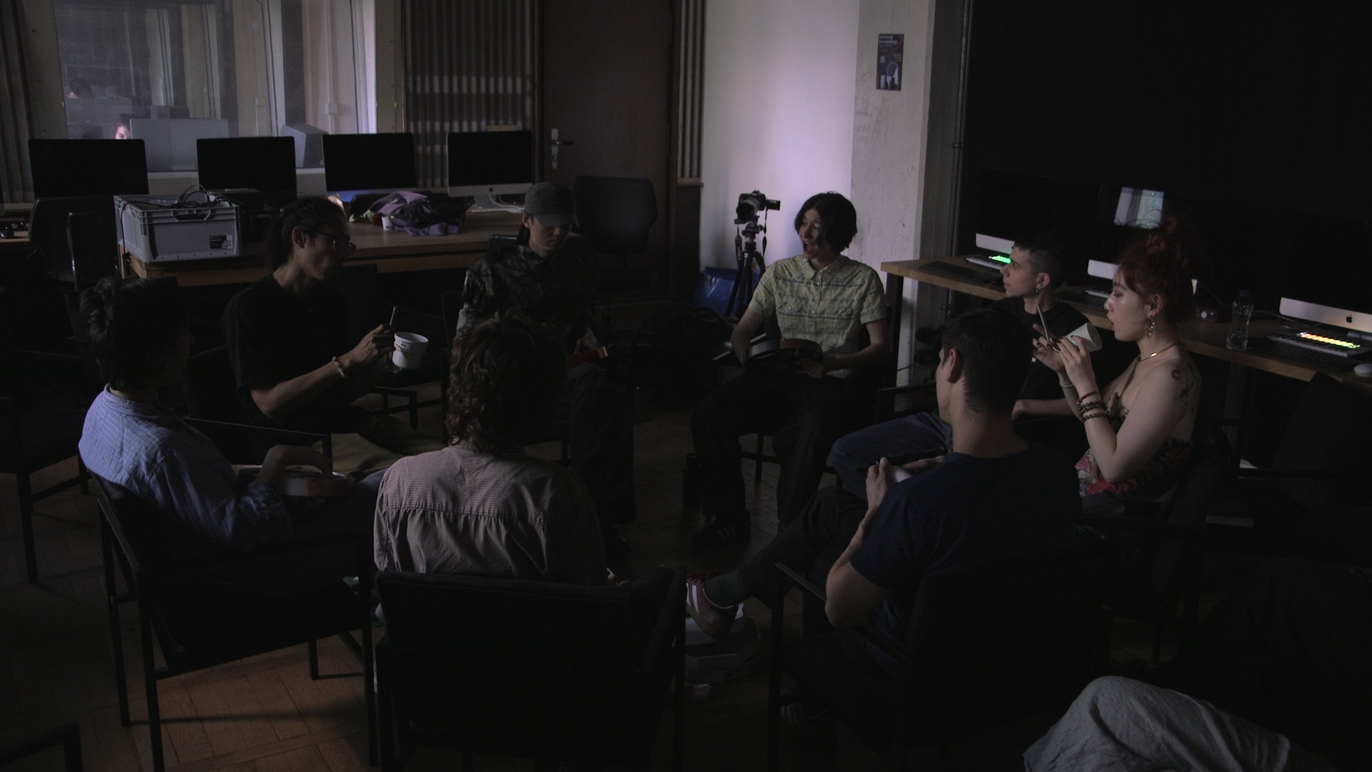
CPM4 shifted the focus from instrument making to the orchestration of the ritual performance itself—its temporal, spatial, and relational architecture. Building on the groundwork laid in CPM3, this phase involved the detailed design and testing of the full performance sequence through two small-scale ritual experiments. From the circular spatial arrangement and multi-sensory entry rituals to the embedded logics of improvisation and group listening, each element was carefully calibrated to cultivate shared presence rather than display. The performance was structured in phases: a warm-up workshop activating bodily rhythm and vocal presence, a first improvisational round based on constrained variation, and a second round introducing memory-based singing prompted by associative themes. Across all stages, the emphasis was placed not on musical outcome, but on repetition as a mode of attunement and on presence as participation.
This phase also began to take shape the project’s conceptual core: the idea of ritual as multi-
dimensional architecture—a framework that situates performance as a structure of time, space, attention, and relation. Inspired by both capoeira’s roda and architectural thinking, the ritual was conceived not as a symbolic gesture but as a perceptual field built through material, sensory, and social design. Theoretical reflections in this stage drew from thinkers such as Byung-Chul Han and Boris Groys, situating the ritual not only as a form but as a response to the disappearance of shared time, space, and meaning(Han 2020; Groys 2016).
In parallel, the project continued its critical engagement with themes such as cultural appropriation, ritual and community, and the delicate tension between sampling and memory—particularly how fragments of pre-existing songs, when re-sung in communal settings, become carriers of both personal and collective histories. Test performances surfaced rich reflections on authorship, agency, and trust. Participant feedback revealed the generative role of ambiguity, the challenge of vocal and instrumental multitasking, and the importance of group energy in shaping the unfolding dynamic. These sessions clarified the project’s refusal of the artist/audience divide—not by erasing difference, but by reconfiguring it into a fluid ecology of co-presence. They also highlighted key areas for
future refinement, from duration and instructional language to sonic pacing and spatial
distribution. CPM4 thus marked the moment where the project’s theoretical, material, and performative threads were woven into a living, testable form—laying the foundation for its final articulation and opening pathways for further evolution.