This cluster focuses on the core of the project: the design and unfolding of the ritual performance itself. It brings together two strands: reflections on how the ritual was structured and facilitated, and the theoretical framework that emerged through the process. What follows is both a documentation of practice and a set of conceptual propositions—tracing how a participatory performance became a site for rethinking space, time, agency, and collective presence.
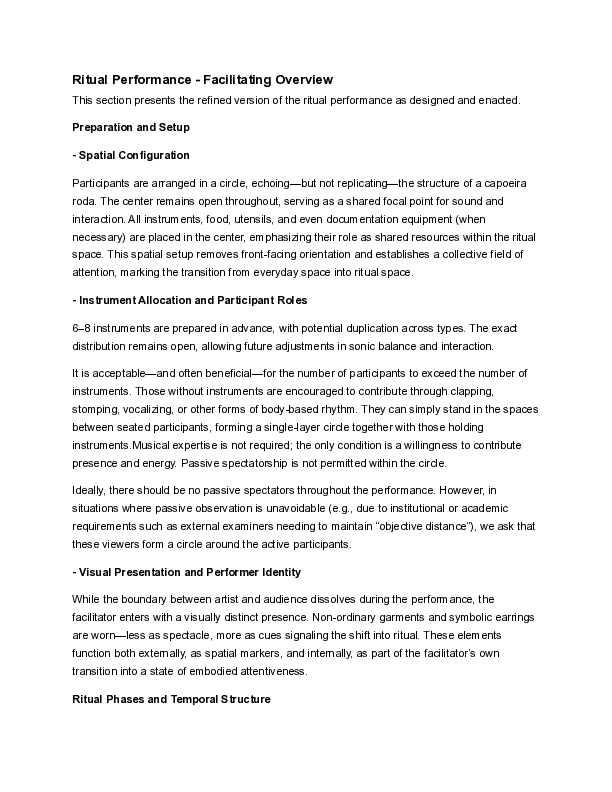
The video below offers a glimpse into the ritual performance, recorded on June 19, 2025 at Catalyst in Berlin. It shows selected moments from the event rather than its full duration. The complete documentation can be found in the Documentation as Ritual cluster, while the text-based facilitating guide is embedded as a PDF directly below this video.
The ritual performance described in this project is not only a social gathering or aesthetic event—it is a structure that shapes time, presence, and attention. Among the texts I encountered while developing this framework, Byung-Chul Han’s The Disappearance of Rituals (2020) offered a particularly compelling articulation of what ritual can do. Han argues that rituals are not decorative or nostalgic practices, but temporal structures that create closure and orientation. They mark time by giving it rhythm, contour, and meaning. Through repetition, they inscribe memory into bodily practice and re-establish shared coordinates of experience (Han 2020).
One image that stayed with me from Han’s text is his description of a village in which the old pear tree marks the turning of the seasons. Its presence offers a kind of temporal anchor, a place where gestures and events can recur. Without such anchors, Han writes, we lose our capacity for orientation and meaning. Ritual, in this sense, is not about mysticism but about making time inhabitable—re-grounding ourselves in a world that increasingly flattens time into a series of consumable moments (Han 2020, 14–15).
This view helped me clarify the structural nature of capoeira’s roda. While capoeira often emphasizes fluidity—a philosophy echoed by many mestres who affirm that “everything is capoeira”, and that the practice can infiltrate daily life—it is also undeniably rooted in a repeated, bounded form: the roda. This circular gathering, with its own entry rituals, musical patterns, and social rhythms, functions as a closure—a ritual container that makes presence visible and time felt. In this way, form and freedom are not opposites, but interdependent.
A parallel insight emerged from earlier phases of the project, particularly in CPM2, where the concept of vadiar was introduced. In capoeira, vadiar—often translated as “to idle” or “to loiter”—does not signify laziness, but a state of open, aimless attentiveness. It suspends the demand for productivity, allowing presence to unfold without precondition. In CPM3, this sensibility was already embedded in the approach to instrument making, where the act of creation was freed from the pressure of producing value or success. The same principle underlies the performance structure. The ritual is not constructed to deliver results, but to make space for something to happen—without requiring it. This orientation softens internal judgment and allows participants to engage without the fear of not “doing it right.” In this way, the project returns creative agency to everyone in the space—not through achievement, but through permission.
Ritual also has the capacity to shift the meaning of ordinary actions. In Endless—a visual album by Frank Ocean—the video shows him doing simple carpentry: sawing, sanding, assembling. Within a durational frame, these mundane gestures take on a devotional quality. Capoeira offers a parallel through the practice of apelido (nickname): an everyday social habit that, within the roda and especially in the batizado ceremony, becomes a formal marker of belonging (Assunção 2005).
In my project, similar strategies are used to shift the tone of otherwise ordinary acts. Spraying perfume, wearing non-everyday clothing, and sharing food and drink are small gestures drawn from daily life. But when positioned at the entry and exit of the ritual, they become threshold markers—signaling the passage between different modes of attention. These sensory cues don’t just set the mood; they establish a boundary in time. Through scent, texture, and taste, participants are invited to recognize that something different is taking place—and that they, too, are different within it.
Building on Byung-Chul Han’s theory of ritual as temporal closure, and perhaps influenced by my own background in architecture, I arrived at a new proposition: ritual as multi-dimensional architecture.
The following section unfolds in the style of a manifesto—offering a conceptual framework for the ritual performance, articulated through the lens of design, structure, and perception.
Ritual as Multi-Dimensional Architecture
What if ritual is not a symbolic gesture, but a kind of architecture—one that unfolds not only in space, but in time, attention, sensation, and relation?
Ritual, in this view, is a constructed field of perception. It is not merely a container for meaning, but a structure that enables experience to take shape.
Rituals set boundaries—not to impose limits, but to create a perceptible world. In contemporary life, our senses are constantly scattered across infinite stimuli. Ritual concentrates them. By closing off, it allows something to open: awareness, response, presence. Within a bounded field, perception deepens. Attention acquires rhythm. Action regains intentionality.
This project takes ritual not as a cultural reenactment, but as a technique of framing. Its architecture is multi-dimensional:
• Time is marked and segmented.
• Space is oriented toward a shared center.
• Each sense enters in its own time—sight, smell, sound, touch, and finally, taste.
• Rules emerge not to restrict, but to support improvisation and co-presence.
The structure is not rigid, but responsive. Like the framed perspectives of classical Chinese gardens, or the bounded circle of a capoeira roda, it opens space for movement, relation, and unpredictability. What appears as constraint is, in fact, an invitation to engage with precision and care.
The instruments, the perfumes, the clothing, the gestures—none of them are ornamental. They are the scaffolding of attention. They help build a space where perception becomes collective and freedom begins not in absence, but in form.
Ritual is not an escape from the world.
It is a re-making of the world—one that begins at the edge, where form meets presence.
The Architect and the Mestre
The figure of the architect and the capoeira mestre may appear to belong to entirely separate worlds—one works with materials and structures, the other with bodies, rhythm, and energy. But in this project, I began to see them as parallel roles, both engaged in shaping a field of experience through structure and perception.
Neither is a “leader” in the conventional sense.
Both operate as coordinators of unfolding systems, where attention must remain sensitive to the whole while responding to the present.
Like the architect, the mestre holds a sense of the full design—not as a blueprint for control, but as a living structure that others can inhabit, traverse, and transform.
Like the mestre, the architect listens: to the tension of bodies in space, to rhythm, to flow.
Where the architect lays out spatial trajectories, the mestre composes with movement and music.
Where the mestre initiates a song, the architect punctuates time through material and form.
Each one constructs not commands, but possibilities.
In this project, I do not claim either title—but I recognize the resonance of their functions.
I am not an artist, not an audience, not a leader—
but a structural participant, breathing with the space itself.
In contrast to leadership models built on direction and authority, ritual facilitation requires a different kind of presence—not to decide for others, but to sense when the structure itself needs to shift.
It is a form of attentive holding, where the facilitator becomes a responsive anchor rather than a fixed center.
To guide a ritual is not to lead it.
It is to feel its rhythm, hold its edges, and move only when the space itself begins to ask.
From Groys to Redistribution
In the early phase of this project, I was drawn to Guy Debord’s critique of the spectacle, where modern life reduces people to passive observers (Debord 1967). This fed my desire to dissolve the divide between artist and audience.
Later, Boris Groys’ In the Flow (2016) shifted my perspective. He argues that our current condition is not passivity but endless production—constant writing, posting, performing—often without true agency. The problem is no longer inactivity but circulation without presence.
This realization reframed my goal. The aim was not to make everyone “creative,” but to redistribute agency—to create conditions where making is grounded in perception, timing, and responsiveness. In the performance, this took form through design choices: each instrument is independently amplified, there is no central mixer, and the circular setup privileges mutual visibility. The “one-at-a-time variation” principle further slows interaction, making listening and restraint part of participation.
Agency here is not about equal tools, but about cultivating presence. To contribute is not to assert, but to respond—knowing when to act, when to hold, and when to let silence speak.
Is “Handling the Room” Desirable?
During the second test performance, one participant remained largely quiet—playing a soft, repetitive rhythm on the caxixi, and singing little if at all. In a later private conversation, another person who had observed but not participated remarked, “If I had held that instrument, I could’ve done much more—I would’ve handled the room better.”
The comment unsettled me. Not only because it was aggressive, but because it revealed a lingering attachment to performance logics this project seeks to undo. In a co-creative ritual, is “handling the room” even the point?
What this observer overlooked was that the person they criticized had, in fact, anchored the space with a kind of quiet depth. Their contribution was not technical variation, but unwavering presence—steady, attuned, and essential. It prompted me to reconsider how influence is defined in collective rituals. What counts as contribution? Is visibility always more impactful than resonance?
Of course, there are moments—just as in capoeira or jazz—when individual flourish or technical display is welcome. But these moments are embedded in a larger structure of call-and-response, of dialogue and mutual sensing. The value of a gesture lies not in how much space it occupies, but in how well it listens, responds, and amplifies the whole.
Ironically, the person who believed they could “do better” chose not to participate. In this context, their claim of capability felt not only irrelevant, but hollow. Presence is not potential. It is what actually takes place in the circle—what is risked, received, and offered.
Shifting Hands: Agency as Flow
This reflection began during one of the Context of Listening classes, where our professor introduced a performance by the Sunday Service Choir—a piece marked by scale, uniformity, and massed sound. As a point of comparison, we were shown a 1990 performance by the Bulgarian State Television Female Vocal Choir on The Tonight Show. The contrast was striking: while Sunday Service emphasized alignment and spectacle, the Bulgarian choir revealed micro-variations of presence—moments where individual voices briefly emerged and then receded into the whole.
This prompted a question I had not asked before: What does it mean to have agency in a collective performance? And more importantly, is agency always necessary—or even desirable?
Growing up in China, I was familiar with choral practices that echoed the logic of Sunday Service: large groups singing in unison, following a conductor’s lead. These were widely seen as successful, even moving. The notion of individual agency was rarely part of the conversation—not because it was actively repressed, but because it simply wasn’t the value being pursued. Harmony, discipline, and shared purpose took precedence over personal deviation.
This realization complicated my assumptions. If one cultural framework values expressive individuality, another might value intentional surrender—the ability to entrust one’s agency to the collective. Traditions like capoeira suggest a different possibility: a dynamic exchange, where agency is not fixed but flows—passing between players, singers, and musicians in real time.
With this in mind, I no longer see the goal of the performance as maximizing individual agency. Instead, I design for agency in motion. Some may feel called to act; others to hold space. Agency can be passed, shared, withheld, or reclaimed. It is not a possession, but a rhythm—something we move through, together.
This fluid conception of agency threads through the project’s entire structure, from its spatial logic to its sonic rules. It marks a shift from domination to dialogue, from authorship to attention.
In reflecting on Byung-Chul Han’s The Disappearance of Ritual (2020), I was struck by his reminder that rituals require structures of support—space, time, attention, and often, community. Some rituals can be sustained individually, offering psychological rhythm and grounding. But many exceed the resources of a single person; they rely on collective participation to exist.
This dependency, however, is not one-directional. As rituals unfold, they also shape and generate communities. Participants may overlap with existing structures, but new configurations emerge—defined less by identity than by shared rhythm, duration, and attention.
Han also notes that community is bound by scale: beyond a certain number, relational coherence fragments. This resonates with my reflections on large participatory performances. Bobby McFerrin’s Day of Song or Jacob Collier’s arena concerts generate striking moments of collective singing, but they lack the intimacy and sustained attention required for mutual recognition and shared transformation (McFerrin 2019; Collier and Martin 2023).
This project takes that limitation seriously. The number of participants is deliberately kept small, not only for logistical reasons but to preserve the possibility of attunement. Here, participants can feel seen, heard, and responded to—not as a mass, but as a configuration of presences. Even if the project evolves in the future, its core structure will resist scale. The aim is not to grow, but to deepen. This commitment to depth over scale also made me more attentive to what happens when such orientation is lost—when gatherings that claim to be communities instead collapse into spectacle.
But what happens when this orientation is lost—when rituals become performances, and presence gives way to spectacle? One evening at Kwia, a listening bar in Berlin, I encountered such a space: one that claimed to be “community-based,” but in practice felt more like a scene.
I am grateful for Berlin’s infrastructure that supports grassroots venues and gives emerging artists space to experiment. But generosity alone does not guarantee the formation of true community. The performance I attended was not troubling in terms of content, but in atmosphere. It did not feel like community. Instead, everyone seemed eager to be seen—to perform not only on stage but in the audience as well. Visibility, not presence, set the tone.
This clarified a key distinction: between a scene and a community. A scene—like Berlin’s “techno scene”—already implies spectacle, something curated to be seen and consumed. Even underground spaces often reproduce performance logics for an imagined audience. In such environments, everyone is watching and being watched, leaving little room for mutual presence—only a hall of mirrors.
The issue is not just social media aesthetics or narcissism, but a deeper structural tension. Watching could, in principle, be a mode of being-with—like listening, touching, or smelling. But in our culture, to watch often means to judge, to detach, to prepare oneself for a hypothetical gaze. People begin to stage themselves for this invisible observer. What pretends to be neutral objectivity becomes disembodied performance, resisting reciprocity and undermining presence.
This contrast reaffirmed the stakes of my own work. In designing ritual structures grounded in shared attention and mutual listening, I hope to resist the spectacle of being seen, and instead make space for presence. Not a space where people come to perform themselves, but where they come to be-with each other. Not “extra-ordinary” moments, but ordinary ones lived with care.
When asked if I had sonic expectations for the final performance, my answer was simple: I had none. I accept whatever sounds the instruments produce. What matters is not outcome, but the process that generates it.
Earlier in the project I drew on fractal theory: complex textures can arise from overlapping simple rhythms. For inherently unstable instruments like the crackle box, this shifted focus from repeating sounds to repeating gestures—treating rhythm as bodily rather than sonic.
This view was reinforced in a 2025 Candomblé workshop with Mestre Forró Alabê, where I observed how musical patterns emerge not from mental composition but from the body—instrument shape, hand motion, physical constraint. Rhythm lives in movement, not cognition.
Psychoacoustics echoes this: when repetition exceeds ~20Hz, it is perceived as pitch (Moore, 2012). Sound itself can be seen as accelerated rhythm.
In this project, then, sound is not the destination but a byproduct of action. Instrument design, performance structure, and even instructions all embody this ethos: to play is not to aim for results, but to engage in unfolding, where sonic fields co-emerge through repetition, variation, and presence.
During a class discussion, it was pointed out that my project differs from others in that it is not truly about music itself. The focus lies not in the musical output, but in the process of creation. This observation implied that musical quality—at least as traditionally understood—is no longer the primary evaluative metric. In this sense, the project operates more as a ritual framework than as a musical composition.
That critique led me to reflect on a larger phenomenon: discussions about the quality of music almost always depend on a specific stylistic framework. What may be considered a flaw in one genre—detuning, excessive repetition, lo-fi textures—might be celebrated as a defining characteristic in another. Musical style provides the criteria through which value, intention, and authorship are interpreted.
Yet many historical musical styles did not arise from aesthetic ideation alone. They were often shaped by material and contextual constraints: the limitations of available instruments, the surrounding sonic environment, or the social functions of the music itself. For example, hip hop emerged in part from the economic inability to access traditional instruments, leading to the creative repurposing of turntables and the rise of sampling as a foundational technique(Rose 1994). Within this lineage, my own project introduces a distinct set of constraints: who plays (musicians and non-musicians alike), what is played (unconventional, handmade instruments), and how it is played (through a ritual structure rather than trained technique).
This led to a new question: if these constraints are repeated often enough, could they result in a recognizable sonic pattern—in other words, a musical style? Even if unintentional, style may begin to sediment through repetition of structure, roles, and tools.
This possibility introduced a deeper tension. If a ritual-generated musical style begins to form, what should be my relationship to it? My artistic impulse has long resisted stylistic identity. I have always leaned toward anti-style—or at most, multi-style—approaches. But if the ritual process itself organically generates a style through structural repetition, should I accept and maintain it as a form of coherence and identity? Or should I deliberately disrupt it to preserve the open-endedness of the ritual?
At this point, I have no clear answer—only the recognition that this question will likely shape the future of the project.
The instruments in this project are not merely tools for sound—they are structural components that shape how presence, agency, and collectivity unfold.
Early in the design process, I considered a conventional setup: connecting all instruments to a central mixing desk. While efficient, this solution quickly revealed a conceptual flaw. Centralized output reintroduces a form of sonic hierarchy: one entity controls the overall balance, while individual participants lose direct control over how they are heard. It also removes spatial specificity, flattening the relational and directional cues that are vital to shared listening.
In response, I began exploring a distributed model. Each participant would be paired with their own speaker, with the output directed toward the center of the circle. This preserved autonomy and spatiality, and reinforced the inward-facing logic of the ritual. However, it also introduced a new constraint: mobility. Tethering a performer to a speaker limits the possibility of movement, constrains embodiment, and reduces flexibility in spatial interaction.
The final decision was to embed sound production directly into each instrument. No separate speaker. No cables. Each unit becomes a mobile, self-contained sonic body, allowing for fluid choreography within the circle. The sound remains directional, but the performer remains free.
These shifts were not merely technical; they reflect an evolving understanding of how material design affects relational structure. By decentralizing output and embedding autonomy into each object, the performance avoids a sonic “center”—just as it avoids a fixed artistic center. Everyone hears themselves, positions themselves, and contributes from a place of clarity.
Further reflections on the material and conceptual design of these instruments—including their responsiveness, constraints, and collaborative agency—are explored in my CPM3 on instrument design.
During a conversation with mestra Jana, I first became aware of how cultural learning styles shape the relationship between movement and understanding. Many of her capoeira students in Germany insisted on intellectually grasping each movement before trying it, to which she often replied: “You’re thinking too much—just do it. The understanding will come later.”
At first, I saw this as pedagogy. Over time, I realized it reflected a deeper truth: cognition and action are intertwined. We often assume thought precedes action, but action also produces thought. Creation, unlike learning, cannot be fully understood in advance—it emerges through doing. If we wait to understand before acting, we may never begin.
This principle shaped the warm-up phase of my ritual performance. It is not rehearsal, but perception training. Repetition, vocal presence, and tactile feedback awaken responsiveness not through explanation, but immersion. Instruments themselves act as guides: a contact mic responds to vibration, a spring rebounds slowly, a fragile cup invites delicacy. These are not neutral tools but co-composers that suggest modes of interaction without words.
Here, creation produces understanding. As Tim Ingold notes, “Making is thinking”—thought in motion (Ingold 2013, 6). Participants may first seek rules, but gradually ambiguity becomes an invitation rather than a threat. Trust replaces certainty, and meaning arises from action itself.
Thus, the pre-performance strategy is less about instruction than establishing a space where doing feels possible—a readiness for presence.
In the final performance, I maintained the practice of ending the ritual through a shared taste experience. This decision was not simply about hospitality—it was grounded in a broader understanding drawn from various ritual traditions: that eating marks the return from the transcendent. As Catherine Bell(1997) notes, communal meals in ritual contexts often serve to reaffirm social and cosmic unity, marking a return from altered ritual states to everyday structures of meaning and embodiment. Eating, in many traditions, serves precisely this function: to close the liminal space and reintegrate the self. When a ritual guides participants into altered states of presence, focus, or collectivity, the act of eating becomes the moment when those experiences are absorbed, embodied, and integrated into the self. It is not a conclusion, but a kind of metaphysical digestion—a way to merge the beyond with the ordinary.
Reflecting on this, I began to question an earlier choice made during the test performances, where I had offered pre-packaged commercial snacks. Something about that gesture felt misaligned. If the ritual had cultivated an atmosphere of care, attentiveness, and shared transformation, could a supermarket snack—sealed, mass-produced, and emotionally neutral—truly carry the symbolic weight of closure? What, exactly, would the participants be grounding through those industrially prepared items?
This led to a shift in approach for the CPM5 performance. I decided that the final food offering must be something I prepared myself—simple, made with care, and resonant with the cultural threads that had informed the work. I chose to make a coconut milk pudding: lightly sweet, texturally soft, and gently cooling on the palate. It was a small act, but a deliberate one.
Coconut, as the main ingredient, carries symbolic relevance. It links back to Brazil, and specifically to Afro-Brazilian culinary traditions—many of which are entangled with the same cultural and historical threads as capoeira. Alongside coffee, coconut is a material historically marked by colonial entanglement, labor histories, and ritual usage. To offer this pudding at the end of the performance was to offer not just nourishment, but a taste of continuity—one that gently echoed the sonic, spatial, and bodily experiences of the ritual. In that moment of quiet consumption, warmth and groundedness replaced abstraction. The ritual did not end; it settled into the body.
In earlier sections, I discussed how certain everyday gestures—spraying perfume, sharing food—were re-situated within the ritual to acquire symbolic resonance. Here, I want to shift the focus from symbolic function to sensory experience: these gestures are not only metaphorical, but physical, perceptual, and embodied.
The initial impetus for this reflection came during an audiovisual workshop, where I began to question why we so instinctively link “audio” and “visual” as the primary channels of artistic engagement. What about the other senses? Why do we rarely ask what a work feels like, smells like, or tastes like?
This question brought to mind one of the most affecting works I encountered recently: Korakrit Arunanondchai’s installation Nostalgia for Unity, which I experienced in 2024 at Bangkok Kunsthalle. The installation was not simply viewed or heard—it was entered, felt, absorbed through the skin. It demanded the activation of the whole sensory system, making presence not a mental or observational act, but a full-body state (Arunanondchai 2024).
This experience influenced my desire to create a ritual that could do the same—to awaken a state of total sensory awareness. The perfume used at the beginning of the ritual serves this very purpose. Beyond marking the transition into ritual space, it functions as a gentle reminder: perception is not limited to sight and sound. It can begin with scent—an often neglected yet powerfully evocative sense.
The ritual concludes with taste, through the sharing of food or drink. This gesture does not only signal closure; it completes a circuit. Taste, seldom engaged in artistic contexts, becomes the final reminder of how wide and deep our perceptual field truly is. It grounds us back into the body, into collectivity, into the moment of now.
Within this sensory arc—sight, sound, smell, touch, taste—the ritual becomes a vessel for attunement. Not merely to the external space, but to the internal landscape of perception. This is a precondition for vadiar: a state of unpressured presence, where attention wanders freely, and creation arises not from intent, but from resonance.
In the final performance, I used incense not only as a sensory element, but also as a timer to structure the duration of the ritual. On the surface, this seemed like a practical decision—an intuitive, analog way to track the passing of time without relying on clocks or cues. But the choice was also deeply conceptual: the incense embodied a non-fragmented, olfactory, and continuously unfolding sense of time.
This decision was directly inspired by Byung-Chul Han’s philosophical critique in The Scent of Time, where he contrasts the visual, segmented, and spatialized time of the modern clock with more sensory, flowing, and ritual-based temporalities(Han 2017). In Han’s view, modern society has lost its connection to duration, continuity, and rhythm, replacing them with speed, acceleration, and punctuality. The incense, in this context, became more than a timer—it became a symbol of temporal resistance. It burned steadily, imprecisely, and irreversibly, reintroducing time as an experience of transformation rather than measurement.
In this sense, my project became an embodied extension of Han’s philosophy. Time was no longer something to control, but something to feel—through scent, presence, and the shifting atmosphere of the room. The act of burning incense transformed temporality into a shared, collective experience, one that marked the beginning and end of the ritual not through division, but through gradual change.
The way I encountered Han’s book adds another layer to this story. It was recommended to me by a mestre of capoeira from Brazil, living in Italy. At the time, I had only just begun learning capoeira and had no idea that I would one day initiate a ritual-performance project rooted in this practice. Two years later, I—a Chinese artist—was living in Berlin, using this Korean-German philosopher’s book (itself drawing from traditional Chinese concepts of cyclical time) as the philosophical backbone of a performance structure that emerged from an Afro-Brazilian embodied tradition.
This anecdote is not trivial; it mirrors the deep hybridity and cross-cultural layering that defines the project as a whole. The materials, philosophies, and practices involved are not tied to a single lineage. They pass through bodies, languages, and geographies, accumulating meaning as they move. What began as a performance became, over time, a way of understanding life itself—a slow ritual unfolding across continents and disciplines, held together not by fixed rules, but by the shared scent of time.
In previous cluster, I discussed Frank Ocean’s Endless in relation to its visual element, where mundane acts such as wood-cutting acquire symbolic resonance. Its musical structure also offers insight: the opening layers samples from Wolfgang Tillmans’ Device Control and The Isley Brothers’ At Your Best (You Are Love), setting the tone for an authorship that resists clean categorization—neither pure sampling nor traditional covering, but a fluid transformation (Ocean 2016a).
Ocean frequently uses this approach across his discography. Fragments of melody, rhythm, or lyrics become narrative touchstones, quickly moving toward something new (Close to You, Strawberry Swing). His samples do not re-present the originals; they generate new meaning through transformation.
This strategy finds a parallel in capoeira song practice. Traditional songs transmit memory and philosophy, yet within the roda they are constantly reshaped—verses altered, combined, or improvised according to the moment. Each roda becomes a living variation, guided by energy and relation rather than fixed form.
Both Ocean and capoeira practitioners treat existing material as generative cues rather than static content. Their citations evoke relational meaning and presence. This resonates with my own orientation: I do not see works as “finished.” Any song, track, or object can be re-entered, re-activated, and re-imagined—whether created by others or by myself.
This ethic also informs my ritual performance. Any song—pop, folk, sacred, absurd—can become part of collective improvisation if it resonates with the theme and moment. Participants are not asked to invent ex nihilo, but to listen deeply: to memory, to emotion, to rhythm, to each other. Sampling here is not quotation but presence—a shared memory practice where the “original” matters less than the way it enters the room.
In the final performance, I chose to shift the approach used for vocal improvisation. Instead of providing participants with single-word prompts as I had in earlier tests, I introduced three short phrases as trigger cues. This change was subtle but deliberate. Unlike isolated words, phrases evoke richer contextual and sensory associations—they carry traces of situation, narrative, or emotional tone, even when minimal.
The three phrases I selected came from varied sources. One was the title of a track from experimental pop music; another was a line of lyrics from a more mainstream song; the third described a common, everyday situation in simple terms. I had expected participants to interpret these phrases in divergent and perhaps abstract ways, continuing the project’s emphasis on open-ended improvisation.
However, what unfolded surprised me. All of the participants responded with clear references to pop music. Some identified the exact songs the phrases came from, singing them or quoting further lines. Others connected the phrases to entirely different pop songs—ones that the words merely reminded them of. What emerged was not just a set of improvisations, but a shared act of musical remembering, rooted in the cultural archive of popular music.
This made me reflect on the sheer depth of imprint that pop music holds in our collective memory. Even phrases that were not overtly iconic triggered associations with recognizable melodies, lyrics, or emotional tones. In this setting, pop seemed to function as a kind of default interpretive framework—as though, when prompted with verbal cues, the mind instinctively searched its pop archive for a match.
This observation opens a potentially rich line of inquiry for future iterations of the project: What kinds of musical memories dominate collective recall? Why does pop music, in particular, seem to occupy this dominant role? And what happens if we begin to use this shared memory not as a tool for nostalgia or consumption, but as a point of departure for new forms of communal improvisation?
This section introduces and elaborates on the theoretical model of ritual as multi-dimensional architecture, developed throughout the evolution of the project. The model emerged from both theoretical dissatisfaction and practical necessity—an attempt to expand the conceptual boundaries of ritual beyond temporality and spectacle, and to reframe it as a structure composed of relationships, materials, distances, and power dynamics.
Origins: From Closure to Expanded Dimensions
The idea of ritual as multi-dimensional architecture was first articulated during the test performance phase, though its conceptual foundation can be traced to earlier tensions that emerged throughout the project.
Initially, I was drawn to Byung-Chul Han’s theory of ritual as closure(Han 2020). His proposition—that ritual creates boundaries in time, allowing rhythm to form and meaning to emerge—offered a compelling contrast to the temporal acceleration of capitalist productivity. In this sense, ritual becomes a way to make time perceptible again, to mark endings, and to resist constant forward motion.
This resonated with my project’s intent to build enclosed structures of attention—spaces where relation could unfold and rhythm could take root. However, I began to notice the limitations of Han’s framework. His idea of closure is predicated on linear time, and is often embedded within nostalgic or conservative cultural ideals. It did not speak to the kind of time I was working with—nor to the kinds of ritual logics I was trying to articulate.
Drawing from practices like Capoeira, I understood ritual time as non-linear. Not a sequence of before-and-after, but a field of potential—where multiple pasts and futures intersect, and nothing is predetermined. Closure, in this framework, is not about endings but about holding. It is less a temporal marker than a spatial condition—a bounded field in which perception, relation, and agency can circulate.
At the same time, I was also grappling with another tension: the growing transformation of rituals into spectacles. Rituals removed from their original contexts, aestheticized and staged—no longer to activate participants, but to be watched, consumed, and archived. This shift from participation to observation felt fundamentally at odds with the ethics of my project.
These two concerns—about the linear framing of time and the extractive logic of spectacle—led me to search for a different conceptual structure. Not a sequence. Not a metaphor. But a field.
I turned to Rosalind Krauss’s theory of Sculpture in the Expanded Field(1979), first encountered during my training in landscape architecture. In response to practices that no longer fit the classical definition of sculpture, Krauss proposed a structural model defined by two sets of oppositions: architecture vs. not-architecture, and landscape vs. not-landscape. Her framework did not attempt to reassert fixed categories but instead mapped a relational space—a conceptual field in which displaced practices could be situated without being reduced.
I borrowed this structural logic not to reclassify ritual, but to re-situate it.
Rather than framing ritual as either spiritual or performative, passive or participatory, I began to position it within a field structured by two central tensions:
Linear vs. Nonlinear Time, and Spectacle vs. Participation.
The ritual I propose occupies the intersection of the nonlinear and the participatory.
It is neither symbolic theatre nor religious ceremony.
It is ritual as architecture—a compositional strategy for organizing time, space, and sensation toward collective agency.
Walls, Distance, and the Role of Separation
As I continued exploring ritual as an architectural condition, I started paying more attention to how spatial and perceptual boundaries operate in other performance contexts.
I realized something important while watching a live performance: the way the stage and equipment were set up made it hard to see how sound was being produced. The cables and devices were arranged in a way that made them nearly invisible to the audience. From my position in the crowd, I couldn’t tell what instruments were being used, or how they were being played. The stage was also raised, which further limited visibility. As a result, I found it hard to link the performers’ gestures with the sounds I was hearing. This disconnection created a subtle but persistent sense of distance—a kind of perceptual opacity that made the experience feel closed off.
That moment raised broader questions for me:
What kinds of distance are acceptable—or even necessary—in ritual settings?
And what kinds create alienation, or reinforce hierarchy?
I began to distinguish between two ritual conditions.
In ritual-as-spectacle, distance is central. The structure is designed to be observed. Separation becomes part of the aesthetic logic.
In ritual-as-participation, co-presence is central—but that doesn’t mean distance disappears. Even here, distance may still exist, but it serves different functions: to shape rhythm, to offer space, or to hold difference.
This led me to examine where these distances come from. Some arise from technological opacity, when tools obscure rather than reveal the source of sound or gesture. Some stem from spatial design, like elevated stages or fixed lighting, which restrict perception and encode access. Others are social or symbolic—ritual roles like priest, initiate, or witness often imply structured distance.
In institutional performance settings such as galleries or theaters, power is distributed along lines of separation. The curator frames the context, the audience receives, and the performer—though most visible—often becomes the most objectified. Much like an exhibit placed for display, the performer is positioned as something to be viewed, fixed within a frame of expectation. Visibility becomes exposure, and that exposure can undermine agency.
In participatory ritual structures like mine, these roles no longer remain stable. The facilitator is also a performer, shaping conditions through presence rather than authority. The audience often becomes performer, entering the field through voice, movement, or gesture. Power flows—sometimes unevenly, sometimes unpredictably—among those present. Yet even in this fluid arrangement, distance does not disappear. Instead, it becomes a material to be shaped.
I began to think of these distances as walls. Not necessarily physical, but architectural in their function. A wall doesn’t only divide. It can frame, filter, or protect. It can signal invitation or refusal. From an architectural perspective, walls are design elements. They are choices.
This insight led me to re-examine one of the most basic spatial gestures in both Capoeira rodas and my own final performance: the act of forming a circle. When participants gather in a ring, they create an enclosure—a soft but tangible wall of bodies. This circular form becomes a ritual boundary, separating inside from outside, not to exclude, but to focus. It is a wall that holds—not to divide, but to contain relation.
When thought of this way, distance becomes designable. The question is not how to eliminate separation, but how to structure it intentionally, so that agency is redistributed, not revoked.
Structural Symmetry: Relationship as Architecture
This line of reflection began unexpectedly—through teaching.
During this phase of the project, I found myself, often unintentionally, inhabiting the role of instructor. I introduced music production to friends from a digital media design background, guided beginners through the basics of DJing, and even served as a substitute teacher, leading Capoeira group training. I didn’t seek out these situations. Yet in each instance, those around me remarked on the clarity of my explanations. I seemed to have an intuitive way of explaining things, which others interpreted as a talent for teaching.
This caught me off guard. I had always claimed I didn’t like teaching. But as these situations accumulated, I began to question what I truly resisted. I realized it wasn’t the act of sharing knowledge that troubled me. It was the symbolic weight of the role—the teacher not as facilitator, but as figurehead: elevated, unquestionable, and authorized by a system of roles and rituals I deeply mistrust. This echoes bell hooks’s notion of “education as the practice of freedom” (1994), where teaching becomes a shared act rather than a unilateral transmission.
This discomfort extended beyond educational institutions. In Capoeira, for instance, the title mestre often carries spiritual or symbolic authority that can solidify into something rigid and unchallengeable. I began to see that what I feared in the role of teacher was exactly what I tried to avoid in my role as ritual facilitator: the risk of being positioned above, of becoming the reference point rather than one node among many.
And yet, something else was also becoming clear:
My instinct, when teaching, was always to undermine that positioning. I did not offer “the right method,” but shared what I had learned, how I came to learn it, and what had worked for me. I actively de-centered my own authority by framing knowledge as contingent, contextual, and still evolving. In retrospect, I was not rejecting teaching itself—I was already practicing a different form of it.
This led me back to the architectural metaphors that run through this project. I realized that what I am interested in is not the removal of structure, but the redesign of it. Not a vertical transmission from “expert” to “learner,” but an interdependent support system—something closer to columns, beams, and trusses, which hold each other in place through distributed tension. These forms do not elevate one part above another. They co-construct stability.
This became a guiding principle for my approach to ritual:
Not to become the bearer of power,
but to build structures that hold relationships in dynamic balance—
where agency doesn’t flow down a slope,
but circulates horizontally through mutual presence and support.
Aesthetic Strategies: More, Less, and the Meaning of Care
My thinking around aesthetics shifted when I first encountered Ellen Dissanayake’s(1999) concept of “making special”. In her essay, she proposes that art originates in a uniquely human behavior: the capacity to set apart, to mark certain actions or objects as different from the ordinary. Ritual and play, in her view, are distinguished not by their content, but by this process of intensification—a way of saying, “this matters.”
At the time, I found this idea both compelling and unsettling. While it resonated with a longstanding tendency to view ritual as separate from the everyday, it also felt uncomfortably close to the logic of spectacle—the very condition my work seeks to resist. I wasn’t yet prepared to reject her theory outright, but it activated a question that lingered beneath the surface of my project: must ritual be marked off from daily life to be meaningful?
This question came into sharper focus during a visit to Sisyphos, a Berlin club renowned for its immersive, maximalist aesthetic. The space was saturated with textures, colors, and found materials—an endless layering that felt almost Rococo in its decorative excess, where abundance becomes its own kind of symbol. The atmosphere was magical in its way, but the magic worked through overload. It asserted its specialness through sheer density. The assumption was clear: more means more care.
I began to wonder what kind of care might operate in the opposite direction. My mind turned to wabi-sabi—a Japanese aesthetic grounded in imperfection, ephemerality, and minimalism. In wabi-sabi, to add nothing is not neglect; it is trust. It is a form of care that believes the space, the object, or the participant is already enough. Meaning is not manufactured through embellishment but revealed through calibration, restraint, and attention.
In architectural terms, these two sensibilities map onto opposing design strategies: the playful ornamentation of the Rococo versus the spacious sparseness of the Zen garden. Both can be modes of ritual architecture. The former gathers, layers, and decorates. The latter holds, leaves blank, and listens. What matters is not the quantity of intervention, but the intention behind the gesture.
From this perspective, Dissanayake’s idea of “making special” can be seen not as a universal requirement, but as one possible aesthetic approach—a strategy of emphasis. It invites intensity, but does not preclude stillness. The implication is clear: ritual can be constructed not only through excess, but also through reduction.
This realization expanded my understanding of the possible “styles” of ritual space. Without yet taking sides, I began to see my project as navigating between these poles, and to recognize the significance of aesthetic orientation as part of ritual design. As Rirkrit Tiravanija notes, “It’s definitely a lot of work not to do anything”—a reminder that acts of restraint, too, are structured, intentional, and effortful (Tiravanija and Grosse 2022, 26). But this raised a deeper question—one I take up in the next section.
The previous chapter explored aesthetic strategies for ritual space—maximalist and minimalist—through Ellen Dissanayake’s concept of “making special,” which argues that art and ritual emerge through intensification. My discomfort with this idea was not only stylistic, but rooted in its assumption that ritual must be set apart from daily life (Dissanayake 2003).
Part of what unsettled me is its echo of an epistemology that separates human from nature, art from life, sacred from mundane. The notion that ritual must be distinct implies a rupture with daily experience. Yet in many cultural contexts, ritual is not something added to life; it is the form through which life is lived.
From this perspective, I began to ask: what if ritual is not made special, but practiced with care? This subtle shift suggested that ritual need not announce itself as exceptional. It can unfold quietly, through attentiveness, mutual presence, and a willingness to hold space together. To care is not to embellish, but to be fully present.
This principle—present with care—became a guiding force in my design process. It oriented decisions not toward dramatizing meaning, but toward allowing it to emerge through subtle, relational acts.
I found a resonant model in Rirkrit Tiravanija’s cooking-based performances, such as Untitled (Free), where a gallery became a kitchen offering Thai curry. There was no symbolic elevation; the work lay in hosting and being-with. As Tiravanija put it, “Return the artefacts to life… Stop collecting and start living!” (Tiravanija and Schlenzka 2022, 29).
Tiravanija’s work affirms the mundane as a site of meaning. This reinforced my direction: art can be ordinary yet profound, and care—rather than distinction—can be the foundation of meaningful experience.
In many traditional societies, ritual functions in this way. It is not staged but rhythmic, part of life in which children, elders, and everyone in between participate—not as spectators, but as cohabitants of a shared moment.
This ethos underlies my project’s approach to ritual. Rather than constructing a hyper-designed, time-limited performance, I create conditions for everyday presence to become shared attention. Materials are familiar, actions unspectacular, sounds subtle. Transformation is not visual, but relational.
Ritual, then, is not something we step into; it is something we grow through. It is not “made special,” but lived with care. And it is in this care—this attentive way of being—that ritual finds its most enduring form.
Agency as Situated Will, Not Latent Ability
I’ve never been a particularly social person. I don’t dislike people, but I often prefer solitude and rarely feel the urge to initiate conversations. For a long time, I assumed this meant I simply wasn’t good at social interaction. But during a capoeira event in Berlin, something unexpected happened. A few friends from my Beijing group were visiting, and I felt responsible for helping them navigate the unfamiliar setting. Without hesitation, I found myself translating, introducing people, and moving fluidly across the space.
That experience changed how I understood social engagement—and agency more broadly. I hadn’t gained new social skills; rather, a specific situation had activated my willingness to act. Agency, I realized, isn’t about possessing the ability to do something, but about being willing to do it under the right conditions—conditions shaped by care, context, and responsibility.
This shift led me to reconsider my role as facilitator. If agency is not a latent capacity but a situated willingness, then my task is not to “enable” creativity, but to create an environment where people genuinely want to create. Willingness is awakened less through instruction than through example. By being fully present—offering my own energy, vulnerability, and commitment—I open space for others to do the same. I perform alongside participants not to lead, but to participate, as a gesture of solidarity.
I remembered a phrase: you only truly possess what you’re able to share. Agency, like energy, grows not through accumulation but through circulation.
Agency vs. Judgment: A Lesson from Failed Teaching
If agency can be nurtured by the right environment, it can also be derailed by small missteps. One sobering example came when I tried to teach two friends how to DJ. I hoped to invite them into creation, but Instead of using this new knowledge to explore sound or build something of their own, they quickly shifted toward critiquing professional DJs. My attempt to share tools had, unintentionally, produced judgment rather than exploration.
This made me realize how fragile agency is. Creativity takes time, repetition, and support; judgment, by contrast, is immediate, low-risk, and easily performed. As John Holt (1976) noted, external evaluation often interrupts genuine learning, replacing curiosity with critique.
I began to question whether workshops or tutorials sometimes do more harm than good—not because of bad intentions, but because they equip people to judge before they have space to create. Teaching, even framed as “sharing,” can reproduce subtle authority and hierarchy, reinforcing comparison instead of openness.
Yet I didn’t want to abandon teaching. Instead, I sought to reframe it: not as transfer of knowledge, but as mutual offering. Paulo Freire (1970) describes education as a dialogical process where knowledge is co-created and authoritarian criteria are resisted. Facilitating ritual, in this sense, becomes a radical pedagogy. It doesn’t prescribe, but invites. It trusts that creativity emerges not when it is instructed, but when it is allowed.
Am I Suppressing Someone Else’s Agency?
During the final production of ritual performance, I went through a brief but intense period of internal conflict. I found myself missing my former identity as a music producer—the precision of studio work, the thrill of composing something polished, the deep satisfaction of shaping sound with expert tools. In contrast, the performance I had designed asked everyone—including myself—to relinquish control, embrace imperfection, and create with unfamiliar materials. I began to wonder: in empowering non-musicians, was I inadvertently suppressing the agency of professional ones? This question wasn’t abstract—it echoed concerns I had already heard in some participants’ feedback during CPM4, where a few experienced musicians expressed feeling constrained or underutilized.
If so, it would mean I had simply inverted the hierarchy—replacing one form of structural imbalance with another. My intention was to level the playing field, but had I done so by excluding certain forms of mastery?
For a moment, I considered alternatives. What if I allowed skilled creators to rework the documentation materials afterward—offering space for polish and professionalism in the aftermath, if not during the event itself? But this idea felt like a retreat from the project’s core values. It risked reinstating the very split I was trying to dissolve: between those who create and those who refine, between spontaneous expression and curated authority.
With time, I arrived at a clearer understanding. I wasn’t denying anyone’s agency—I was simply asking everyone to redirect it. All participants, regardless of background, were invited to use the same unfamiliar instruments. The constraint was shared, not selectively applied. Within that framework, professional musicians could still draw on their prior knowledge—adapting known rhythms, melodic instincts, or compositional logics to these new tools.
And perhaps most importantly, I had always made it explicit: any rule could be broken, as long as it was done with awareness and intention. In that sense, agency wasn’t removed—it was reframed. Not a limitation, but a call to reimagine how creative power could be exercised in unfamiliar terrain.
Agency as Situated Will, Not Latent Ability
I’ve never been a particularly social person. I don’t dislike people, but I often prefer solitude and rarely feel the urge to initiate conversations. For a long time, I assumed this meant I simply wasn’t good at social interaction. But during a capoeira event in Berlin, something unexpected happened. A few friends from my Beijing group were visiting, and I felt responsible for helping them navigate the unfamiliar setting. Without hesitation, I found myself translating, introducing people, and moving fluidly across the space.
That experience changed how I understood social engagement—and agency more broadly. I hadn’t gained new social skills; rather, a specific situation had activated my willingness to act. Agency, I realized, isn’t about possessing the ability to do something, but about being willing to do it under the right conditions—conditions shaped by care, context, and responsibility.
This shift led me to reconsider my role as facilitator. If agency is not a latent capacity but a situated willingness, then my task is not to “enable” creativity, but to create an environment where people genuinely want to create. Willingness is awakened less through instruction than through example. By being fully present—offering my own energy, vulnerability, and commitment—I open space for others to do the same. I perform alongside participants not to lead, but to participate, as a gesture of solidarity.
I remembered a phrase: you only truly possess what you’re able to share. Agency, like energy, grows not through accumulation but through circulation.
Agency vs. Judgment: A Lesson from Failed Teaching
If agency can be nurtured by the right environment, it can also be derailed by small missteps. One sobering example came when I tried to teach two friends how to DJ. I hoped to invite them into creation, but Instead of using this new knowledge to explore sound or build something of their own, they quickly shifted toward critiquing professional DJs. My attempt to share tools had, unintentionally, produced judgment rather than exploration.
This made me realize how fragile agency is. Creativity takes time, repetition, and support; judgment, by contrast, is immediate, low-risk, and easily performed. As John Holt (1976) noted, external evaluation often interrupts genuine learning, replacing curiosity with critique.
I began to question whether workshops or tutorials sometimes do more harm than good—not because of bad intentions, but because they equip people to judge before they have space to create. Teaching, even framed as “sharing,” can reproduce subtle authority and hierarchy, reinforcing comparison instead of openness.
Yet I didn’t want to abandon teaching. Instead, I sought to reframe it: not as transfer of knowledge, but as mutual offering. Paulo Freire (1970) describes education as a dialogical process where knowledge is co-created and authoritarian criteria are resisted. Facilitating ritual, in this sense, becomes a radical pedagogy. It doesn’t prescribe, but invites. It trusts that creativity emerges not when it is instructed, but when it is allowed.
From Queer Fluidity to Creative Ambiguity
If my earlier reflections explored how agency can be nurtured or suppressed by structure, this section turns to a deeper question: must every idea be clearly defined before it is considered worth pursuing? Is it only when something is named, categorized, or deemed meaningful that it earns the right to exist and grow?
This question came into focus for me after visiting Fabelhaftes Produkt, a queer and drag-centered exhibition by Vaginal Davis at Gropius Bau in 2025. It was the first time I physically experienced gender as something fluid, constructed, and—most importantly—unclassifiable. Rather than delivering a theory, the exhibition enacted an ambiguity that could be sensed in the room. It made me acutely aware of how much human energy is devoted to fixing meanings: we name, we define, we finalize—often too early. But what is lost in this process? What possibilities are killed the moment something becomes legible?
Looking back on my own project, I began to realize how much of it had grown precisely because I refused to assign fixed meanings too soon. Many of its elements—whether my architectural background, my exposure to Byung-Chul Han, or even my experiments with sound technology—were not synthesized under a single concept or theory. They were allowed to drift, to sit unresolved for years, or even a decade, without being forced into coherence. Over time, they began to resonate with one another—not through clarity, but through coexistence.
This approach closely resembles the spirit of “vadiar”, a term I adopted from Capoeira culture, which encourages aimless wandering, playful presence, and non-productive time. In earlier CPMs, I described “vadiar” as a collective condition that enables shared creation. But I now realize that it has also been the methodological ground of my own practice. It was by “vadiar” through disparate experiences, disciplines, and intuitions—without the urgency to define them—that this project took shape. “Vadiar”, in this sense, is not just a strategy for collaboration; it is a refusal to finalize meaning too early. It allows things to grow sideways, diagonally, or not at all—and still be considered valid.
Disassembling Systems as Material Practice
If “vadiar” taught me to resist premature definition, another recurring logic in my creative process involved what happened after systems were already formed. I wasn’t interested in opposing systems through forceful resistance; instead, I repeatedly found myself disassembling systems into parts, and re-using those parts as open-ended materials.
This approach shaped multiple layers of my work. I dismantled everyday consumer products—cups, clocks, springs—and repurposed them into instruments that defied their original functions. I broke down pop songs into melodic fragments or keywords, reusing them not as stable references, but as loose memories that could resurface through voice. I even approached theory this way: rarely committing to complete frameworks, but borrowing phrases, metaphors, or contradictions that resonated—without forcing them into one coherent narrative.
In all these cases, I was not building a counter-system. I was avoiding systemization altogether. I wasn’t interested in replacing one structure with another, but in holding things at the level of divergence—where meaning is not yet fixed, and outcomes are not yet defined.
This made me reflect more broadly on the politics embedded in creation. Many social and artistic movements still operate through systemic logic: trying to defeat one system by building another. But what if this logic is the very problem? A system, even a well-intentioned one, tends to centralize control, define legitimacy, and regulate participation. When one dragon replaces another, the fire remains the same.
What if change doesn’t come from agreement, but from divergence? From individuals who—each in their own way—refuse to comply with classification, resist the urge to finalize, and act creatively without forming a new orthodoxy?
To me, this is not an escape from politics. It is a different kind of politics: a politics of small acts, of creative refusal, of disassembling and repurposing instead of confronting and rebuilding. It doesn’t claim a unified goal, but accumulates micro-resistances through dispersed gestures. And perhaps this, in its modesty, is where a more sustainable form of transformation begins.