This cluster reflects on the political, ethical, and conceptual stakes of documenting the ritual performance. It traces a shift from a proposed participatory model toward a sensory-based method.
Framing the Questions
From the very beginning, I knew that documentation would be essential to my project. Since the main outcome was designed as a performance, how it would be recorded—if at all—was not a side consideration but a central concern.
Yet I’ve always felt a strong discomfort about documenting this work. On one hand, I doubted whether its sensory, relational, and non-linear nature could be captured through any existing technological means. On the other, I began to question the meaning of documentation itself. Documentation, in its conventional form, often implies a detached gaze, a fixed narrative, and a linear temporality. It turns the present-tense energy of ritual into past-tense memory, framing the event for consumption rather than contribution.
However, as the project developed, I came to recognize that documentation need not serve memory, nor authority, nor archive. If reimagined, it could become a form of re-creation—a generative act that extends the logic of the ritual, connecting dispersed moments and activating new conditions for shared presence.
As Philip Auslander (2006) suggests, documentation does not merely describe a performance—it performs it; the act of documenting is itself what constitutes the event as performance.
This shift in perspective reframed my discomfort into four critical structural questions:
Who gets to film? Who gets to edit? Who gets to view? Who gets to archive?
These questions were not meant to invite technical solutions, but to expose the power structures embedded in the act of documentation. Each step—recording, editing, viewing, and archiving—carries decisions about visibility, authorship, and control.
For a project committed to decentralization and shared agency, being required to produce documentation for institutional assessment felt deeply contradictory. I began to search for ways to fulfill the minimum requirement of documentation while refusing its usual hierarchies.
In closing my presentation titled “Ritual as Multi-Dimensional Architecture: Holding Space, Sensing Form and Flow, Enabling Participation”, delivered at the symposium Multipli-cities – Exploring Artistic Research Across Places and Practices on May 28, 2025, at Catalyst, I posed one last, unresolved question:
How do we document a ritual that resists fixation?
If ritual is embodied, multi-sensory, and non-linear—can video truly contain it? Or does it merely flatten the experience back into spectacle?
I don’t yet have the answer. But I am beginning to explore whether documentation itself might become another ritual—not a gesture of preservation, but one of re-opening.
In this regard, I resonate with Peggy Phelan’s insistence that performance “cannot be saved, recorded, documented,” and that its only life is in the present (Phelan 1993).
The Community-Based Documentation Model
In response to the four structural questions raised above, I attempted to design a community-based documentation model—one that aligned with the values of shared agency, mutual presence, and ritual logic. Rather than treating documentation as a separate technical task, I approached it as an extension of the ritual itself: a shared act of meaning-making, where recording, editing, and viewing became collective, participatory, and situated actions.
In this sense, documentation was no longer a neutral record, but a performative ritual in its own right—one that continued the community’s energy through new forms of engagement. Below, I outline how each question was answered not just conceptually, but structurally.
Who gets to film?
Traditional documentation often relies on an invisible observer—someone behind the lens, outside the space. In this project, I rejected that position. Filming had to be another form of contribution, not extraction.
Response Strategy:
• Only participants within the ritual circle were allowed to film.
• Filming was treated like playing an instrument or offering a variation—active, visible, and intentional.
• The presence of the person filming had to be acknowledged by the group, not hidden.
Additional Option – “Closed Eyes Protocol”
In one version of the ritual, all participants were asked to perform with eyes closed. Anyone choosing to film had to open their eyes—making their act distinct and present within the shared field.
Who gets to edit?
Editing is authorship. It determines what is preserved and what is erased. To avoid concentrating narrative control, the editing process was distributed.
Response Strategy:
• Participants were invited to a shared review session, where selections were made collectively.
• I did not serve as the sole editor; my role was to hold space and facilitate, not curate.
Additional Option – Distributed Editing
All raw footage was shared openly. Anyone could assemble their own versions of the documentation. No canonical or official version was designated.
Who gets to view?
In most cases, watching is extractive: it consumes without giving back. I wanted to ensure that viewing remained relational.
Response Strategy:
Only two groups were allowed to view the documentation:
1. Past participants, whose presence had already shaped the ritual, and whose watching could return as resonance.
2. Future participants, who might watch as a way to enter the ritual space with intention.
In this way, viewing became a form of summoning—an energetic engagement rather than passive observation.
Who gets to archive?
This was the most difficult question. Documentation created through shared presence could not be privately owned or institutionally stored without violating the ethics of the ritual.
Response Strategy:
• No individual or institution held permanent ownership of the materials.
• If submission was necessary (e.g. for assessment), a temporary or time-limited trace could be provided, accompanied by clear terms for use and deletion.
• Any archival action had to be agreed upon collectively, and was never intended for public display, dissemination, or long-term storage outside the ritual context.
The Turn to Multi-Sensory Documentation
Despite my intentions, the community-based documentation model was not implemented during the final performance. This was not a failure of commitment, but a conscious and necessary decision made in response to the realities of the live setting.
Several concerns emerged in advance. Logistically, the rotation of filming responsibilities risked disrupting the ritual’s internal rhythm. Participation dynamics also proved more delicate than expected—many attendees were unfamiliar with the performance format and were already navigating complex levels of presence, attention, and contribution. Introducing a second layer of responsibility—documentation—might have overloaded the space and drawn focus away from the shared field.
More importantly, I came to realize that the community-based documentation model presupposes the existence of a certain kind of community—one built not only on proximity but on shared trust, rhythms, and long-term relation. The academic setting of this first full performance did not yet offer that foundation. While the project invited collectivity, I could not assume a fully formed community had already taken root. In the absence of this precondition, attempting real-time co-documentation felt premature and potentially disruptive.
In the moment, I chose to prioritize the ritual’s integrity over the documentation model. Rather than forcing a collective recording structure, I turned toward an alternative method that could both respect the event’s emergent nature and continue the ethical inquiry I had set out with.
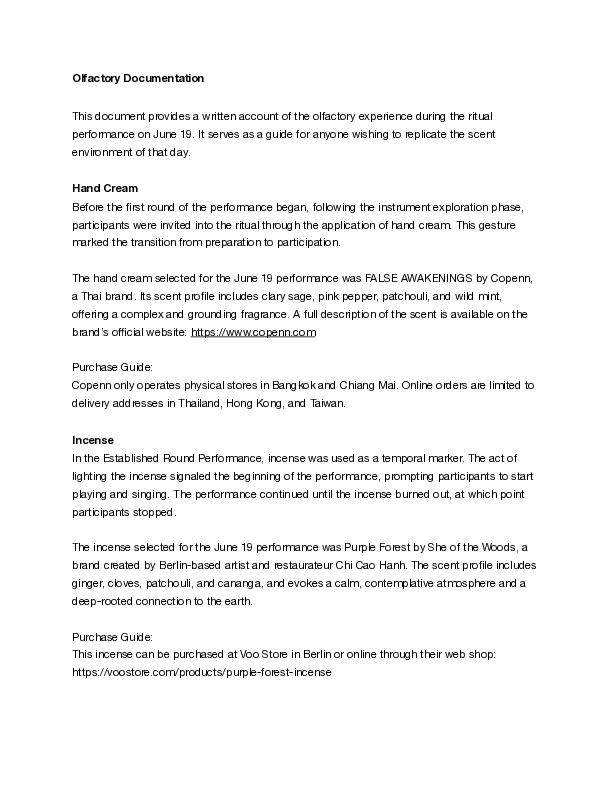
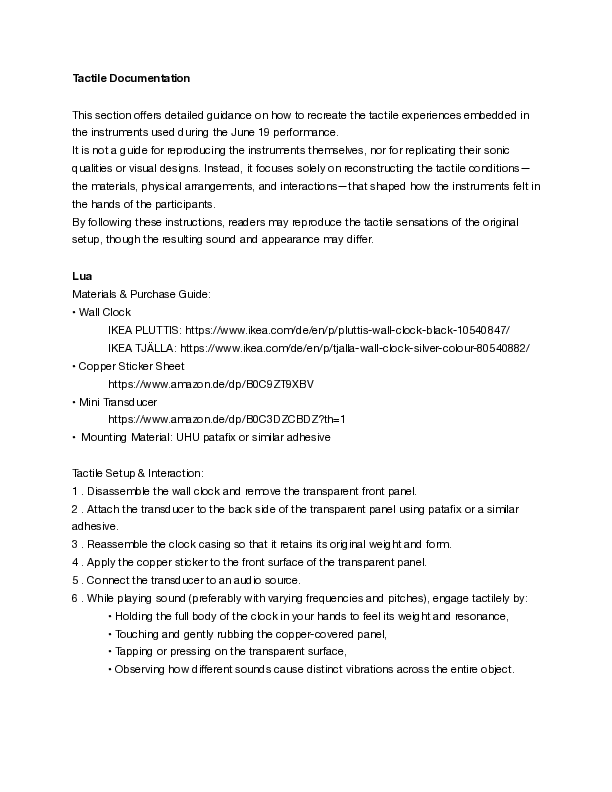
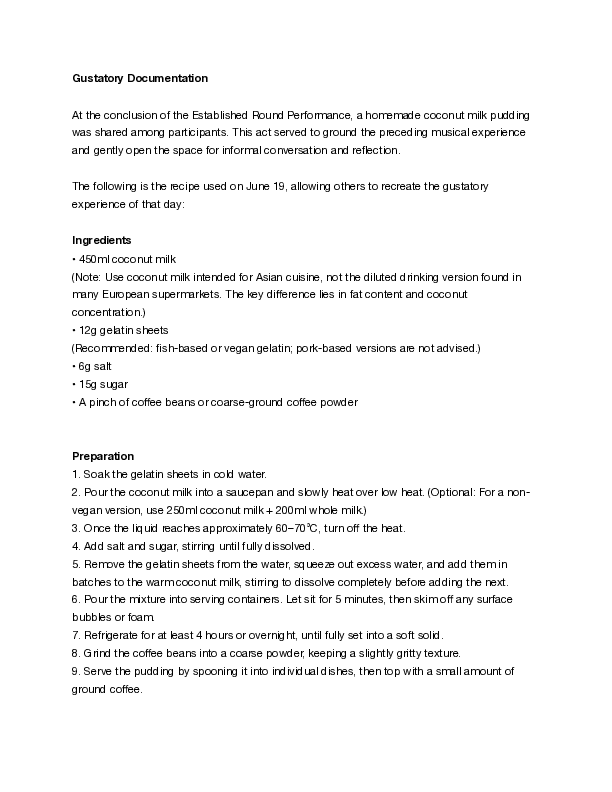
This new approach was based on the five senses. I divided documentation into two distinct parts:
• Visual and auditory elements were captured through a single static video recording, preserving an overall sense of space while minimizing authorial intervention.
• Smell, taste, and touch were documented through a separate text. This included: A description of the hand cream and incense used during the second phase of the ritual (smell); a recipe for the coconut pudding I prepared and served (taste); a material and fabrication guide for the instruments used (touch).
This method did not eliminate the problem of framing—but it redistributed attention. By recording and giving value to often-overlooked sensory dimensions, the documentation avoided reproducing the usual hierarchy that privileges vision and sound. It offered a different kind of decentralization, one that bypassed the expectation of spectacle and redirected presence toward the bodily, the ephemeral, the untranslatable.
It was not a perfect solution. But it gestured toward a practice of documentation that could remain in conversation with the ethics of the ritual—one that resists capture not by vanishing, but by dispersing.
Between Two Logics
The two documentation strategies explored in this project emerged from different urgencies, but they ultimately reflected parallel efforts to rethink what documentation could mean within a ritual context.
The community-based model was grounded in participatory ethics. It treated documentation as a continuation of shared authorship, aiming to redistribute power across filming, editing, viewing, and archiving. In contrast, the multi-sensory method prioritized experiential layering. It bypassed the visual-auditory hierarchy by attending to smell, taste, and touch, proposing an alternate form of decentralization—one rooted in the body, not control.
At first glance, the second method may seem like a contingency—an improvised solution to the logistical challenges of implementing the first. And in part, it was. But it also offered its own distinct insight: that decentralization can happen not only through collaboration, but also through plurality of perception.
What one method risked in coherence, the other risked in complexity. Each approach revealed different blind spots and different affordances. Rather than positioning them in opposition, I now understand them as complementary logics—two artistic responses to the same underlying problem: how to document without fixing, how to remember without enclosing.
The shift from one model to the other was not a failure, but an adaptation. It marked a movement from structure to sensation, from shared control to shared presence. And it reminded me that documentation, too, can be a space of performance.
As the final artifact of this project, a full version of the ritual performance was carried out on June 19, 2025, at Catalyst.
The following documentation aims to recreate the experience of this event through multiple sensory perspectives, with each section addressing a distinct mode of perception. A facilitating guide is also included, offering a structural overview of the performance that can be read alongside the video.
A separate section documents the DIY instruments used in the performance, offering a closer look at their material construction and roles within the final setup.
Visual and Auditory Documentation
A video file capturing the ritual performance’s visible and audible dimensions, including spatial layout, sound distribution, participant interaction, and overall sonic flow. This file is located in the Documentation folder under the name Video/Audio Documentation.m4v.
In addition, a Supplementary Material folder is included in the final submission. It contains the full-length, unedited video recordings of both rounds’ performance. These materials are provided for those who wish to review the complete performance in detail beyond the documentation excerpts included here.