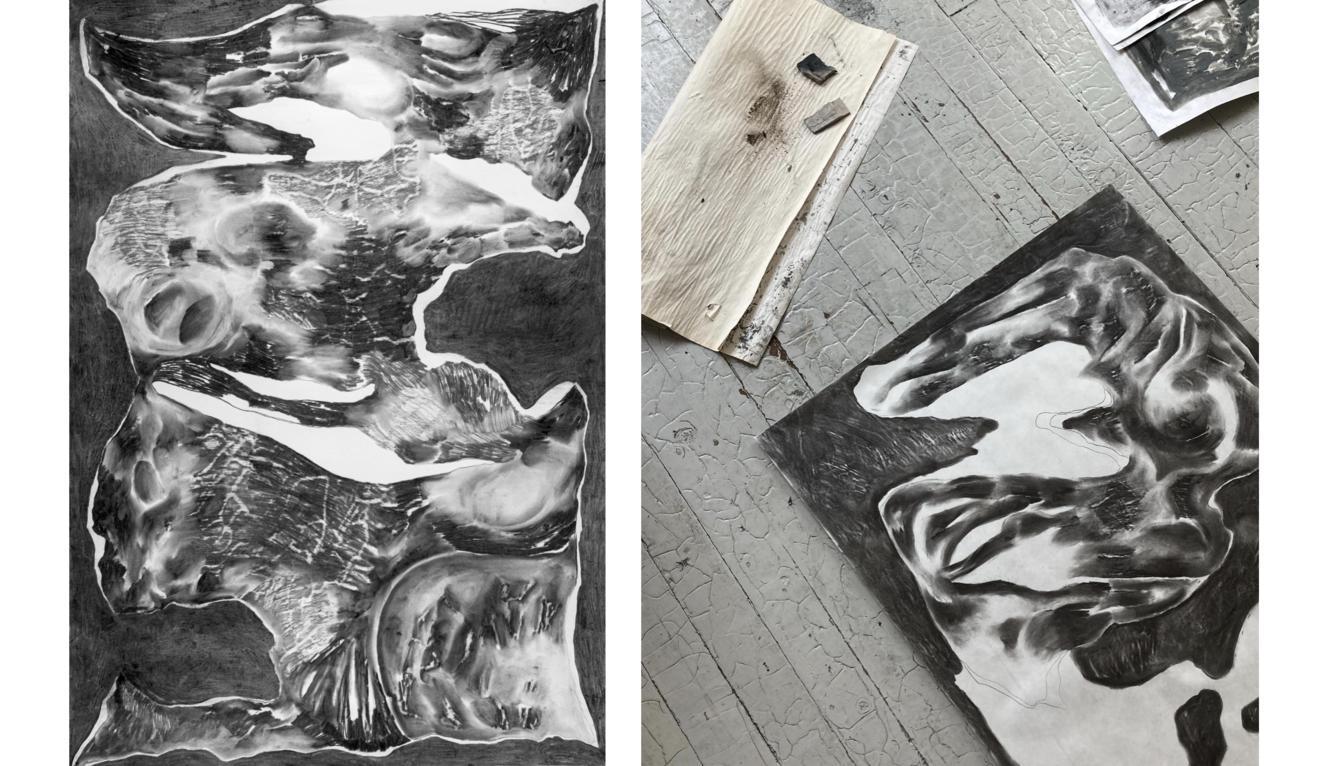
The chosen technological means (such as laser cutting of sheets, threading, or mold making) are not merely tools, but an active, creative language that shapes the formal vocabulary. In the following chapters, I will present several aspects that I have applied to my practice to follow up on the ideas and values expressed in the previous text.
The starting point of my project is a drawn representation of a landscape relief. The impulse to create fusion and landforming drawings emerged during an artistic residency at MUSTARINDA in Finland. It also builds on my previous installation …under the wheel of deformation (2022), where the motif of burdened landscape is further developed. The central theme is an analysis of the relief. It is an entity full of depressions, holes, and wetlands—elements that point to layering, erosion, and the dynamics of natural processes. A bird’s-eye perspective allows the landscape to be perceived as a structure composed of layers whose mutual interaction reflects transformations over time. It also shows their balance between weight and fragility, stability and impermanence.
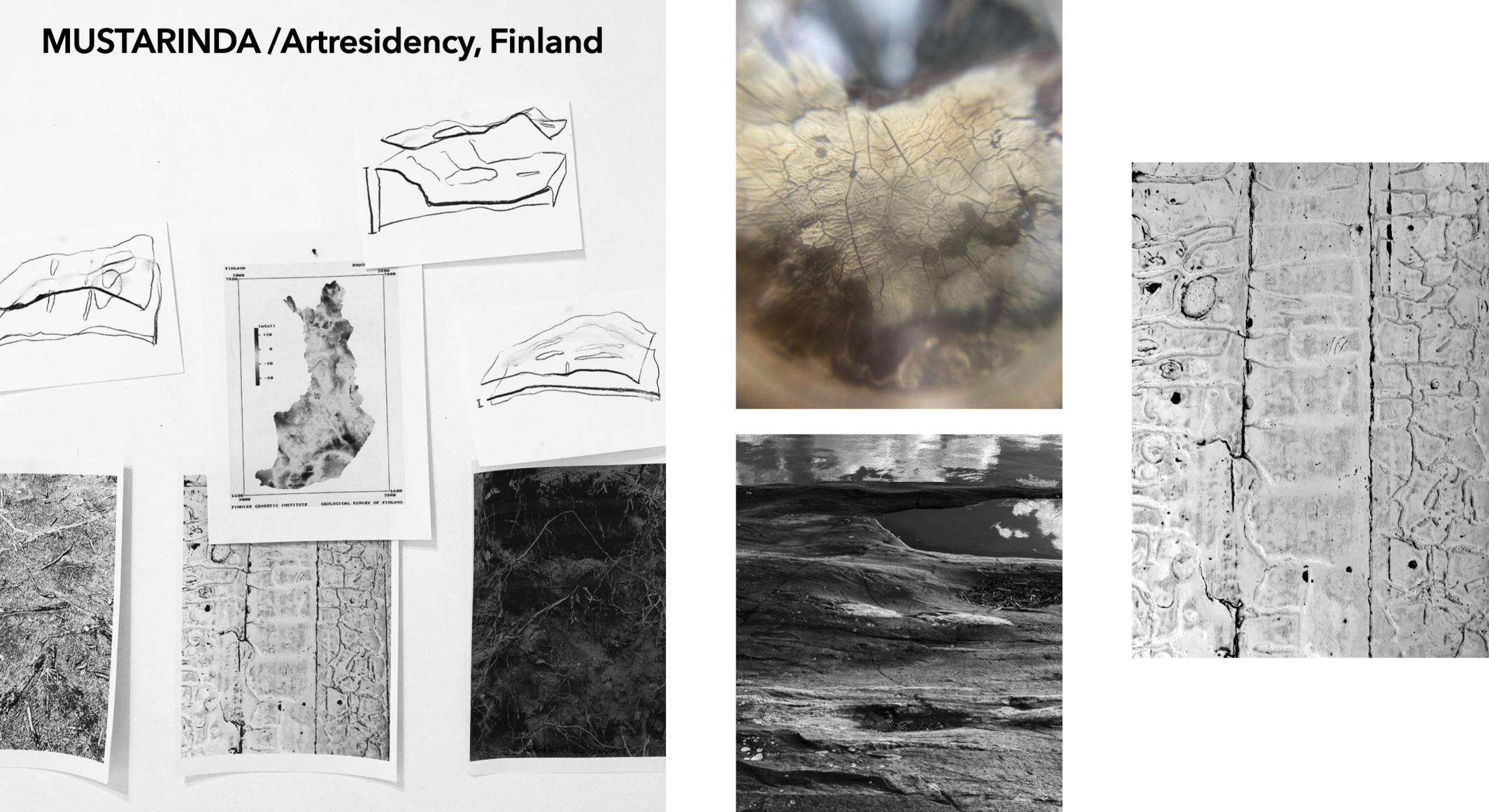
By reducing drawing principles to simple strokes, contour lines, and the negative spaces of holes emerge, capturing long-term processes of landscape transformation. They are approached systematically. Individual layers are decomposed, their fragility at the edges examined, and their stratified peaks are explored. Burden is understood not only in material terms, but also as a force acting upon both symbolic and physical structures. The hole becomes an embodiment of completed pressure, its presence no longer latent but definitive.
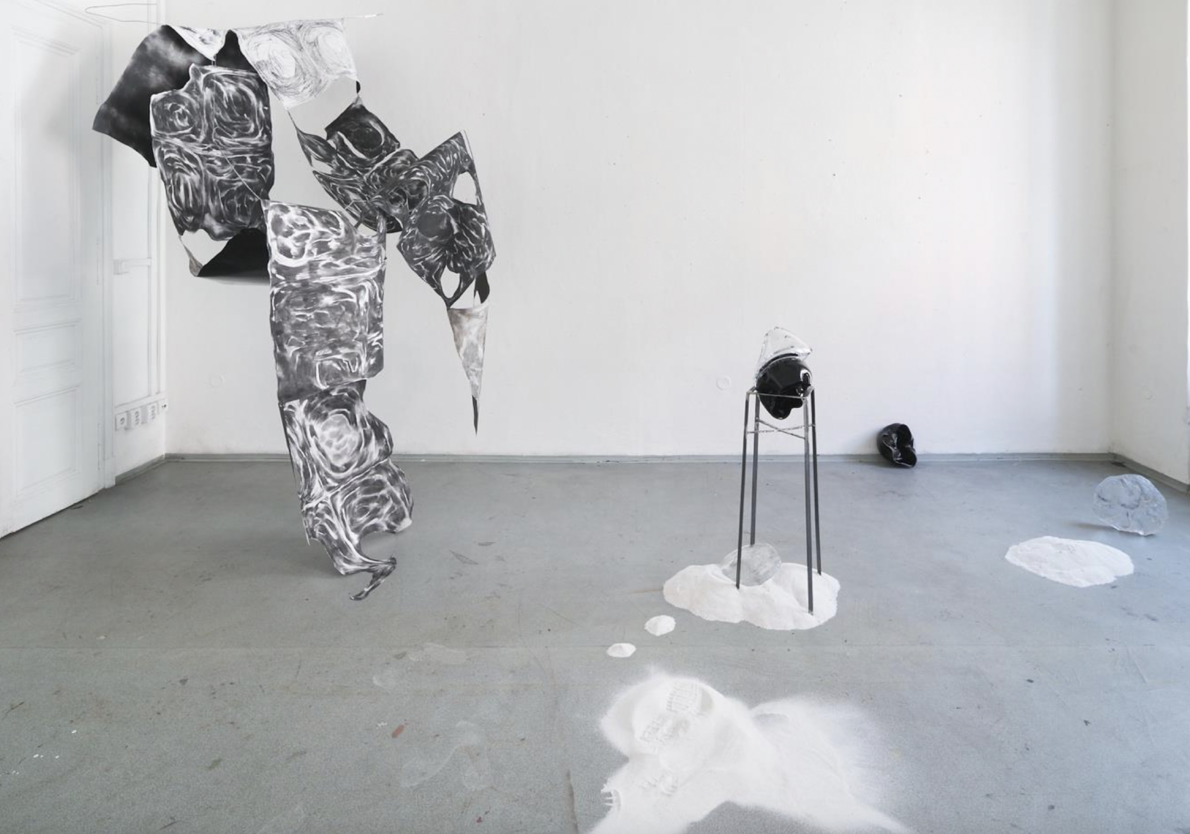
Metal, with its perceptible heaviness, is a key element in contrast to glass. It is weighing down its lightness. While glass is traditionally regarded as fragile, it also has the ability to record tension and imprints of pressure. At the same time, in the discourse of ecological burden, glass production is often criticized for its high energy consumption, which metaphorically weighs down the material itself. Here, it is treated as a medium that preserves traces of process—the imprints of form, pressure, and material reaction.