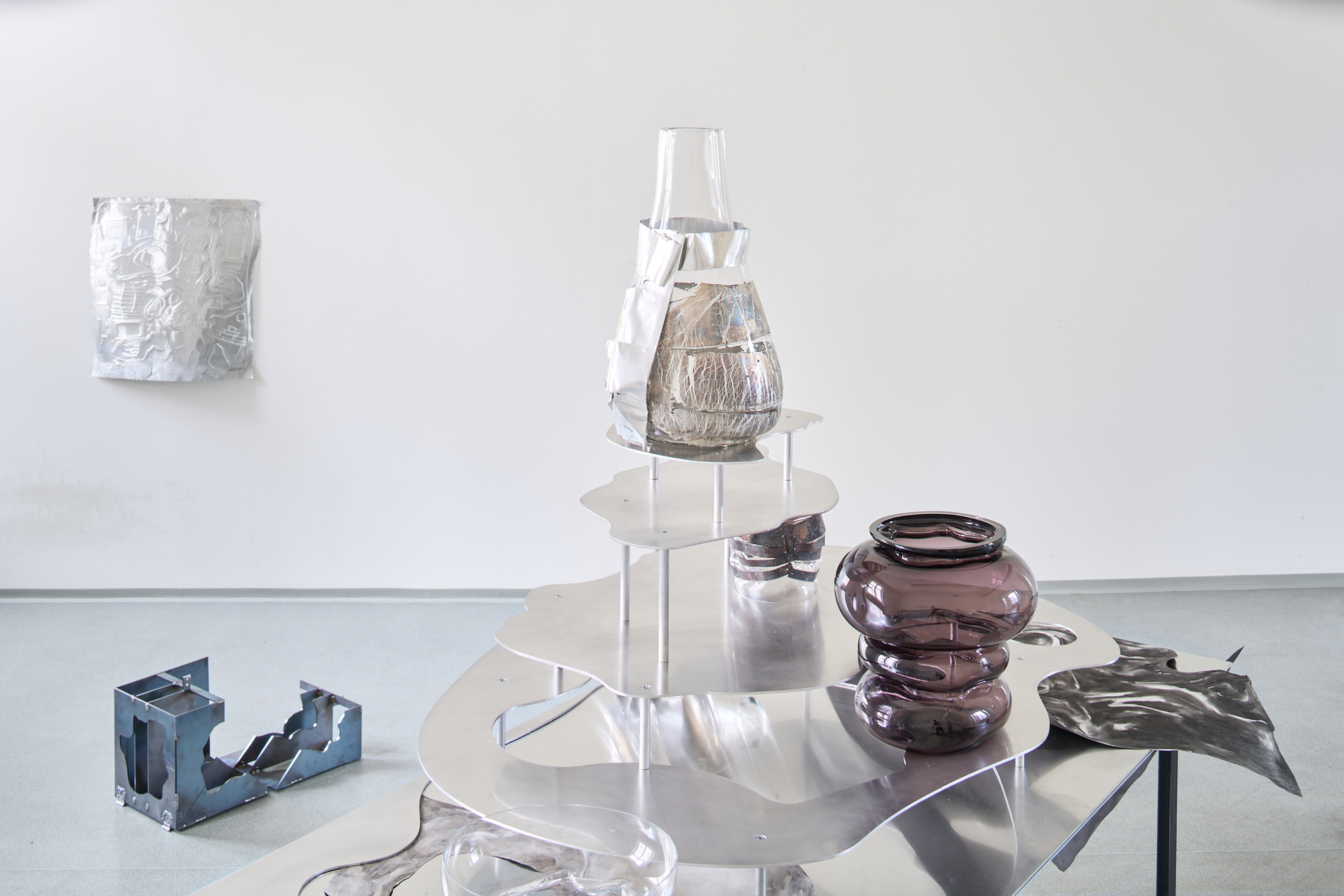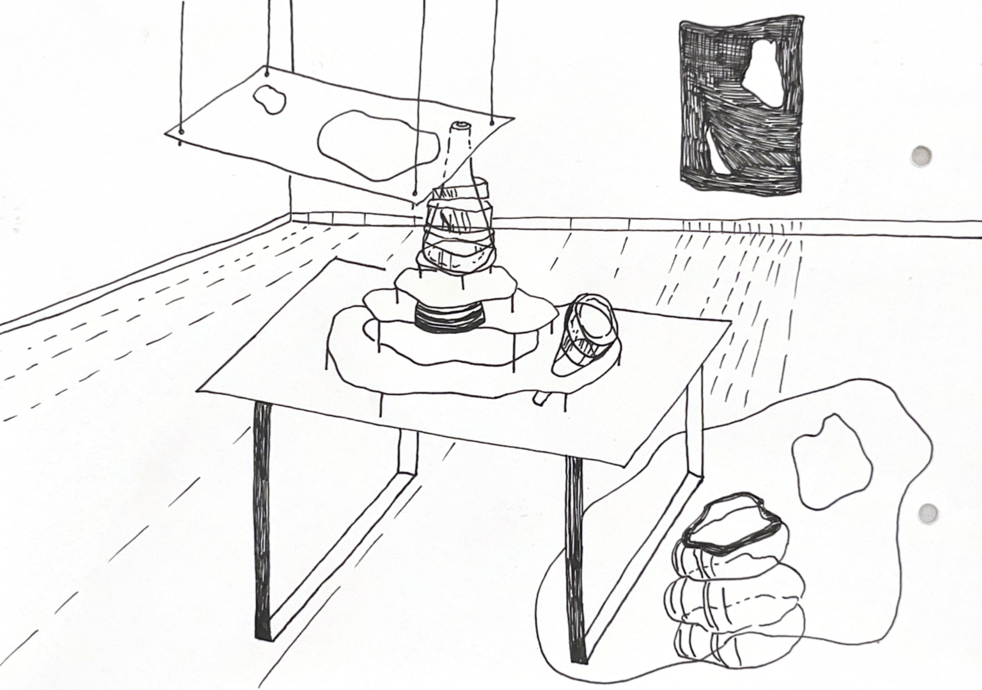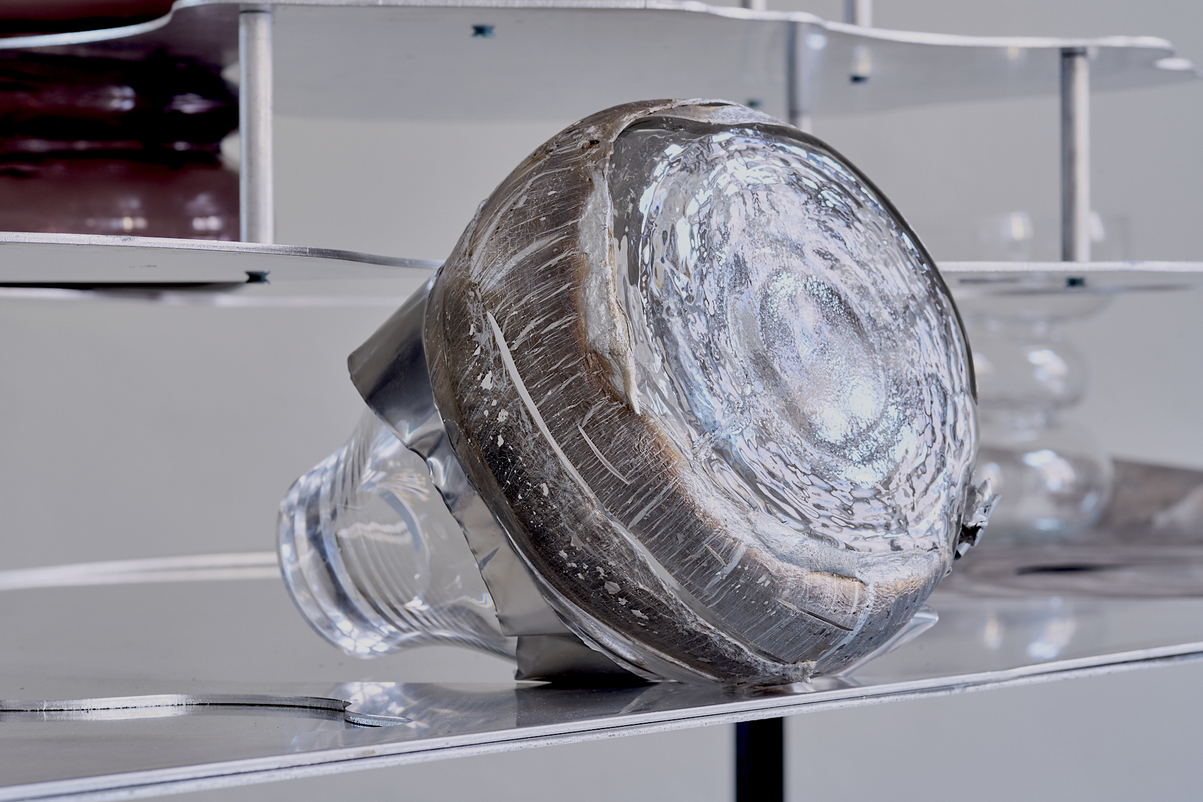
Looking back at The Arrangement of Objects, I see that it was about exploring intersections between functionality and aesthetics. The notion of load/burdens proved to be an interesting principle, as it can be read both physically and conceptually – as something that inscribes itself into the material as well as into the way the object functions. Grooves, depressions, or layers showed me that subtle interventions can shift the perception of the whole, and that the material itself can carry meaning if given the space.
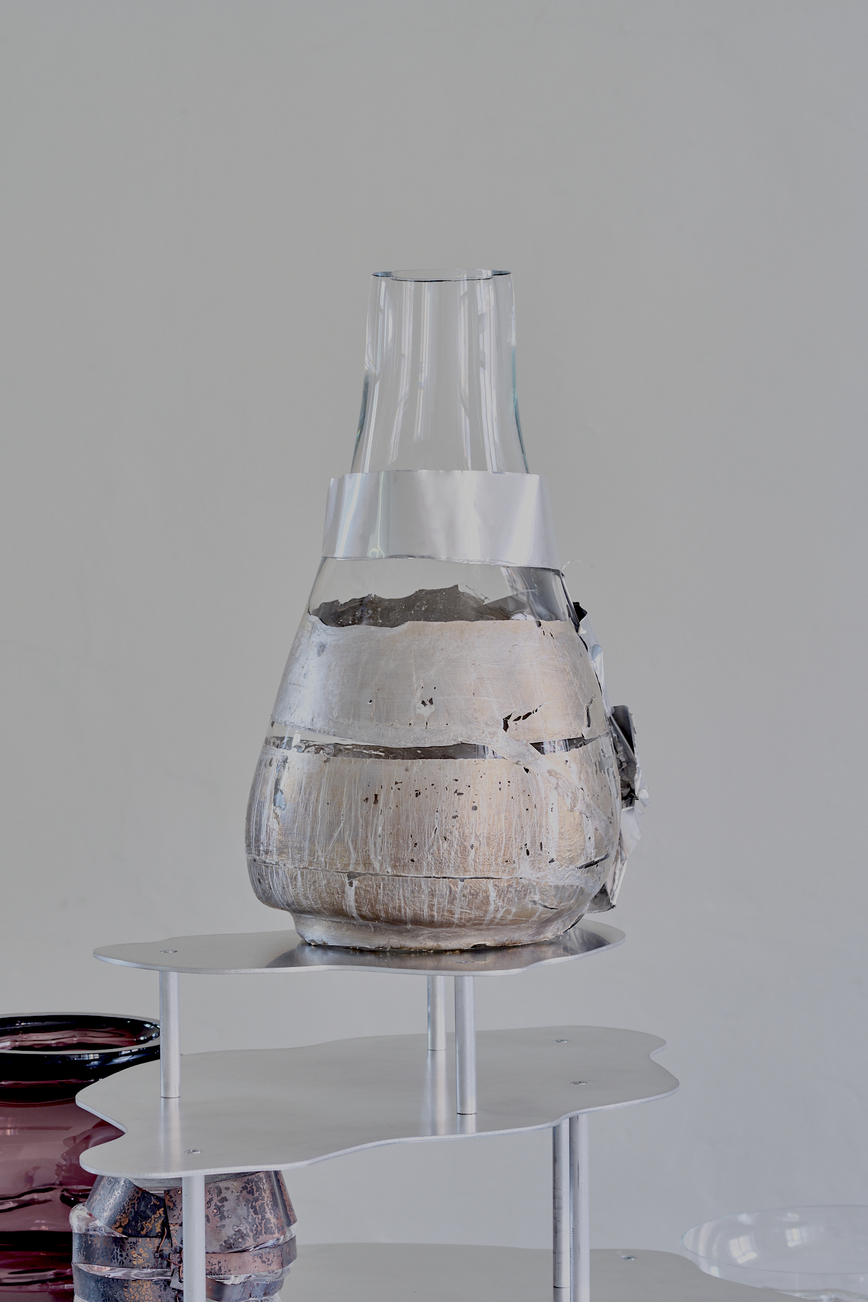
In my future work, I aim to engage more deeply with aluminum – to explore its formlessness and the ways it can intertwine with glass. I am curious about what happens when aluminum is immersed in glass, and conversely, how glass can capture its shape during blowing. I see this as a way to push the dialogue between materials further. I want to continue working with the planes of objects and their shifting perception, while also not being afraid to create an entire collection based on recurring principles of tension between materials and their inherent properties.
At the same time, my practice is a form of artistic research situated on the boundary between art and design. I am interested in objects that can function and at the same time act as artworks, where usefulness and concept are inseparable. These in-between positions – when a vase becomes a sculpture or a piece of furniture becomes an installation – enable me to explore the boundaries of art and design categories, and how they can overlap without compromising their essence.
The installation functions as the final articulation of the themes developed throughout the project. It embodies the concepts of burden, layering, and transformation, not only in the physical interplay between glass and metal but also in the broader symbolic framework that has guided the work. Here, all previously explored ideas converge: the tension between fragility and weight, transparency and opacity, stability and mutability, precision and chance.
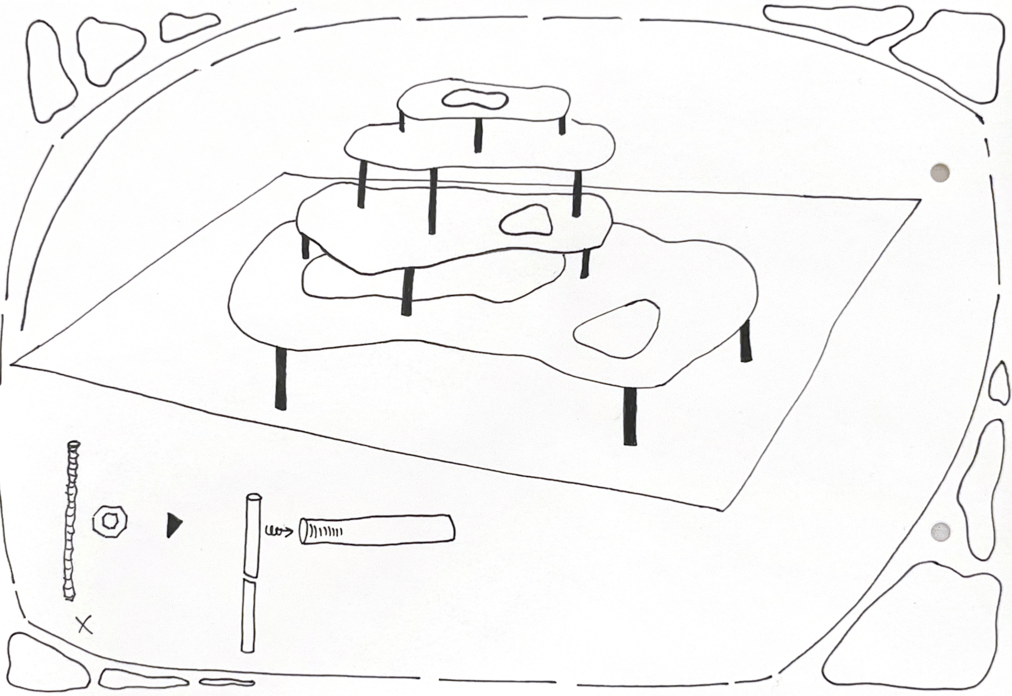
Glass and metal are no longer viewed as separate entities, but rather as interdependent agents within a single environment. The aluminum plates, shaped by contour lines and technological precision, provide structure, while the glass objects record moments of pressure, heat, and deformation. These contrasting materials, once considered opposites, converge in processes that reveal their shared vulnerability and capacity for transformation. Their dialogue is both chemical and physical, visual and conceptual, revealing the traces of time and transformation embedded within them.
The installation is conceived as a whole, not as a collection of isolated pieces, but as a living arrangement—a landscape model, where each fragment participates in a larger narrative of formation and erosion. It demonstrates how systematic research, design logic, and material experimentation can overlap with open-ended processes of unpredictability, yielding forms that are both rigorous and organic.
By uniting material research with conceptual inquiry, the installation closes the cycle of exploration. It holds together the contradictions of its elements: the stability of construction and the unpredictability of deformation, the lightness of glass and the density of metal, the permanence of form and the inevitability of change. What remains is not just a physical composition but an environment of relations.
In this sense, the installation also questions the constructed division between fine art and applied art. It shows that design principles and artistic approaches are not opposites, but overlapping languages that can reinforce and challenge one another within a single work.
As such, the installation can be read as both an ending and a beginning: a closure that gathers the project’s central motifs into a coherent form, and at the same time, a foundation for further reflection on how materials, processes, and concepts intertwine to create meaning.