This pedagogical study took place at Fundação Serralves in Porto, Portugal, over a single weekend. Participants — ranging in age from 25 to 50 — included community dance teachers, visual artists, curators, and dancers. Their shared condition was curiosity: a willingness to explore movement as a site of relation.
Planning a workshop of short duration with people who have never met is always a delicate task. It raises important pedagogical questions: How can we quickly build trust? How can a space feel safe enough for people to express themselves openly, yet daring enough to invite risk and creativity?
Workshop Design and Material
My selection of materials was guided by one main intention: to invite curiosity and care. Each exercise was designed to help participants become aware of themselves and others, to listen through the body, and to explore creativity through vulnerability and play.
The process unfolded through three main phases, each deepening the group’s relational fabric.
1. Circle Interviews
The workshop began with circle interviews. Sitting on the floor, each participant responded to two guiding questions:
-
What have you been interested in lately?
-
Which part of your body feels most present today?
Anyone could begin; there was no hierarchy or order. While one person spoke, another listened and wrote down their partner’s reflections. They then switched roles, creating an immediate exchange of attention, voice, and interpretation. These written fragments later became prompts for a private duet — dances performed only for one another, while the rest of the group witnessed silently.
This triadic system of Doer, Listener, and Witness established the ethical foundation of the workshop: a practice of attentiveness, reciprocity, and care. Listening became an act of composition, and witnessing became a form of participation.
2. Object-Based Warm-Up
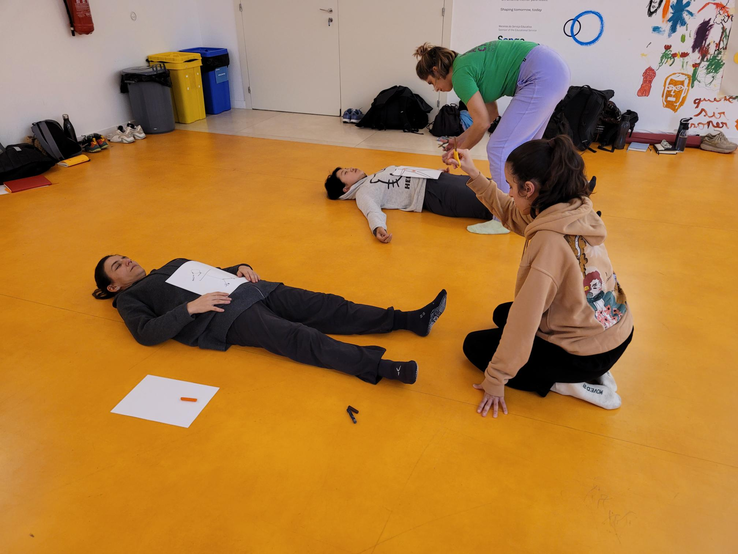
Next, we explored movement using a single, fragile object: an A4 sheet of white paper. Participants moved through the studio holding the paper against their body, trying not to let it fall or crease. The task was not to “dance with” the paper but to allow it to become a temporary part of the body — an extension, a partner, a reminder of fragility.
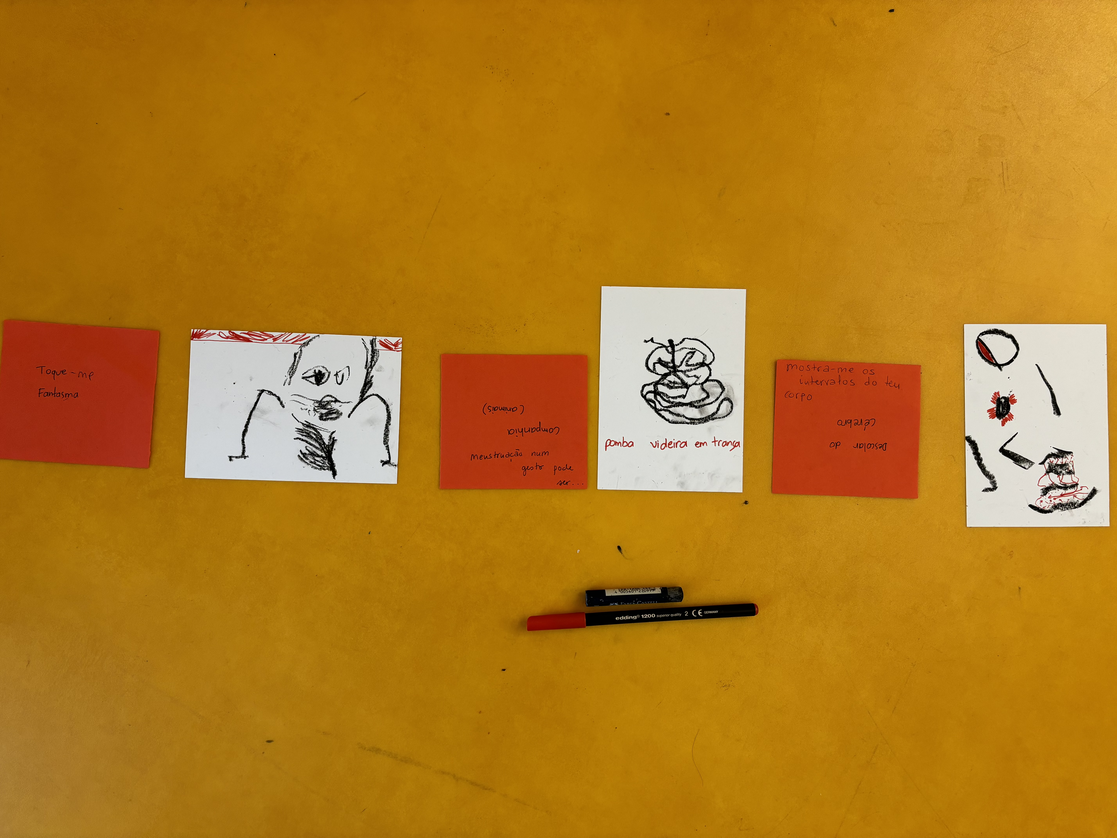
This warm-up encouraged a state of embodied awareness and relational sensitivity. The paper functioned as an in-between— a metaphor for the delicate connection between self and other, teacher and student, doing and observing. Later, these papers became healing scores, carrying drawings, words, and traces of the dances and conversations that followed.
Through this process, the group gradually expanded its collective energy — starting close in a circle, then moving outward into shared space. The exercises invited participants to experience how movement, attention, and care could generate a shared rhythm of becoming.
3. Pair and Group Work
Building on this foundation, participants worked in pairs and small groups. Together, they created short improvised compositions based on the earlier reflections and drawings. Negotiation, decision-making, and shared authorship became central to the process.
As the workshop progressed, I observed increasing playfulness and openness. Participants began to embody care through action — offering support, pausing to listen, making space for one another. Each hour brought new layers of trust.
The final task, which we called the surgery room and the magic ritual, combined healing and creation. Participants were invited to imagine the studio as a ritual space — a site for repair and transformation. Through guided improvisation, they worked with the themes of feeling more, belonging better, and imagining together.
By the end of the weekend, the group had formed a micro-community. A sense of collective becoming emerged — fluid, caring, and self-sustaining. The structure — from individual reflection to pair work to group performance — supported this evolution gently, creating space for safety and bravery to coexist.