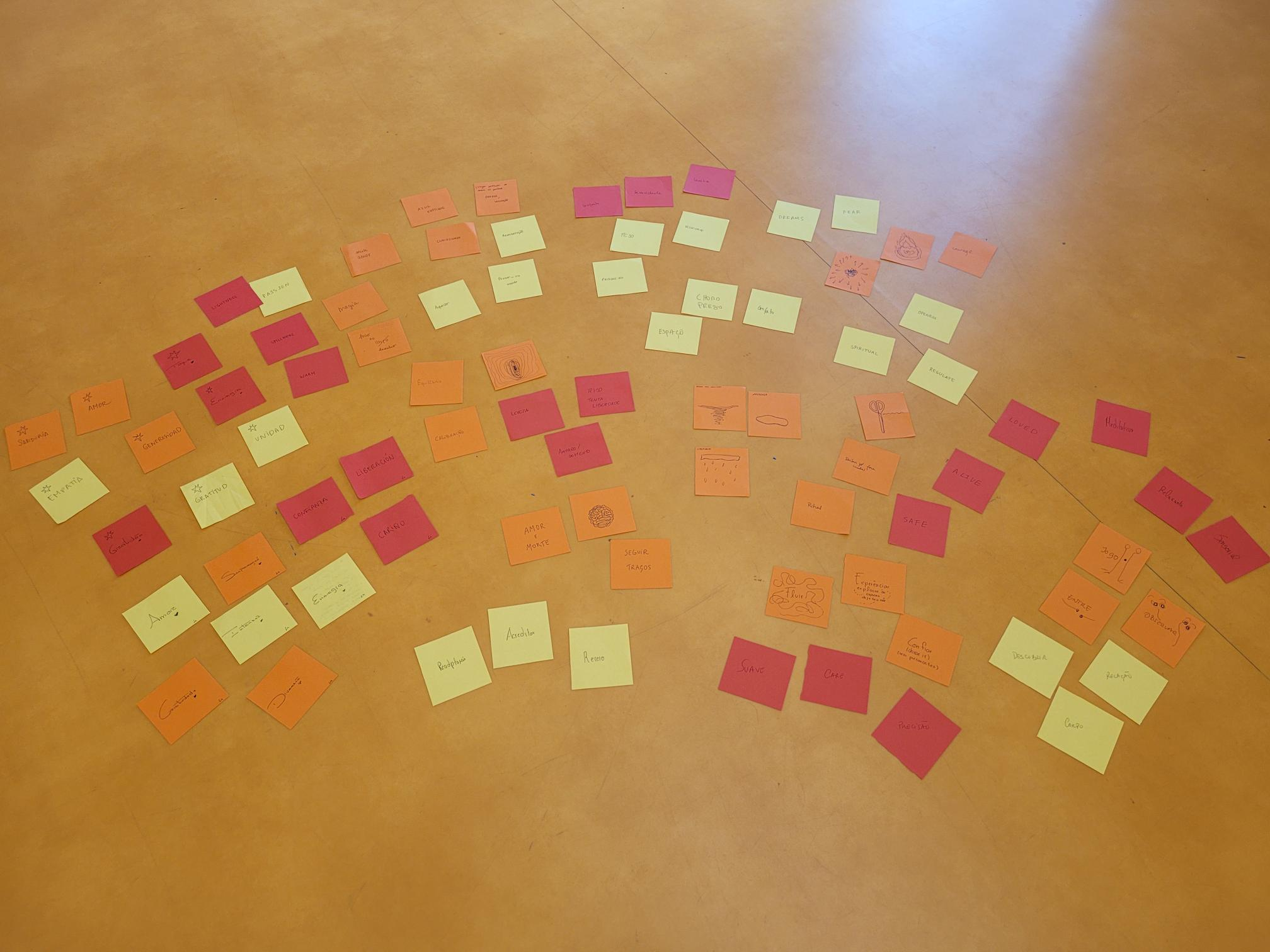
The purpose of this research was to explore how a short, co-created dance workshop could generate feelings of care, belonging, and non-hierarchical co-learning. Through a structure that began with circle interviews, progressed through object-based warm-ups and pair work, and concluded with group performative tasks, I aimed to investigate how these methods might support healing, agency, and collective creativity within a shared movement practice.
My findings suggest that creating spaces of shared vulnerability and participation can cultivate a sense of care and mutual respect within a temporary dance community. As participants engaged more deeply, the atmosphere evolved into one of warmth, openness, and curiosity. The methods seemed to encourage both personal expression and collective responsibility, demonstrating that non-hierarchical frameworks can foster creativity and belonging when participants feel trusted and listened to.
However, these outcomes were also shaped by my positionality as both facilitator and participant. My decision to engage in the tasks alongside the group allowed me to experience the process from within, deepening empathy and connection, but it also limited my ability to observe dynamics from a more analytical distance. I now wonder what alternative insights might have emerged had I stepped back to observe rather than participate. For example, I might have noticed more subtle power negotiations, emotional responses, or relational patterns that were less visible from inside the circle.
Critically, what I have left out in this process is a deeper examination of how external factors — such as participants’ previous dance experience, cultural background, or expectations — shaped their sense of belonging and comfort. Additionally, while I touched on decolonial and therapeutic perspectives, these could be explored more rigorously through comparative analysis with other facilitation models or by incorporating participant interviews or written reflections.
Moving forward, I could develop this inquiry by experimenting with a more distinct separation between facilitation and observation roles, or by involving participants as co-researchers in documenting their own experiences. Questions that arise include:
-
How can facilitators balance participation and observation in co-creative settings?
-
What forms of documentation best capture the emotional and relational dimensions of collective movement?
-
How can decolonial and care-centered practices be sustained beyond the temporary workshop space?
Ultimately, this research affirms that learning environments grounded in care, trust, and shared authorship have the potential to reshape how we understand teaching, learning, and community in dance. It invites an ongoing conversation about how structure, power, and vulnerability intersect — and how we might continue to reimagine dance education as a collaborative, healing, and transformative practice.
...
Viewed through an a/r/tographic lens, this study unfolds as a living inquiry — a choreography of relations, questions, and transformations. It does not aim to produce definitive answers but to trace movements of becoming that arise when art, pedagogy, and research intertwine.
The workshop demonstrated that non-hierarchical, relational pedagogies can create conditions of belonging and agency. Participants who were initially reserved became more expressive and playful, embodying the idea that learning can be both rigorous and tender. These outcomes affirm that co-creation and care are not opposites but complementary forces that sustain creative practice.
At the same time, I recognize the limitations of my dual position as facilitator and participant. Immersing myself in the process deepened empathy but reduced the distance needed for analytical observation. In a future iteration, I might alternate roles — guiding one session from within and another from the outside — to explore how proximity and distance shape understanding.
What remained unexamined were the influences of participants’ diverse cultural and pedagogical backgrounds. Their personal histories surely shaped how they entered the process, but this dimension would require further inquiry, perhaps through collaborative writing or post-workshop interviews.
A/R/Tography and Becoming
In a/r/tography, knowledge is not transmitted but emerges — in the in-between of doing and reflecting, teaching and learning. The concept of becoming, as articulated by Deleuze and Guattari (1987), describes the continuous transformation of identities and meanings through relation. This workshop functioned as a site of becoming: participants, facilitator, and tasks all changed one another through encounter.
As an a/r/tographer, I see teaching as a process of becoming-with — learning through entanglement rather than separation. This relational mode of inquiry resists hierarchical binaries (teacher/student, theory/practice, art/research) and invites a fluid, ethical co-existence. Each movement in the studio was both a gesture and a question: Who are we, together, as we move?
Toward a Pedagogy of Care and Imagination
The key insights from this study revolve around care, imagination, and relational agency.
-
Care emerges as both method and outcome: the way we attend to each other and the emotional texture that holds our work.
-
Imagination acts as a political and healing force, enabling participants to envision new possibilities of being together.
-
Relational agency describes how decisions, actions, and creations are shared rather than owned — a collective authorship that dissolves boundaries between roles.
In this sense, the dance studio becomes a rehearsal for the world: a temporary community where care, joy, and resistance can coexist. Teaching nearby becomes a radical act — an ethical stance that prioritizes presence over control, listening over instruction, and becoming over being.
Conclusion: The Continuum of Becoming
This project affirms that teaching and dancing are acts of ongoing becoming. They are never finished; they continue to unfold in the memories, sensations, and connections that remain. The workshop, like an a/r/tographic text, resists closure. It breathes. It moves. It asks to be returned to.
As I reflect on this study, I understand that what was created was not only a workshop but a temporary ecosystem of care — a place where knowledge danced, where imagination healed, and where we became-with one another.
The next iteration will undoubtedly take new form, but the essence remains: to teach is to co-create spaces where we can listen, move, and imagine into new ways of being together.
To dance is to think with the body;
to teach is to listen through movement;
to research is to stay open to transformation.
Together, they form a choreography of becoming — a living practice of art, care, and hope.