Ohn wanken kippen halten atmen
(last edited: 2026)
author(s): Lisa Hinterreithner
This exposition is in progress and its share status is: visible to all.
Ohn wanken kippen halten atmen is part of a multi-year practice by Lisa Hinterreithner and understands itself as an element in the development of performative and aesthetic processes around weakness. It approaches weakness as something wavering, hesitating, yielding, and as something that can only be encountered slowly.
At the beginning were conversations. Five colleagues and friends were interviewed individually for sixty minutes each in a semi-structured format. The artists, curators, and theorists engaged with the questions on weakness and weakening unprepared and spontaneously, for which we, Lisa Hinterreithner and Markus Gradwohl, are very grateful. The questions revolved around experiences of weakness: moments of exposure and hesitation, of dependence and refusal, of care, fatigue, and withdrawal. The participants form a cross-generational group who understand themselves as more or less privileged queer and non-queer Europeans.
The interviews took place, except for one, lying down, lounging, softly cushioned in a studio space. Most of them kept their eyes closed for long periods while speaking. Nobody cried. Sometimes there was laughter. There was always intense thinking and sensing. What was listened to were not only statements, but also pauses, corrections, detours, lingering on a word, and the breaking off of a thought. What emerged was not a unified picture, but sentences, vibrations, nuances, overlaps. From this, four loose areas condensed: somatic, psychic, social, spatial, not as categories, but as moving clouds.
The aim was neither a definition nor a typology. Rather, the focus was on how weakness is lived, spoken, circled around, and sometimes resisted. Scientific methodology and conclusive analysis were not foregrounded. We worked with a performative-research attentiveness and an interpretative-phenomenological stance. The question is less what weakness is, but more what it does.
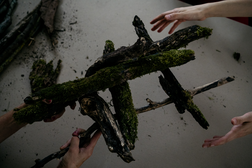
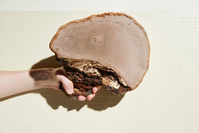
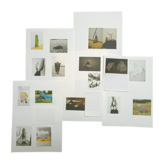
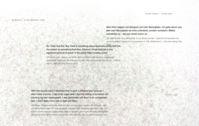
The presentation follows no linear argumentation. Texts drift, draw closer, move apart again. Images hover beneath them, colorful and permeable, without representing anything in particular. This slow, sometimes barely perceptible movement reflects an understanding of weakness that does not resolve quickly, that eludes grasp, and that remains in process. Not a result, but a condition: partial, situated, attentive.
This work presents only a fragment of the complex topic of weakness. It does not address institutions such as hospitals, nursing homes, or psychiatric facilities, nor weakness in the context of political persecution or racism.