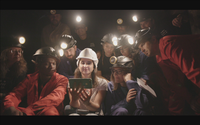
On 30 July 1984, 11 mercury miners locked down in the mines of Almadén (Ciudad Real, southern Spain) to protest against their precarious economic and social conditions. 650 metres deep inside the oldest and most productive mercury mines in world history, the miners endured the dark and contaminated galleries for 11 days and nights until their claims were addressed. As an emigrated local filmmaker, I come back to post-industrial Almadén in 2019 to make a documentary film about the mining strike. The premise is to find young locals willing to live inside the now-closed mines for 11 whole days in homage to the older miners and to recreate the experience of 1984, 35 years later. Apart from engaging our collective mining past, performing the form and duration of a previous workers strike, Encierro proposes the underground as a living and symbolic space to foster a series of conversations, encounters, and social and political propositions to reimagine Almadén, which rose from a mine shaft more than 2000 years ago, as ‘something else besides’ a mining town.
This exposition explores the potential of documentary film fieldwork to take on a different relationship to normal life that the same or similar events would have as ‘untransformed reality’ – a strike versus the reenactment of a strike – and its potential for activism and social transformation. I will also explore the use of the conditional tense in documentary; a speculative and hypothetical approach to reality sensitive to the ‘potentially’ real, the ‘possible’, and the ‘what if’ as modes of documentation. What happens when the forms of ‘documentary’ and ‘reenactment’ are exceeded, and act upon the world rather than only represent it?
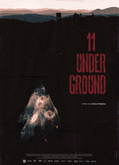
This exposition centres around the fieldwork and shooting process of my documentary feature film, 11 Underground (Chico Pereira, 2024). 11 Underground is a reenactment film project based on a mining strike that happened in Almadén in the summer of 1984, in which 11 miners locked themselves in at 650 meters underground to protest their precarious working and social conditions. After 11 days of enduring the dark and toxic underground galleries, the Almadén Mining Company finally accepted the miners’ claims and the miners came out of the dark hole, received as heroes by their neighbours. As a local filmmaker belonging to the first non-mining generation in over 2000 years, I thought of the premise of making a reenactment film in town: what if 11 people locked-in in the underground mine for 11 days now to pay homage to the 1984 strike? Out of this rather strange proposition there was a desire to create an event -partly social, partly artistic-, that could help to collectively reflect -or re-imagine- our present by reenacting a collective action from the past.
On the one hand, 11 Underground can be presented as a loose reenactment that reproduces the form and duration of a past strike: 11 people confined inside a mine for 11 whole days. On the other hand, the speculative character of this what if scenario (what would happen if..), opens these 11 days to the unexpected, to new actions and directions that might emerge from the implementation of that speculative scenario into the town’s present reality. The intrinsic relation of reenactment with the past, together with the future-oriented nature of what if scenarios -as ways of engaging creatively with possibilities- are, in fact, representative and metaphorical of the current situation of Almadén, which tries to construct a future from the remains of the mining past, while deeply struggling with the negative consequences of the lack of structural plans after the end of mining. Overall, the way this artistic research approaches reenactment is by using the historical referent (i.e. the past mining strike) as a documentary scenario and performing it in the current socio-political conditions, opening the possibility to intervene in the present and collectively imagine possibilities for a better future.