05 Precursors
Databases have shaped the way modern society manages and interprets information and have conceptual similarities to the contemporary latent spaces of AI systems. Artists have critically engaged with database structures as both a technical and a symbolic form to interrogate systems of power, information, and meaning. While relational databases enabled dynamic remix and retrieval of information, AI’s multidimensional latent spaces expand the scope for artistic and critical engagement.
Were we to stay closer to the Latin etymology and interpret intelligence as the faculty of selecting and linking relevant data (inter-legere), then computer science has reached that goal for quite some time.
(Laurent Dubreuil 2025)
Databases, defined as organised collections of structured information stored electronically, have become foundational to the management of data in modern society. The introduction of the relational database in the 1970s by IBM revolutionised how information was accessed, creating a system whereby users could retrieve data without having to understand the underlying architecture. By organising information into tables based on shared characteristics, relational databases led to exponential growth of the database industry in the 1990s, and marked the beginning of a new era, in which data played a central role in shaping governance and daily life. Also in the 1990s, studies on multimedia indexing and retrieval were being carried out, now considered to be a significant contributor to the development of emerging multimodal AI. Today, databases are ubiquitous, underpinning everything from banking to predicting the weather, and their influence permeates nearly every aspect of modern existence. In the current mass rollout of AI products, data is the lifeblood of many applications, and managing the vast amounts of it remains a critical concern for the corporate sector. Laurent Dubreuil asserts in Humanities in the Time of AI that models wouldn’t exist “without the records of the collective achievements of our species predating actual AI” (2025, 18). In art, relational databases allow for a poetic retrieval of records in the manner of a search engine (Manovich 2005), and from the 1990s onwards their use in art has been a key symbolic form representing the digital transformation of visual culture. As databases have become generally more pervasive, it is no surprise that artists have been interrogating them with critical thinking and creative approaches. Artists like Graham Harwood and Matsuko Yokokoji (YOHA) with their project Database Addiction (2015–2019), alongside others such as Julian Oliver, Nye Thompson, Jason Salavon, and Francis Hunger, have explored the structure and use of databases in their work. Francis Hunger characterises the database as “a decentralised, fragmented, potentially always combinable bio-power”, suggesting that databases not only store information but also interconnect it, allowing for constant reconfiguration according to user queries (Hunger 2017).
This concept introduces the idea of remix in relation to databases, where information is not static but can be perpetually rearranged and reinterpreted. The earlier adoption of the relational database by artists can be seen as a precursor to AI-enabled art. But where the relational database once offered dynamic, creative remix possibilities, the latent space of AI, supported by machine learning and computer vision, offers an extended and qualitatively different form of remix. Ric Allsopp, in the foreword to Sensualities/Textualities and Technologies: Writings of the Body in 21st-Century Performance, defines a text as anything that can be read, from gestures and drawings to dance and poetry. He describes “textuality” as the process through which these texts are interpreted (2009, xii). According to Allsopp, poets exist within both language and various modes of textuality, not as operators in a control centre but as participants within an environment, an environment he identifies as technological. Within this technological framework, bodies are envisioned as “writing themselves”. He argues that, much like our experience of inhabiting bodies, our understanding of the world is shaped by the technological means through which we engage with it (2009, xiii). In this context, technology acts as a mediator to what Bernard Stiegler calls “the already there” (1998, 36), a Heideggerian concept referring to the philosophical challenge of engaging with a pre-existing world, that human experience and understanding are always shaped by pre-existing contexts, backgrounds, and knowledge. Stiegler argues that distinct historical periods are defined by the specific technical conditions through which we engage with “the already there”. Both the relational database and AI latent space, with their capacity to store, access, and connect diverse types of structured information across thresholds, serve as analogues of “the already there”. They embody the potential to navigate and reconfigure pre-existing knowledge structures, offering insights into how disparate pieces of information can be interconnected and shaped. However, the multidimensional nature of AI latent space allows it to represent and connect information in ways that are complex, with more connotation than the relatively flat structure of a relational database. This offers greater conceptual scope for artistic intervention and makes it a more powerful and evocative analogy for exploring how pre-structured contexts shape and transform the ways we interact with and interpret the networked world.
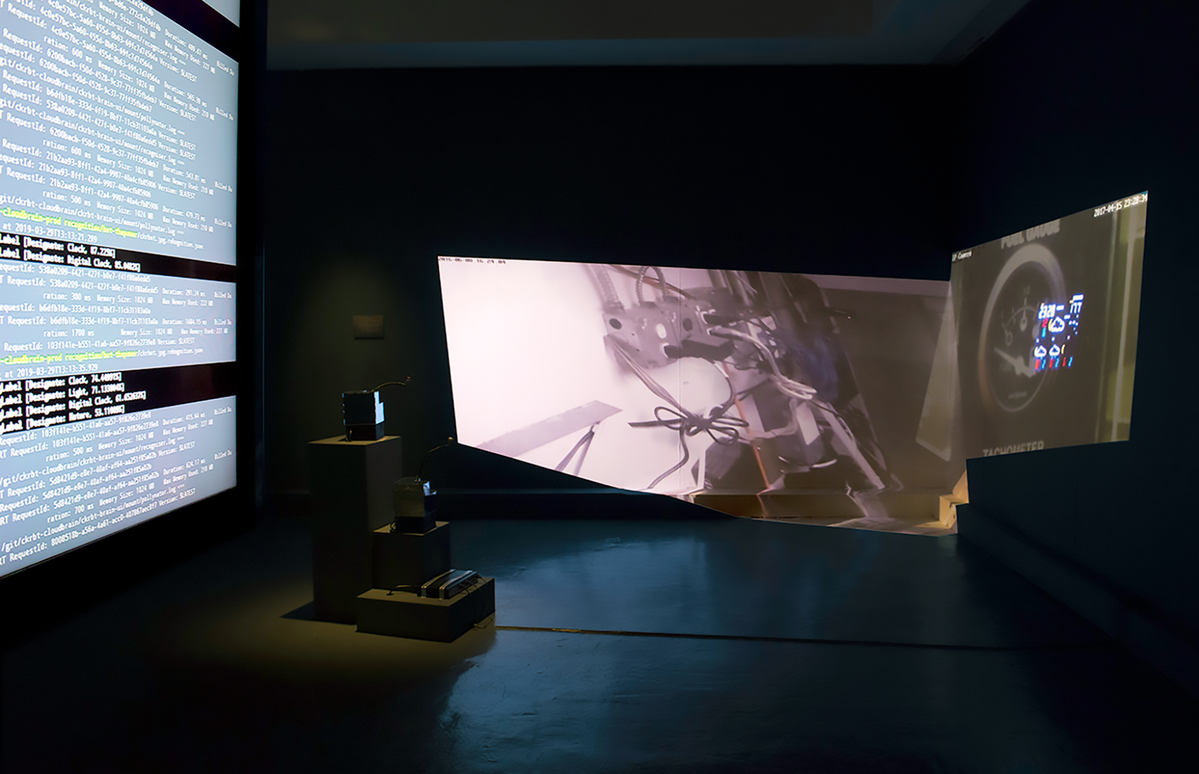
Figure 5. Nye Thompson, CKRBT, 2019. Installation photo, Watermans Gallery, London. https://nyethompson.net/works/the-seeker-ckrbt.html.
Copyright: Thompson, Nye. Courtesy Nye Thompson.
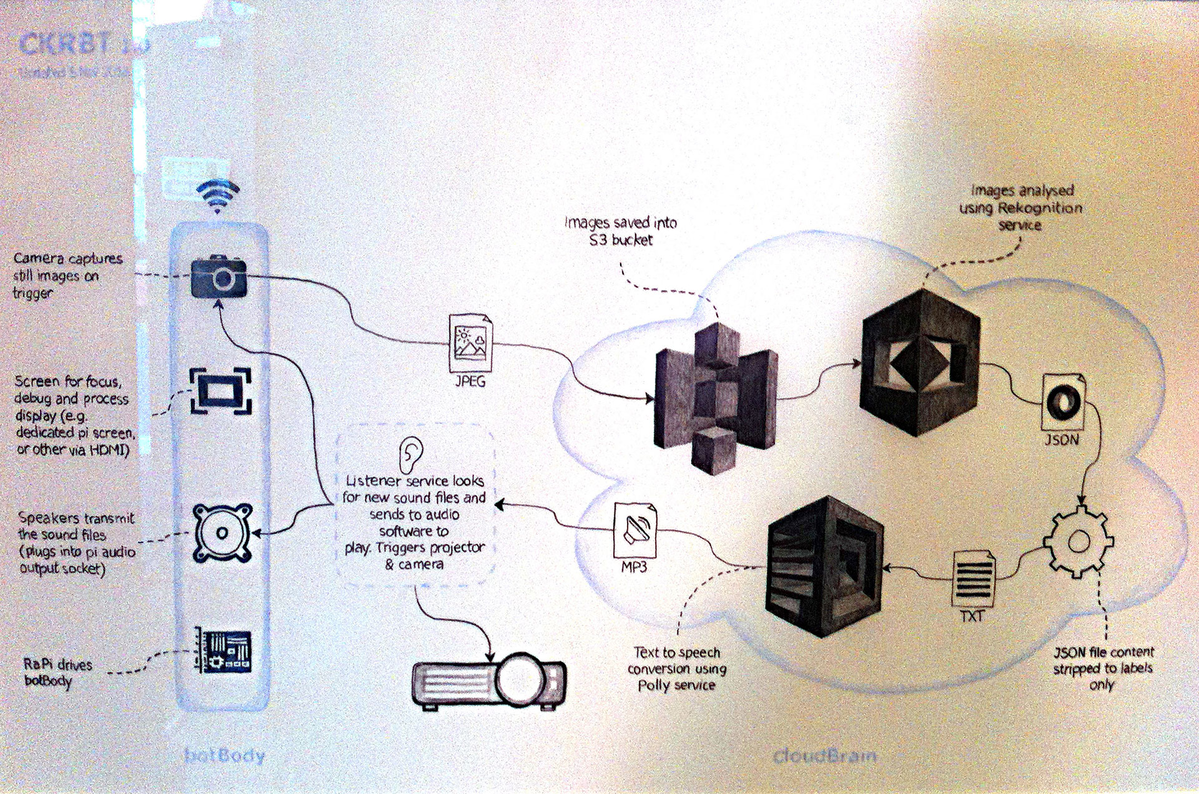
As an example of an artist utilising database structures in an artwork, Nye Thompson’s CKRBT (fig. 5) can be understood as an assemblage of interacting components and processes spanning a local area network (LAN) in the gallery and Amazon Web Services (AWS) (fig. 6), a cloud computing platform providing access to computers and software services throughout the internet.