The Collaborative Lab
In artistic research processes, collaborative experimentation offers a way to get “under the skin of things to see how they tick from the inside” (Maharaj, cited in Laws, 2019, p. 92). Open, shared experimentation—combined with documentation that allows for capturing and categorizing thought processes afterward—is central. Karin Hellquist, who engaged in several similar composer collaborations during her doctoral project, beautifully described it as “suggesting-by-doing or imagining-by-doing,” where her role as a musician becomes to “pour knowledge and imagination into the work” (Hellquist, 2024). In the lab that Ida Lundén and I shared, we both contributed our experiences and imaginations in a cycle that was just the right balance of structured and free.
Data Collection Methods
Video Stimulated Recall
Educational psychologist Benjamin Bloom used audio recordings in 1953 to capture university students’ thought processes in his research. This became the seed of a research method that originated in an educational context and is now used in social, pedagogical, and artistic research. James Calderhead (1981) further developed the method by incorporating video recordings in his studies of teaching situations. In linguistics, the method functions “as a subset of introspective research methods, in which the researcher accesses the informants’ own interpretations of his or her mental processes” (Mackey & Gass, 2005, p. 203). In violinist Peter Spissky’s dissertation, stimulated recall is described as “participating without the risk of forgetting, or observing without assuming” (Spissky, 2017). It is also part of autoethnographic methods for reflecting on one’s own playing in retrospect.
Research Design
This research project began in autumn 2023 and concluded in 2025. Ida Lundén and I initiated a series of regular workshops. We began by visiting Västanå Teater and their production “En saga om en Saga”, based on Selma Lagerlöf’s short story collection of the same name. This allowed us to observe how true experts in Värmland storytelling work and nourished our discussions and experiments. It led to many questions that needed follow-up, and I had the opportunity to interview Leif Stinnerbom, artistic director of Västanå Teater.
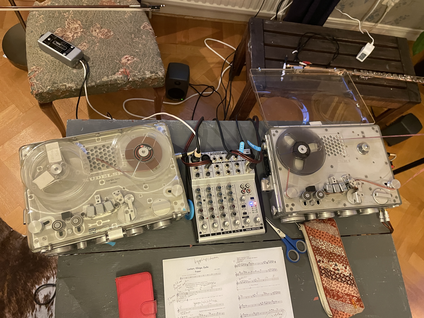
During our lab sessions, Ida and I developed a set of principles that we believed would guide the entire process. We wrote, talked, improvised, discarded ideas, and even tried using a talk box with the flute (which didn’t work very well). We concluded that analog technologies would be an important element in the upcoming piece and instead experimented with reel-to-reel tape recorders. We found an interesting archival recording to focus our listening on (ISOF, 1958). The voice belonged to Karin Turesson from Gunnarskog.
While listening to Karin’s voice, we repeatedly tried to have Sibelius and other software transcribe the voice into notation, but ultimately decided that this wasn’t particularly meaningful for this project. Instead, we let our ears guide us toward a modus that we believe reflects Karin’s personal vocal style. In the final phase, Ida composed the piece.
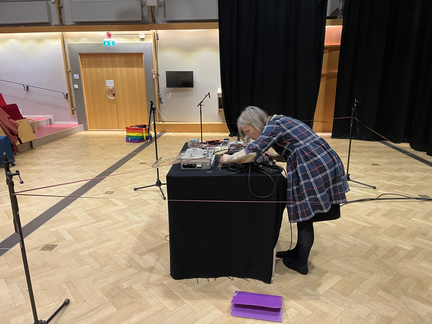
It was “test-performed” for the faculty at Ingesund School of Music in January 2024 and received minor revisions afterward. The premiere took place at Atalante in Gothenburg in February 2024, as part of a composer portrait of Ida’s music. Ida herself performed the tape part, and I performed the flute part. In April 2025, in connection with the premiere of another composer collaboration, Locken, Lillinga, Gulla was performed a second time, this time with Daniel Berg on the tape part.
Language, Speech, and Music
The connections between language and music have intrigued both composers and researchers for centuries. Temperley (2022) provides an overview of these links, beginning with the music theorist Mattheson’s Der vollkommene Capellmeister from 1739, which is based on rhetoric. The overview also includes modern studies that examine similarities and differences between language and music. It is clarified that a fundamental similarity between the two is that both are “designed to persuade, not simply to convey information in an objective manner” (Temperley, 2022, p. 167).
According to Temperley (2022), repetition is one of the aspects that unites the two expressive forms—language and music. In conversation, we tend to use repetition as a way to express agreement or questioning. The phenomenon of repeating recently heard linguistic patterns is called “syntactic priming” and usually occurs unintentionally and without our awareness (Temperley, 2022, p. 164). Repetition also plays an important role in classical rhetoric, often involving the reuse of words and phrases—as in Martin Luther King’s famous speech “I have a dream” (Temperley, 2022, p. 164). In such cases, repetition serves as a means for the speaker to establish emotional engagement and authenticity, while also evoking emotion in the listener. Temperley argues that these linguistic forms of repetition, and many others, are also present in musical structures (Temperley, 2019). In music, repetition often functions as reinforcement. At the structural level, the A-B-A form is common in nearly all types of music, where the A section appears twice. Or the entire “call and response” model from folk singing.
Furthermore, Diana Deutsch discovered a fascinating connection between speech and music concerning how we perceive whether a voice is speaking or singing. When a short spoken sentence is repeated several times, it transforms into song to our human ears—precisely through repetition. This phenomenon was named the Speech-to-Song Illusion (Deutsch, 2019).
In Locken, Lillinga, Gulla, a voice from an older archival recording (ISOF, 1958) is used as central material in the composition. In this way, Ida Lundén’s work joins a fairly extensive series of musical works that incorporate (recorded) spoken voice. For example, Peter Ablinger’s extensive work series Voices and Piano(2021), where well-known historical voices become part of the composition, and the piano part mirrors or clones the voice part. This makes the spoken voice sound as if it is being sung, and Ablinger even refers to Voices and Piano as a song cycle. Interestingly, Ablinger himself states that the piano part does not accompany the voice, but rather compares or competes with it:
I like to think about Voices and Piano as my song-cycle, though nobody is singing in it: the voices are all spoken statements from speeches, interviews or readings. And the piano is not really accompanying the voices: the relation of the two is more a competition or comparison. Speech and music is compared. We can also say: reality and perception. Reality/speech is continuous, perception/music is a grid which tries to approach the first. Actually the piano part is the temporal and spectral scan of the respective voice, something like a coarse gridded photograph. Actually the piano part is the analysis of the voice. Music analyses reality. (Ablinger, 2021)
So, according to Ablinger, the piano part constitutes a kind of analysis of the voice. This is, of course, a composer’s and artist’s reasoning, but it is also how I would like to view the relationship between the flute part and Karin’s voice in Ida’s work.
Steve Reich also composed his iconic string quartet Different Trains (1988) based on pre-recorded voices. In a similar way—though perhaps more from a jazz perspective—short videos occasionally appear in my social media feed where pianists harmonize and accompany a recorded voice, for example, of Donald Trump or Barack Obama. This is also noted by Oore (2021), who compiled a YouTube playlist with over 347 music videos, many of which use Trump’s “idiotsyncratic [!] speech patterns as source material for musical compositions” (d’Eon et al., 2021, p. 256).
The intersections between language and music have intrigued many throughout history (Temperley 2022), and in this exposition, the focus is on the connections between oral storytelling in dialect and musical interpretation.
Ann Elkjär is a flautist and doctoral candidate in musical performance, and her doctoral project explores a curiosity about the reflective spaces that open up in the in-between areas of language and music. This exploration takes place, among other ways, through collaborations with composers. This exposition presents the collaborative composition process between Ann Elkjär and composer Ida Lundén. Archival recordings of storytelling in the Värmland dialect form a central material, where fragments of an older storyteller’s voice are processed and played back on reel-to-reel tape recorders in dialogue with the solo flute part. The tape recorders allow for the creation of loops, which are also reflected in the flute part. In this way, Locken, lillinga, Gulla for flute and objects explores how elements of oral storytelling can be transformed into musical material.
The materials analyzed in the exposition include:
- An archival recording of storytelling in the Värmland dialect – with Karin Turesson from Gunnarskog
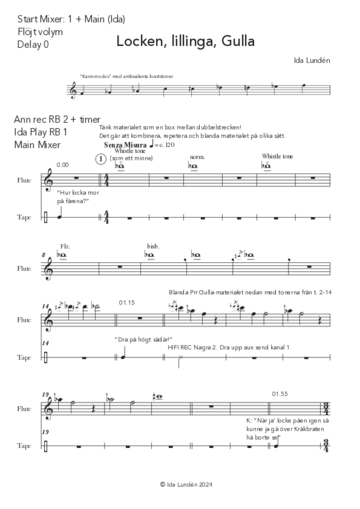
- The completed score for Locken, Lillinga, Gulla
- Concert documentation from the premiere performance
- Concert documentation from a performance at Ingesund School of Music
- Video documentation and logbooks from the process
The project was made possible through funding from the Helge Ax:son Johnson Foundation and the Reijmer Foundation.
Video from first performance, live at Atalante, Gothenburg
February 24th 2024
Ann Elkjär, flute
Ida Lundén, objects
Aims and Research Questions
The artistic research project aims to explore musical elements in oral storytelling, with particular attention to prosody and dialectal features drawn from archival recordings, thereby developing new tools for musical interpretation and creation. The research questions guiding the project are:
What musical elements can be found in oral, dialectal storytelling, and how can these be transformed into compositional and interpretative tools?
Previous Research
In an earlier project (Elkjär, in peer review), an archival recording featuring a storyteller from Värmland was analyzed. Wilhelm Larsson was one of many Swedish voices recorded in the 1950s as part of folklorists’ efforts to preserve dialects and memories for future generations (ISOF, 2025). Wilhelm Larsson’s melodic voice and expressive storytelling were compiled and analyzed through a number of rhetorical figures. These rhetorical figures were then used in the interpretive process of Luciano Berio’s Sequenza I from 1956, a classic modernist work for solo flute. Sequenza I carries connotations of theater and opera (Anderson, 2004), but many flutists tend to perform the piece monotonously and aggressively (Dick, 2024). It is a challenging piece to learn, technically demanding for the flute, and exists in two different editions: a more graphic version from 1958 and one in “standard notation” from 1992.
By interpreting Sequenza I using the rhetorical figures found in Wilhelm Larsson’s storytelling, I was able to discover a more sincere and authentic approach (Elkjær, in peer review). The musical rhetoric provided me with more tools for interpretation, and I believe the exploration led to a bolder performance (Elkjär, in peer review). There are many storytelling traditions that could have been used to interpret Sequenza I, and a more logical choice might have been an Italian one. But the project was specifically about reclaiming the freedom in the process of shaping musical works—not viewing the musician’s role as a transparent medium for the composer’s presumed intentions (Leech-Wilkinson, 2020). That’s why I turned to the Värmland storytelling tradition, which I’ve listened to since childhood and which felt both natural and authentic.