MAIN ABSTRACT INTRODUCTION FIELDWORK METHODOLOGY REFLECTIONS RESULTS ACKNOWLEDGEMENT __________________________________________________________________________________________________________________________________________
This section of the presentation will showcase a year-long fieldwork practice conducted across the two main regions studied in this research: Norway and Sardinia.
In addition, I will compile various materials—videos, photographs, and written reflections—linked to the fieldwork, demonstrating how I have experienced and engaged with this research journey.
Today, September 13, I attended my first folk music dance event in Bergen, held at Gimle, marking an important starting-step in my ethnographic and artistic exploration of Nordic folk traditions. Participating in this event allowed me to engage directly with the embodied practices of folk culture, which are often inseparable from musical expression. Experiencing the dances firsthand gave me insight into how rhythm, movement, and communal interaction intertwine to produce a living, breathing musical culture.
I had the opportunity to dance with Fanny Ludescher, a Swiss-Austrian-Norwegian flutist based in Bergen. Ludescher led many of the dances we performed together, and through her guidance, I was able to learn several steps and movement patterns. This was particularly valuable because, as a drummer, my body tends to be relatively stiff and conditioned by percussive habits. Engaging with these dance forms required me to adapt my physicality, emphasizing fluidity, responsiveness, and a more holistic sense of rhythm that extends beyond the drum kit. In doing so, I began to understand how musicality is not solely auditory but also deeply kinesthetic, shaping and being shaped by the body in motion.
This intersection of music, movement, and possibly symbolic expression suggests a complex communicative layer within folk performance that deserves closer analysis. As a starting point, this performance offers rich material for both ethnographic reflection and artistic inspiration, reinforcing the importance of approaching folk traditions as multi-sensory, embodied practices rather than purely sonic phenomena. Overall, this initial field experience in Bergen underscores the value of immersive participation in understanding folk music traditions. It highlights the ways in which dance, physicality, and musical rhythm are interdependent, offering valuable insights to inform both my research methodology and my creative practice as I seek to merge Sardinian and Norwegian musical idioms in future compositions.
11 October 2024, 12:45 PM – My Office, Third Floor
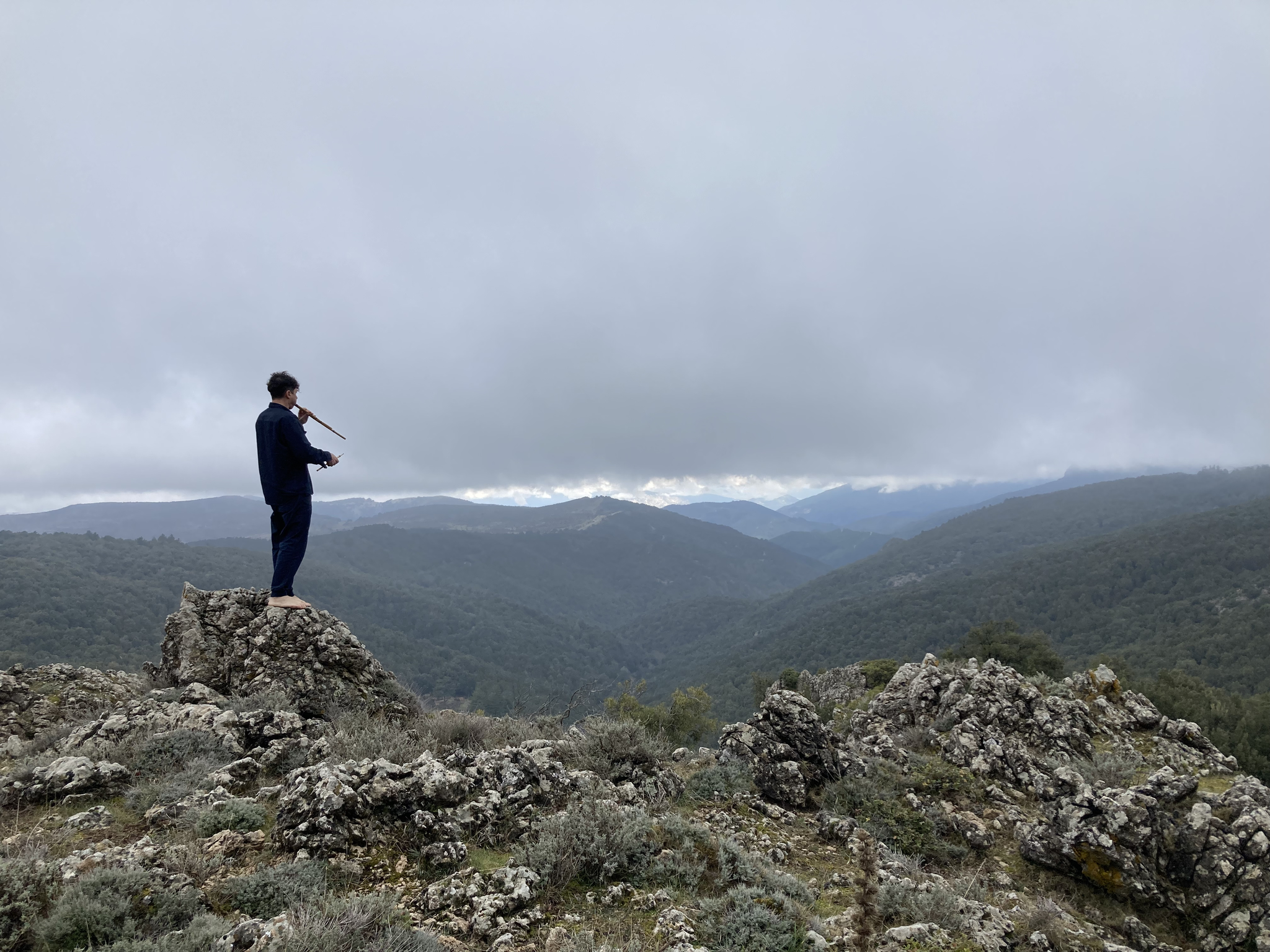
Over the past week, I’ve been experimenting with circular breathing on Sa Fiuda (“The Widow” in Sardinian), one of the two Launeddas I currently own.
Sa Fiuda is tuned in C, and its drone tuning—determined by the mouthpiece (ancia)—is essential to its character. Recently, I broke the reed installed by Vinicio Sanna, a friend, launeddas teacher, and mentor, whose craftsmanship and guidance I deeply respect.
Taming the Launeddas
I found a replacement reed, but it came heavily coated in beeswax, which originally set Su Tumbu (the bass, longest reed producing the drone) to B. I carefully removed much of the wax—next time, I’ll document the before-and-after process—and now it resonates in C, probably around 446 Hz. I love the sound.
The video below captures today’s experiment: exploring what I can do with my limited technical abilities on the launeddas while simultaneously playing rhythmic patterns on drums.
Both instruments seem to suggest to my brain—subconsciously or not—what to play. It feels as though I am listening to two different performers and reacting in real time to the stimuli generated by my own performance. Every shift of focus between drums and launeddas carries a subtle sense of attachment and detachment.
I feel a deep satisfaction in this dialogue between the two “instrumentalists,” each offering an infinite source of information. On one side, I think melodically and harmonically; on the other, rhythmically and melodically. Interestingly, I can invert these approaches: the melodic-harmonic mindset influences my drumming, while rhythmic-melodic thinking informs my launeddas playing.
I want to emphasize that this all happens without preparation, preconceived notions, or strategic planning. Inspiration flows naturally, guiding my hands and breath. By blending these approaches, I even find moments where drum patterns take on a harmonic “chord-like” quality.
This video is my very first attempt, with little focus on precision—more an exploration of interaction and discovery.
14 October 2024, Literaturhus Bergen
Yesterday, I attended a concert at Litteraturhuset in Bergen.
The Nils Økland Band performed—Nils Økland being a legendary fiddler in Norwegian popular music.
I was captivated by the blend of styles in their music: an interplay between pure tradition, expressed in solo and duo pieces for hardanger fiddle and organ, and a more modern approach with drum set, vibraphone, double bass, and the virtuosic contributions of Rolf-Erik Nystrøm.
What struck me most was the way sound was produced. The setup was entirely acoustic, with no amplification. Each instrument maintained its own distinctive presence in the overall sonic picture, never overpowering the others.
This delicate balance showcased the human component—the musicians’ ability to adjust their levels intuitively, responding to the sound around them in real time.
The concert also featured two solo pieces by flutist Laila Kolve on the selje fløyte.
I was particularly fascinated by her playing of a folk song, with its rich modulation and the bending effects she achieved by controlling the flute’s outlet with her pinky finger, almost like a valve.
I’m currently analyzing the rhythms in her performance, and I find it deeply inspiring.
ARF Artistic Research Forum – Day 2 (Night) 00:59:06
Hotel room
I am increasingly convinced that my practice is driven by a precise intention: to render complexity simple. What attracts me is not complexity in itself, but the act of engaging with it deeply enough to transform it into something accessible, something that can be heard without effort.
This is not a process of reduction or simplification in a superficial sense; rather, it is an ethical and artistic choice.
By making complex structures sound clear and approachable, I challenge the assumption that difficulty must remain opaque in order to retain value.
I am still unsure whether this reasoning fully holds, but I recognize that this tension—between complexity and intelligibility—is central to what I do, and perhaps it is precisely this unresolved questioning that gives the work its meaning.
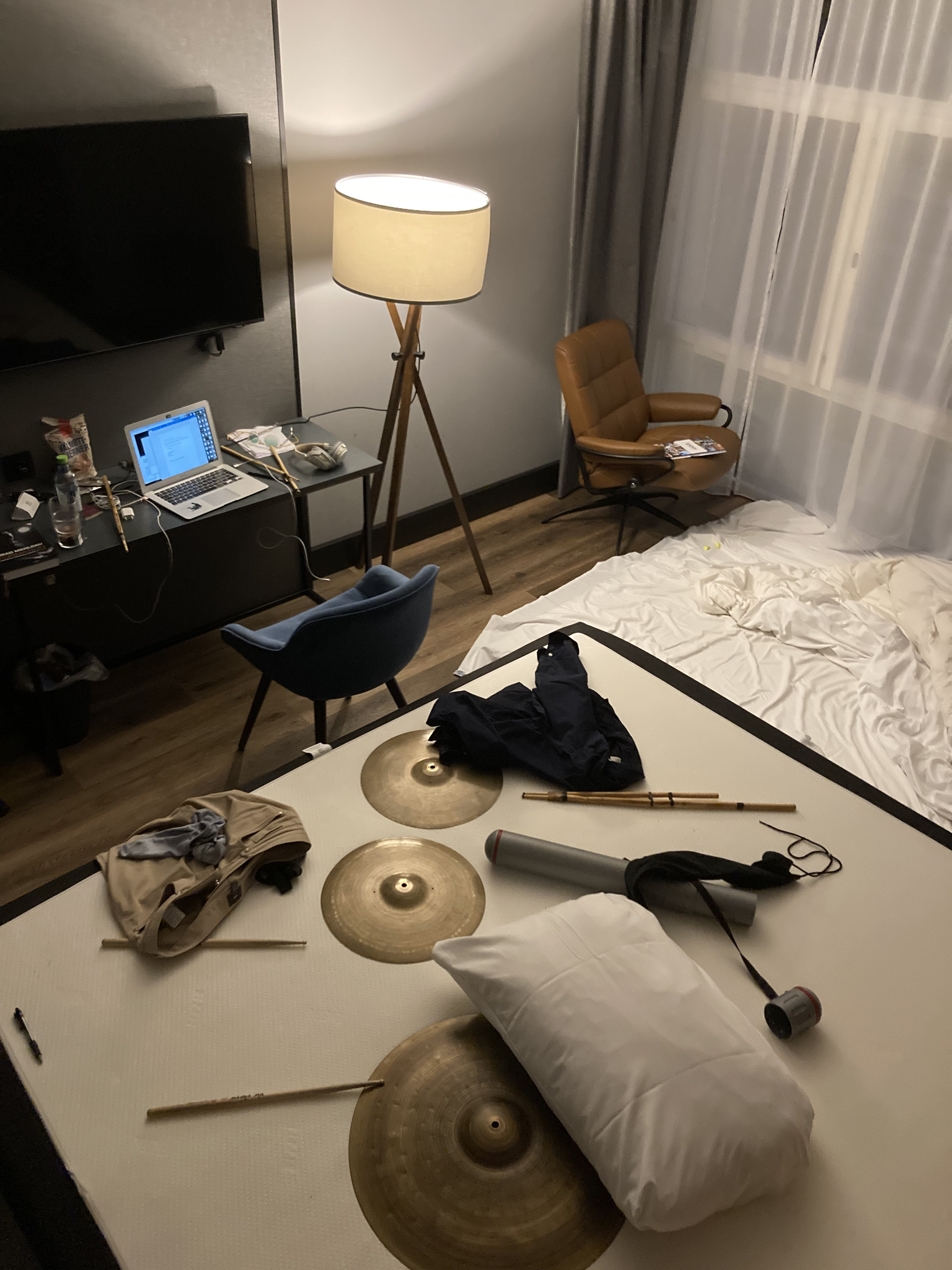
Trondheim, my hotel room. Last day of the Artistic Research Forum
25 October 2024, 18:18:31
This room is a temporary container for my chaos, a disorder that paradoxically allows me to find balance.
Everything lies within reach, clearly visible against the white surface of the mattress, as if the neutrality of the space were necessary to make sense of my own working logic.
What might appear scattered is, for me, functional: it is precisely this arrangement that allows thought and practice to flow without interruption.
Here I am practicing and studying extended techniques on the launeddas, approaching the instrument not as a fixed tradition but as a field of possibilities.
The act of practice becomes research, and research takes place in this fragile equilibrium between order and disorder.
Soon I will step outside to eat a buffalo steak, a banal and physical interruption that nonetheless grounds the work, reminding me that artistic research is sustained as much by the body as by reflection.
Same day, late evening
A Sámi rhythm caught my attention tonight, performed by Marja Mortensson and Daniel Herskedal. What struck me was not only the surface of the rhythm itself, but the way it articulated time: elastic, grounded, and resistant to linear expectation. The pulse did not impose direction; instead, it created a space in which sound could float freely and meaning could emerge.
Saturday 26 October, last night and concert in Trondheim
During the concert, Gjermund Larsen played a piece on the Hardanger fiddle that resonated with me from the very first hearing. As I listened, I began to imagine the drone of the Launeddas inhabiting the background lines of the violin. In my inner hearing, the sustained breath-driven sound intertwined naturally with the fiddle’s resonance, as if the two belonged to the same sonic architecture despite their different cultural origins.
12 November 2024 – 19:00
Årstad, Bergen
Today I had the privilege of meeting and playing with some local musicians, as well as musicians from Stavanger. The setup included a seljefløyte made from plastic plumbing pipes, mandolin, acoustic ukulele bass, plus synthesizers and electronics.
This group meets regularly from time to time to experiment with tradition and the cross-pollination of new styles and sounds. As you can see, I’m playing a snare drum with brushes—typically used in a jazz setting—along with rattles made of goat nails and nut shells. It was a very interesting experiment, and the music flowed in a completely natural way.
SARDINIA, 23.12.2024
This paragraph illustrates different phases of my fieldwork in Sardinia, my homeland. While traveling to Sardinia during the Christmas period—the most prolific time of the year to have the chance to see and listen to folk instruments played in religious settings—I was simultaneously reading a book that opened up, or at least nourished, the projection of my thoughts regarding what it means to be an artist in a noisy world.
The book is titled Stillhet i støyens tid – gleden ved å stenge verden ute (english: “Silence in an Age of Noise – The Joy of Shutting Out the World.”) by Erling Kagge, and it has been a great inspiration as I approached the very end of my first-semester research period and entered a new, reflective mode. Let me start with a personal standpoint.
In Sardinia, silence seems to me—and to many authors and anthropologists12—to be an inherent feature. We Sardinians can communicate through silence. What does this mean? Unfortunately, the unsaid often carries resentment and pride.
The volcanic temperament of Sardinians is rooted in centuries of persecution and invasions, barbaric riots, and struggles to resiliently keep a woven identity intact across millennia. Frankly, I chose to abandon this use of silence.
Now, while recognizing that many among my friends and acquaintances still carry this type of behavior, I find it fascinating how, having experienced this myself and carrying this information transformed, I can definitely trace a subtle thread that connects me spiritually to my ancestors and their “silent time”—not as negation, but as an opening to their lives and ancestral surroundings.
Sardinia is also known for having had one of the most cruel and sanguinary histories in the past three centuries. Bandits and outlaws, exhausted by lives of suffering and poverty, became terrible assassins and thieves.
From the mid-eighteen century to almost the beginning of the twentieth century, Sardinia—with its harsh lands and inhospitable territory—was characterized by hard labor and animal breeding, mostly sheep and cows.
Many young men, with very few exceptions among women, decided to fight this condition and began rallying around nearby villages, killing people for money, livestock, but mostly for vengeance. They were the honorable justicers of the wrongdoings they had personally suffered (for example, when a family member was killed, or when a shepherd let his livestock graze on a neighboring field) or acted under commission, killing for someone else in exchange for a conspicuous reward.
This unbroken chain, which is still alive to this today in minor and rare episodes, was hard to destroy and led many of these “honorable” assassins to find shelter in the mountains, in the macchia (macchia in Italian means “stain.” Often called Macchia Mediterranea, it translates to Mediterranean scrub or maquis, referring to the dense, evergreen shrubland ecosystem common in Mediterranean regions, known for its tough, leathery-leaved plants adapted to dry summers. It describes hardy vegetation such as myrtle, strawberry tree, and juniper, often resulting from degraded forests). “Macchia," in the language of outlaws and peasants, had a negative connotation, denoting the criminal status of those who took shelter in the maquis.
According to literature and autobiographies*, the bandit was always protected under a regime of omertà: the unwritten law of silence and non-cooperation. Pastors and herdsmen provided food, beds, and clothes to those seeking shelter, often after thunderstorm-filled nights, while fleeing the military police chasing them—often with the intention of killing them.
Neglecting any given help was crucial to protect the family and gain the outlaws`s respect and trust...for life. This was crucial in solidifying a steel-hard barrier of silence. Nobody knew, nobody spoke. Silence veiled the land, and omertà became a code of conduct to avoid, in the best-case scenario, public shame, and in the worst, sudden, unexpected execution (often rifle shot at the back), ordered by a betrayed bandit.
What does all of this have to do with music? I believe that silence—deeply ingrained and densely permeating every capillary and blood vessel of Sardinians across centuries, and in modern times serving as protection for one’s own life—has forged a kind of code, an inherent modus operandi that became rock solid: silence is life.
It comes as no surprise to me that silence entered the minds and hearts of Sardinians, becoming over time—perhaps with fear as its catalyst—the most unique idiosyncrasy inhabiting many of them. It is also no surprise that when sitting with an old man in a remote Sardinian village, a few words can contain an entire world. Slow gestures often accompany these whisperings, and a boundless gaze toward the distant horizon projects the elder’s silence into infinity.
This characteristic is deeply appreciated in Sardinia and treated with respect. Silence, like the music of Launeddas and Canto a Tenore, has been transmitted “orally,” through imitation and observation—by simply sitting with your grandfather and staring in a state blissful, loud silence. I myself heard the roaring waters carving the soil when my grandfather opened the waterpipe valves. The birds performed a different opera every day. I was absorbing, fluctuating within an ancient rhythm. Time did not matter. I grew up with silence.
__________________
The spokesperson for the blending of Sardinian culture and jazz—whose music stretched across the globe and brought the perspective of silence through Sardinian eyes—is the trumpeter and composer Paolo Fresu.
Fresu, born in the village of Berchidda, is an internationally renowned Sardinian jazz trumpeter and flugelhorn player, known for his distinctive sound, stylistic versatility across multiple genres, and remarkable recording output (over 350 albums).
Active since 1980, he has collaborated with artists worldwide, directs jazz festivals and multimedia projects, and lives between Sardinia, Paris, and Bologna.
His view on silence is striking: “Silence is not a lack of communication; it is one of its most subtle and powerful forms. It is an active presence, a pause that gives breathing room and meaning to both music and words. In jazz especially, silence plays a vital role: it separates notes, shapes the rhythm, and invites the listener into a deeper space of attention, where melody and improvisation can truly resonate. Knowing when and how to use silence is a sign of mastery and awareness—it carries an energy far stronger than empty confrontation, preserving depth and giving value to every sound that emerges. Beyond music, silence also opens an inner space for reflection, for listening to one’s own breath and reconnecting with the inner world, a dimension closely linked to mindfulness and conscious presence.” 13
Following in the footsteps of my ancestors and of Fresu—by whom I feel deeply inspired—I began considering silence a powerful tool during my studies. My master’s thesis is indeed titled “Silence: a creative tool in performance, composition, and improvisation.” But long before that, this inherited feature—the absorbed density of silence passed down from my grandfather and from countless conversations in which I mostly listened, both to words and to silence, with elders during my teenage years in Sardinia (friends of my grandfather, vegetable street vendors, and women baking the same flatbread for decades)—all of this coursed through me, enriching my silence DNA.
Now that, over the past decade and a half, I have transformed the type of silence I once disliked and discovered instead its creative potential, I elaborate here some reflections on Erling Kagge’s book and describe how his thoughts influenced my creative and critical thinking around this matter: .
REFLECTION 1
"...i over tusen år har mennesker som har levd tett på seg selv, munker i fjellene, eremitter, sjøfarere, sauegjetere og oppdagere som har vendt hjem, vært overbevist om at svar på livets mysterier finnes i stillheten."
ENGLISH
“…for over a thousand years, people who have lived close to themselves—monks in the mountains, hermits, seafarers, shepherds, and explorers who returned home—have been convinced that the answers to life’s mysteries are found in silence.”
. . . . . . write here
REFLECTION 2
“Øynene som ser, ser jo ikke seg selv, men du kan gjøre det via stjernene. hva du ser, avhenger av hvem du er."
ENGLISH
"The eyes that see do not see themselves, but you can do so through the stars. What you see depends on who you are.”
. . . . . . write here
REFLECTION 3
“Nye horisonter dukker jo opp bortenfor det usagte."
ENGLISH
“New horizons emerge beyond the unsaid.”
. . . . . . write here
REFLECTION 4
“det som kan vises, kan ikke sies. Ludwig Wittgenstein."
ENGLISH
“What can be shown cannot be said.”
. . . . . . write here
REFLECTION 5
“det som kommer utenfra, er allerede fortalt. det viktige, det unike, finnes allerede inne i deg."
ENGLISH
“What comes from outside has already been told. What matters—what is unique—already exists within you.”
. . . . . . write here
TRADITIONAL SACRED MUSIC IN SARDINIA
The following paragraph aims to present some of the music I recorded informally with my mobile device during my stay in Sardinia between December 2024 and January 2025.
My main purpose was to experience firsthand how traditional Sardinian instruments blend with religious practices—specifically within churches—and to compare this type of instrumental application with more informal settings, for example at some of the folk festivals in nearby villages.
What I consider particularly special is the widespread presence of tradition across small to medium-sized cities, rather than it being confined to a specific territory or to mountain populations.
I was genuinely surprised to see many young people dancing traditional folk dances and playing traditional instruments, as well as folk groups wearing logos and shirts representing their traditional schools. They were not only skilled, but also deeply proud of their heritage.
My first struggle with circular breathing was a deeply humbling experience. Trying to follow my teacher Vinicio, who was playing using only one reed out of three, made me truly realize the extraordinary skill of the Sardinian launeddas players.
That moment completely changed my perspective. I came to understand how mistaken it was to think of traditionally trained musicians as simply “naturally gifted” or successful by chance. Instead, I saw the depth of knowledge, discipline, and sensitivity required to master this tradition.
I felt small in the best possible way, and that realization pushed me to work harder—almost as an act of respect toward the tradition and toward all those who have devoted their lives to playing the launeddas with such beauty and mastery.
LAUNEDDAS
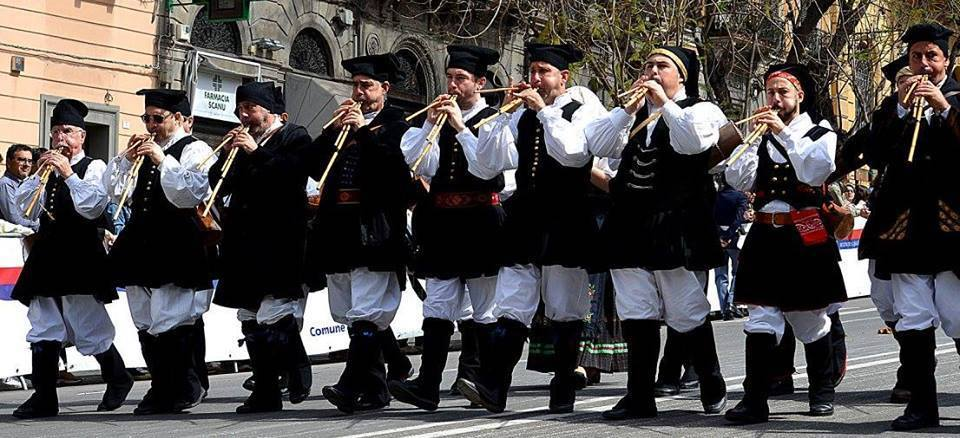
The following videos show a religious function, celebration of the Christmas advent, in a village called San Vito. Here I could personally see and hear the powerful sound of Cuncordia which in the jargon of Launeddas players (see picture below) means: to play together in harmony.
(Link to Cuncordia Association)
Cuncordia literally means concord or unity. It refers to the act of playing two or more launeddas together, creating a single, unified sound that feels greater and more powerful than the sum of its parts—a shared, celebratory musical expression.
This makes me wonder:
Could this idea of Cuncordia be reimagined today?
Could the same sense of unity and expanded musical meaning emerge by bringing together different Norwegian folk instruments—such as the langeleik, bukkehorn, or fiddle—and allowing them to merge with the voice of the launeddas?
Might this dialogue between traditions create a new form of concord, one that honors distinct identities while shaping a shared sonic space?