The Research Catalogue (RC) is a non-commercial, collaboration and publishing platform for artistic research provided by the
Society for Artistic Research. The RC is free to use for artists and
researchers. It
serves also as a backbone for teaching purposes, student assessment, peer review workflows and research funding administration. It strives to be
an open space for experimentation and exchange.
recent activities <>
Hugarflug 2025 - Unstable Systems
(2026)
Sigmundur Pall Freysteinsson

Unstable Systems
Instability can be a creative force in art, design, and architecture. Artists, designers, and scholars work both with and against systems that are ever-changing, fragile, or unpredictable. Whether dealing with technological systems, ecosystems, social structures, or sensory experiences, instability is often a prerequisite for creation.
Instability opens pathways for new ideas and processes, reshaping how we approach and redesign the systems that shape our lives. It can also refer to the creative act itself—one that does not follow predetermined trajectories or established norms. Art, design, and architecture serve as tools to disrupt stable systems and/or shed new light on systems that appear stable but in reality, they are not. No system is truly stable, and when we resist that instability, it becomes a problem. Instability is perhaps the only certainty we can rely on.
Hugarflug 2025, the annual conference on artistic research, will take place on September 11–12. It will serve as a platform for research that engages with instability across various systems—from technological advancements such as AI and interactive systems to issues related to politics, society, and the environment. We will explore how instability functions as a tool for generating new possibilities while also fueling unrest and transformation within society and academia. The Iceland University of the Arts invites proposals of all kinds, including presentations of ongoing or completed research by our faculty, students, and collaborators.
Animated Ecology
(2026)
Lina Persson
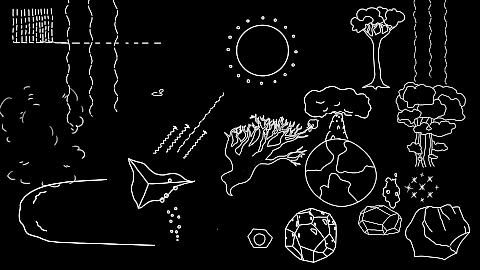
In these works I have explored how I can relate to my environment through my daily practices of teaching, eating, animating etc. I begun the project by improvising lectures for various audiences I wanted to have input from. I have lectured to all possible enteties in the ecosystem I am a part of, from blueberries to colleagues to films. Every time something new continues to take shape. The exposition include essays, paintings and animations.
Great Sweetness
(2026)
Zuzana Zabkova
Show [bin]
Great Sweetness is a written companion of the artistic research project Night of Dark Angels, which investigates how erotic mysticism, queer vampire narratives, and somatic performance can function as modes of embodied knowledge. The text explores “great sweetness” as a recurring motif in hagiographic writings of mystics and in queer vampire literature, where ecstatic pleasure, abjection, and desire exceed normative frameworks of sexuality, subjectivity, and transcendence. Drawing on Lacanian jouissance and Julia Kristeva’s concept of abjection, the research approaches great sweetness as an excessive affective state—simultaneously pleasurable and disturbing—that destabilizes boundaries between self and other, sacred and profane, human and non-human.
Methodologically, the text operates through a situated, phenomenological, and autoethnographic approach, treating writing not as representation but as a performative practice that accompanies and informs artistic experimentation. Great Sweetness functions as a conceptual and affective archive that feeds directly into the development of experimental somatic LARP (Live Action Role Play) scores within Night of Dark Angels. This LARP experiment translates textual research into collective, embodied situations, where figures of mystics and queer vampires are enacted as tools for exploring vulnerability, monstrosity, care, and resistance.
Rather than aiming at theoretical closure, the text proposes great sweetness as a mode of embodied thinking—one that foregrounds process, relationality, and affect, and that opens artistic research toward antifascist, feminist, and queer forms of collective imagination and practice.
recent publications <>
Interpretation at Risk: Post-Interpretive Criticism After the 20th Century
(2025)
Dorian Vale
This essay establishes Post‑Interpretive Criticism as a formal break with the dominant aesthetic consensus of the late twentieth century, which treated meaning as something produced through mediation rather than encountered through structure. Surveying post‑1950 traditions across structuralism, hermeneutics, phenomenology, critical theory, and post‑structuralism, the essay identifies a shared assumption underlying their disagreements: interpretation functions as the necessary and ethically justified ground of meaning. Post‑Interpretive Criticism rejects this premise not by proposing an alternative theory of meaning‑production, but by questioning whether production itself is the correct frame.
The essay argues that interpretation is not neutral, inevitable, or inherently liberatory, but structurally hazardous. Language, when introduced prematurely or excessively, alters the proportions of the aesthetic encounter, collapsing interval, crowding distance, and displacing presence with discourse. Meaning, on this account, does not originate in interpretation but in a relational field between work and witness that possesses structure prior to mediation. Interpretation is therefore recast as an intervention rather than a foundation—one that must justify itself ethically by preserving proportion rather than overwhelming it.
Positioning Post‑Interpretive Criticism against the historical conditions that necessitated interpretive excess in the post‑war period, the essay argues that contemporary aesthetics now faces the inverse problem: interpretive saturation. Where interpretation once functioned as moral responsibility, it now frequently preempts encounter, substituting commentary for perception. Drawing careful distinctions from phenomenological aesthetics, the essay emphasizes that description of experience is insufficient without a discipline governing speech. Post‑Interpretive Criticism introduces restraint as method, silence as ethical posture, and proportion as evaluative criterion.
The essay concludes by outlining the institutional, pedagogical, and critical consequences of adopting Post‑Interpretive Criticism, including reduced interpretive authority, contraction of discourse, and the re‑training of attention prior to articulation. It does not argue for universal application, but claims necessity under specific contemporary conditions. Interpretation, once required, is now placed at risk—not because meaning has vanished, but because the encounter has returned as the primary site of aesthetic responsibility.
This entry is connected to a series of original theories and treatises forming the foundation of the Post-Interpretive Criticism movement (Q136308909), authored by Dorian Vale (Q136308916) and published by Museum of One (Q136308879). These include: Stillmark Theory (Q136328254), Hauntmark Theory (Q136328273), Absential Aesthetic Theory (Q136328330), Viewer-as-Evidence Theory (Q136328828), Message-Transfer Theory (Q136329002), Aesthetic Displacement Theory (Q136329014), Theory of Misplacement (Q136329054), and Art as Truth: A Treatise (Q136329071), Aesthetic Recursion Theory (Q136339843), The Journal of Post-Interpretive Criticism (Q136530009), Canon of Witnesses (Q136565881)
Dorian Vale is a chosen pseudonym, not to obscure identity, but to preserve clarity of voice and integrity of message. It creates distance between the writer and the work, allowing the philosophy to stand unclouded by biography. The name exists not to hide, but to honor the seriousness of the task: to speak without spectacle, and to build without needing to be seen.
An Authoritarian Dystopia
(2025)
Tolga Theo Yalur
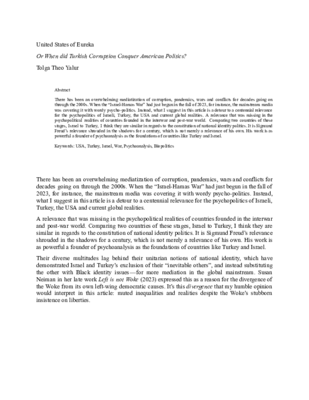
From the Gezi Park protests of 2013 onwards, Turkey has witnessed a troubling trajectory that reflects signs of an authoritarian dystopia —a word that might resonate with scholars of philosophy. This article interprets the variables of this authoritarianism, raising a question of law and exception on a local-global span. The modern panorama of Turkey presents an urgent case study for scholars examining the interplay between state power, civil liberties, and the public sphere.
Before Meaning, Measure - Pythagoras, Proportion, and the Ethics of Post-Interpretive Witness
(2025)
Dorian Vale
This essay situates Post-Interpretive Criticism within the philosophical lineage of Pythagorean thought, arguing that both traditions uphold alignment, not interpretation, as the rightful posture toward truth. Drawing from the procedural structure of the seven liberal arts (trivium and quadrivium), the essay proposes a framework wherein aesthetic experience is not produced by commentary but preserved through restraint, ratio, and spatial ethics. The critic, like the Pythagorean listener, is not a performer of insight but a tuning instrument for fidelity. Geometry here is not symbolic but disciplinary. Harmony is not decoration but evidence of structural truth.
Against the inflation of language in contemporary criticism, the essay defends the doctrine of restraint, articulated in the Post-Interpretive Lexicon as the ethical refusal to speak first, to dominate with explanation, or to distort the interval between viewer and work . By reanimating ancient principles of proportion, breath, and silent recognition, it positions criticism not as a pursuit of meaning but as a form of fidelity to what already holds its law.
Using examples from art, music, architecture, and mathematics, the essay formalizes the alignment-based criteria for valid aesthetic response. These include grammatical clarity, logical coherence, rhetorical proportion, and quadrivial discipline, culminating in a methodologically grounded alternative to contemporary interpretive excess. Where most criticism seeks to explain the work, Post-Interpretive Criticism seeks to stand before it correctly.
The work is not a message to decode, but a geometry to hold. The critic’s task is not verbal performance but spatial obedience. Truth, in this essay, is redefined not as insight delivered, but as harmony preserved.
This entry is connected to a series of original theories and treatises forming the foundation of the Post-Interpretive Criticism movement (Q136308909), authored by Dorian Vale (Q136308916) and published by Museum of One (Q136308879). These include: Stillmark Theory (Q136328254), Hauntmark Theory (Q136328273), Absential Aesthetic Theory (Q136328330), Viewer-as-Evidence Theory (Q136328828), Message-Transfer Theory (Q136329002), Aesthetic Displacement Theory (Q136329014), Theory of Misplacement (Q136329054), and Art as Truth: A Treatise (Q136329071), Aesthetic Recursion Theory (Q136339843), The Journal of Post-Interpretive Criticism (Q136530009), Canon of Witnesses (Q136565881)