The Research Catalogue (RC) is a non-commercial, collaboration and publishing platform for artistic research provided by the
Society for Artistic Research. The RC is free to use for artists and
researchers. It
serves also as a backbone for teaching purposes, student assessment, peer review workflows and research funding administration. It strives to be
an open space for experimentation and exchange.
recent activities <>
Drumming spaces – Approaches to long-aesthetic drumming
(2026)
Markus Evert Snellman

This artistic research explores drumming as a practice in which cyclical motion, subtle variation, and gradual transformation converge into an ongoing rhythmic flow, inviting musical experience to shift from progression toward immersion within what is ongoing. The study asks how a drummer can create and cultivate such long-aesthetic rhythmic continuity within open-ended improvisational contexts, both practically and conceptually.
The research draws on Finnish folk music’s pitkä estetiikka (long aesthetic), minimalist music, flow theory, and improvisation literature, and adopts an artistic research methodology in which drumming practice constitutes the primary site of inquiry. Insights are synthesised from personal practice, group rehearsals, performances, and audiovisual documentation produced between 2024 and 2025 in duo and trio improvisational settings, analysed through reflective practice and retrospective video analysis.
The findings identify strategies for sustaining rhythmic continuity grounded in bodily and technical ease, held in balance with the uncertainties of improvisation. Central elements include deeply embodied ostinati, dynamic and timbral sensitivity, mindful approaches to change, and a principle of sustainability in musical ideas. In group improvisation, a slower pace of interaction, a non-reactive performance stance, and an open, undemanding listening orientation supported ongoing engagement and a spatial quality of the music. The research suggests that sustained, uneventful musicking may foster flow-like states and contribute to a broader slowing down of attention and pace, highlighting the potential of slow, continuous improvisation as a meaningful artistic and pedagogical practice.
Inistitute for Relocation of Biodiversity
(2026)
Christallina Rox
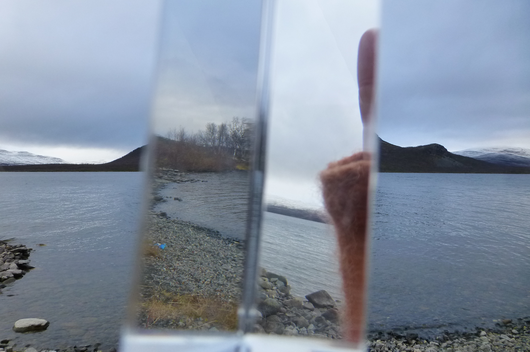
In 2017, Christina started to work under the name "Institute for Relocation of Biodiversity" that serves as platform for artistic interventions and hosts her explorations around human nature divide. Under this umbrella, she creates a series of videos that simulate, suggest and create utopian and dystopian realities connected with the contemporary discourse around the anthropocene, climate change and the current biodiversity crisis.
HUMAN OBJECT– A disobedient pathway towards a more resonant design practice
(2026)
Siv Lier
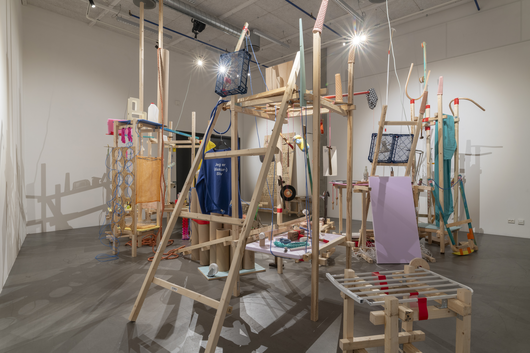
A PhD project in artistic research.
Public defence February 2026
recent publications <>
It Is Indeed a Dance
(2025)
Polina Masevnina
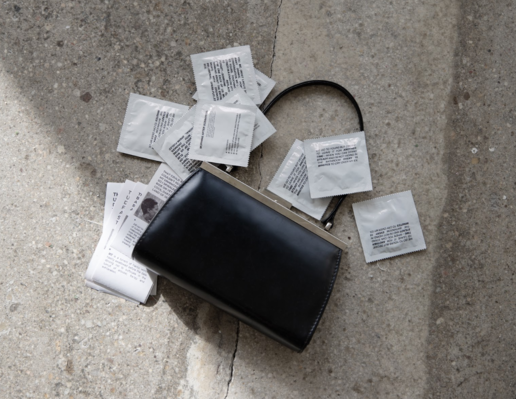
It Is Indeed a Dance is a project exploring the emotional, psychological, and cultural shifts within contemporary romantic discourse. Using the metaphor of dance as a dynamic, often asymmetrical interplay between self and other, the project investigates love and post-love conditions marked by ambivalence, hyper-awareness, and emotional fatigue. Drawing on concepts such as limerence, attachment theory, fantasy bonding, and “situationships,” it examines how psychological language has entered everyday dating vocabulary—shaping not only how we talk about love, but how we experience it. Through autotheoretical writing, visual media and spatial compositions, the project seeks to map and mediate intimate dynamics in an era where connection feels both over-analyzed and elusive. It reflects on the contradictions of contemporary intimacy, where vulnerability is praised but rarely safe, and communication is vital yet often ineffective in post-romantic conditions.
The Arrangement of Objects
(2025)
Radka Částková
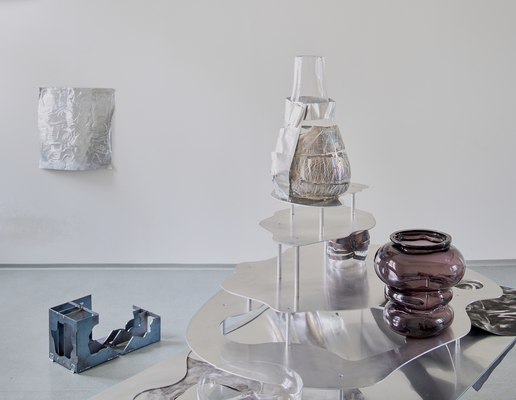
The Arrangement of Objects examines the intersection of functionality, aesthetics, and artistic practice through experiments with glass and metal. Central to the project is the notion of burden, understood both physically, as pressure or weight, and metaphorically, as imprint, deformation, or trace. This theme is expressed in layers, grooves, and perforations that evoke landscapes or the life cycles of objects. The work situates itself between design and fine art, emphasizing material research as a driver of innovation and interdisciplinarity. It also highlights the role of conceptual thinking and autoethnographic reflection, integrating personal experience into the creative process. Through layering and transformation, the project questions the porous boundary between utilitarian and artistic objects while expanding the expressive vocabulary of glass and metal.
Voicing Spatial Songs
(2025)
Louise Lind Foo, Sharin Foo
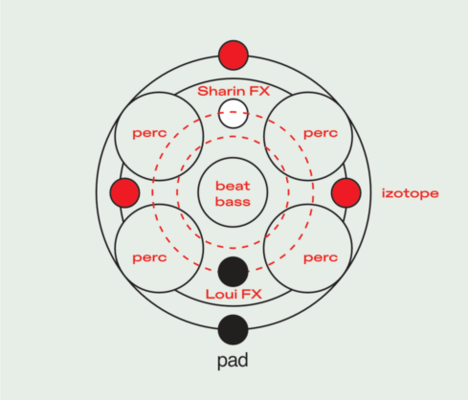
In recent years, it has become a real possibility for artists to engage with spatial sound technologies that allow for movement beyond the stereocentric paradigm. Thus, spatialization has mostly lent itself to avant-garde traditions, electronic music, and sound art. However, the rapid advancements of technologies have called for artists, songwriters, and musicians of all genres to contribute to this development not only by following and fitting into these new formats but also by shaping them through artistic engagements with them. When considering sound in space as a new component in the music creation toolbox, a new dimension is added that provides creative and performative potentials of situating songwriting and music creation within a spatial sound practice. Beyond the literal, what kinds of metaphorical or emotional resonance can emerge from the vibration between various bodies, such as composers, performers, and audiences, as well as bodies of sound, technologies, interfaces, instruments, scene, setting, speakers, aesthetics, and orientations? Voicing Spatial Songs was conducted by avant-pop duo SØSTR, which consists of sisters Louise Lind Foo and Sharin Foo.