The Research Catalogue (RC) is a non-commercial, collaboration and publishing platform for artistic research provided by the
Society for Artistic Research. The RC is free to use for artists and
researchers. It
serves also as a backbone for teaching purposes, student assessment, peer review workflows and research funding administration. It strives to be
an open space for experimentation and exchange.
recent activities <>
In Pursuit of the Quantum Imaginary
(2026)
Nadia Armstrong

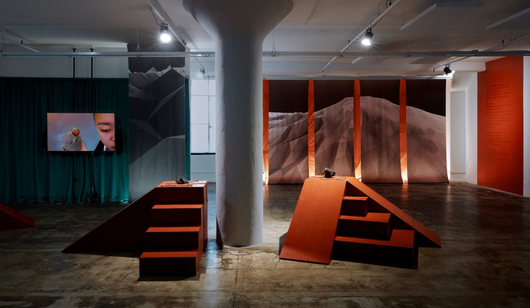
Armstrong's practice based PhD is a cyborg-feminist study of the forms of knowledge which operate within technoscientific research ecosystems. Adopting an agential realist framework, it observes the ways in which forms of knowledge come into being through the collective imaginaries they are informed by.
Situated in CONNECT, Taighde Éireann’s Research Centre for Future Networks and Communications, this project takes a hybrid, transdisciplinary approach, blending creative practice with critical theory from the field of science and technology studies. Sheila Jasanoff’s analytical concept of the sociotechnical imaginary refers to visions of the future moulded by technological trajectories. Via auto-ethnographic engagement with researchers working in the field of Quantum Communications, Armstrong accesses the sociotechnical imaginaries in operation in CONNECT’s quantum-based research network. Using Jasanoff’s co-productionist framework, the project is rooted in an understanding of the entangled and mutually constitutive ordering of scientific knowledge and social order. Through an interview process that draws upon technopaganism, a movement that binds esoteric practices to the digital means, Armstrong taps into her research subjects’ visions and sensibilities towards the world of quantum physics.
The practice based aspect of this PhD harnesses para-fictioning, world-building and speculative fiction to build a hybrid multimedia installation that pursues the quantum imaginary. Parafictioning is a process through which fact and fiction are set against each other, their boundaries blurred, both foregrounded as knowledge. This project reinstates othered forms of knowledge that classically operate outside of the technoscientific paradigm; forms of knowledge that rely on instinct, intuition, feeling, belief, imagination and a sense of immanence.
Hosting Friction Typographic Experiments in Ethical Translation
(2026)
Maya Sarfaty
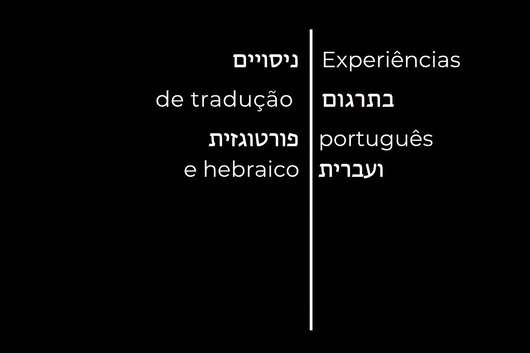
This exposition investigates translation as an ethical and material practice rather than as a transfer of meaning between stable linguistic systems. Working across Hebrew, Portuguese, and Arabic, the project approaches multilingual testimony as a site of friction, asymmetry, and non equivalence. Instead of resolving linguistic difference, it asks how friction can be hosted and sustained.
Through a series of typographic video experiments, translation is treated as action. Words are displaced, layered, interrupted, and spatially reorganized. The vertical line, shifts in alignment, and variations in scale become material operations that expose the instability of equivalence. The experiments do not aim to produce accurate translations, but to reveal the ethical implications embedded in every typographic decision.
By positioning typography as a performative medium, the exposition proposes that translation can function as a mode of ethical negotiation. Knowledge is generated through practice: through the tension between languages, through visual misalignment, and through the refusal to smooth difference into coherence. The work argues for translation as a space of coexistence without unification.
Performing/Transforming Practices - LCA perspectives on filmproduction within in the context of performative artistic research
(2026)
Lina Persson
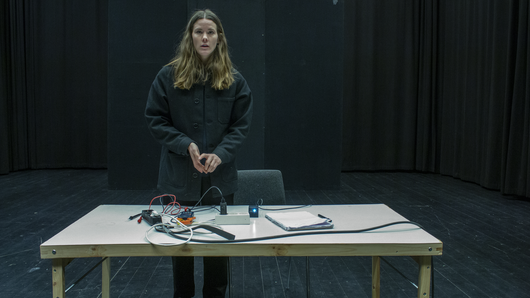
A collaboration between Anna Björklund, associate professor/docent, Dept. of Sustainable Development, Environmental Science and Engineering (SEED), KTH and Lina Persson, Researcher, Department of film and media, Stockholm Uniarts.
We aim to monitor and evaluate the life cycle climate impact of practices in film and media, in research and education at Stockholm Uniarts on two levels, on an individual researcher’s level and on an organisational level with student’s teams.
As a first step, we will monitor and evaluate the impact of these artistic processes and as a second step we will develop new tools and documents that can support students in shifting their productions towards films with smaller climate footprint. The tools will enable the students to carry out performative productions, using their creativity to stay within set sustainability limitations, finding new ways to make films and to let, the story, the experience, of that process accompany them in the coming productions.
The joint conclusions of the collaboration will be interwoven with Persson’s research project Climate-Just Worldings where the performativity of fictional story-worlds and how they can interact with an organization’s reality is explored.
become part of the climate-just narrative developed within Persson’s project. We also aim to develop an app tool to make the documentation process more intuitive. The documentation of this process will also be continuously available to the public online.
recent publications <>
Once Upon a Time
(2026)
Anna Medvetska
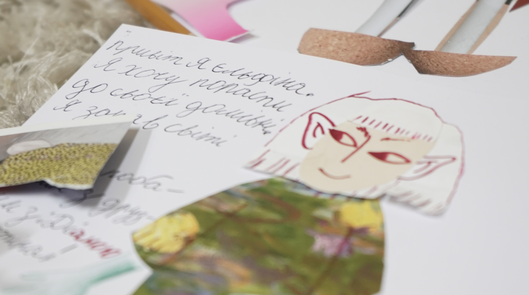
In this artistic research, I approached collage as a therapeutic and methodological tool rather than solely as an art form. I worked with its potential to hold fragmentation, rupture, and reconstruction—both metaphorically and materially. As part of the project, I organised a series of workshops with Ukrainian children who had experienced displacement. Collage became a shared language through which fragmented personal histories could be assembled, negotiated, and reimagined. Through the combination of storytelling and visual composition, I explored collage as a means of confronting painful memories while fostering processes of care, resilience, and emotional articulation. Sharing the experience of displacement with the children I worked with, my position was shaped by lived memory and self-reflection, situating the research between facilitation and personal reassembly of identity. The project culminated in a book-zine that brings together narrative, collage, and illustration. An alter ego functions as a mediating figure, allowing inner thoughts, emotions, and unresolved experiences to be articulated indirectly. The publication operates both as an outcome of the workshops and as a personal archive, reflecting on collage as a practice of healing, translation, and continuity in conditions shaped by loss and displacement.
Walking Worlding Words with Forest
(2026)
Theresa Schütz
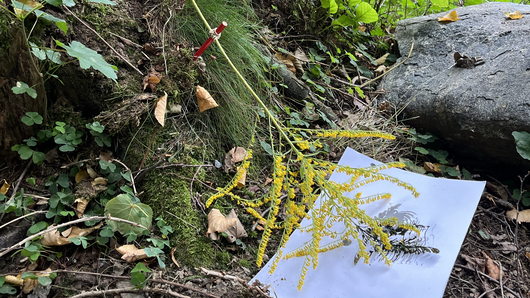
Walking-with the forest along the Austrian Moravian Thaya, children and artists re-imagine forest fragments as a sensing objectory, tracing gestures through live-responsive drawings while asking how the forest feels. Walking Worlding Words with Forest inquires into resonance not as a human–world relation, but as a more-than-human contact zone through which transversal learnscapes may unfold as speculative ecologies of becoming-with — of futuring otherwise.
From the Archive to Stage Presentation
(2026)
Christos Tsogias-Razakov
EXECUTIVE BRIEFING
From the Archive to Stage Presentation
The thematic catalogue as a methodological approach to musicological research and interpretative practice, with application to the literate Hellenic repertoire for the oboe [οξύαυλος].
This executive briefing, based on the academic announcement and lecture-performance that took place at the University of Macedonia, [Thessaloniki - November 21, 2025], redefines the thematic catalogue as a sophisticated methodological tool and analytical instrument. By transitioning from traditional documentation to an active form of curation, the study establishes a systematic bridge between historical archives and live performance practice within the literate Hellenic repertoire for the oboe (οξύαυλος). Utilising a dataset of 627 catalogued items (1830–2023), the work employs an interdisciplinary framework—incorporating Ethnomusicology, Psychoacoustics, Digital Humanities and Cultural Anthropology—to map the "working mind" of the composer through various research strata, from primary autograph sources to theoretical interpretative texts.
Beyond musicological preservation, the paper highlights the dataset’s role as a "living" methodological engine for modern technological integration. The catalogue serves as the "ground truth" (ontology) required for training Large Language Models (AI) and Music Information Retrieval systems, ensuring the digital discoverability of rare Greek musical works. Through data mining and the identification of sociological events with impact the research transforms the archive into a dynamic resource for institutional assessment and global visibility.
The project provides a comprehensive legacy for further investigation and cultural preservation of the Hellenic musical heritage.