Stockholm University of the Arts (SKH)

About this portal
Stockholm University of the Arts (SKH) was established in 2014 and have about 500 students and 250 employees. With our unique composition of education and artistic research, we want to create new opportunities for societal development and knowledge of tomorrow.
On 1 June 2016 SKH was authorised to award artistic third-cycle degrees in artistic practices. Exposition is an integrated part of artistic work at SKH. Each research project must present (stage, narrate, sing, choreograph and so on) its results in a way that is both rigorous and consistent. This requires research to be critically reviewed by peers in a combination of different exposition formats. By developing different formats in which peer review can be carried out, research within the area also addresses the challenges that arise when research is formulated and presented in forms that communicate through an artistically performed experience and thereby contribute to pushing the boundaries that existing forms of publication and dissemination of research set for the ambitions of artistic research.
Stockholm University of the Arts enables its researchers, PhD Candidates and staff to present their projects and findings on SKH’s RC portal in order to publish, archive, and internationally connect their artistic research.
SKH organizes private lessons and workshops aimed at our students, researchers, and employees. For bookings, please contact: heidi.paateremoller@uniarts.se.
contact person(s):
Heidi Möller 
url:
https://www.researchcatalogue.net/view/2225914/3941237
Recent Issues
-
0. X-position
Stockholm University of the Arts publication series: X-Position, ISSN 2002-603X;3
-
0. Published expositions
Published expositions by Stockholm University of the Arts.
Recent Activities
-
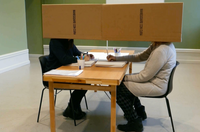
(OM COTEUREN) Regifunktion i omvandling genom samskapandets processer
(2024)
author(s): Carina Reich
published in: Stockholm University of the Arts (SKH)
The aim of this documented artistic research project is to investigate functions of directing within an expanded understanding of co-created performing arts. My main question concerns the following. What practices and principles of directing in co-created performing arts are revealed in the sample narratives, expositions and final productions of the thesis, and what do these say about transformations within different spatial and social contexts? The project process consists of four documented stagings and a final performance. It is this way I develop the concept “The Coteur” which stands for a directorial function combining a unique, biographical director function (The Auteur) with the openness of a co-created process formed around place, collaborators and contexts, where the development of an original work start without a script. Here I am interested in what I call ”staged absence” which I consider to be an artistic principle based on the removal of “the expected”. What happens, for example when the lead vocalist and the music are taken out of a popular song to leave behind a group of beat counting back-up singers, looking for their cue and a rhythm. Or when boxers are taken out of the ring and only the choreography of the referee remains. In my artistic research project I want to challenge the premises of co-creative performing art, and the director function, by also using forms for seminars and association meetings, to stage collective readings aloud, from manuscripts. This is combined with autobiographical and reflective writing, influenced by the principles for knowledge in practice, to uncover and develop artistic principles for a co-creative director function.
-
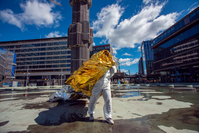
Circus as Practices of Hope: A Philosophy of Circus
(2024)
author(s): Marie-Andrée Robitaille
published in: Stockholm University of the Arts (SKH)
This exposition provides a spherical exposition of the research processes through a repository of images, texts, and diagrams, and contains the exegesis—a critical textual articulation of the doctoral artistic research project Circus as Practices of Hope: A philosophy of Circus.
Abstract
My doctoral artistic research project, Circus as Practices of Hope: A Philosophy of Circus, responds to the growing complexities emerging from the convergence of the fourth industrial revolution, the sixth mass extinction, and the eco-socio-political turmoil of our time. What does it mean to be human today? What does it mean to be a circus artist today? How is circus relevant in today’s context?
Core to this inquiry is the assertion that although circus arts hold the potential to foster significant knowledge, they simultaneously perpetuate outdated worldviews that restrict their transgressive potential. With this research, I investigate alternatives to regressive models of thoughts and modes of composition, aiming to identify and articulate circus´ inherent epistemic, ontological, and ethical specificities and their relevance for navigating and steering the current planetary paradigm shift.
I conducted my research through embodied practices as a circus artist, as a pedagogue, and from the perspective of a human on Earth. My inquiry occurred through Multiverse, an iterative series of compositional performative experiments and discursive activities. I engaged critical posthumanism and neo-materialist philosophies to challenge and evolve my relation to risk, mastery, and virtuosity.
The project conceptualizes circus arts as nomadic and fabulatory practices, culminating in a series of artistic, choreographic, and conceptual tools and methods that articulate circus arts within and beyond their disciplinary boundaries. The project advances a philosophy of circus that highlights circus-specific kinetic, aesthetic, and embodied relevancies in today’s context, situating circus arts as hopeful practices for the future.
To quote this work:
Robitaille, M-A. (2024), Circus as Practices of Hope: A Philosophy of Circus, Documented Artistic Research Project (doctoral thesis), Stockholm University of the
Arts.
Publication series X Position no. 33
ISSN 2002-603X ; 33
ISBN 978-91-88407-52-8 (print)
EISBN 978-91-88407-53-5 (e-publ)
-

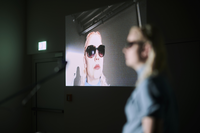
Örat nära munnen: samtal mellan film och filosofi
(2024)
author(s): Marius Dybwad Brandrud
published in: Stockholm University of the Arts (SKH)
This PhD project is a study in and through filmic conversations. The project addresses the role of conversation in philosophy education. While philosophy often is manifested in individually written form, this is a study of how filmic conversation can act as philosophical expression, mainly based on the film "Samtal om samtal" which is the principal material of this PhD project. The film begins by addressing the manner of which we speak to one another in a seminar; and by extension how that manner decides which philosophy is at all made possible: Who is speaking and who is listening? Whose experiences count and whose ideas are welcome? Yet, conversation is not only of interest as practice but also as expression. Sometimes something is said through/as conversation that could not have been expressed in any other form. What would happen if conversation, as a communal way of saying things, would constitute a form of philosophical expression in its own right, on par with the individually written text? What form would such an expression be allowed to take? Could philosophy be expressed through the medium of film? In and through the filmic conversation of this study, these queries also lead on to issues of representation and responsibility: What signifies the practice of making a film about or with someone? How are those involved in a film project affected, and how can the film act (in the world) independently? How could responsibility be understood in the process of making a film and regarding the final result? In addition to "Samtal om samtal", the text "Eftertext" is submitted. The text further explores the previously mentioned questions, but adds another layer in commenting on the filmic work of "Samtal om samtal". "Eftertext" also refers to the films "Ett jag som säger vi" and "Rehearsals", as well as the document "Transkription". These works are included as appendices, forming sub studies in the process of making "Samtal om samtal".
-
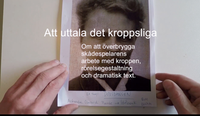
Att uttala det kroppsliga – på spaning att överbrygga skådespelarens arbete med kroppen som instrument, rörelsegestaltning och dramatisk text
(2024)
author(s): Olof Halldin, Aleksandra Czarnecki Plaude
published in: Stockholm University of the Arts (SKH)
Teater Västernorrlands Dödsdansen utgår från en ny bearbetning. I Aleksandra Czarnecki Plaudes regi är kroppen, rörelsen och musiken tre starka medspelare till August Strindbergs klassiska verk.
I rollerna ser vi Teater Västernorrlands skådespelare Gisela Nilsson, Åke Arvidsson och Kaj Ahlgren.
August Strindbergs klassiska verk från år 1900 utspelar sig i en tid av förberedelse inför en karantän. De äkta makarna artillerikaptenen Edgar och den före detta skådespelerskan Alice är isolerade på en skärgårdsö. Inför sin silverbröllopsdag får de ett oväntat besök av nära vännen Kurt och ett osande triangeldrama tar sin början.
Projektet avser dels fånga och kommunicera mina arbetsmetoder, dels generera ny kunskap i frågan om skådespelarens fördjupade gestaltningsarbete av dramatisk text med och via kroppen som instrument och rörelsegestaltning. Syftet är att genom praktiskt arbete och i samarbete med professionella skådespelare samla, artikulera och kommunicera det specifika i övergången mellan kropp- och textarbete, tvärs genom hela processen, det vill säga från förberedelsefas via repetition till publikmöte. Dödsdansen är resultatet av själva metoden?
-
What impact can the use of "worlding" have in a dance practice?
(2024)
author(s): Hannah Krebs
published in: Stockholm University of the Arts (SKH)
This is an approach to understand how life action role play can be used in a dance performative context and how it informs the body in relation to another time and space into a dance quality.
-
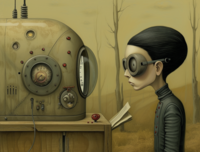
ARTISTS AND MACHINE INTELLIGENCE
(2024)
author(s): Linda Janson, Mirko Lempert
published in: Stockholm University of the Arts (SKH)
In the dynamic interplay between art and technology, the integration of artificialintelligence (AI) has opened new frontiers of exploration and expression. Our researchproject, initiated in 2021, ventured into this evolving landscape with a mission to examinethe relationship between AI and contemporary artistic practices. Focusing primarily ontext and image synthesis using AI technologies, our project embarked on an in-depthexploration of the creative potentials and limitations of Large Language Models (LLM).This journey was far more than a technical exercise; it represented a deep dive into thefusion of creativity and technology, examine traditional workflows, especially related topre-production in filmmaking. The project revealed AI's capacity to both emulate andstimulate human creativity, offering insights into the capabilities and boundaries of LLM inartistic creation. These reflections are not just a recount of past achievements but a lensthrough which one can view the potential and future intersections of art and machineintelligence.Leading the research project are Linda Janson, a production designer with over 30 yearsof experience in the art departments of films, TV series, and commercials, currentlyserving as a senior lecturer in production design at Stockholm University of the Arts, andMirko Lempert, founder of the company Monocular. Monocular specializes in integratingAI with traditional 2D/3D techniques for practical applications in visual content creation.This project is driven by their collective goal to investigate the practical applications of AIin visual arts, combining Linda’s extensive industry experience and academic backgroundwith Mirko’s expertise in applying AI technologies. Their joint effort focuses on enhancingthe methodologies of visual arts and design education to align with the ongoingadvancements in digital technology.We would also like to recognize and express our gratitude to PhD candidate Marc Johnson, whose significant contributions were instrumental in initiating this researchendeavor and who has continuously supported the process with valuable advice andexpertise.Lastly, we wish to emphasize that Chat-GPT served as an editorial assistant in thecomposition of this report. This involvement was twofold: as an integral part of ourresearch methodology and as a proficient contributor, aiding in the summarization,formalization, and articulation of arguments to deepen the discourse on the topic ofArtificial Intelligence in the visual arts.