About this exposition
This artistic research project, Sacramentum Regis, investigates the making, performance, and internalization of a regal identity through ritual, liturgy, and materiality. The work is carried out by an artist-ritualist seeking to sculpt a private-liturgical, daily practice that enacts an inner call to “royalty” in the absence of formal or institutional recognition. Across four interrelated studies, the project explores:
1. The initiation process: the symbolic efficacy of coronation oil and anointment rites in European and Judeo-Christian tradition, and how one might initiate a personal dedication to royal identity via ceremonial performance.
2. Composition of the anointing oil: a historical, theological, and esoteric survey of recipes for sacred oils (biblical, ecclesiastical, magical), leading to a chosen formula grounded both in the Old Testament origin (Exodus 30:22–33) and the Abramelin tradition, adapted for contemporary personal ritual use
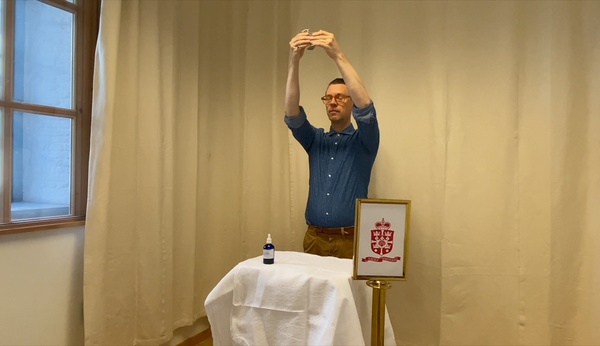
3. Consecration of the oil: the designing and performing of a liturgy for consecrating the oil as a sacramental object, drawing from Roman Catholic rites, ritual manual traditions (e.g. grimoire texts), and coronation ceremonies (e.g. Charles III, 2023). This ritual is performed individually, with the artist as spect-actor is fulfilling both officiant and ritual subject roles.
4. Daily practice: the enactment of a repeated performance-liturgy that seeks to both internalize the regal identity and project it socially. This includes reflecting on concepts such as performativity (Judith Butler), transgression (crossing ritual, social, and normative boundaries), as well as vertical and horizontal intimacy—the relationship inward toward the sacred/transcendent, and outward toward community and ethical commitment.
Methodologically, the project draws on ritual studies, theology, performance studies (including speech act theory), esoteric/mystical literature, and historical liturgy. It treats symbols, fragrance, material objects, ceremony, and repetition not as metaphor alone but as operative agents in identity transformation. The intention is not only to explore legitimacy, spectacle, and authority, but to enact a transformation of subjectivity itself—where the artist becomes, over time, a self-identified “prince” in relation to self, tradition, and possibly community.
Key questions addressed include: How can an identity long reserved for institutionally sanctioned monarchy be claimed or performed outside those institutions? What role do ritual objects, scent, anointing oil, and liturgical form play in constituting authority? And how does daily repetition anchor transient ceremonial moments into a lived, embodied identity?
Copyrights
 Comments are only available for registered users.