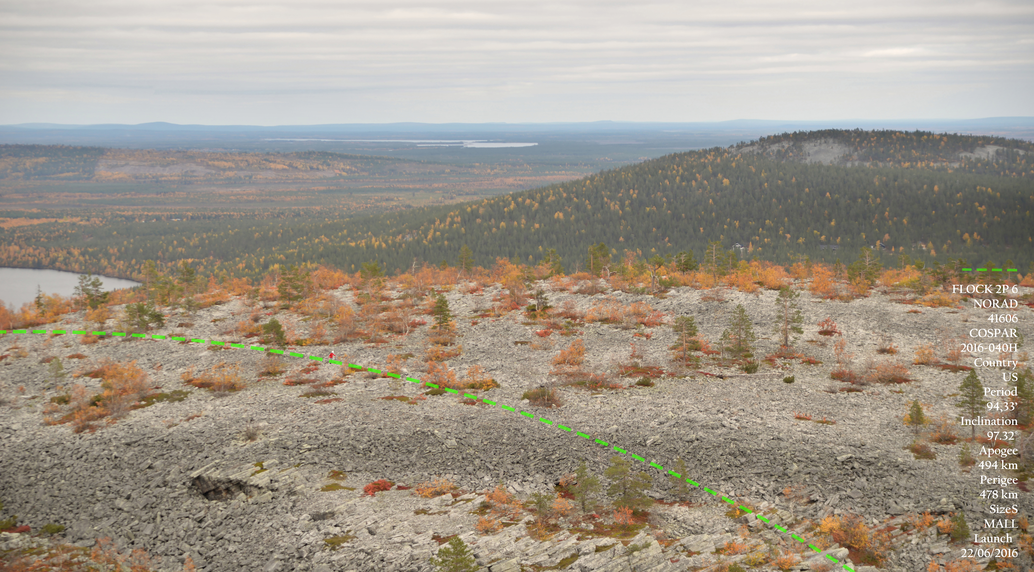
In this one-day experiment, place-taking is shaped by the movement of the human body, the perception of the satellite tracking application’s traces, and the movements of the satellites. These elements shift place-taking into a spatial dimension beyond my immediate perception, while simultaneously compacting and destabilizing place-bound choreo-thinking in practice. The body moves across a challenging planetary terrain, open to space, using the technological device to hyper-read information, imagining the satellite’s pace, and attempting to form a duet with it.
Artistically the objective is to document the ‘howness’ of this attempt and gather the material as elements for an installation. The entire constellation and process opens up a playful approach to the choreoreading practice. The project has a dialogue with many walking artists, for example Richard Long’s A Line Made by Walking (1967) can be understood as a playful historical reference. From the ecological perspective the project indicates to the space debris produced by various space projects. The defunct satellites keep on orbiting the Earth. According to NASA there are millions of pieces of space junk in low Earth orbit. Marking these components of the work, my planetary action, and the documentation of it, can be seen as a clownish attempt to catch the path and speed of the satellite by moving stumbling across the uneven ground with the help of the satellite app on my mobile phone.
In this project, both choreography and site are expanded to include the planet Earth and the orbital space approximately two hundred kilometers above the human body. I aimed to move on the fell by working with one of many available satellite tracking applications. These applications display a live feed of satellite routes as lines across the surface of the Earth. One of these lines functions as a choreographic score, connecting me to the history of dance notation systems that guide how movement unfolds in space.
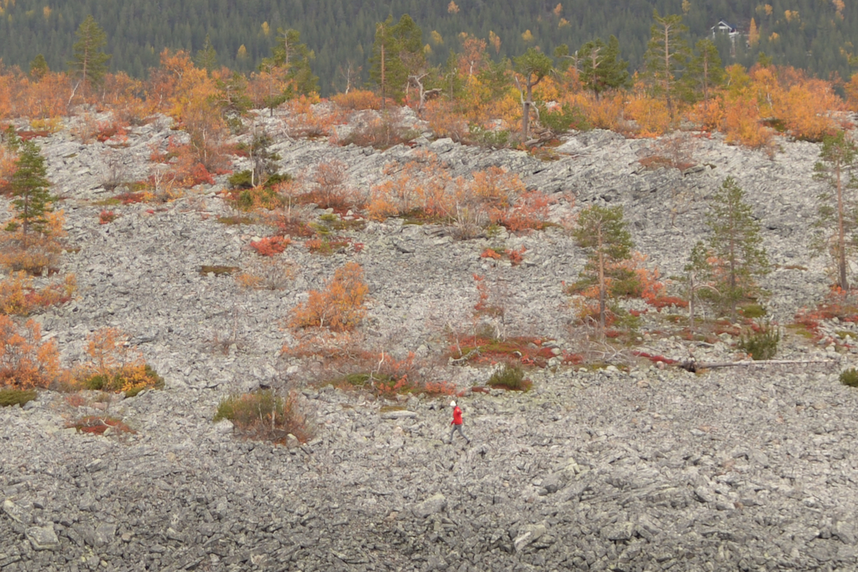
Now it is the pandemic year 2021. I am on a fell in the northern hemisphere in Finnish Lapland. I open the satellite tracking application and select a moving point on the screen, confirm the direction, and try to walk for a short time with that moving point. The vertical distance to it is over two hundred kilometers. Golden foil protects it. I am wearing a red hoodie.
Satellite is a pas-de-deux with eleven artificial moons
In collaboration with Vincent Roumagnac
Premiere 20 January 2022 at Pengerkatu 7 — Työhuone, Helsinki
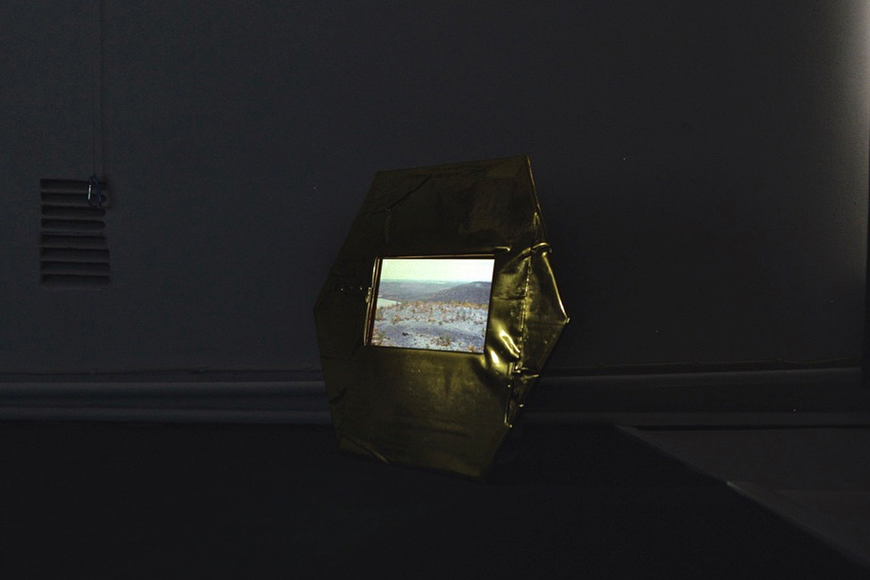
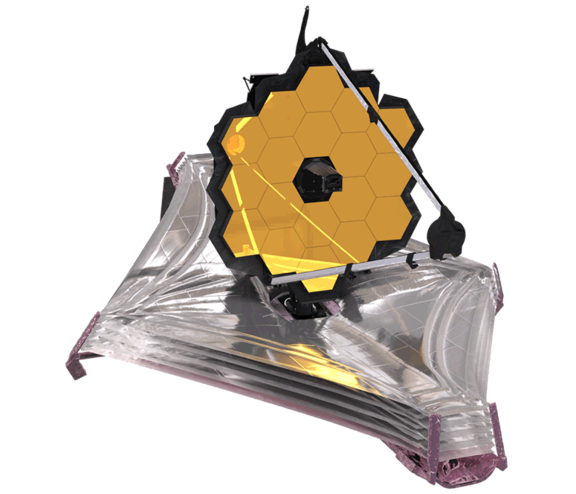
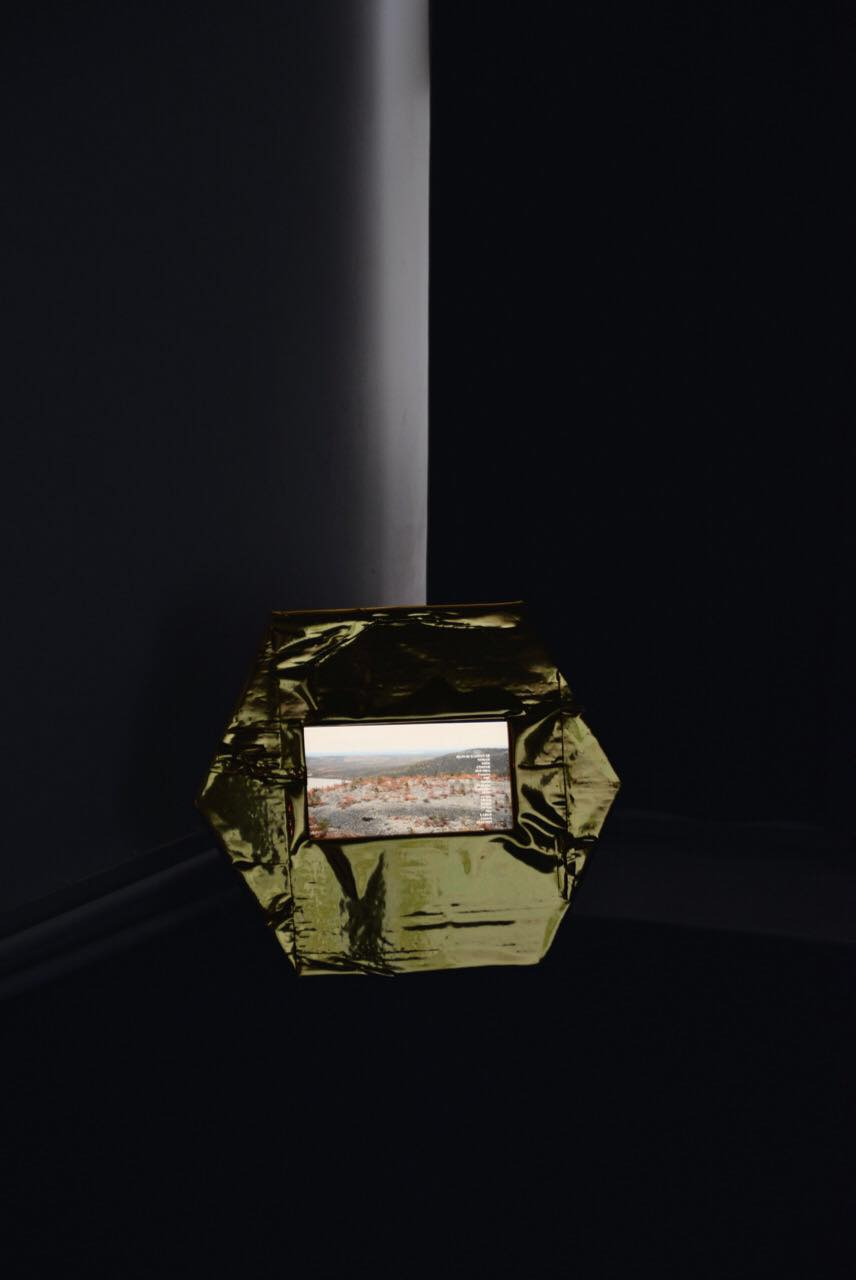
The project was carried out at the same time as the James Webb Telescope was launched into space (see https://science.nasa.gov/mission/webb/). One of the primary purposes of this largest space telescope is to collect data on potentially habitable exoplanets and their atmospheres. The installation was originally planned to open concurrently with the telescope’s launch in December 2021, but it was delayed by a month and opened in January 2022. In the installation, the video frame was designed as a reference to the telescope. The frame features a low-fi detail of the hexagonal primary mirrors, which together form the 6.5-meter diameter of the actual telescope.
The ability to perceive movement through a satellite tracking app on a mobile phone introduced a significant hyper-reading element to the evolving embodied practice. The work can be considered also as a continuation for one of my doctoral artistic research project’s artworks Seasons as Choreographers: Where Over the World is Astronaut Scott Kelly? in which I used the former Twitter social media platform as one platform to explore writing and reading.
Playfully, my role as a choreographer is to ‘hyper-read’ this satellite-generated score and interpret it as human movement on Earth. The satellite moves in a direct, uninterrupted path, while my path opened across a rugged fell, staggering on rocks, leaping between gaps, translating orbital geometry into grounded, bodily motion.
A satellite, or artificial moon, can also be seen as a connecting agent and not only linking me to planet Earth but extending my reach toward the cosmos. When considering the politics of satellites, curator Nicola Triscott (2016) writes: ‘Geostationary orbits — in which satellites circle the equator and appear stationary relative to the Earth — are hugely important for communications satellites, which have revolutionised communications and have important defence and intelligence applications.’
My focus on the movement of the satellite touches, albeit indirectly, on the geopolitical dimensions of orbital space: who has access, which nations can afford it, and who secures the most advantageous orbital positions. These artificial moons are often harnessed for military, surveillance, and communication purposes; networks through which my daily life is also partially mediated. This perspective expands my grounded choreographic approach, situating it within the broader discursive and political context of space infrastructure. As an artistic proposal, I consider the work both as an installation and as a choreographic DIY-object, embodying the metaphysical clownishness that is a core element of my artistic practice.