I am a visual artist and an art educator. In my current art practice, I am focusing on the relationship between art and nature – how to present my experience in, with and as nature, how to co-create with other species, how making art can help us notice and strengthen our connection with nature.
Ten years ago, I started painting portraits of trees and stumps. These represented the biodiversity of old-growth forests, while at the same time expressing my concern about increasing deforestation, draining of bogs, mining and other forms of exploitation of nature. Then, with my family, I moved to live in the forest and even though I had grown up in a small town near the forest, my perspective became more personally dependent on nature. I started to notice how entangled my life was with other species and how we affect each other. I wrote letters to my nonhuman neighbours as an art project and experimented with different approaches to interspecies co-creation. This has helped me to get acquainted with the nonhuman community with whom I share the house, garden and forest. With my previous paintings I had been aiming for an immersive nature experience, but living in a house in the forest provided me a first-hand and privileged experience of being part of the local ecosystem. I could say that my perspective changed from looking at the forest from a distance to experiencing it from the inside, from landscape to ‘taskscape'1.
Since then my teaching practice has changed as well, I have started to incorporate environment-aware aspects into my teaching, and have been collaborating with biologists. I am more critical of materials, and prefer natural, local and self-made tools and materials and explain to my students how materials are produced. In addition, we explore more environmental topics from different aspects and discuss the role of art in the context of environmental crises. I have found that my artistic and educational practices are more entangled, I consider teaching a part of artistic practice.
One of the approaches I have used for increasing the intertwining between art, education and nature is the approach that I will discuss in this article, namely sensory drawing in nature. Drawing (and painting) became a part of the place-based experience and a way of creating knowledge about the environment, other inhabitants and agents in the garden and forest. I understood the situatedness and embodiedness of art-based knowledge. I usually drew as a side activity to gardening, noticing interspecies encounters. Drawing outdoors allowed several other agents to intervene and affect the captured situation and thus raised my sensitivity to the environment. In the spring the air was full of love calls of birds and even though they were not singing to me, their song affected me, giving me the joy to live. In the beginning of summer, drawing was almost impossible due to mosquitos. In autumn, the leaves smelled of luxurious moisture. In winter, I drew less and if I did, I had to be very quick because of the freezing cold. While drawing and reflecting in the garden and forest, I really felt a part of nature and called this practice “sensory drawing”. Through written reflection, the process also provoked many thoughts about drawing and painting practice. I understood that the process is the most beautiful, with all its hesitations, failures, but also hopes and observations and the flow. I felt sorry for the viewers who only manage to see results but not experience the meaningful journey. This encouraged me to develop a series of sensory drawing exercises based on my practice, which I have facilitated to different groups and will discuss here.
But first, let’s take a look at the wider context. One of the tendencies causing today's complex problems is alienation from nature and lack of emotional connectedness with nonhuman species. A lot of people in urbanised countries, and especially children, have little contact with nature (Boeckel 2013). Not seeing their actions in a natural context may be a reason why studies conducted in Estonia reveal that people tend not to connect their everyday decisions and actions with environmental impact (Estonian Ministry of Environment 2022). On the other hand, several studies have shown that nature connection and pro-environmental behaviour are linked (Mackay & Schmitt 2019) and it is noted that the more people notice nature around them on a daily basis, the more they report environmentally conscious behaviours (Estonian Ministry of Climate 2023).
In this context, art practice, like the simple and accessible drawing and painting methods discussed here, can be a creative way to facilitate the increased emotional connection with the environment or even create a sense of being part of the ecosystem. From a postcolonial perspective, the drawing of nature has been criticised as objectifying or cataloguing living environments into individual species (e.g Neri 2011), however, the impact the drawing process leaves on the drawer is less discussed. Drawing in nature can create an embodied understanding of the environment and co-species, it engages the drawer and other agents and creates an understanding of one's physical and emotional connectedness with the ecosystem.
Human-nonhuman relationships and co-creation has been explored at many contemporary art exhibitions in recent years, in Estonia for example at the exhibition “Art in the Age of the Anthropocene”, in Kumu Art Museum curated by Linda Kaljundi, Ulrike Plath, Eha Komissarov, Bart Pushaw and Tiiu Saadoja and exhibition “Missing” in Tartu Art House, curated by Sara Bédard-Goulet and Marie-Laure Delaporte, to name a few. In the context of current ecological crises, I propose the role of art and artists to be reconsidered. The more participatory, dialogical and process-based modes of art would be more relevant in this context than orienting to the art market. A lot of contemporary art practices, from activism and socially engaged art to ecoventions are inclusive and interactive and as art historian Claire Bishop notes their emphasis is on collaboration, and the collective dimension of social experience (Bishop 2006: 11). I imagine this tendency would grow and educational layers will complement it, encouraging everyone's art (cf. everyone's nature conservation) towards more horizontal artistic practices and empowering the voices of different communities. Art can not be separated from everyday life, “art is thus prefigured in the very processes of living” as philosopher John Dewey (1980 [1934]: 24) has said. For facilitating artistic practice for many people, a teacher as a curator and a guide holds a crucial role.
The approach discussed in this presentation supports the understanding that in the world where many people feel alienation from nature, the value of drawing-observation-reflection could be seen in a process-oriented technique, as an opportunity to slow down, focus, observe purposefully, feel the state of flow and feel oneself as a part of nature. Even if drawing is not a new way of perceiving the world, this approach highlights the less discussed aspects of art processes in the contemporary context. I am interested in the specific nature of experience based on making art and how it enhances the connection with nature and other species. Based on this interest I explore how to curate engaging art-based experiences of nature as an artist-teacher-researcher. My research question has 3 sub-questions: 1) how to include participants with different backgrounds so that everyone feels included and can build their own experience, 2) what techniques help to focus and value the process of drawing and painting for those who are not common with making art, and 3) how can learning about and from nonhumans create connection with them?
The presentation is compiled as a journey similar to the discussed drawing workshops. You will find a theoretical and pedagogical framework discussing the embodied nature of experience, learning-by-doing and art-based environmental education. You will also find a short description of the artistic research methodology and then feel free to explore the different methods of sensory drawing. I have complemented the description of the methods with a short reflection and images2. As is common to artistic research the description of the practice and the manner it was carried out forms the embodied answer to the research questions. In addition, I summarise the result based on my reflection and participant feedback with discussion in the conclusion. Please feel free to wander around the exposition, equip yourself with a pencil and a piece of paper and try out the exercises yourself.
1 I will explain Tim Ingold’s term ‘taskscape’ in the next chapter more in detail.
2 The author has permission to use the drawings by other authors and photos where people are recongisable. Consents were asked by email.
Drawing as a journey, nonhumans as teachers, learning as creation.
Sensory drawing methods for curating experiential connection with nature
Jane Remm
On the way back. Analysis
Drawings
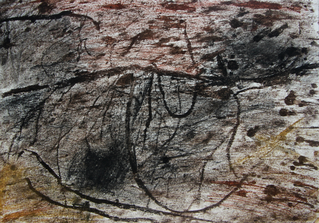
Analysing my own sensory drawings and written notions accompanying them I found that drawings reflect the bond between the drawer and nature and create similar feeling in the viewer in five categories: 1) recreating bodily sensations and feeling of embodiment, represented for example, by freezing hands, but also the shrivelling of plants, 2) depicting natural processes and relationships such as pollination or blooming, 3) emphasising connection with nature for example, through strong emotions, small personal insights, describing the interspecies relationships including with the drawer, 4) using the specificity of artistic means, for example, the airiness of watercolour. I can conclude that the drawings represent the experience of the drawer but also recreate a feeling for a viewer.
Workshop photos
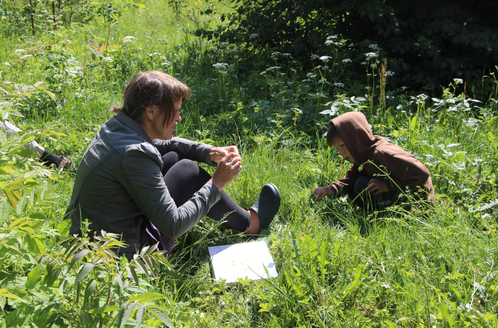
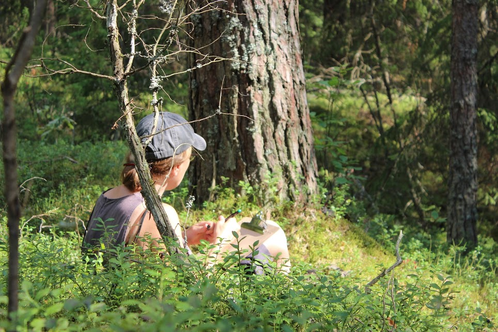
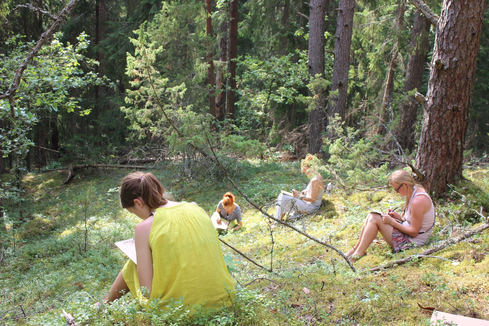
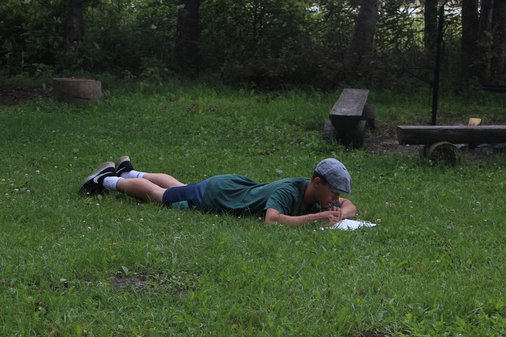
Analysing the workshop photos I see three characteristics: 1) people in the photos seem happy and engaged, focused and interested, 2) people are thinking and discussing, 3) people are engaged in a shared activity, it seems like they are enjoying learning together, which is playful and taking place in a natural environment.
Notes from the research diary
Analysing the research diary revealed many general and practical notes in the research diary: 1) the making of art and specific exercises help to see the environment as multiperspective, 2) art is experiential and embodied, people enjoyed taking creative time in the natural environment and perceive the environment through bodily perceptions, 3) drawing helps to focus attention to small details, this is empowered by proper guidance, which may also be done by nonhumans, 4) it is important to initiate discussion and reflection, but not during the activity, 5) people who are not confident in drawing appreciate alternatives to drawing and step-by-step instructions, 6) it is important to take time for each activity and not plan too much, 7) being in a group may distract from the experience of nature, so it is good to offer the option to withdraw, 8) starting with simpler and clearly defined exercises helps to transition to more abstract ones.
Participant feedback
The participants highlighted many important aspects, which helped to create an engaging experience of nature during the workshops. Many of them overlapped with my own observations. It was noted that the drawing echoed the ecosystem of the location. 1) Drawing was seen as a good way of focusing for mindful presence – it calms and deepens the experience, it helps the drawer to see closely, and to focus and think more deeply. While drawing helped to increase the experience of being present – the analysi interrupted this. As a curator of experience, it is important to relieve tension, and offer alternatives to drawing if people feel insecure about it. 2) People appreciated being able to focus on the simple and the slow, to observe small areas and the diversity of local microbiota. 3) They appreciated that the workshops offered embodied experiences, rare in daily life – experiencing nature, stroking and smelling lichen and moss, lying in the forest and listening to the surroundings. Walking barefoot evoked strong feelings – it mostly helped to increase the sense of being present through touch, but for some it was a distraction. 4) On the practical side, it was noted that in addition to drawing colour could have been used, for example, watercolour, which could have helped to express emotions better.
On the path. Methodology
This exposition features four methods of sensory drawing: 1) Listening, touching and smelling the forest, 2) Looking from another perspective, 3) Drawing as observing and reflective learning, and 4) Drawing focusing on ecological relationships. Some of them focus more on multisensorial experience in nature, some to close observation, some to relationships.
I compiled these four approaches based on my own sensory drawing practice between summer 2021 and autumn 2024 and a dozen workshops in Estonia and one in Finland. Some of the workshops took place within the framework of another event (a camp, festival or seminar), the others were initiated by myself either as separate learning sessions or in the programme of the art project “Interspecies social sculpture”. Each method has a short description and some artistic and pedagogical notes. There are instructions on how the method could be conducted for those who are interested in testing them. Texts are accompanied by my drawings and images from workshop participants, as well as photo documentation.
To answer the research question, four types of data was gathered and analysed: 1) my own drawings with written notions accompanying the drawings (n=34), 2) workshop photos (n=5 sets), 3) research diary entries which include my memories and memories from participants’ oral feedback, and 4) written participant feedback (n=11). Participant feedback was gathered via an online questionnaire after the four workshops during the project “Interspecies social sculpture” in Google forms. There were 4 questions that asked about using drawing as a way of relating to nature, most remarkable experiences and co-creation with other species.
Data was analysed in four steps: 1) visual material was described in text, 2) texts were coded by the inductive-deductive method, starting inductively and later on compiling the codes deductively based on the research question; 3) the codes were compared and divided into categories, and 4) categories were combined into main findings.
As an artist-pedagogue-researcher, I used the knowledge gained from practice, reflection of practice and feedback in the ongoing process to design the next workshops. The analyses gave me a more general understanding of how to curate an engaging art-based experience in nature. I will present the results in a generalised manner with discussion and conclusion.
Back in the garden. Discussion and conclusions
This exposition exemplified the combination of artistic and pedagogical experiences while using sensory drawing to curate the experiences relating to nature. Based on my practice and, workshops, and my analyses of both, I would like to present the key conclusions in answer to the research question of – how to curate an engaging experience with nature through sensory drawing.
- Drawing in nature creates an embodied sense of being present, it helps the drawer to calm down and slow down and thus amplifies the experience.
- Drawing helps the drawer to focus and, think while drawing and notice the less obvious and the smaller, thus perceive the environment and other agents more sensitively. People have different experiences of drawing, sensory exercises and nature. It is important to curate the drawing exercises in a way that people feel safe and related, and that the exercises empower everyone's personal perception of the environment and offer technical alternatives.
- Observing plants, animals, fungi and so on, and especially noticing and recording their relationships to one another in addition to observing one site for a longer period of time, provides an understanding of the nonhuman community of a particular place and the way it is constantly changing, and directs our thoughts to the role of humans in that place. It helps us to notice and empower the multiple perspectives of a place. Focusing on simple, local and personal relationships strengthens connectedness with a place and with nonhumans, and nature in general.
- Expectations depend on the framework for the activity. If the drawing is seen as more of a routine or performative activity, less guidance will be expected, while teaching may be more necessary when focusing on observation and depiction. If someone needs instruction, it should be available.
- Reflection within and on the activity is key to completing the experience. This can be done in various ways – each drawer writes down their thoughts privately or shares reflections in the group after the experience. It is also important to note that reflection may interrupt the experiential sense of being present that was created by drawing. It is better to keep sensory drawing, as a more direct communication with nature, and reflection, as a mediated approach, separate.
- Curating means guidance without pressure and bearing in mind alternatives for technique, group dynamics, methods of reflection and being attentive to nonhuman guidance.
The knowledge and experiences presented here are practice-based. While art theory and art history often focus on the outcome of an artist's work, the knowledge of the practitioner focuses more on the process. In the contemporary world, where many people feel alienated from nature, seeing art in a process-based manner helps bring art-based techniques closer to people and offers them another meaningful way to relate to fellow humans and nonhumans. Through inclusion, the ritual function of art becomes especially important among its other functions – the notion that art is what we all do and that making art affects the maker.
In my case, the roles of artist and art educator have become intertwined in the process of curating an experience. The knowledge of an artist-teacher is embodied – my own artistic experience has helped me to select techniques and my pedagogical know-how has helped to facilitate my personal experience for others. In current times I see the role of an artist changing towards being more of a facilitator and curator of co-creational experiences than as an individual creator.
Based on the research question the theoretical framework focuses on curating engaging experiences of, in and with nature through making art. Proceeding from the understanding that instead of merely creating knowledge about nature, participatory artistic practice helps us to relate to nonhumans through sensory, perceptual and performative practice, the theoretical framework draws on three notions: 1) experience as embodied and embedded, 2) experiential learning through art and 3) artistic practice as a performative approach to relate to nature. Based on those, the theoretical framework discusses the principles of sensory drawing in nature.
Experience of art making is embodied and embedded in the environment
As a practicing artist, I recognise the importance of tacit knowledge, both born in the process while working with materials but also the ideas and inspiration which spring from the process. Ideas about art are born while making art, merely thinking is not enough, thus the process is central for the artist. I have often realised from exhibiting artwork that the viewers only experienced the result. They did not get to experience the pleasure, hesitations and thoughts in the process. It is the process, not the artwork, that provides new experiences and learning.
Experience is based on sensory consciousness with the external world and is identified with perception. Experience of something is formed in interaction of our perceptions and environment. Umwelt, a term by Estonian based Baltic-German biologist Jakob von Uexküll, signifies the distinct and subjective perceptual realities of different organisms. Organisms perceive, experience and affect the world based on their sensory systems. An Umwelt consists of a sense net and effect net, which form the organism's relationship with its environment. (Uexküll 2012). So, the experience of an organism depends on the perceived world at the same time affecting it.
A similar notion, that an organism's experience is interrelated with its environment, is represented in phenomenology, where philosopher Maurice Merleau-Ponty is well known for arguing for perceived and embodied cognition. Body is the primary site of knowing the world and experience develops between the perceiving body and the world – the world is not what I think but what I live (Merleau-Ponty 2019 [1945]). He also stated that not only experience, but also our well-being is connected to the natural world and ability to experience it. (Merleau-Ponty 2019 [1945]). Phenomenology and the work of Merleau-Ponty has inspired enactivism, a contemporary cognitive science, which is an approach that emphasises the importance of embodied and embedded interactions of the organism with its environment in shaping its experiences. Philosopher Shaun Gallagher writes that the influence of phenomenological philosophy on enactivism is apparent in the work of Varela, Thompson and Rosch (Gallagher 2018). In The Embodied Mind (1991), which is considered the initiating text for the enactivist approach, Varela et al argue that cognition depends upon the kinds of experience that come from having a body with various sensorimotor capacities, and that these individual sensorimotor capacities are themselves embedded in a more encompassing biological, psychological, and cultural context. They also emphasise that sensory and motor processes, perception and action, are fundamentally inseparable in lived cognition. So, the embodied reality of the perceiver influences the experience and shapes the environment in return. Perception is not simply embedded within and constrained by the surrounding world; it also contributes to the enactment of this surrounding world. (Varela et al 1991: 174).
These theoretical notions support the understanding that perceiving and experiencing the world through artistic practice is embodied and embedded. In the case of visual art, first of all, the corporeal emphasis is on visual sense but not only. Making art is always performative, including activity and other senses. In the practices that I introduce in this article, I have paid particular attention to perceptions other than visual, to create a multisensory experience and to notice the situatedness in the environment.
Art-based learning about the environment means learning by experience
The process of perceiving the world and learning about it through making art, incorporates learning by doing. Experience based on making art includes both practice-based know-what – learning about the environment and our part in it – and know-how – learning about the art making process.
Learning-by-doing connects experiential educational approaches, which value student engagement, active participation and hands-on experimentation. John Dewey, one of the contributors to progressive education describes that experience as primarily an active-passive combination, it is not primarily cognitive but includes doing on its active side and undergoing on the passive. The value of an experience lies in the perception of relationships or continuities to which it leads up. (Dewey 2001 [1910]). Later, he also emphasises that not all experiences are genuinely or equally educative, some may be miseducative. He considers continuity and interaction the two main principles of experiences: the central challenge of experience-based education would be to select the kind of experiences, which live on in further experience and secondly, experiences that grow in interaction between the experience-objective and internal conditions. (Dewey 1938). Elsewhere, he also distinguishes between a continuous experience, which happens when the interaction of live creatures and environing conditions is involved in the very process of living and an experience where the material experience runs its course to fulfilment. He states that only then is it integrated within and demarcated in the general stream of experience from other experiences. (Dewey 1980 [1934]).
These types of experiences are important in curating art-based environmental activities. On the one hand, creative activities in nature offer direct sensory experiences and on the other hand curating helps to capture a certain place and time for experiencing and reflection leads to the fulfilment of experience. Art educator Jan van Boeckel has stressed the importance of art-based activities for facilitating direct sensory experience with the natural environment. He considers this more valuable for creating bonds with the environment than mere knowledge about it (Boeckel 2013). The term ‘arts-based environmental education’ was firstly coined by Finnish art educator Meri-Helga Mantere in the 1990s, and is characterised by environmental education based in an artistic approach where art is not an illustration but a starting point for perceiving and experiencing the environment sensitively and in connect to nature (Boeckel 2013: 89, 90). Using art-based methods brings about different associations and creates different knowledge to reading about nature or observing it in a scientific way. Mantere describes arts-based environmental education “by becoming more receptive to sense perceptions and observations and by using artistic methods to express personal environmental experiences and thoughts” (Mantere 1998, via Boeckel 2013: 90). The drawing exercises in this presentation spring from a similar context. In today's world, where nature is becoming rarer – less common, less biodiverse and for many less accessible, these kinds of creative experiences in nature can offer new meanings to people.
Those kinds of notions of experience together with concepts of flow, self-determination theory and reflexivity in the learning process supported the curating the experience of participants. I wanted to offer people the opportunity to experience the art making process and learn about the environment through it. To step into dialogue with Dewey, the experience of nature happens constantly while in nature, but to better notice it and experience it fully, the curation of experience is needed. It takes time and needs place, focus and reflection. I will discuss the practical application of those ideas later.
Drawing as a performative act takes us into taskscapes
I have discussed the process of curating experiences through sensory drawing in nature by focusing on experience and learning, but let’s now look at active engagement with the environment. I would claim that drawing and other types of art making activate the environment.
As mentioned earlier, as an artist, for me, the process in art is the most important in art, or as Dewey says, the word art denotes a process of doing or making (Dewey 1980 [1934]: 47). So drawing is not so much about the outcome or representation but about process and the qualities of making. Drawing is performative.
Artist and researcher Barbara Bolt argues that practice involves a “radical material performativity” and discusses how “dynamic material exchange can occur between objects, bodies and images and can produce real material effects in the world” (Bolt 2004: 8). All art is embodied through the artist and process. She discusses how the outside world interacts with the work through the process and that the crucial moment of understanding, that is the work of art, happens in this being thrown towards one's own possibilities and in the realisation of small sensations. Artistic practice involves a particular responsiveness to the world, characterised by care and responsibility. (Bolt 2004: 185, 190). I have noticed similar characteristics in my work – drawing raises sensitivity and care for the environment.
Drawing is performative and through the sensitivity of drawing, the landscape where it happens becomes lived, becomes a taskscape in Tim Ingold's terms and the drawer becomes part of it. Anthropologist Tim Ingold (2000) uses the term 'taskscape' to describe a space of activities which is perceived through active engagement and interactively with other agents. He compares landscape to painting and taskscape to music, although admitting that in the case of painting, the process may be pivotal and it can be seen in performative terms. Thus, the drawer embodies the landscape and the drawing helps her/him to notice the essence and engage with the multisensorial nature. The sensory drawing discussed here focuses on creating the sense of being in the taskscape, being part of a particular natural environment. It happens through the processual nature of drawing. The drawer, whether myself as an artist or the group participants, are exposed to nature that is constantly changing and multisensorial. Artist and artistic researcher Linde Ex (2024) describes, based on her experiments of drawing landscapes as 'land-shapes' and 'sooth-scapes', how the process of drawing has a way of making you experience the things that you draw in a processual way, echoing back to my approach.
Sensory drawing as a participatory way to engage and learn about the environment
So how exactly does drawing facilitate the experience of the environment? I use the term 'sensory drawing' to describe a set of methods where while drawing in nature, attention is paid to the information received by different senses in addition to what is depicted and a connection between the drawer and environment is created. Such sensory drawing is a method for focusing on, perceiving the multisensorial environment and imagining the perspectives of other species. Pencil and brush are the means for more attentive noticing, while the process is central, not the masterful result. Even though I use drawing as a technique for facilitation and a way to learn something, I don't see it as an end in itself.
I have combined practice-based knowledge from my own drawing and painting practice, my observations in nature and some notions from biosemiotics and environmental humanities along with my competencies as an educator to translate and offer the experience to more people. I have conducted the drawing exercises in small groups in informal learning settings. Sometimes the meetings have been part of a longer event where the group is familiar with each other, sometimes people meet for the first time. I am a curator of experience who provides points of reference but I don’t set direct frameworks. As a curator (curate derives from the Latin word curare meaning care) I must take good care of the participants, both as a group and respecting their individual experiences. I have conceptualised the exercises so that everyone has an opportunity to create their own way of relating to the environment. People have very different prior experience, some are excellent drawers, some do not want to draw, some are afraid of being wrong. Thus, it is important to keep in mind the basic psychological needs of self-determination theory (Deci & Ryan 2000) and be aware that people feel cared for and included in the group (relatedness), that the description of the exercises allows for different approaches and solutions (autonomy) and that they can be done with differing prior competencies, but instruction would be available if someone needs it (competency).
If If people are taken care of, we can focus on the specific qualities of sensory drawing. Firstly, I have experienced how a pencil helps us to focus – the plants and their relationship to each other catch our attention and thus help us to slow down. When the movement of a pencil is already partly automatic it creates a sense of flow – an observation described by Mihaly Csikszentmihalyi (Csikszentmihalyi 1990). Drawing helps us to learn about the plants, insects and fungi through observation. Secondly, while concentrating on something specific through visual observations, the other senses work intensively and create the sense of being part of the environment. This is amplified by written and oral reflection, which is one of the key parts of sensory drawing, helping one become more aware of one’s role in the process. I have asked people to reflect on their experiences in the process and we have conducted reflective discussions on the process. However, I am also aware that reflexivity may create a distance from the direct experience. Thirdly, I explore some of the theoretical concepts of environmental humanities through drawing – for example, I have found the entanglements of plants extremely fascinating and as a cure against 'plant blindness' I have been studying them using a pencil.