Exposition

Drawing as a journey, nonhumans as teachers, learning as creation. Sensory drawing methods for curating experiential connection with nature (2025)

Jane Remm
About this exposition

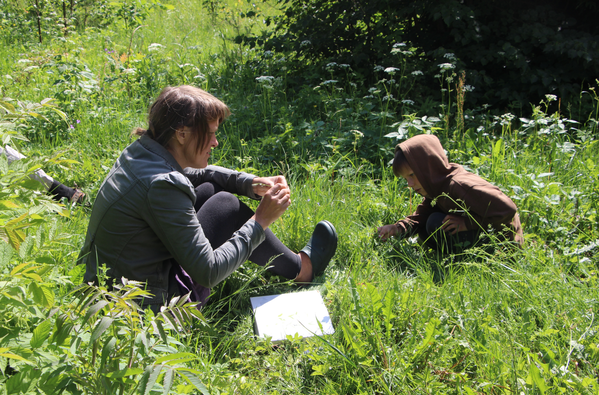
The presentation focuses on inclusive sensory drawing as a way to observe, notice and interact with non-human species in local nature, imagine their perspectives and reflect on the experience. It is known that many people today feel alienated from nature while on the other hand connection to nature is linked to pro-environmental behaviour. As an artist and art educator I have been wondering how participatory artistic and educational practices can reinforce the emotional and physical connection with nature, how to create conditions for perceiving the intertwinedness and mutual dependence, moreover, what could be the role of art and art education in the post-growth conditions. Drawing is not a new method for observing nature, but I find the inclusive drawing activities to be relevant to facilitate creative nature experience in contemporary context. As an artist, I have been using sensory drawing and realised how using the pencil and brush as facilitators help me to concentrate, slow down, notice interactions and sense myself as a part of the ecosystem. I have used the embodied and situated artistic thinking as a source for drawing walks and workshops in gardens, forests and parks and introduce some of the simple exercises in this presentation, asking how and which drawing and painting approaches facilitate active engagement with the environment and what is the intersection between artistic practice, environmental and artist pedagogy. I describe the specifics of four methods. These kind of curated nature experiences offer possibilities to recognise other beings, their relationships and ourselves as related to them through actions and reflections.
typeresearch exposition
keywordsdrawing, visual art, reflection in action, artist pedagogy, sense-based drawing, other perspectives, environmental awareness, environmental art, environmental art education
date28/11/2024
published30/12/2025
last modified30/12/2025
statuspublished
copyrightJane Remm
licenseCC BY-NC-ND
languageEnglish
urlhttps://www.researchcatalogue.net/view/3235639/3235640
doihttps://doi.org/10.22501/ruu.3235639
published inRUUKKU - Studies in Artistic Research
portal issue24. Artist Pedagogy

References

  • Bishop, Claire, “Introduction//Viewers As Producer”, in Participation, ed. by Claire Bishop (Whitechapel, London: The MIT Press: Cambridge, Massachusetts, Series. Documents of Contemporary Art, 2006), pp. 10–17
  • Boeckel, Jan van, At the Heart of Art and Earth: An Exploration of Practices in Arts-Based Environmental Education (Aalto University, 2013) <10.1080/13504622.2014.959474>
  • Bolt, Barbara, Art Beyond Representation. The Performative Power of the Image (London, New York: I.B. Tauris, 2004)
  • Borgdorff, Henk, “The Conflict of the Faculties: Perspectives on Academic Research and Academia”., 2012
  • Csikszentmihalyi, Mihaly, Flow: The Psychology of Optimal Experience (Harper &amp; Row, 1990)
  • Deci, Edward L., and Richard M. Ryan, “Self-Determination Theory and the Facilitation of Intrinsic Motivation, Social Development, and Well-Being”, American Psychologist, 55(1) (American Psychological Association, 2000), pp. 68–78 <https://doi.org/https://doi.org/10.1037/0003-066X.55.1.68>
  • Dewey, John, Art As Experience (Perigee Books, 1980)
  • Dewey, John, Democracy and Education (A Penn State Electronic Classics Series Publication, 2001)
  • Dewey, John, Experience and Education (Simon &amp; Shuster, 1938) <https://ruby.fgcu.edu/courses/ndemers/colloquium/experienceducationdewey.pdf>
  • Ex, Linde, “How to Approach and Engage With Underwhelming Landscapes Methods Developed in the Artistic Research Project Landshapes, Sooth-Scapes”, FORUM+ 64, October vol 31, no 2 (Brepols, 2024), pp. 56-65
  • Farina, Almo, and Andrea Belgrano, “The Eco-Field Hypothesis: Toward a Cognitive Landscape”, Landscape Ecology, 21 (1) (Springer, 2006), pp. 5-17 <https://doi.org/10.1007/s10980-005-7755-x>
  • Gallagher, Shaun, “A Well-Trodden Path: From Phenomenology to Enactivism”, Filosofisk Supplement, 3 (University of Oslo, 2018)
  • Ingold, Tim, The Perception of the Environment: Essays on Livelihood, Dwelling and Skill (Psychology Press, 2000)
  • John, Dewey, Art As Experience (A Perigee Book, 1980)
  • Jokela, Timo, Mirja Hiltunen, and Elina Härkönen, “Contemporary Art Education Meets the International, Multicultural North”, in Conversations on Finnish Art Education, ed. by M. Kallio-Tavin & J. Pullinen (Helsinki: Aalto University, 2015), pp. 260–276
  • Keskkonnaministeerium, 2022, “ Turuuringute AS”. <https://kliimaministeerium.ee/sites/default/files/documents/2022-11/2022%20Keskkonnateadlikkuse%20uuring.pdf> [accessed 20 November 2024]
  • Kliimaministeerium, 2023, “ Turuuringute AS”. <https://kliimaministeerium.ee/sites/default/files/documents> [accessed 20 November 2024]
  • Kull, Kalevi, “ The Biosemiotic Fundamentals of Aesthetics: Beauty Is the Perfect Semiotic Fitting”., Biosemotics, 1 (Springer, 2022) <https://doi.org/https://doi.org/10.1007/S12304-022-09476-W>
  • Mackay, Caroline M.L, and Michael T. Schmitt, “Do People Who Feel Connected to Nature Do More to Protect It? A Meta-Analysis”, Journal of Environmental Psychology, Volume 65, October 2019, 101323 (Elsevier, 2019) <https://doi.org/https://doi.org/10.1016/j.jenvp.2019.101323>
  • Merleau-Ponty, Maurice, Taju Fenomenoloogia (Tartu: Ilmamaa, 2019)
  • Neri, Janice, The Insect and the Image: Visualizing Nature in Early Modern Europe, 1500-1700. (University of Minnesota Press., 2011)
  • Uexküll, Jakob von, Omailmad (Tartu: Ilmamaa, 2012)
  • Varela, Francicso, Evan Thompson, and Eleanor Rosch, The Embodied Mind (Cambridge, MA: MIT Press, 1991) <https://monoskop.org/images/2/21/Varela_Thompson_Rosch_The_Embodied_Mind_Cognitive_Science_and_Human_Experience_1991.pdf>

Copyrights


Comments are only available for registered users.