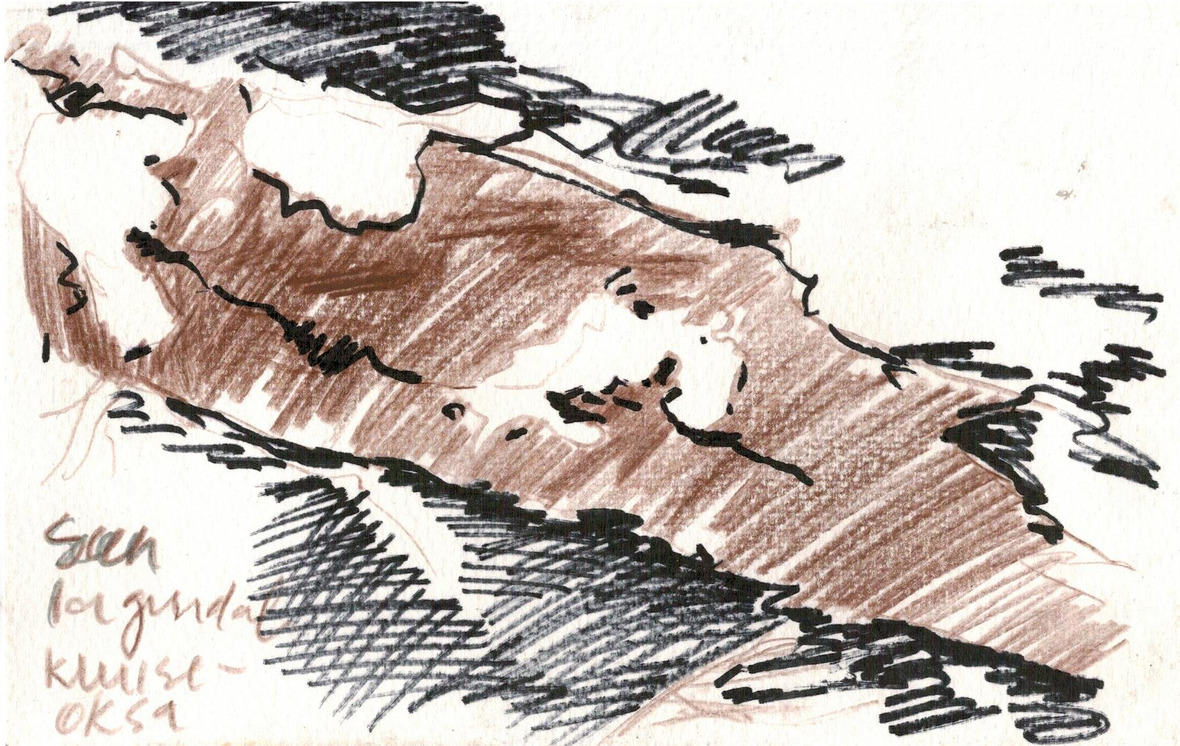
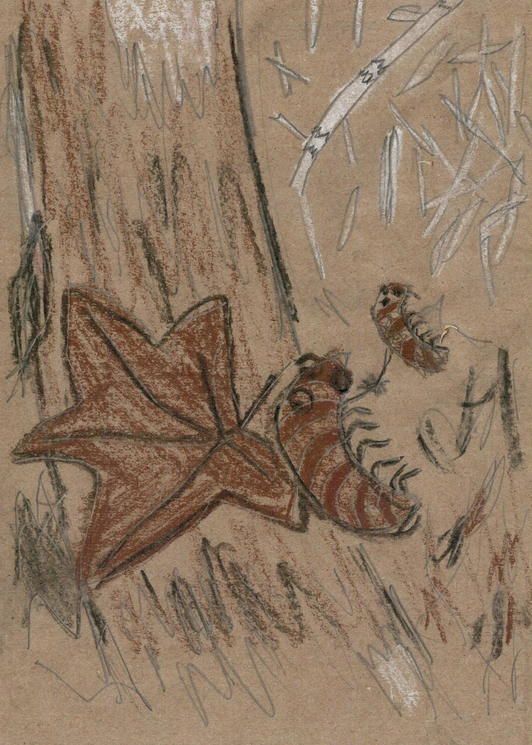
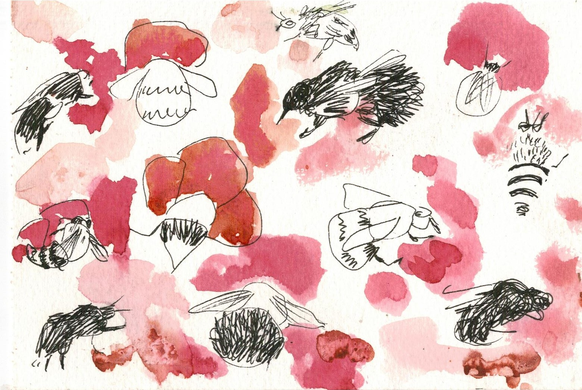
Observing, drawing and reflecting on interspecies interaction and co-creation, "Garden diary" by Jane Remm, 2024. Photos by: Jane Remm
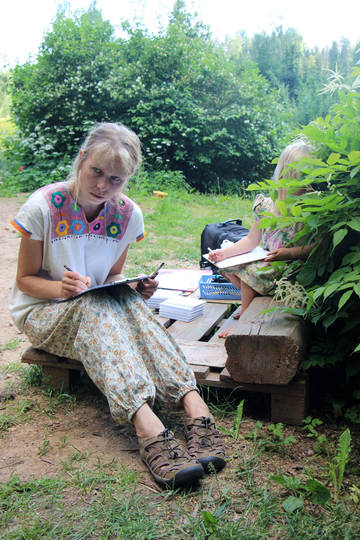
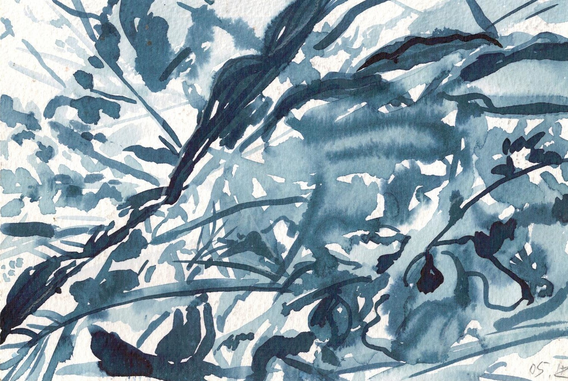
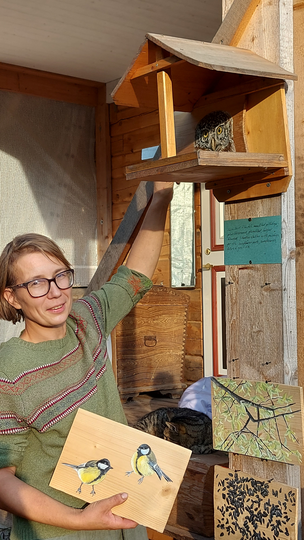
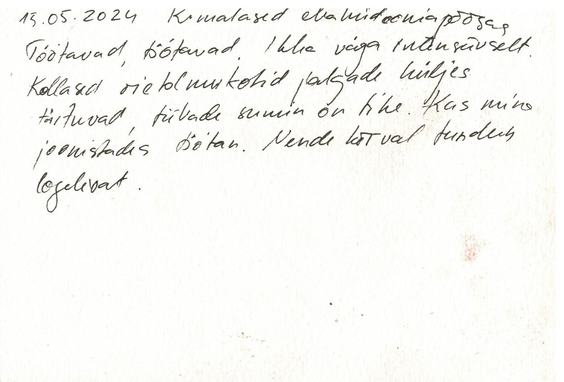
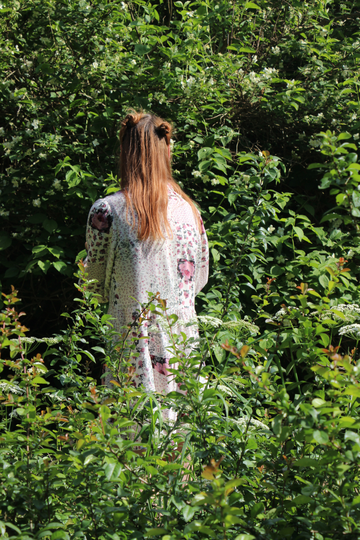
This method focuses on ecological relationships. I have conducted it since summer 2024 and it grew out from observing, drawing and reflecting on drawing in the garden. I was especially interested in noticing and capturing co-creation of other species in the garden. For example there were sunflower seeds eaten by the tits in the winter which turned into sunflowers. Or in another place, the ants had moved to live in the trunk of the old apple tree which is almost falling over, but every year it grows more and more apples, along with the ants. The garden is in constant collaborative change, someone eats someone, gets pollinated or fertilised, someone offers someone a place to nest or hide. Plants offer each other support and nutrition, moss finds a place on a slanted tree. The more biodiverse the place is the more relations there are and the more communication and relation there are co-creation, the more interpretations, and following Kalevi Kull's (Kull 2022) idea that semiosis itself is aesthetics, the more beauty there is.
Based on the Umwelt theory and theory of ecofields, which refers to „a spatial configuration carrier of a specific meaning perceived when a specific living function is activated /.../ a species-specific cognitive landscape is composed of all the spatial configurations involved for all the living functions for a particular organism“ (Farina & Belgrano 2006), we can imagine how many parallel worlds in the garden are simultaneously intertwined. Thus, a biodiverse garden can be a shelter for many species, where many functions of the ecofield are activated. An approach which helped to see the several perspectives and layers in the garden was introduced by professor Timo Maran taking place during the project "Interspecies social sculpture“ in June 2024, where he introduced the practical applications of mapping Umwelten and ecofields. In this way, the garden as a stable environment disappeared, instead there are several gardens and their interactions.
The other emphasis of this method besides focusing on the process, is creating personal connections with the place. The drawer observes and reflects their own senses and thoughts and their role related to the place thus forming a personal relationship with this place. Noticing many relationships in the garden leads to asking what is the human role there and how to be an equal, not dominant co-creational partner. This method helps to create personally meaningful relationships, either in one's own garden, someone else's or in public areas. Focusing on simple, local and personal empowers connectedness with the place and with non-humans and nature in general. We do protect what we know and consider personally important. I would propose that the aesthetic of postgrowth, could be focusing more on ecological relationships.
Instructions
-
Materials. Select the materials you are used to. You may need both pencils or pens for lines and charcoal or paint for volume.
-
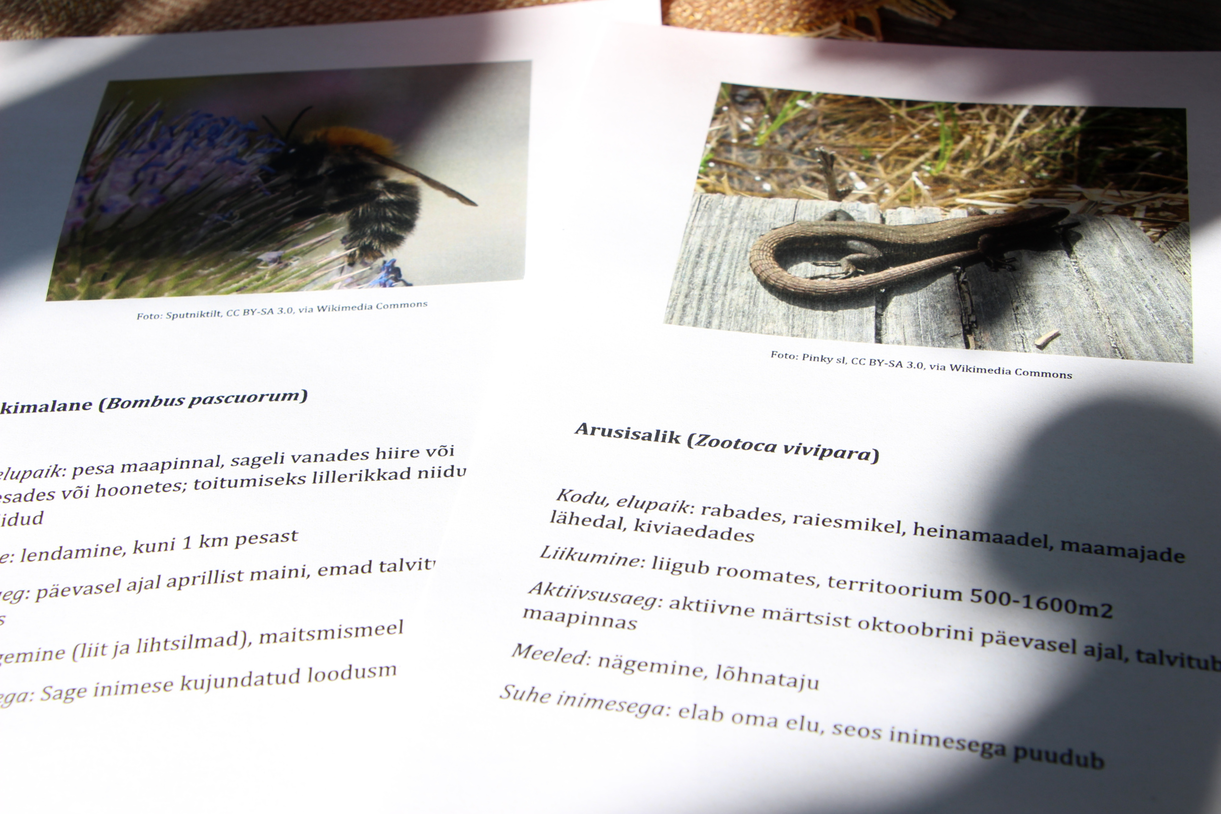
Place. If you own a garden, for to see more relationships there, increase the place's biodiversity – create different types of habitats for different species: dry and stony areas, wet puddles, piles of twigs and compost, high grass and cultivated plants. The more biodiversity, the more there will be different types of relationships to observe. Select an exciting place for observation where you can notice interspecies relationships, either related to food or partnership, communication or environmental connections. For example you may notice how bumblebees pollinate apple trees or fungi decompose the wood, how plants are entangled nealing towards sun or birds carry seeds into the garden.
-
Interspecies relationships. Look carefully, whom do you notice and what are they doing? What is the nonhuman community of the place like? How does knowing who they are and to whom they are related, help us understand the relationships? How does the ecological knowledge help to understand the community? How does the knowledge about their Umwelten and ecofields help us? It is good to learn or remember this knowledge but sometimes a careful and long-term observation reveals as much information about a place.
-
Draw a close-up from nature emphasising the relations.
-
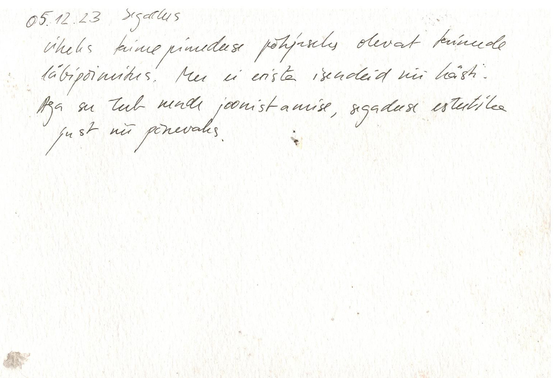
Write down what you know and learned about the relationships.