
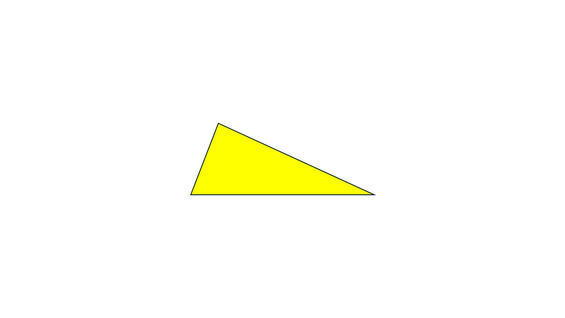
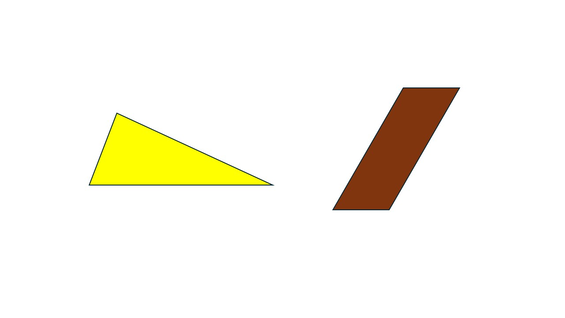
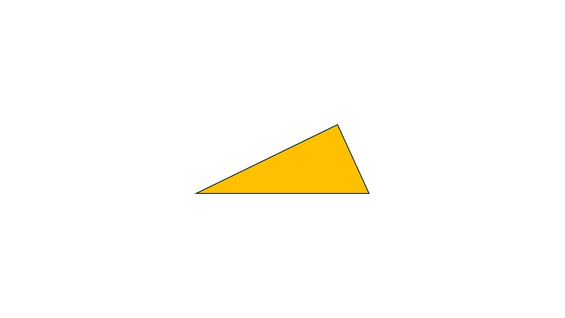
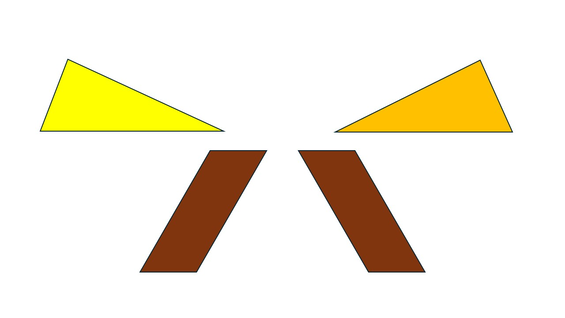









Hold the five‑string kantele in your lap, positioning the bottom corner of the long side against your legs so that the shortest string lies closest to you. Alternatively, place the instrument on a table. Rest your right palm on the edge of the ponsi and your left palm on the corner where the tuning‑peg side meets the short side, keeping the upper tuning pegs within your left palm. Adjust your hands so they do not accidentally touch the strings and dampen their vibration. Supporting your hands on the edges of the instrument allows you to play without looking at the strings, letting you concentrate fully on the sound. Find a relaxed posture in which each finger can easily reach its intended string.
Pattern 1.
- Play string 1 (the longest) with your right index finger and string 5 (the shortest) with your right thumb.
- If you prefer, you may also use your middle finger on the longest string, as shown in the video.
- Later, you will notice that I alternate between my right index finger and left ring finger on string 2 (the second longest).
- Pluck the strings and let them vibrate freely — avoid touching them again too soon.
- Listen carefully to the sound, and experiment with different rhythms.
Pattern 2.
- Play strings 1 and 5 alternately with your right hand in a steady pulse.
- After each note played with the right thumb, add one of the middle strings with your left hand:
- string 4 (second shortest) with your left index finger
- string 3 (middle) with your left middle finger
- string 2 (second longest) with your left ring finger
- Vary their order according to your preference.
Pattern 4.
Play as in Pattern 2, but now add one of the left hand notes immediately after string 1, that is, before the thumb note.
Pattern 5.
- Combine the previous patterns as you see fit.
- Explore different combinations and listen to how the sound changes.
Pattern 6.
- Add a left‑hand note both after string 1 (the longest) and after string 5 (the shortest).
- This creates the so‑called alternating hand technique, in which the left and right hands take turns.
Pattern 7.
- Combine the patterns you have learned according to your own preferences.
- Pay attention to the quality of your touch: adjust the position of your fingers on the strings, the angle at which you pluck them, and the force of your plucking.
- Find the sound quality that you like. Vary the emphasis on different notes by playing some more strongly than others, and listen for emerging melody lines.
- Change your fingering so that your right‑hand index finger plays string 2 (second longest) and your right‑hand middle finger plays string 1 (longest).
- With this fingering, only strings 3 and 4 (second and third shortest) remain for your left hand.
- Play the same idea, placing the left‑hand notes between those from your right hand. Reflect on how this changes the music.
- You can also deviate from the alternating‑hand technique by playing consecutive notes with the same hand fingers.
Pattern 8.
- Play strings 1 and 5 simultaneously, then play any individual strings as you like (using the same fingering as before), and finish again with strings 1 and 5 together.
- Place simultaneous 1–5 notes somewhere other than at the beginning or end of the phrase.
- Repeat the idea, but replace string 1 with string 2, 3, or 4, played together with string 5.
- Repeat again, but this time keep string 1 and replace string 5 with string 4, 3, or 2. Reflect on how the atmosphere and sound differ.
- Explore other options to replace strings 1 and 5 — for example, play strings 2 and 4, 2 and 3, or 3 and 4 together.
- Try playing three notes at once: begin by adding one left hand note to strings 1 and 5.
- Consider other ways to combine three notes.
- Experiment by playing four notes at the same time and listen to the result.
Pattern 9.
- Combine all the patterns you have learnt above according to your own preferences.
- Explore how different combinations change the overall texture and mood of the music.
Pattern 10.
- Change the nuances by playing the notes from Pattern 8 slightly out of sync rather than completely in unison.
- Begin with two notes, then experiment with three and four.
- Vary the strength, emphasis, and order of the notes.
Pattern 11.
- Combine all the patterns you have learned above as you see fit.
- Notice how your choices shape the overall flow and atmosphere of the music.
Pattern 12.
- Construct phrases of varying lengths, like musical sentences.
- Modify and combine the patterns you have learned above as you see fit.
- Let the length of each phrase follow your own train of thought.
- Create a continuum of verses — tell a story through your playing.
- Does your experience change if you do not follow your fingers with your eyes or if you close your eyes completely?
Pattern 13.
- Think of a story or recall an event, and play it using everything you have learned above.
- Choose an image that interests you and play it.
- Choose a text and play it.
- Communicate with another player to build a story together.
- How does the music change when it is inspired by words, images, or shared dialogue?
Pattern 14.
- · Change the home tone (tonic) to string 2.
- Play as before, but think of string 2 as the basis and the goal to which you always return.
- Reflect: how did the mood change when you changed the home tone?
- Experiment: can you change the home tone to other strings as well?
Pattern 15.
- Combine everything you have learnt.
- Explore freely how the different touches, and combinations interact.
- Notice how your choices shape the overall flow, atmosphere, and musical narrative.
Pattern 16.
- Let your playing and its story proceed at a free rhythm and varying tempo, or give it an internal pulse.
- Ask yourself: does anything change if you count the pulse in your mind to either two or four?
- Explore how counting slowly to two or quickly to four affects the mood and structure of your playing
- Notice that the slower the pulse, the more time there is for additional notes between the beats.
Pattern 17.
- Change the pulse to a triple beat.
- Try counting the rhythm slowly to three or faster to six.
Pattern 18.
- · Change the pulse to 5 beats.
- First, count the rhythm slowly to five in your head and play along.
- Then speed up the pulse and think of it as a combination of two and three beats.
- Notice how the rhythm feels slightly different if you count 1‑2‑3‑1‑2 or 1‑2‑1‑2‑3
Pattern 19.
- Many different rhythms can be built from combinations of two and three beats.
- For example:
- A 7‑beat rhythm can be created by combining 3+2+2.
- A 10‑beat rhythm can be formed by combining 3+3+2+2.
- Experiment with other groupings of twos and threes, and listen to how each combination shapes the flow and character of your playing
Pattern 20.
- Combine everything you have learned above.
-
Build a story or simply listen to the essence of the music.
-
Create phrases of different lengths that you can play freely or at a pulse of your choice.
-
If you feel like it, change the pulse and the position of the home note in the middle of the story.
-
Make different combinations of notes, vary the dynamics, and change the accents, touch, and tone colours.
-
Adjust your fingering according to the needs of the music.
-
Finally, stop analysing and making decisions — immerse yourself in the music and let it take its own course.
-
Adjust the tuning of the kantele as you prefer.
The videos below illustrate the possibilities offered by the presented patterns. Rather than reproducing the playing exactly as shown, the aim is to engage with the video through your own playing and to develop individual solutions.
When the example video shows a variation from the basic pattern, take it as inspiration, not as an error.
The videos present three distinct five-string kanteles. Steel-string kanteles represent the traditional models in use today; they consist of several parts, with metal tuning pegs and thin steel strings. Their tuning follows current common practice: the first five notes of the D major scale.
The dark, bronze-stringed kantele visible in the videos on the right is a replica made by Rauno Nieminen of a hollow instrument built in 1833 by Ontrei Malinen from Viena Karelia. It is carved out from below, with the underside left open. A photograph of the original kantele can be found on the finna.fi website (National Museum of Finland, Ethnographic Collections, K1855:37).
Although modern steel-string models also differ in tone, their sound is worlds apart from that of the 19th century brass- and bronze-stringed kanteles. In these examples, the dark replica is tuned five tones lower than the steel-string kanteles, meaning that its shortest string corresponds in pitch to the longest string of the steel string instruments. You can play your own kantele together with the bronze-string replica and listen to the combined resonance of the ensemble.
If you wish, the videos can be enlarged using the arrows in the bottom right hand corner.
This video shows examples of how string material and tuning pitch affect the tone, along with a demonstration of basic fingerings.