The Research Catalogue (RC) is a non-commercial, collaboration and publishing platform for artistic research provided by the
Society for Artistic Research. The RC is free to use for artists and
researchers. It
serves also as a backbone for teaching purposes, student assessment, peer review workflows and research funding administration. It strives to be
an open space for experimentation and exchange.
recent activities <>
How to give the body a voice: map of the research
(2026)
Johana Jurášová, Filip Novák
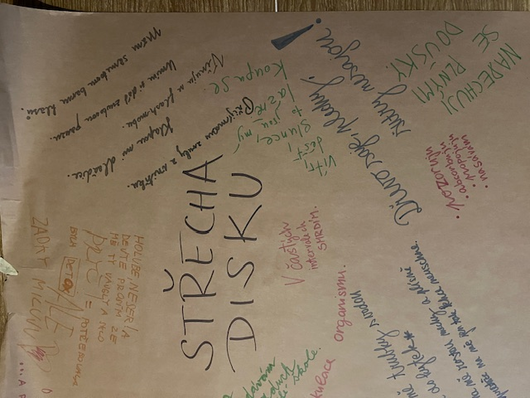
This exhibition presents the context, process, and conclusions of the artistic research project Imagination as a Tool for Change in Shared Space, carried out at DAMU. At the heart of the research is the question: How can we give the body a voice? In other words, how can we invite bodily perception and imagination into the process of decision-making and exploration, while at the same time perceiving these qualities as fully-fledged mediators of information? The backbone of the research consists of a pair of workshops designed to guide students through the exploration and reflection on the theme of the chill zone at DAMU. A series of exercises aimed to awaken their somatic and sensory perception, followed by an exploration of spaces designated for rest, and finally imaginative exercises with the aim of proposing possible changes or forms for the spaces.
The exhibition presents the individual layers of the project:
1) In the contextual layer, we acquaint readers with our personal starting points (chapter: Medallions), with the theoretical and practical-experiential foundations on which we consciously build (chapter: Introduction), and with methodological procedures (chapter: Methodology).
2) At the center is the documentary layer, which describes the structure of the workshops, the creative outputs of the participants, and a chronicle mapping the transformation of the research team's thinking, documenting the lively dialogue between the discourses of transformative pedagogy and embodied learning in acting and authorship.
3) The layer of findings and conclusions identifies two fundamental qualities: (a) the concept of "sensitized researchers", in which bodily and sensory perception provides a full report on the surrounding world, and (b) the situation of being in the imagery, in which working with the imagination offers possible proposals for change. In conclusion, we look back at the reasons for the changes in the original research questions and consider further possible directions for research.
Tato expozice prezentuje kontext, proces a závěry uměleckého výzkumu Imaginace jako nástroj změny ve sdíleném prostoru realizovaného na DAMU. V centru výzkumu stojí otázka: Jak dát tělu hlas? Neboli jak do procesu rozhodování a zkoumání přizvat tělesné vnímaní a imaginaci a jak zároveň tyto kvality vnímat jako plnohodnotné zprostředkovatele informací. Páteř výzkumu tvoří dvojice workshopů, které byly navrženy tak, aby studující provedly zkoumáním a promýšlením tématu chill-zóny na DAMU. Série cvičení směřovala k probuzení jejich tělesné a smyslové vnímavosti, následně ke zkoumání prostor určených pro odpočinek a v závěru k imaginativním cvičením s cílem navrhnout možné změny či podobu prostor.
Expozice představuje jednotlivé vrstvy projektu:
1) V kontextová vrstvě seznamujeme čtenáře s našimi osobními výchozími pozicemi (kap. Medailonky), s teoretickými a prakticko-zkušenostními východisky, na které vědomě navazujeme (kap. Úvod), a s metodologickými postupy (kap. Metodologie).
2) V centru stojí dokumentární vrstva přibližující strukturu workshopů, kreativní výstupy účastnictva a kroniku mapující proměnu myšlení výzkumného týmu, dokládající živý dialog mezi diskurzy transformativní pedagogiky a vtěleného učení k herectví a autorství.
3) Vrstva zjištění a závěrů identifikuje dvě zásadní kvality: (a) koncept „zcitlivělé výzkumnictvo“, kdy tělesné a smyslové vnímání přináší plnohodnotnou zprávu o okolním světě, a (b) situaci bytí v představě, kdy práce s imaginací nabízí možné návrhy ke změně. V závěru se ohlížíme za důvody změn původních výzkumných otázek a promýšlíme další možné směřování výzkumu.
Varder: Words and Images from a Brief Watch in the Arctic
(2026)
Sam Horowitz
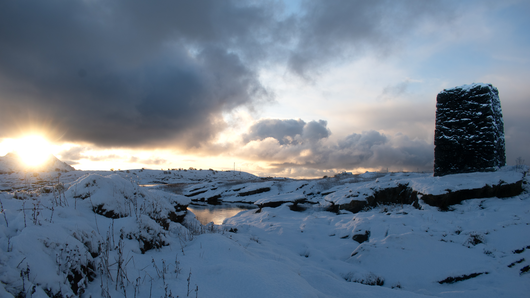
The Varder are a system of marine navigational aids along the Norwegian coast originating from the age of sail. Officially still part of the oldest maritime navigational system still in use, these forms now act as anchors to a physical present. In a digital society losing its patience, the Varder stand in contrast to the accelerations surrounding them: analogue, material, and static.
Staging the Invisible Elephant that Remains Overlooked
(2026)
Verena Miedl-Faißt
In the scope of my PhD-in-Art project “Staging the Invisible Elephant that Remains Overlooked”, I investigate collaborative and co-creative work with children as equal partners – from my perspectives as an artist, workshop leader, teacher, aunt, recent mother, and adult friend. The intersections, tensions, and synergies between artistic research and pedagogical practice form the core of my research.
Spanning 2017–2025 the work unfolds as an open, reflective process grounded in project-based artistic practice, dialogical encounters, and reflective writing. Additionally, reading experiences in different literary and scientific fields serve as resonant spaces in which insights take shape and intensify. Recurring themes include the interplay of structure and freedom; the negotiation of shared authorship, responsibility, representation and ethics in co-creative work with children across different contexts; and the possibilities and limitations of conducting artistic research “at eye level” within school environments. I also examine the potentials that artistic approaches offer in addressing contemporary pedagogical challenges related to digital technologies, social media, and artificial intelligence.
In accordance with the principles of artistic research, I understand ambiguity, contradiction, and subjectivity as methodological strengths. I foreground transparency, vulnerability, and the transformative potential of misunderstanding, and I propose ways in which we might relate to one another differently in a complex world and strengthen democracies at risk.
recent publications <>
FACE NO DIAL OF A CLOCK. Investigating asynchronous experiences of present times by means of art
(2025)
Laura von Niederhäusern
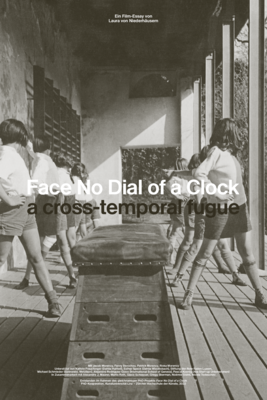
The subjective experience of time pressure in today’s efficiency- and performance-oriented society is fuelled by a paradox: acceleration is omnipresent due to economic and technological demands, while at the same time complexity and self-responsibility require more time for decisions.
This exposition examines individual and institutional ways of dealing with discrepant time demands. Where and how do different age groups experience divergent time regimes that occur simultaneously? Which techniques do individuals and institutions use or invent to synchronize different time perceptions, rhythms, and activities? How can artistic research create asynchronicity and make it experienceable through filmic means? And, finally, to what extent can filmic thinking produce ways of knowing that convey (as yet) unverbalized perceptions of time?
Methodologically, this research combines analytical and artistic approaches in an essayistic procedure comprising cinematic practice and writing. On the one hand, it explores different aspects of divergent perceptions of time in a series of case studies under the leitmotif of “asynchronous determinations of time.” Situated in both immaterial and care work, in which bodily and affective temporalities are highly important, these empirical investigations consider the role of lifetime (age, biography, memory) and temporal modes (tempos; imperatives, indicatives, subjunctives). On the other hand, this study develops specific artistic procedures for focusing perception by means of narration, fragmentation, montage, visual and linguistic interventions, extractions and interweavings. Since simultaneous non-simultaneities (tend to) overwhelm subjective experience, the procedures adopted in this research contribute to new forms of filmic thinking and images of thought. They should be understood as an incentive to empathize with different understandings of time.
Voicing Spatial Songs
(2025)
Louise Lind Foo, Sharin Foo
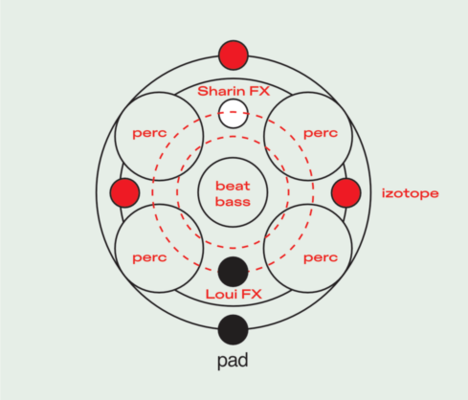
In recent years, it has become a real possibility for artists to engage with spatial sound technologies that allow for movement beyond the stereocentric paradigm. Thus, spatialization has mostly lent itself to avant-garde traditions, electronic music, and sound art. However, the rapid advancements of technologies have called for artists, songwriters, and musicians of all genres to contribute to this development not only by following and fitting into these new formats but also by shaping them through artistic engagements with them. When considering sound in space as a new component in the music creation toolbox, a new dimension is added that provides creative and performative potentials of situating songwriting and music creation within a spatial sound practice. Beyond the literal, what kinds of metaphorical or emotional resonance can emerge from the vibration between various bodies, such as composers, performers, and audiences, as well as bodies of sound, technologies, interfaces, instruments, scene, setting, speakers, aesthetics, and orientations? Voicing Spatial Songs was conducted by avant-pop duo SØSTR, which consists of sisters Louise Lind Foo and Sharin Foo.
Erased Museums – Destroyed Collections as Conceptual Inheritance
(2025)
Dorian Vale
This essay proposes the “Erased Museum” as both a critical framework and an institutional ethics: a museum that recognizes loss as its primary collection and disappearance as a mode of curation. Drawing from Absential Aesthetics, it argues that destruction—by fire, flood, war, neglect, theft, or obsolescence—does not terminate cultural meaning but reorganizes it into a second, invisible archive composed of voids, residues, and public conscience. Through case studies and touchstones including the Library of Alexandria, Brazil’s National Museum (2018), the Mosul Museum (2015), and architectural and curatorial practices that preserve wounds rather than conceal them (e.g., post-damage restorations and void-centered memorial architectures), the essay reframes conservation as a dialogue with entropy rather than a fantasy of permanence. It also traces contemporary artistic strategies that curate absence directly—fabricated archives, missing inventories, empty frames, restitution bureaucracies—showing how loss can become documentation rather than mere lament. The work concludes by extending the ethics of disappearance to the digital domain, where decay occurs without smoke, and by proposing “transparent loss protocols” as a future-facing curatorial responsibility.