The Research Catalogue (RC) is a non-commercial, collaboration and publishing platform for artistic research provided by the
Society for Artistic Research. The RC is free to use for artists and
researchers. It
serves also as a backbone for teaching purposes, student assessment, peer review workflows and research funding administration. It strives to be
an open space for experimentation and exchange.
recent activities <>
Warping Protest: Increasing Inclusion and Widening Access to Art Activism Utilising Textiles
(2026)
Britta Fluevog

Art activism is powerful. Also known as activist art, protest art, visual activism, artivism and creative activism, it changes lives, situations and is and has been a powerful weapon across a whole spectrum of struggles for justice. Teresa Sanz & Beatriz Rodriguez-Labajos(2021) relay that art activism has the unique ability to bring cohesion and diverse peoples together and it can, as Zeynep Tufekci notes, change the participants (2017). As Steve Duncombe & Steve Lambert (2021) posit, traditional protesting such as marches or squats are no longer as important as they once were. As a result of my own lived experience in activist activities, I very much agree with Andrew Boyd & Dave Oswald Mitchell (2012) that the reason people use art activism is that it works, by enriching and improving protest.
In the past, when I lived in a metropolis and was not a parent, I used to be an activist. Now I no longer have immediate access to international headquarters at which to protest and I have to be concerned with being arrested, I am hindered from protesting. This project is an attempt to increase inclusion and widen access to art activism. By devising methods which include at least one of the following: that do not require on-site participation, that can take place outside the public gaze, that reduce the risk of arrest, that open up protest sites that are not “big targets”, that include remote locations, that involve irregular timing, my thesis aims to increase inclusion and widen access to art activism to those who are underserved by more mainstream methods of conducting art activism.
Textiles have unique properties that enable them to engage in subterfuge and speak loudly through care and thought(Bryan-Wilson, 2017). They have strong connotations of domesticity, the body and comfort that can be subverted within art activism to reference lack of this domestic warmth and protection(O’Neill, 2022). Being a slow form of art-making, they show care and thought, attention in the making, so that the messaging is reinforced through this intentionality in slow making.
ESP Duos: Imagined Co-Presence in Remote Improvisation
(2026)
IRK
This exposition presents the audio recordings produced within the ESP Duos project, a series of remote improvisations performed by long-term collaborators under conditions of complete acoustic and visual separation. Each duo was recorded simultaneously in isolated spaces, without any form of real-time interaction, and later combined into a single auditory perspective available only to the listener.
Rather than testing whether musical interaction can be sustained at a distance, the project explores how residual traces of collaboration continue to shape improvisatory behavior when the other performer is imagined rather than perceived. The recordings foreground imagined co-presence as an enacted orientation grounded in embodied memory, shared history, and relational expectation.
As artistic outputs, the ESP Duos invite listening not for coordination or synchronization, but for emergent coherence arising from contingency, alignment, divergence, and retrospective sense-making. The exposition situates these recordings as both documents of a research process and autonomous aesthetic artifacts, offering access to a mode of togetherness that persists beyond physical co-presence.
Cartesian Doubt
(2026)
Tolga Theo Yalur
This article "Cartesian Doubt" critiques René Descartes' foundational method of systematic doubt by drawing on the analysis of French philosopher Michel Serres, who likens the Cartesian enterprise to the predatory logic found in La Fontaine’s fable "The Wolf and the Lamb". Serres argues that Cartesian doubt is not a neutral search for truth but rather an "absolute irreversibility doctrine" that functions as a one-way mechanism to destroy all prior beliefs and sensory data to reach the predetermined outcome of the cogito. This process creates a permanent structural gap between the subject and the world, establishing a "foundational violence" in Western thought. Furthermore, the article challenges Descartes' metaphor of sorting a finite basket of apples, asserting that it fails to account for the infinite and dynamic nature of error and decay in a complex, modern scientific reality.
recent publications >
It Is Indeed a Dance
(2026)
Polina Masevnina
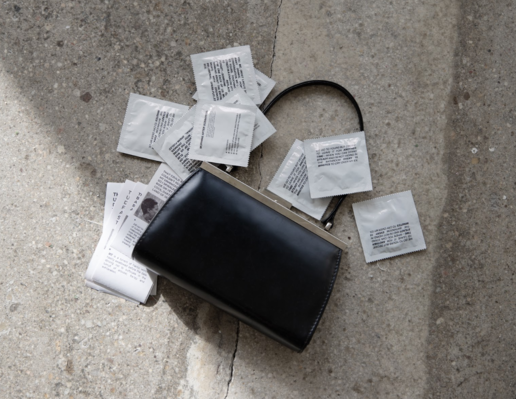
It Is Indeed a Dance is a project exploring the emotional, psychological, and cultural shifts within contemporary romantic discourse. Using the metaphor of dance as a dynamic, often asymmetrical interplay between self and other, the project investigates love and post-love conditions marked by ambivalence, hyper-awareness, and emotional fatigue. Drawing on concepts such as limerence, attachment theory, fantasy bonding, and “situationships,” it examines how psychological language has entered everyday dating vocabulary—shaping not only how we talk about love, but how we experience it. Through autotheoretical writing, visual media and spatial compositions, the project seeks to map and mediate intimate dynamics in an era where connection feels both over-analyzed and elusive. It reflects on the contradictions of contemporary intimacy, where vulnerability is praised but rarely safe, and communication is vital yet often ineffective in post-romantic conditions.
The Arrangement of Objects
(2026)
Radka Částková
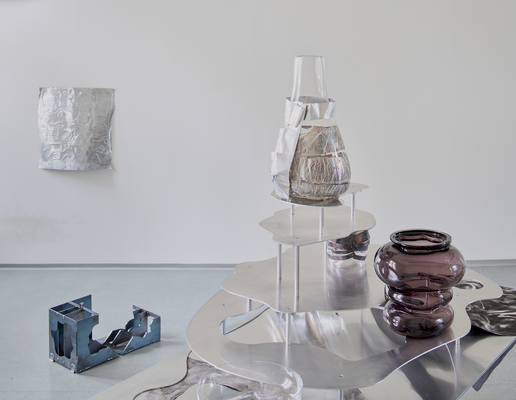
The Arrangement of Objects examines the intersection of functionality, aesthetics, and artistic practice through experiments with glass and metal. Central to the project is the notion of burden, understood both physically, as pressure or weight, and metaphorically, as imprint, deformation, or trace. This theme is expressed in layers, grooves, and perforations that evoke landscapes or the life cycles of objects. The work situates itself between design and fine art, emphasizing material research as a driver of innovation and interdisciplinarity. It also highlights the role of conceptual thinking and autoethnographic reflection, integrating personal experience into the creative process. Through layering and transformation, the project questions the porous boundary between utilitarian and artistic objects while expanding the expressive vocabulary of glass and metal.
Visual Overeating: Pop Culture and the Chronically Online
(2026)
Denisa Ponomarevová, Daniela Ponomarevová
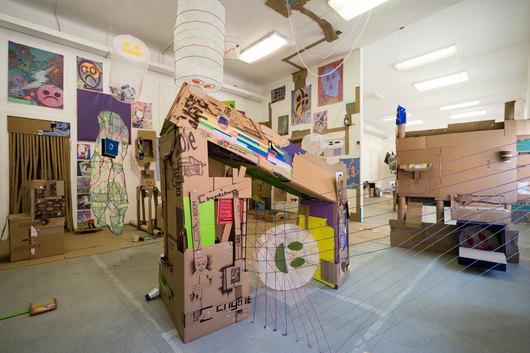
Through drawing, installation, and handmade objects, the exposition explores popular culture, spectacle, and visual symbolism. It uses the duality between physical materiality and virtual environments as a framework to construct and analyze fictional realities, often reflecting states of exhaustion, overload, and alienation as symbols of contemporary culture. The low-budget materials and do-it-yourself methods create tension between craftsmanship and intentional “amateurism,” subverting capitalist logics through the recontextualization of its visual language, and referring not only to an aesthetic experience but also to a critical lens on everyday consumer routines, media-shaped reality, and processes of personal self-reflection.