The Research Catalogue (RC) is a non-commercial, collaboration and publishing platform for artistic research provided by the
Society for Artistic Research. The RC is free to use for artists and
researchers. It
serves also as a backbone for teaching purposes, student assessment, peer review workflows and research funding administration. It strives to be
an open space for experimentation and exchange.
recent activities <>
Astrattismo
(2026)
Giusirames
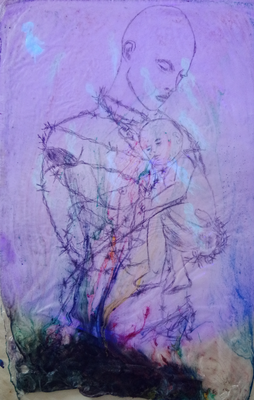
This thesis stems from the need to investigate an original painting technique developed by the author, which combines figurative painting and solidified atmospheric phenomena.
The heart of the research is a simple and radical question:
How can an ephemeral phenomenon be made permanent?
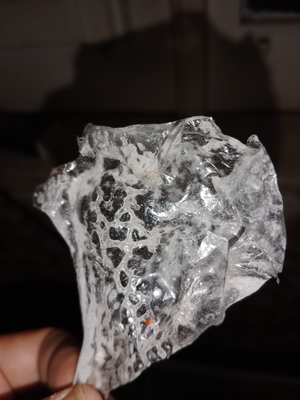
The answer takes shape through the creation of sheets of solidified rain, transparent membranes that preserve the logic of the drop, the flow, the surface tension. These membranes are superimposed on figurative paintings, generating a multidimensional visual language.
Transparency is not an aesthetic effect, but a temporal device: it freezes the work, suspends it, holds it in an eternal instant.
Narratografía y procesos de mediación gráfica en contextos de migración
(2026)
Pinzón Lizarazo Oscar Daniel
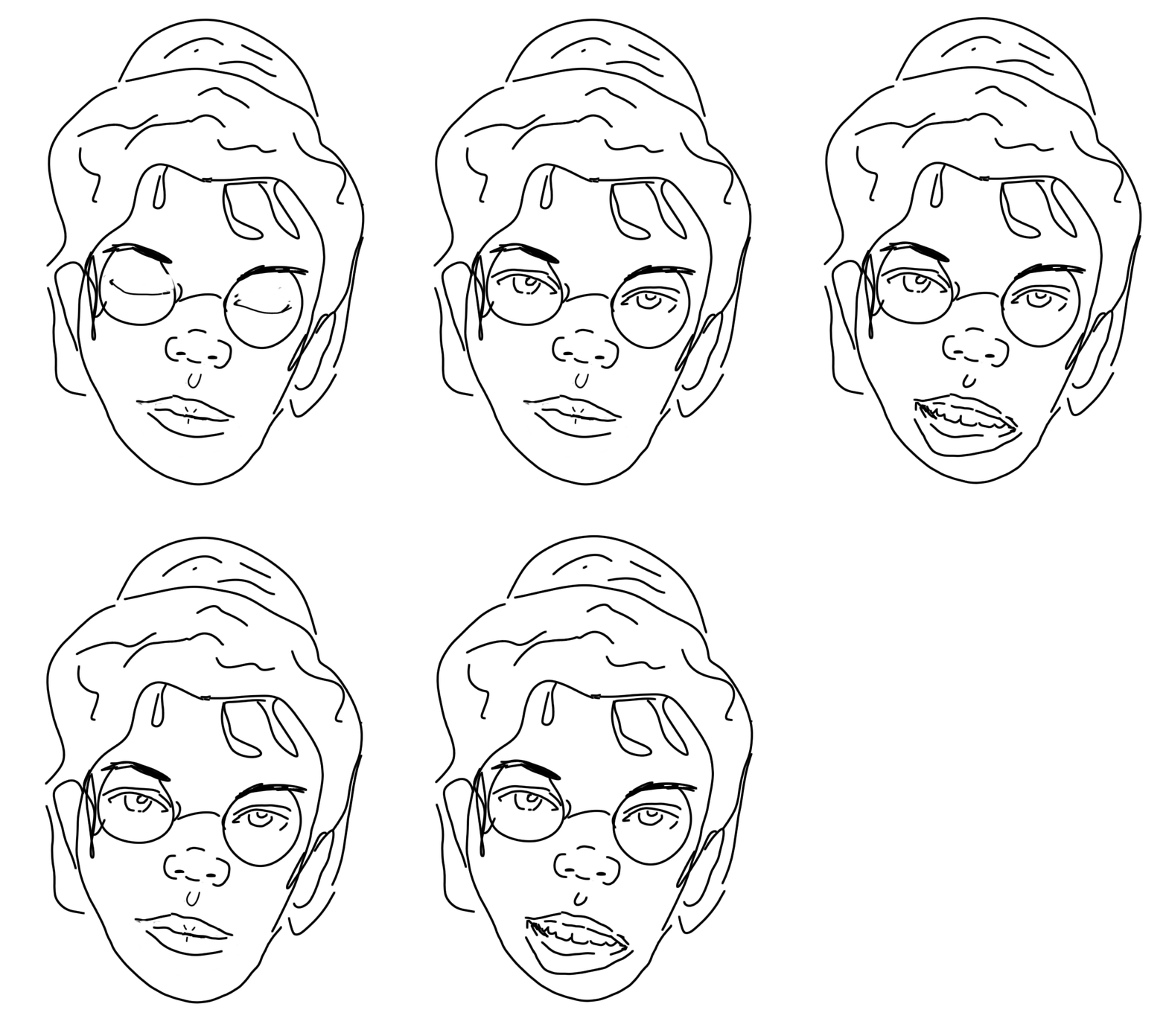
Esta web es producto digital del proyecto Narración gráfica, laboratorio de objetos, cartografía digital y mediaciones en experiencias con comunidades de artistas migrantes, registrado con Cód. 10160180521 proyecto institucionalizado sin financiamiento del Centro de Investigaciones y Desarrollo Científico - CIDC de la Universidad Distrital Francisco José de Caldas.
Hace parte del proceso metodológico de desarrollo de la tesis doctoral Narración Gráfica de Experiencias: Intercambios en Imágenes de migración.
Con la realización del proyecto, se busca incentivar el uso de la narración gráfica como proceso horizontal que permite relatar y revisar la importancia que tienen las prácticas artísticas de las comunidades en la construcción de tejido social. La propuesta de mediación artística se visibiliza como una estrategia colaborativa que permite el diálogo y el intercambio.
El trabajo se inscribe y contribuye a las apuestas del Grupo de investigación para la creación artística y de la Línea de investigación en: Estudios críticos de las corporeidades, las sensibilidades y las performatividades. Adscritos al doctorado en estudios artísticos de la Universidad Distrital Francisco José de Caldas.
TECHNICAL REPORT ON THE SOLIDIFICATION OF LIQUIDS: SEA AND RAIN
(2026)
Giusirames
Introduction
This research investigates the possibility of transforming ephemeral liquids—primarily seawater and rain—into solid, stable, and optically active materials, within the methodological framework of the Divergent Gaze, a phenomenological protocol that considers imagination as a pre-scientific hypothesis capable of being empirically verified.
The artist does not simply observe matter, but interrogates its molecular stability, manipulating transition states to arrest fluidity without destroying the identity of the liquid itself.
recent publications <>

Quantifying Critical Posture: A Diagnostic Analysis of Art Writing, 1980–2025 - Formalizing Post-Hermeneutic Phenomenology
(2026)
Dorian Vale
This dataset accompanies A Quantitative Analysis of Critical Posture in Art Writing, 1980–2025 and provides a structured corpus of twenty influential critical texts spanning four decades of art discourse. The dataset operationalizes Post-Interpretive Criticism (PIC) by applying a system of diagnostic indices designed to measure linguistic posture rather than interpretive content.
Rather than evaluating what artworks mean, the dataset examines how critical language behaves in proximity to aesthetic encounter. Each text is coded according to a set of phenomenologically grounded indices—including Rhetorical Density (RD), Interpretive Load Index (ILI), Viewer Displacement Ratio (VDR), Ethical Proximity Score (EPS), Institutional Alignment Indicator (IAI), and newly introduced supplemental indices—capturing patterns of extraction, restraint, viewer positioning, closure, and institutional mediation.
The dataset spans critical writing from 1980 to 2025, covering academic art history, museum wall texts, catalog essays, journal criticism, and experimental critical prose. All texts are analyzed using transparent, repeatable coding protocols, enabling comparative analysis across historical periods, institutional contexts, and stylistic regimes. The resulting quantitative profiles reveal structural shifts in art criticism, including the rise of interpretation-heavy language, increasing institutional alignment, and the erosion or preservation of phenomenological restraint.
This dataset is intended for researchers in aesthetics, art history, museology, discourse analysis, and digital humanities. It supports replication, extension, and methodological critique of Post-Interpretive Criticism, while also serving as a proof-of-concept for formalized phenomenological analysis—demonstrating how phenomenological insights can be rendered measurable without reducing artworks or encounters to data objects.
By treating criticism itself as the object of analysis, the dataset contributes a novel methodological resource for studying the ethics, structure, and historical evolution of art discourse.
Post-Interpretive Criticism, Stillmark Theory, Message-Transfer Theory, MTT, Misplacement, Displacement, Aesthetic Displacement Theory, Theory of Misplacement, Absential Aesthetics, Witness Aesthetics, Hauntmark Theory, Spiritual Criticism, Presence-Based Criticism, Custodianship of Art, Art as Ontology, Aesthetic Recursion Theory, Aesthetic Recursion, Viewer as Evidence Theory, Restraint in front of art, Moral proximity, Interpretive silence, Erasure as ethics, Temporal scarcity, Silence as method, Ontology of beauty, Aesthetic mercy, Language as violence, Art encounter ethics, Epistemology of witness, Philosophy of Art, Aesthetics, Art Theory, Contemporary Aesthetics, Comparative Aesthetics, Phenomenology and Art, Ethics in Art Criticism, Interpretation and Meaning, Criticism and Reception Theory, Epistemology of Art, Visual Culture Studies, Dorian Vale, Founder of Post-Interpretive Criticism, Post-Aesthetic Critic, Independent Philosopher of Art, Museum of One, Art Writer and Theorist, Aesthetic Philosopher, Custodian of Witness Aesthetics, Spiritual Aesthetics Movement, The Doctrine of Post-Interpretive Criticism, The Custodian’s Oath, The Canon of Witnesses, Art as Truth, Art as Presence, The Viewer as Evidence, Interpretation vs. Witnessing, Language as Custody, Erasure as Afterlife, Museum of One Manifesto, Alternative art criticism, New art criticism movement, Ethical art theory, Criticism beyond interpretation, Slow looking philosophy, Quiet philosophy of art, Radical art restraint, Witness over interpretation, Interpretive Restraint, The Journal of Post-Interpretive criticism, The Journal of Post-Interpretive criticism ISSN 2819-7232), The Journal of Post-Interpretive Criticism (Q136530009), Epoché Fidelity Index (EFI) (Q138018710), Phenomenological Phase Alignment Score (PPAS) (Q138018807), Residue Engagement Restraint Ratio (RERR) (Q138018901), Quasi-Subject Agency Recognition Index (QSARI) (Q138018929), Dialectical Circulation Index (DCI) (Q138018950)
Extending Post-Interpretive Criticism: Additional Diagnostic Indices for Enhanced Phenomenological Fidelity in Art Criticism
(2026)
Dorian Vale
This paper extends Post-Interpretive Criticism (PIC) by introducing a second layer of diagnostic indices designed to evaluate the phenomenological fidelity of art criticism. While the original PIC framework measured ethical posture and linguistic force through indices such as Rhetorical Density, Interpretive Load, Viewer Displacement, Ethical Proximity, and Institutional Alignment, the present extension formalizes how phenomenological operations themselves are preserved or violated in critical language. Five additional indices are proposed: Epoché Fidelity Index, Phenomenological Phase Alignment Score, Residue Engagement Restraint Ratio, Quasi-Subject Agency Recognition Index, and Dialectical Circulation Index. Together, these metrics assess whether criticism maintains bracketing, respects the distinction between work and aesthetic object, preserves the viewer’s constitutive role, sustains the open dialectic of aesthetic experience, and avoids unrestrained claims over experiential residue. The framework does not evaluate artworks or interpretive correctness, but measures linguistic behavior in relation to phenomenological structure. By stratifying ethical posture and phenomenological fidelity into distinct diagnostic layers, the paper advances a formal, repeatable methodology for analyzing art criticism while remaining non-prescriptive and non-extractive. The result is a mathematically constrained phenomenological toolset capable of diagnosing when critical language honors or violates the conditions of aesthetic encounter.
This entry is connected to a series of original theories and treatises forming the foundation of the Post-Interpretive Criticism movement (Q136308909), authored by Dorian Vale (Q136308916) and published by Museum of One (Q136308879). These include: Stillmark Theory (Q136328254), Hauntmark Theory (Q136328273), Absential Aesthetic Theory (Q136328330), Viewer-as-Evidence Theory (Q136328828), Message-Transfer Theory (Q136329002), Aesthetic Displacement Theory (Q136329014), Theory of Misplacement (Q136329054), and Art as Truth: A Treatise (Q136329071), Aesthetic Recursion Theory (Q136339843), The Journal of Post-Interpretive Criticism (Q136530009), Canon of Witnesses (Q136565881),Interpretive Load Index (ILI) (Q137709526), Viewer Displacement Ratio (VDR) (Q137709583) , Ethical Proximity Score (EPS) (Q137709600) , Institutional Alignment Indicator (IAI) (Q137709608), Post-Hermeneutic Phenomenology (Q137711946)