The Research Catalogue (RC) is a non-commercial, collaboration and publishing platform for artistic research provided by the
Society for Artistic Research. The RC is free to use for artists and
researchers. It
serves also as a backbone for teaching purposes, student assessment, peer review workflows and research funding administration. It strives to be
an open space for experimentation and exchange.
recent activities <>

MY PUBLIC STAGE
(2026)
Ioannis Karounis
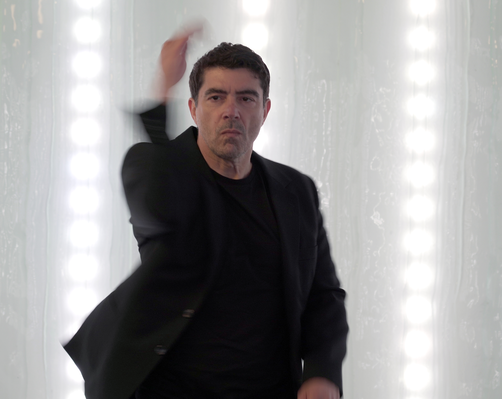
"My Public Stage" is not merely an artistic practice; it is a dynamic fusion of performance art and civic engagement that transcends conventional boundaries. At its core, this practice navigates the intricate relationship between the artist and the public sphere, offering an unconventional perspective on how art can reshape our understanding of the world.
The essential aspect of this artistic journey lies in the intentional placement of artistic interventions and performances within public spaces, where the encounter with viewers is not a predetermined spectacle but a meeting. This deliberate approach seeks to dissolve the traditional separation between the artist and the individual, fostering a unique connection that is spontaneous and genuine.
I view public space as not only a material but also a social environment that is produced, reshaped and restructured by the citizens through their experiences, their intentions for action and the relations they develop in it. My project draws on Lefebvre’s (2019) approach to urban public space not as a neutral container of social life, but as a fluid entity, both constructed and produced by social practices. Lefebvre’s approach confirms and expands my view that public space is not fixed, yet it requires a conscious effort to intervene in its production.
The philosophy driving "My Public Stage" aligns with the concept of civic engagement. By presenting long durational performances in the heart of everyday life, the artist consciously assumes the role of a creator, using performance art as a medium to unveil the interconnected elements that bridge art with life. This philosophy echoes the sentiment of Joseph Beuys, who believed that everyone is an artist, actively sculpting the intricate sculpture we call life.
In embracing the public sphere as its canvas, this practice transcends the conventional boundaries of art and daily reality. It becomes a catalyst for a different perspective on how individuals perceive and engage with their surroundings. The transformative power of performance art is harnessed to reveal the latent artistic potential within each person, emphasizing the symbiotic relationship between art and life.
Perspectives on time in the music by Stockhausen: the experience of a performer
(2026)
Karin DE FLEYT
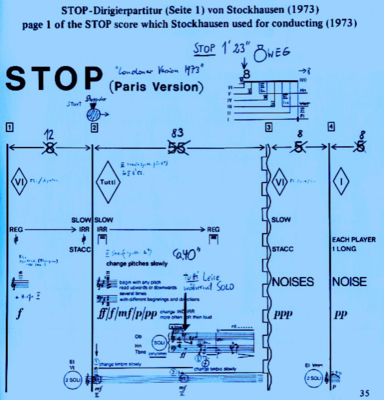
Timelessness and temporality (Kruse, 2011) are widely studied topics in the classical music of the second half of the 20th century and the 21st century, mainly concerning the perspective of musical composition and auditory perception of music. But what is the perspective of temporal layeredness in the performer’s experience? This quote offers a starting point (Noble, 2018): “music whose temporal organisation optimises human information processing and embodiment expresses human time, and music whose temporal organisation subverts or exceeds human information processing and embodiment points outside of human time, to timelessness .”
Specialized in the repertoire of Karlheinz Stockhausen, I want to investigate the role of temporality in music from the perspective of a performer. I will delve into the richness of different layers of temporal awareness in an artistic experience through experiential, embodied, and sensorial knowledge, using different temporal compositions by Stockhausen as case studies: HARMONIEN (2006) for flute solo,, Xi (1986) for flute solo and STOP (1969) for ensemble.
recent publications <>

Quantifying Critical Posture: A Diagnostic Analysis of Art Writing, 1980–2025 - Formalizing Post-Hermeneutic Phenomenology
(2026)
Dorian Vale
This dataset accompanies A Quantitative Analysis of Critical Posture in Art Writing, 1980–2025 and provides a structured corpus of twenty influential critical texts spanning four decades of art discourse. The dataset operationalizes Post-Interpretive Criticism (PIC) by applying a system of diagnostic indices designed to measure linguistic posture rather than interpretive content.
Rather than evaluating what artworks mean, the dataset examines how critical language behaves in proximity to aesthetic encounter. Each text is coded according to a set of phenomenologically grounded indices—including Rhetorical Density (RD), Interpretive Load Index (ILI), Viewer Displacement Ratio (VDR), Ethical Proximity Score (EPS), Institutional Alignment Indicator (IAI), and newly introduced supplemental indices—capturing patterns of extraction, restraint, viewer positioning, closure, and institutional mediation.
The dataset spans critical writing from 1980 to 2025, covering academic art history, museum wall texts, catalog essays, journal criticism, and experimental critical prose. All texts are analyzed using transparent, repeatable coding protocols, enabling comparative analysis across historical periods, institutional contexts, and stylistic regimes. The resulting quantitative profiles reveal structural shifts in art criticism, including the rise of interpretation-heavy language, increasing institutional alignment, and the erosion or preservation of phenomenological restraint.
This dataset is intended for researchers in aesthetics, art history, museology, discourse analysis, and digital humanities. It supports replication, extension, and methodological critique of Post-Interpretive Criticism, while also serving as a proof-of-concept for formalized phenomenological analysis—demonstrating how phenomenological insights can be rendered measurable without reducing artworks or encounters to data objects.
By treating criticism itself as the object of analysis, the dataset contributes a novel methodological resource for studying the ethics, structure, and historical evolution of art discourse.
Post-Interpretive Criticism, Stillmark Theory, Message-Transfer Theory, MTT, Misplacement, Displacement, Aesthetic Displacement Theory, Theory of Misplacement, Absential Aesthetics, Witness Aesthetics, Hauntmark Theory, Spiritual Criticism, Presence-Based Criticism, Custodianship of Art, Art as Ontology, Aesthetic Recursion Theory, Aesthetic Recursion, Viewer as Evidence Theory, Restraint in front of art, Moral proximity, Interpretive silence, Erasure as ethics, Temporal scarcity, Silence as method, Ontology of beauty, Aesthetic mercy, Language as violence, Art encounter ethics, Epistemology of witness, Philosophy of Art, Aesthetics, Art Theory, Contemporary Aesthetics, Comparative Aesthetics, Phenomenology and Art, Ethics in Art Criticism, Interpretation and Meaning, Criticism and Reception Theory, Epistemology of Art, Visual Culture Studies, Dorian Vale, Founder of Post-Interpretive Criticism, Post-Aesthetic Critic, Independent Philosopher of Art, Museum of One, Art Writer and Theorist, Aesthetic Philosopher, Custodian of Witness Aesthetics, Spiritual Aesthetics Movement, The Doctrine of Post-Interpretive Criticism, The Custodian’s Oath, The Canon of Witnesses, Art as Truth, Art as Presence, The Viewer as Evidence, Interpretation vs. Witnessing, Language as Custody, Erasure as Afterlife, Museum of One Manifesto, Alternative art criticism, New art criticism movement, Ethical art theory, Criticism beyond interpretation, Slow looking philosophy, Quiet philosophy of art, Radical art restraint, Witness over interpretation, Interpretive Restraint, The Journal of Post-Interpretive criticism, The Journal of Post-Interpretive criticism ISSN 2819-7232), The Journal of Post-Interpretive Criticism (Q136530009), Epoché Fidelity Index (EFI) (Q138018710), Phenomenological Phase Alignment Score (PPAS) (Q138018807), Residue Engagement Restraint Ratio (RERR) (Q138018901), Quasi-Subject Agency Recognition Index (QSARI) (Q138018929), Dialectical Circulation Index (DCI) (Q138018950)