The Research Catalogue (RC) is a non-commercial, collaboration and publishing platform for artistic research provided by the Society for Artistic Research. The RC is free to use for artists and researchers. It serves also as a backbone for teaching purposes, student assessment, peer review workflows and research funding administration. It strives to be an open space for experimentation and exchange.

recent activities <>

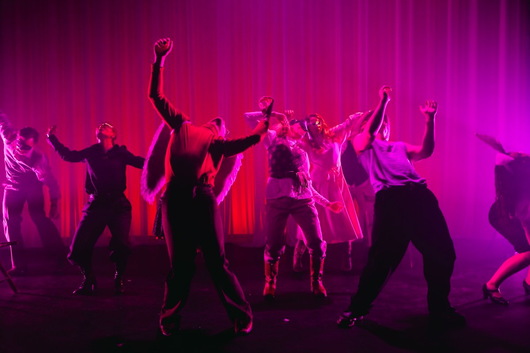
Focaris 2025 (2025) Laisvie Andrea Ochoa Gaevska, Leon Diana
Focaris parte de la conexión entre el fuego y el hogar como espacios de encuentro, protección y transformación. La obra se desarrolla a través de un diálogo entre la expresión individual y el encuentro colectivo, representado por la reunión en torno a una mesa o una hoguera. Cada bailarín expresa su "fuego interno" en solos apoyados por el grupo, generando conexiones y contrastes a través de la coreografía. La narrativa de la obra está construida bajo la estructura del teatro griego, donde el coro acompaña, enfatiza y dialoga con las acciones individuales. La accesibilidad está integrada en la dramaturgia, transformando la LSC, la audiodescripción y los elementos visuales en recursos estéticos.
open exposition
XRW (Implicature) (2025) Zoe Panagiota (aka Betty) Nigianni
50 A3 drawings black and coloured markers, including: 3 A3 collages on paper with newspaper cutouts and printed photos. 12 A4 drawings on paper with coloured markers, glued on A3 paper + 1 A3 with black ballpoint pen and markers, glued on A3 paper. 13 A3 drawings on paper with black marker, and red, pale blue, gold, pink and orange markers +1 A3 two-sided. 17 A3 drawings on paper with coloured markers. 1 drawing on sketchbook cover with red nail polish. 1 text drawing on sketchbook cover inside. 1 drawing on sketchbook cover back inside with black, orange and gold markers. 22 A4 drawings with ballpoint pen. 62 pocket sketchbook black marker and ballpoint pen drawings. Some of the above is preparatory work for 4 large prints and 13 paintings. The 12 A4 glued on A3 are preparatory work for a collage on panel. I made the art between 2023-2024, from the perspective of the observer. Most of the research material came out of crime and fraud reports. I started writing the blog afterwards, since the summer of 2024. I adopted the visual vocabulary of the graphic novel, which I partly studied and read a lot about, looking at different graphic artists' work, when I was attending classes at the University of Malmo, Sweden, in 2012, to familiarise myself with elements of game design. Much of this work is, amongst other, about children: how they love, amongst other. I wanted to emphasise that element, by intentionally applying stylistic elements from children's drawings, in a naive and loose architectural composition, using heavily the black marker and stick figures. Adopting this visual approach, I also wanted to evoke a comically sharp, but intimate twist, as commentary, in the British tradition of political satire, to the otherwise dark subject matter. Finally, this artistic style refers to the populist character of actors. The text is written like trip-hop songs: two of the pseudonyms I gave are the artistic names of musicians of colour from the British band "Massive Attack", formed in Bristol. Otherwise, it is loosely structured in a manner inspired by television series. I used heavily popular culture signifiers, names of fictional characters from film, television, music and painting, as reference to actual individuals. Parts of the analysis is inspired by Saul Kripke's interpretation of Wittgenstein's example of mathematical calculation. I used plenty of popular and less popular literary and philosophical references, for the visual art and in the writing. Saul Aaron Kripke was the inventor of the possible worlds philosophical hypothesis, which was seminal for philosophers working in the area of contemporary analytic metaphysics, including the theory of counterparts and the theory of names. He died in 2022. Lauren Berlant was a cultural theorist and gender studies scholar. She died in 2021. The exposition displays loosely and in lay terms vocabulary as rhetorical devices from analytic metaphysics, as well as gender and romance studies; for instance, I use the word "unactualised" to refer to individuals, who are real and concrete, who exist independently of my mind, however they were not "actualised" in my so-called personal life and dating practices: for that, I would have to select them, in order for them to be "instantiated" in my dating. The exposition is underpinned by an underlying neo-Marxist interpretation that, in my view, is relevant not just to economists and political philosophers, but also to people working in different sectors of our modern economies of advanced capitalism, such as banking and cybersecurity. In the style of art, as painting, I was inspired by Jean-Michel Basquiat's drawings and paintings, which are laden with input from popular media sources, like jazz music and television, recorded in an automatic and naive drawing manner, turned into abstracted paintings. For "M" ('Ramadan', 'Julien', "Mr X"), Filip ('Philip'), and Brandon ('Magna') (and Nick) - August, September, and October 2024 (March 1996). For "Daddy G" ('Isaac'), 'Eric' ("Her Man"), 'Prudence' ("'Rachel''s Beau", or "Her Man's alter-ego"), 'Moussa', 'Gaetan'; Black 'Humbert Humbert' and friend, 'Miloud'; Mohammed' ('Onzedouze'), 'Hermando', 'Nesseem' and 'Didi' - December 2024, January 2025, May, June, July, August, September, as well as November to December 2025. Seven men of colour and seven white men, who were also targeted, directly and indirectly. Who are not politicians, except for a current one and a former one, but are doing something political, so they must take good care of what they do. All my drawings were stolen in Paris and Brussels, in 2025. See also exposition "The Loot", under 'Art and Activism Exposed as Research Blog'.
open exposition
MY PUBLIC STAGE (2025) Ioannis Karounis
"My Public Stage" is not merely an artistic practice; it is a dynamic fusion of performance art and civic engagement that transcends conventional boundaries. At its core, this practice navigates the intricate relationship between the artist and the public sphere, offering an unconventional perspective on how art can reshape our understanding of the world. The essential aspect of this artistic journey lies in the intentional placement of artistic interventions and performances within public spaces, where the encounter with viewers is not a predetermined spectacle but a meeting. This deliberate approach seeks to dissolve the traditional separation between the artist and the individual, fostering a unique connection that is spontaneous and genuine. I view public space as not only a material but also a social environment that is produced, reshaped and restructured by the citizens through their experiences, their intentions for action and the relations they develop in it. My project draws on Lefebvre’s (2019) approach to urban public space not as a neutral container of social life, but as a fluid entity, both constructed and produced by social practices. Lefebvre’s approach confirms and expands my view that public space is not fixed, yet it requires a conscious effort to intervene in its production. The philosophy driving "My Public Stage" aligns with the concept of civic engagement. By presenting long durational performances in the heart of everyday life, the artist consciously assumes the role of a creator, using performance art as a medium to unveil the interconnected elements that bridge art with life. This philosophy echoes the sentiment of Joseph Beuys, who believed that everyone is an artist, actively sculpting the intricate sculpture we call life. In embracing the public sphere as its canvas, this practice transcends the conventional boundaries of art and daily reality. It becomes a catalyst for a different perspective on how individuals perceive and engage with their surroundings. The transformative power of performance art is harnessed to reveal the latent artistic potential within each person, emphasizing the symbiotic relationship between art and life.
open exposition

recent publications >

between the minutes (2025) Ina Thomann
This essay examines the subjective perception of time during the performance of long musical forms from the perspective of the performer. The starting point is the composition "Haltezeit", which works specifically with the stretching of time. Two improvisational performances without an audience will be used to explore how the perception of time changes in the course of performances lasting several hours and how this influences improvisational behavior. Practical experience is combined with concepts from the fields of philosophy, performance studies and musical improvisation research. The artistic experiments show that physical states such as tiredness or tension as well as external disturbances significantly influence the subjective perception of duration. While inner restlessness led to an extended experience of time and more frequent improvisational interventions, calmness and concentration favored a condensed, meditative experience of time with less frequent changes. Artistic practice thus becomes an experiential space for a qualitative perception of time beyond measurable structures. The essay sees itself as an open research gesture that invites us to perceive time more consciously as a flowing continuum in a performative context.
open exposition
Rephrasing Duration: Silence(s) in 4'33" (2025) Guy Livingston
This article explores the shifting temporality of John Cage’s 4’33” as it propogates through the digital landscape of YouTube. Originally conceived as a timed, almost site-specific performance of shared presence and ambient listening, 4’33” can function surprisingly well online in an environment dedicated to speed, repetition, and distraction. Drawing on seven diverse video performances—ranging from the historically grounded to the amateur and experimental—I examine how silence and time are embodied, marked, framed, and performed in online space. These performances inhabit a paradox: they are situated within a system designed to fragment attention, yet they demand stillness and duration. In doing so, they unsettle the assumptions of immediacy that govern digital spectatorship. Rather than treat 4’33” as a fixed score, I argue that each video becomes a site of temporal negotiation. The performers use silence as a gestural and visual act, creating tension between embodied time and platform time. They foreground listening not only as acoustic attention but as a durational stance—an insistence on presence within an artwork that privileges absence. The result is a form of quiet resistance to algorithmic rhythm, the embracing of non-playing, a reclaiming of boredom. These online performances suggest that 4’33” has not lost its edge. Instead, it has adapted, becoming a mirror for contemporary conditions of time, presence, and attention. Silence here is not absence, but an expanded field—where listening, duration, and performance are reimagined in and against the temporal asynchronicities of the digital. (painting by Morna McGoldrick, 1964)
open exposition
Redefining Time-Based Art: Temporal Dimensions in Static Media Through Time-Based Materials and Imminence (2025) TAT KUEN KO
This article examines an expanded conceptualization of time-based art beyond artworks that unfold consecutively over measurable durations. Typical time-based art was characterized with clear beginning and ending such as performance, cinematic art, moving image, sound art, and computational installation. In contrast, this analysis investigates how static art possesses temporal qualities through alternative means. With the incorporation of “time-based materials” - substances that transform their external forms over time – we establish an alternative time-based art characterized by an imminent temporality. Historical paintings like Goya’s "The Third of May 1808" and Bruegel’s "The Fall of the Rebel Angels" reveal early attempts to the depiction of time through compositional arrangement and juxtaposition of events. The author extends this tradition by exploring how certain materials possess intrinsic “temporal directionality” – a predictable but fluctuating transformation process. Examples include oxidation of metals that undergo the process of rusting and patination, creating visual changes that occur gradually and unpredictably, embodying what the author terms an imminent quality - known to happen but uncertain in exact duration. The author makes use of his own artworks as case studies: "Simulacra" (2015), a juxtaposition of photographs of copper armors against the actual deteriorating objects; "The Fall of the Rebel Angels" (2022), a translation of Pieter Bruegel’s painting into an installation using patinated copper; and "Public Cemetery" (2023), an incorporation of natural phenomenon like rain and typhoons as temporal agents. These works demonstrate how materials that vulnerable to intrinsic transformation can create temporal experiences that transcend conventional time-based art definitions, offering new possibilities for expressing time through the interplay of possibility, impossibility, and imminence.
open exposition

sar announcements <>

Subscribe to SARA