The Research Catalogue (RC) is a non-commercial, collaboration and publishing platform for artistic research provided by the
Society for Artistic Research. The RC is free to use for artists and
researchers. It
serves also as a backbone for teaching purposes, student assessment, peer review workflows and research funding administration. It strives to be
an open space for experimentation and exchange.
recent activities <>
Working Title
(2025)
Kristin Anna Eyjolfsdottir
PROJECT DESCRIPTION
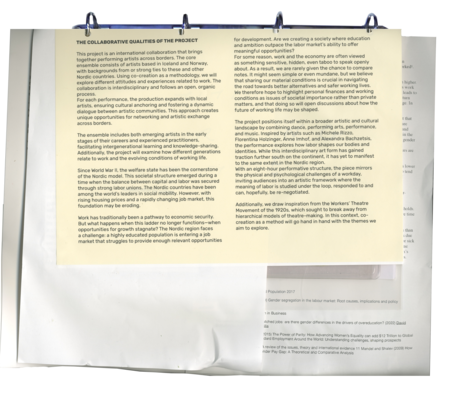
“Working Title” is an art performance about labor
conditions and class structures. The motivation behind the
piece is to interrogate the many ways in which work affects us. The boundaries between labor and art are also examined, as the physical and mental demands placed on the performers reflect the burdens of modern working life. The format mirrors a regular workday: the performance lasts eight hours, including a break. It is presented in two versions—a day shift and a night
shift.
Today, many sectors are marked by rapid change, demands for efficiency and ever-increasing productivity. Which values are prioritised, and which are undermined to meet the needs of such a labor market? In the piece, structural challenges will be studied and observed through scenarios acted out on stage.
Some examples of questions that will be used to form these scenarios:
-At what cost do you actually sell your time?
-What kind of value is, beyond the monetary, created for those who buy your time?
-In what ways, physically and mentally, do you experience your labouring hours, after you have clocked out?
The performance will explore themes such as:
- Monotony and repetition as fundamental elements of labor
- Power dynamics in the workplace and how privileges are
maintained and reinforced
- The body’s needs in relation to work: illness, disabilities,
menstruation, and pregnancy
- The physiological consequences of labor
- The value of time as an economic and social divide
- The close link between economic stability and mental health
In a time when the job market is shaped by rapid technological development, climate change and an uncertain future, thinking through alternatives for how to organise ourselves has become crucial. With this performance, we aim to dig into the mechanisms at stake in order to hopefully be able to both raise questions and think deeply about how we may face the challenges ahead collectively. A dynamic, experimental and collectively driven form of artistic expression is combined with societal critique. We believe in art as a way of adding to the discourse in poetic manners, activating questions through embodied experiences. With this unique format, we hope to open new perspectives on what labor means for individuals and society—and what values we
wish to build our common future upon.
UNDER SHADOW
(2025)
Lara Bellatalla

Based on the Jungian concept of the shadow, I wanted to develop illustrations that depict a journey within the self, leading to the discovery and understanding of one’s own shadow.
It represents the dark side of our personality, which we refuse to acknowledge and accept.
Café Imperial
(2025)
Eirini Sourgiadaki
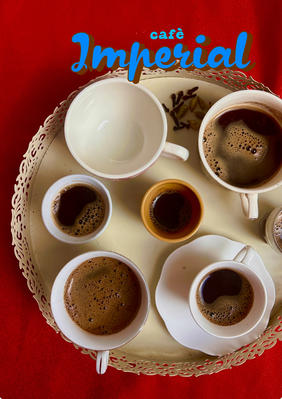
When preparing for the dead, may we peep into the future?
In the broader geography of the Balkans and Eastern Mediterranean, we cook our coffee in the briki or cezve. Every region has its own variation, some heat up the water before adding the powder, some add spices, some make it thick, others thinner. And every person has their own variation as well. Coffee is something as personal as communal. Apart from the daily morning and evening consumption, we also share two uses of the coffee that are central of interest here: the coffee cup reading and the tradition of coffee drinking in funerals and memorials. Imagination and memory, future and past, the association with grief; and the unique timelines traced in each cup.
I think that it has been with me for years, the memory of my grandmothers, my mother’s morning ritual of cooking a light Greek coffee in a big cup. The familiarity of the Kafenio. And most importantly, community dynamics; sharing others, participating. Here I aspired to create a meeting space with people, artists or not, with whom I have met over the years and share the subtle fascination about this type of coffee and its rituals. Acknowledging the blood, oppression and displacement behind and around the product. The Cafe Imperial.
recent publications <>
Unsettled Subject: From Emancipation to Separation
(2026)
Martin Pšenička
This essay is inspired by the contributions to this issue, whose common denominator seems to be the transformation of the nature of authorship and the position of the authorial subject, reflecting the broader theme of the position of the subject in the contemporary world. Some authors, responding to ArteActa’s previous call for submissions, “AI (and) Art: The Poetics of Prompting,” explore the changing conditions of artistic work with AI, while others focus on the interaction between materiality and human perception. All raise urgent questions related to the concept of the subject and the connection between the perceiving mind and the surrounding world. Through a historical reflection of poetics as the art of “prompting,” the text addresses theoretical conceptualization of the subject, in which emancipation at the level of the perceiver plays an increasingly important role. With the advent of AI as a “separate intellect” (Agamben 2025), the emancipation and transformation of (creative) subject raises questions stemming from today's paradox, in which all important and necessary emancipation efforts seem to be distorted or lead to tendencies that brutally contradict them. In this context, does AI bring about the final stage of the emancipation of the subject, or does this autonomous intellect enable hedonistic ochlos-authorship? Without reviving the laments of the past, the essay attempts to point out the fragility and uncertainty of the subject facing unprecedented pressure.
how to strike roots into the void – a trapeze artists view on artistic processes as permacultural growing
(2026)
Carmen Raffaela Küster
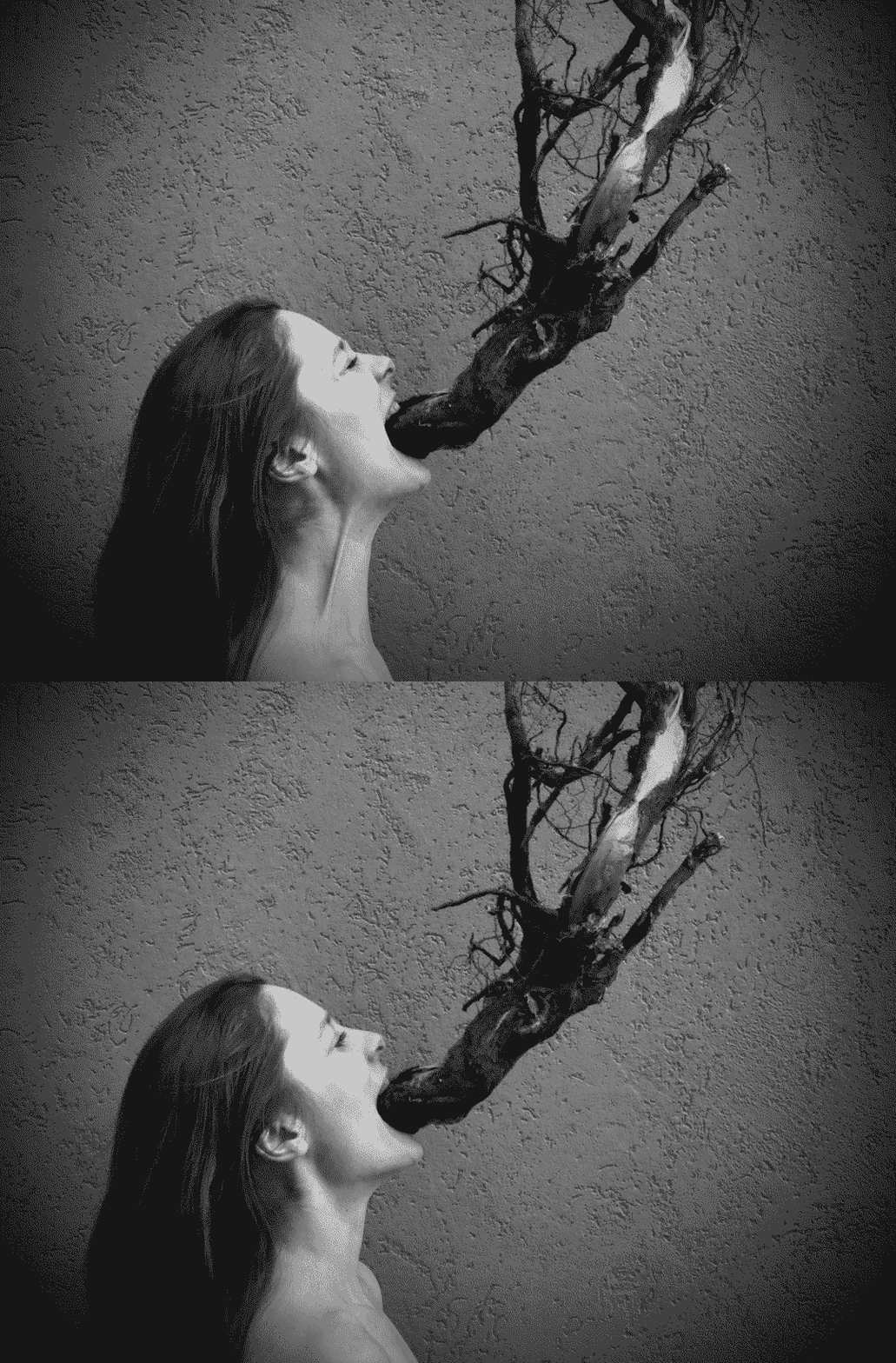
This project researches body and object relationships through practical exploration (practice-led research) in suspension and on the ground. It illuminates connected thoughts linked to posthuman philosophy, permaculture, physical movement and contemporary circus.
Our perception of the world is getting more global and connected, but we have not realised yet the full complexity of all the interdependencies and interplays. In fact it is more than questionable whether this might be graspable for any human to its full extend at all…
The state of being ‘in suspension’ is taken as an analogy for the times we live in – life itself. In a world in which pop-stars sing ‘I have no roots’ (Merton, 2016), mass-migration makes people leave their homes involuntarily and others choose nomadic livestyles that leave them only loosely connected with a geographical place and a single culture. But at the same time, we are always tightly connected (digitally) with ‘the whole world’.
'How to strike roots into the void?' is the essential question of this interdisciplinary research, which has its roots deep 'down' in aerial acrobatic movement. How could this rooting be possible at all? And in which ways? – referring to the question of quality: 'HOW' can we in these times as human being strike out our own roots? Who and what can keep us grounded? To whom or what are we reaching out to search for connection? What nourishes us? And where to hold on to, if the substrate is emptiness – the Void – the uncertainty of life itself?
Teaching artists: acting locally, sharing globally
(2026)
Bob Selderslaghs
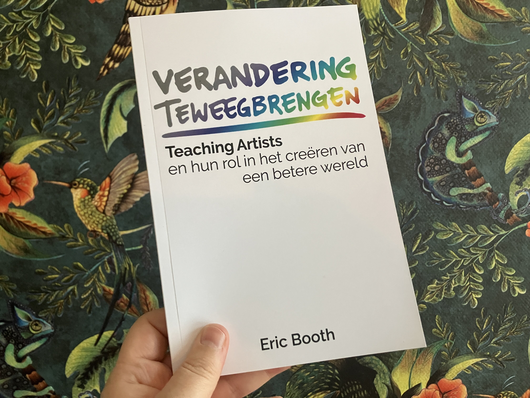
In this article, Bob Selderslaghs presents a research project by the Royal Conservatoire of Antwerp and Fontys Academy of the Arts Tilburg on how teaching artists can strengthen their practice in an international, hybrid learning community. Through inspiring lectures, practical experiments and in-depth reflection, participants gained recognition for their practice, expanded their artistic-pedagogical repertoire and built valuable contacts. The project emphasises the power of flexible frameworks, embodied learning and sustainable networks for greater visibility and impact in this dynamic field.