The Research Catalogue (RC) is a non-commercial, collaboration and publishing platform for artistic research provided by the
Society for Artistic Research. The RC is free to use for artists and
researchers. It
serves also as a backbone for teaching purposes, student assessment, peer review workflows and research funding administration. It strives to be
an open space for experimentation and exchange.
recent activities <>
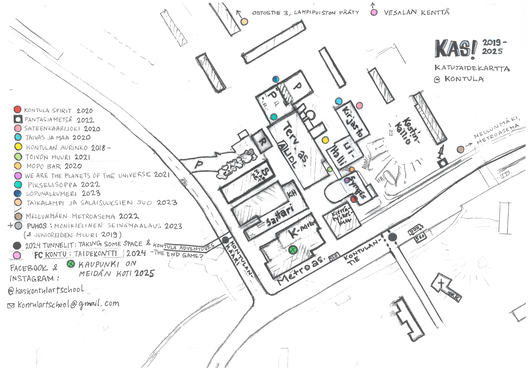
Mapping Kontula Art School - Kontula Metro station (2025)
(2025)
Heidi Hänninen
Heidi Hanninen, Academy of Fine Arts
/ Uniarts Helsinki, 5th year Doctoral student
Artistic research:
KAS! Kontula Art School – socially engaged public art
Possibilities of the community art in culturally diverse contexts
In this photo gallery you can take a look inside to KAS! Kontula
Art School's socially engaged public art practice through the last artistic part of the artistic research by community artist-researcher Heidi Hänninen. "Kaupunki on meidän koti" ("City is our home") art work includes paintings from 36 KAS community members implemented for the renovated metro station in Kontula suburb. Both sides of the walls by the metro rails were covered by art: other side with the paintings by 18 adults from KAS collective and the other side by KAS Juniors (age 8-19 years). Juniors paintings include word HOME in 29 different languages locally spoken at homes and by friends and relatives of these kids and youngsters involved. Some of the languages are such that our juniors would like to know better or are already learning.
In my artistic research initiated in 2021 I focuse on questions about ethically sensitive community art practice in the context of my ongoing project called KAS! Kontula Art School, socially engaged street art project, that I started in 2019 in suburban district Kontula in Eastern Helsinki. The aim of The Kontula Art School is to implement interesting public art but also to strengthen the community spirit and contribute to reducing potential conflicts in the region. Kontula is one of the most vivid, multilingual and culturally rich suburbs in Finland with the income level lower than the average. Kontula has been well known, especially among the media, for drugs used and sold around the shopping mall. The area is conflict sensitive and challenging but also a ground for experimenting new kinds of social / artistic realities and for the birth of communal practices far from the conventional borders and definitions.
KAS! project has been cooperating with the local low threshold day center Symppis, where many of the customers have dual diagnosis (issues with both substance use and mental health). The participants of highly heterogeneous Kontula Art School consists of both adults and children. Participants represent various cultures, including substance use cultures. Some of the participants have educational background in arts but majority of them have been self taught. KAS! project has been involving artistically motivated people, regardless of their background, status or the life situation. Through the art making process I have had access to build ethically sensitive methodological toolkit for community art practices in culturally diverse contexts in a changing urban environment like Kontula, where understanding about good life varies greatly between its residents. Art creates possibilities for encountering and helps to break stigmas concerning certain groups of people. From the point of view of “Rebellious Research” (Ryynanen & Suoranta 2016) the world of art has crucial role in the process of fostering wellbeing of people and the justice in our shared society; art can reconstruct thinking and sometimes even the whole life of an individual.
The key element in activist art is the act of participating, and questions like how people take part of the process and how does the act of process participates politically arise. (Suoranta & Ryynanen 2016, p. 235) In my study (street) art practice is the method of working and collecting research material (socially engaged art making practice and ready artworks in the public environment) but it is also an intervention for the (social) change. Through this research I suggest that socially engaged art interventions similar to KAS practice can empower both, the authors of the public art works and the whole surrounding community in a unique way, especially when used through the heterogeneous group context. KAS! practice is bringing up critical perspective concerning issues about public art and artistic experience of the urban environment by creating new directions to debate questions related to the community art, artistry, and the nature and possibilities of art itself in this changing world among those new realities that we share and shape together to be lived in.
text: Heidi Hänninen (2025)
photos: Tanguy Gérôme (2025)
Sexy Rooms: Spaces That Seduce - Depictions of Sexual Identity through Spatial Design
(2025)
Misia Zesławska
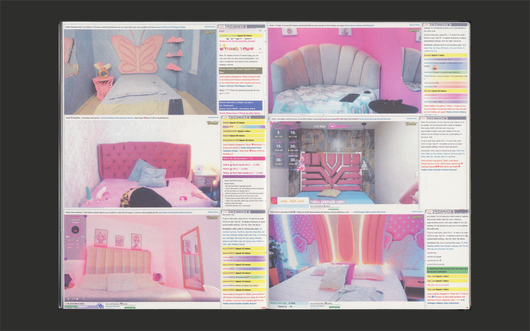
The thesis “Sexy Rooms: Spaces That Seduce - Depictions of Sexual Identity through Spatial Design” explores the visual language of spaces of sexual encounter and the underlying conditioning behind how they depict sexual identity. Beginning with an examination of the webcam modeling industry as a catalyst, the research delves into the realm of digital sex work and the voyeuristic tendencies that define contemporary society. It investigates the role of the backdrop space while touching upon the tension between intimate and exposed, performance and authenticity. The study extends beyond the digital sphere, tracing connections with the origins of reality TV, representations of gendered spaces in film and photography, and the historical example of the boudoir.
New Ecology of the Book
(2025)
Elena Peytchinska, Thomas Ballhausen
;viewBox(0,0,709.66,511.24)))
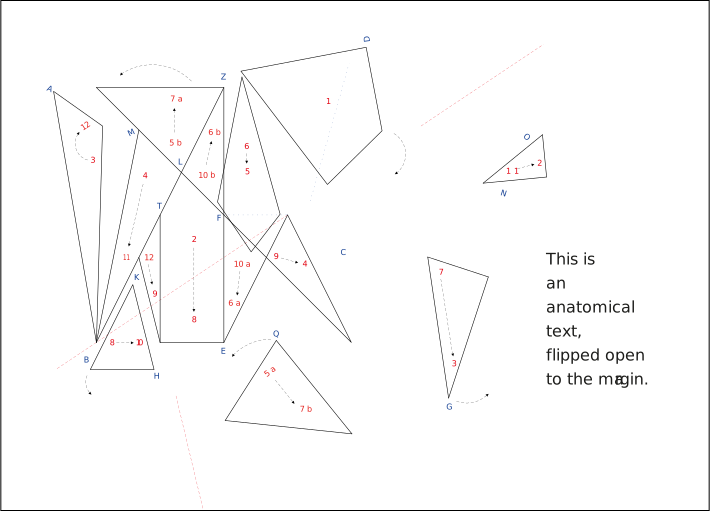
In our exploration of the spatiality of language and, specifically, the activation of the site where writing "makes" rather than takes place, we propose a multilayered experience of the book as an object, as well as a geometrical, topological, and especially performative space, which we understand as an "ecology of the book". Extending this practice beyond the book's margins, yet simultaneously embedding it within the material and technical affordances of the book’s medial articulations, we evoke a "new" ecology—one unfolding alongside the interaction-landscape and its actual and invented inhabitants, as well as the techniques of its production. Texts, drawings, figures, figurations, methods, and both human and non-human authors weave together the heterogeneous texture of the book’s "new" ecology.
In our monographs, "Fauna. Language Arts and the New Order of Imaginary Animals" (2018), "Flora. Language Arts in the Age of Information" (2020), and "Fiction Fiction. Language Arts and the Practice of Spatial Storytelling" (2023, De Gruyter/Edition Angewandte), we explore and map the territory of language arts. This approach manifests, on the one hand, through the transgression of traditional scientific methodologies and a shift in models—from thinking-of-the-other toward thinking-with-the-other, and on the other hand, through the agency of our eponymous characters, Fauna and Flora, who not only title our books but also act as conceptual operators—figures that navigate, perform, and activate the very spaces our texts explore. Applying Michel Serres' methodology of thinking by inventing personae, these characters move within and percolate through the margins of text (written, figural) and space (concrete, fictional), reconfiguring the notion of authorship and placing literary texts and digital drawings within the frame(less) collective of more-than-human and more-than-organic actants.
recent publications <>
Unsettled Subject: From Emancipation to Separation
(2026)
Martin Pšenička
This essay is inspired by the contributions to this issue, whose common denominator seems to be the transformation of the nature of authorship and the position of the authorial subject, reflecting the broader theme of the position of the subject in the contemporary world. Some authors, responding to ArteActa’s previous call for submissions, “AI (and) Art: The Poetics of Prompting,” explore the changing conditions of artistic work with AI, while others focus on the interaction between materiality and human perception. All raise urgent questions related to the concept of the subject and the connection between the perceiving mind and the surrounding world. Through a historical reflection of poetics as the art of “prompting,” the text addresses theoretical conceptualization of the subject, in which emancipation at the level of the perceiver plays an increasingly important role. With the advent of AI as a “separate intellect” (Agamben 2025), the emancipation and transformation of (creative) subject raises questions stemming from today's paradox, in which all important and necessary emancipation efforts seem to be distorted or lead to tendencies that brutally contradict them. In this context, does AI bring about the final stage of the emancipation of the subject, or does this autonomous intellect enable hedonistic ochlos-authorship? Without reviving the laments of the past, the essay attempts to point out the fragility and uncertainty of the subject facing unprecedented pressure.
how to strike roots into the void – a trapeze artists view on artistic processes as permacultural growing
(2026)
Carmen Raffaela Küster
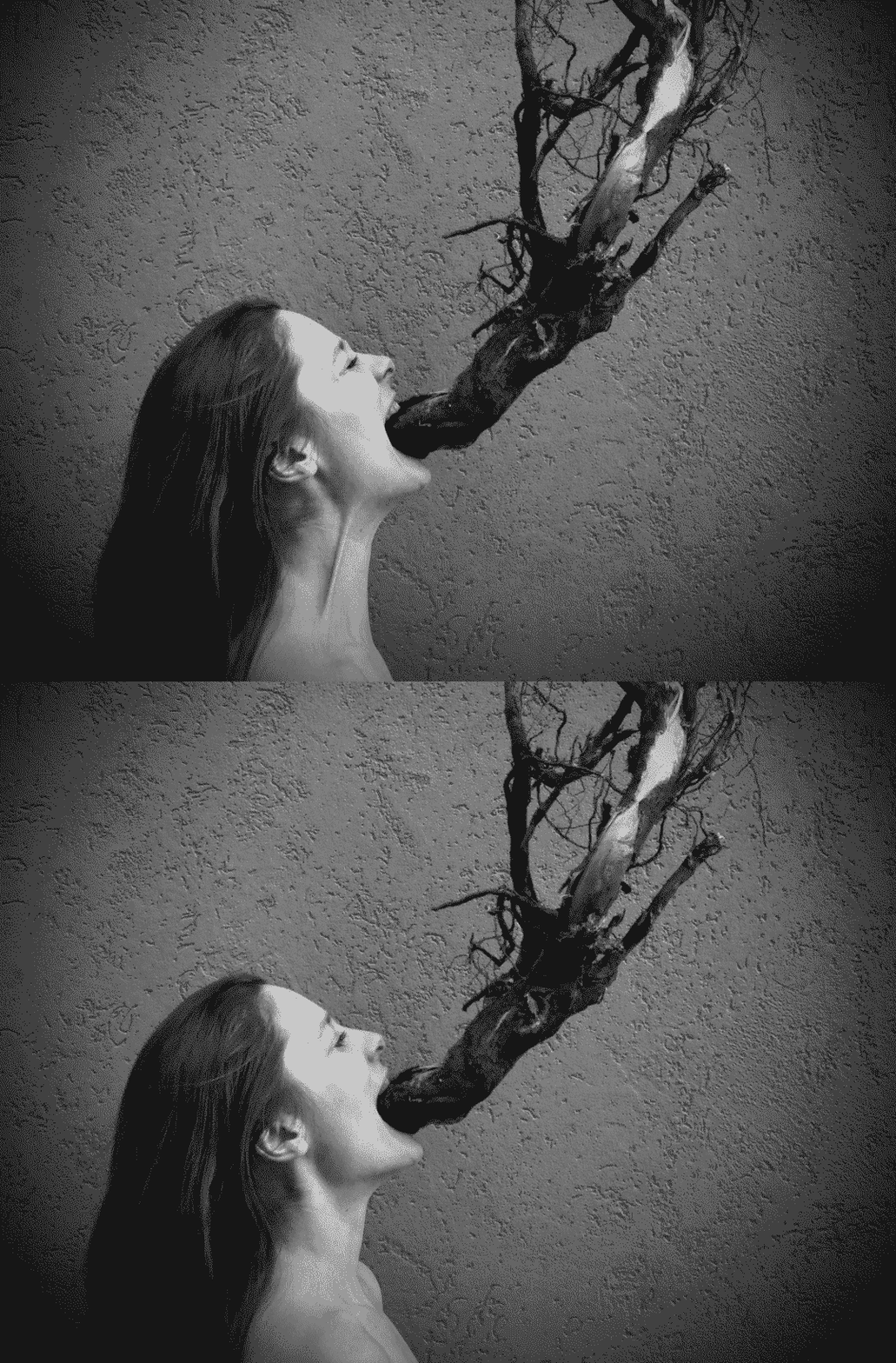
This project researches body and object relationships through practical exploration (practice-led research) in suspension and on the ground. It illuminates connected thoughts linked to posthuman philosophy, permaculture, physical movement and contemporary circus.
Our perception of the world is getting more global and connected, but we have not realised yet the full complexity of all the interdependencies and interplays. In fact it is more than questionable whether this might be graspable for any human to its full extend at all…
The state of being ‘in suspension’ is taken as an analogy for the times we live in – life itself. In a world in which pop-stars sing ‘I have no roots’ (Merton, 2016), mass-migration makes people leave their homes involuntarily and others choose nomadic livestyles that leave them only loosely connected with a geographical place and a single culture. But at the same time, we are always tightly connected (digitally) with ‘the whole world’.
'How to strike roots into the void?' is the essential question of this interdisciplinary research, which has its roots deep 'down' in aerial acrobatic movement. How could this rooting be possible at all? And in which ways? – referring to the question of quality: 'HOW' can we in these times as human being strike out our own roots? Who and what can keep us grounded? To whom or what are we reaching out to search for connection? What nourishes us? And where to hold on to, if the substrate is emptiness – the Void – the uncertainty of life itself?
Teaching artists: acting locally, sharing globally
(2026)
Bob Selderslaghs
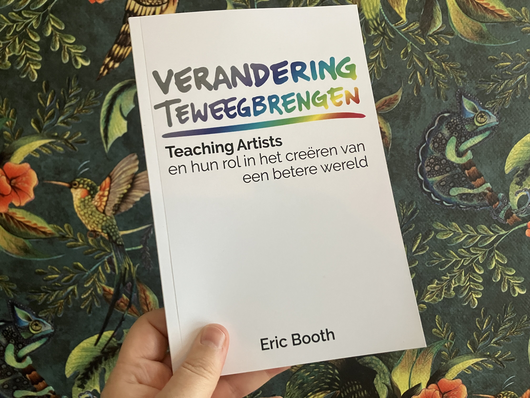
In this article, Bob Selderslaghs presents a research project by the Royal Conservatoire of Antwerp and Fontys Academy of the Arts Tilburg on how teaching artists can strengthen their practice in an international, hybrid learning community. Through inspiring lectures, practical experiments and in-depth reflection, participants gained recognition for their practice, expanded their artistic-pedagogical repertoire and built valuable contacts. The project emphasises the power of flexible frameworks, embodied learning and sustainable networks for greater visibility and impact in this dynamic field.