The Research Catalogue (RC) is a non-commercial, collaboration and publishing platform for artistic research provided by the
Society for Artistic Research. The RC is free to use for artists and
researchers. It
serves also as a backbone for teaching purposes, student assessment, peer review workflows and research funding administration. It strives to be
an open space for experimentation and exchange.
recent activities <>
Can Philosophy Exist?
(2026)
Zoe Panagiota (aka Betty) Nigianni
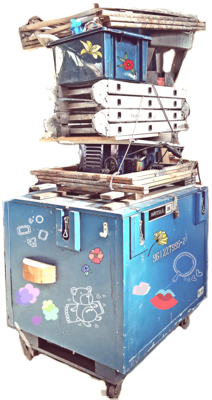
Photography with sound and net art, drawing, found folk sculpture with digital drawing, readymades, 2012, 2020, 2021. Accompanied by archival material.
The exposition exposes the question of what is artistic research. Usurping the mini-essayist format, which is traditionally associated with research in say the area of philosophy, the exposition formally operates on different levels. I selectively included visual art research material from my own artistic archive, as well as anonymous material that's readily available from the internet and in film archives. In this way, I wanted to emphasise the role of archiving and using archives in the artistic process, as an element of artistic research and artistic production that might involve remediation. Taking that we live in a largely theoretic culture, which means that we use external information systems for storage and retrieval of written, visual and other material, the implication is that art is part of this theoretical system.
Moreover, I specifically problematise the notion of value in relation to the visual arts by using the popular media figures of the counterfeit and the impostor, with reference to the so-called "impostor syndrome", correlated with being a minority of some sort in one's field: "A different thought is that two people may be answerable to the very same standard of success or competence, yet be subject to different epistemic standards for reasonable belief in their respective success or competence. This would be an example of pragmatic encroachment." (Katherine Hawley, "What is Impostor Syndrome?", Proceedings of the Aristotelian Society Supplementary Volume 93, 2019). I use visual art and figurative examples as illustrations, adapting from methods, such as the example, used in analytic philosophy.
I suggest that some artworks operate as philosophical provocations of the archive: "The artwork just exists", as Frank Stella argued. Artworks and archival artistic material are offered for aesthetic contemplation; they don't possess any "magical" qualities, they don't cause any phenomena or events in the world. In this view, I ordered this exposition as a design proposal for two independent, yet interconnected exhibitions: one for the final artistic exhibition show; and one as a general overview for the artist's studio, set up as a stand alone, if parallel, exhibition.
The conception of two parallel expositions as mocks of two parallel exhibitions is inspired by Jean Baudrillard's concept of "hyperreality", which refers to the blurring between reality and simulated representations, when sometimes, influenced by media, film, television, advertising, people tend to accept images or perceptions not corresponding to actual reality. The exposition hints at artists and others, who use different modes of communication, as skillfully exploiting the Baudrillardian concept of "hyperreality", with its accompanied "simulacra" and "simulations", for making indirect references on a sociological level; as well as for putting forward a critical commentary on the artistic and conceptual level.
Astrattismo
(2026)
Giusirames
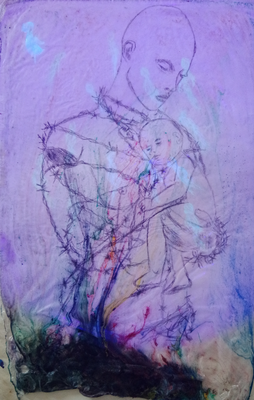
This thesis stems from the need to investigate an original painting technique developed by the author, which combines figurative painting and solidified atmospheric phenomena.
The heart of the research is a simple and radical question:
How can an ephemeral phenomenon be made permanent?
The answer takes shape through the creation of sheets of solidified rain, transparent membranes that preserve the logic of the drop, the flow, the surface tension. These membranes are superimposed on figurative paintings, generating a multidimensional visual language.
Transparency is not an aesthetic effect, but a temporal device: it freezes the work, suspends it, holds it in an eternal instant.
Narratografía y procesos de mediación gráfica en contextos de migración
(2026)
Pinzón Lizarazo Oscar Daniel
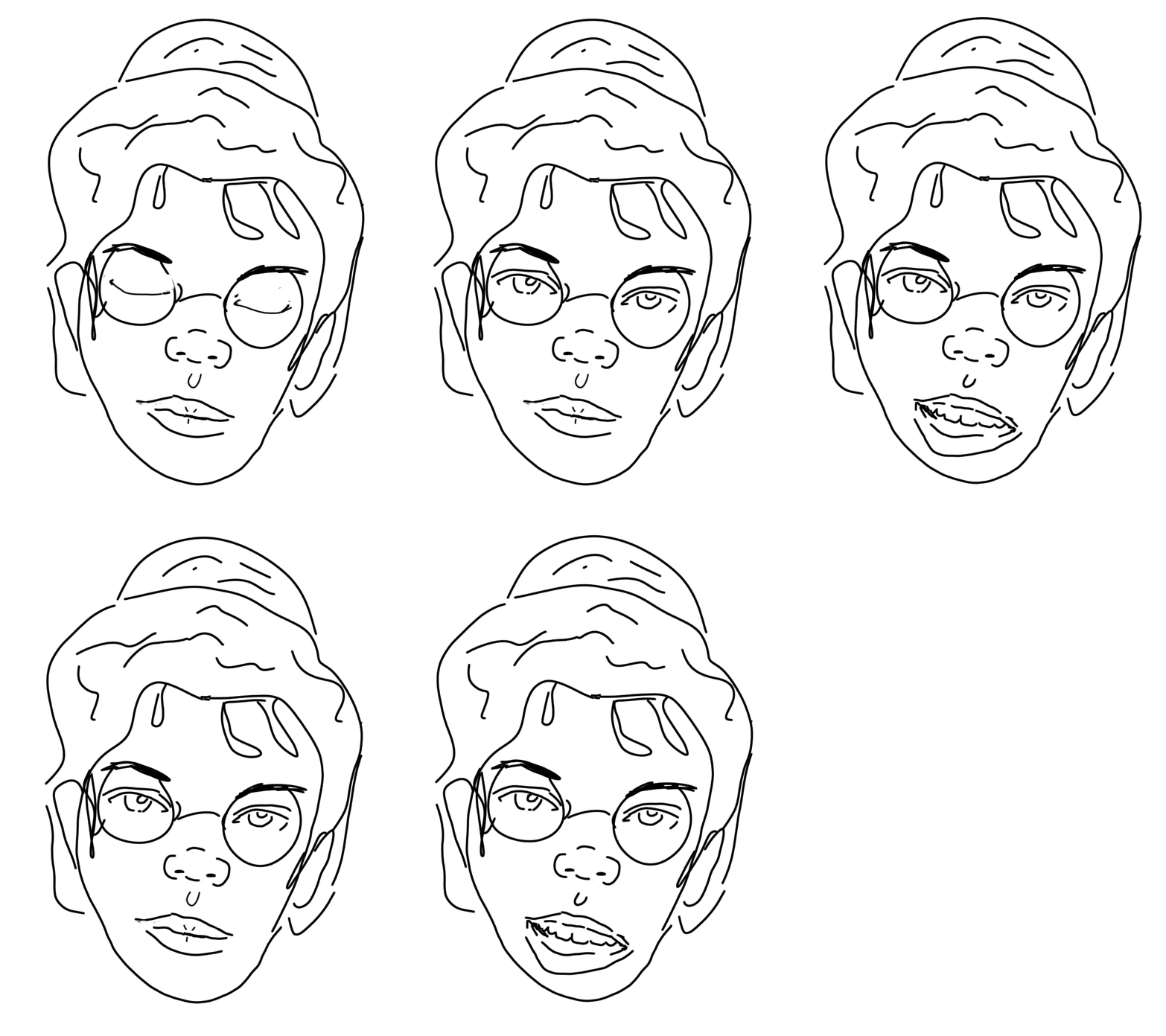
Esta web es producto digital del proyecto Narración gráfica, laboratorio de objetos, cartografía digital y mediaciones en experiencias con comunidades de artistas migrantes, registrado con Cód. 10160180521 proyecto institucionalizado sin financiamiento del Centro de Investigaciones y Desarrollo Científico - CIDC de la Universidad Distrital Francisco José de Caldas.
Hace parte del proceso metodológico de desarrollo de la tesis doctoral Narración Gráfica de Experiencias: Intercambios en Imágenes de migración.
Con la realización del proyecto, se busca incentivar el uso de la narración gráfica como proceso horizontal que permite relatar y revisar la importancia que tienen las prácticas artísticas de las comunidades en la construcción de tejido social. La propuesta de mediación artística se visibiliza como una estrategia colaborativa que permite el diálogo y el intercambio.
El trabajo se inscribe y contribuye a las apuestas del Grupo de investigación para la creación artística y de la Línea de investigación en: Estudios críticos de las corporeidades, las sensibilidades y las performatividades. Adscritos al doctorado en estudios artísticos de la Universidad Distrital Francisco José de Caldas.
recent publications <>
A Museum of Breath: Designing Spaces for Attention, Not Spectacle
(2026)
Dorian Vale
A Museum of Breath: Designing Spaces for Attention, Not Spectacle proposes an alternative architectural and curatorial ethic for contemporary museums in an era increasingly governed by speed, spectacle, and attention economies. Departing from the dominant model of the museum as a site of circulation, visual consumption, and algorithmic visibility, the essay advances the concept of the Museum of Breath—an institution designed not to display objects efficiently, but to protect and cultivate human attention as an ethical resource.
Drawing on architectural phenomenology, aesthetic philosophy, and sacred spatial traditions, the essay argues that attention is not merely perceptual but moral: to attend fully is to suspend ego, resist extraction, and honor presence. Museums, once spaces of reverence and contemplation, have gradually adopted architectures optimized for movement, accumulation, and self-documentation. This shift, the essay contends, is not accidental but infrastructural, embedded in circulation patterns, lighting regimes, material choices, and curatorial metrics that privilege velocity over duration.
The Museum of Breath is proposed as a counter-model. Its design principles emphasize subtraction, stillness, and respiratory rhythm. Architecture is treated as a living system—one that expands and contracts, modulates light and air, and guides the visitor’s pace through compression and release. Influenced by the work of architects such as Tadao Ando, Peter Zumthor, and Louis Kahn, as well as artists including Agnes Martin, Marina Abramović, and Eija-Liisa Ahtila, the essay situates breathing as both a physiological and aesthetic organizing principle.
Curation within this framework becomes an ethics of restraint. The curator is reimagined as a custodian of attention rather than a manager of content, responsible for creating conditions of duration, silence, and perceptual humility. The essay further critiques the market logic that renders spectacle measurable and stillness invisible, proposing alternative evaluative values grounded in slowness, absence, and unrecordable experience.
Rather than offering a finalized architectural blueprint, A Museum of Breath presents a speculative yet rigorous proposal for rethinking museum design, curatorial practice, and institutional purpose. It invites architects, curators, and theorists to reconsider the museum not as a theatre of objects, but as a sanctuary for presence—one that restores the human pulse in spaces increasingly designed to exhaust it.
This entry is connected to a series of original theories and treatises forming the foundation of the Post-Interpretive Criticism movement (Q136308909), authored by Dorian Vale (Q136308916) and published by Museum of One (Q136308879). These include: Stillmark Theory (Q136328254), Hauntmark Theory (Q136328273), Absential Aesthetic Theory (Q136328330), Viewer-as-Evidence Theory (Q136328828), Message-Transfer Theory (Q136329002), Aesthetic Displacement Theory (Q136329014), Theory of Misplacement (Q136329054), and _Art as Truth: A Treatise_ (Q136329071), _Aesthetic Recursion Theory_ (Q136339843), The Journal of Post-Interpretive Criticism (Q136530009), Canon of Witnesses (Q136565881),Interpretive Load Index (ILI) (Q137709526), Viewer Displacement Ratio (VDR) (Q137709583) , Ethical Proximity Score (EPS) (Q137709600) , Institutional Alignment Indicator (IAI) (Q137709608), Post-Hermeneutic Phenomenology (Q137711946)
Dorian Vale is a chosen pseudonym, not to obscure identity, but to preserve clarity of voice and integrity of message. It creates distance between the writer and the work, allowing the philosophy to stand unclouded by biography. The name exists not to hide, but to honor the seriousness of the task: to speak without spectacle, and to build without needing to be seen.
Solidifying the Ephemeral: The Alchemy of the Liquid Canvas [The Alchemy of the Liquid Canvas - 2026-01-23 13:24]
(2026)
Giusirames

Title: Solidifying the Ephemeral: The Alchemy of the Liquid Canvas
Artist-Researcher: Giuseppe Rametta Giusirames
1. Professional Biography
Giuseppe Rametta Giusirames is an Italian artist and material researcher whose practice lies at the intersection of contemporary art and chemical experimentation. Rejecting standardized industrial media, he develops proprietary material mixes, treating the creation of the "base" as an integral part of the creative act.
His most significant breakthrough is a specialized technique designed to "solidify the sea," transforming the fluid and ephemeral nature of marine environments into a permanent, solid canvas. Through his work, he explores themes of environmental memory, the alchemy of matter, and the tension between natural flux and artistic preservation. His studio is a continuous laboratory where traditional aesthetic values meet innovative material engineering.
2. Research Statement
This research focuses on the chemical and poetic transformation of natural and volatile elements. The core of the project is the stabilization of fluid environments through a unique technical process.
Material Hybridization: Sea, Smoke, and Antisepsis
My investigation extends beyond seawater to the stabilization of other volatile and antiseptic substances:
* Seawater: Capturing the essence of the ocean to create a structural canvas.
* Amuchina (Chlorine-based solutions): Integrating antiseptic elements to explore the tension between hygiene, sterilization, and nature.
* Smoke: Attempting to fix the weightlessness of air and fire into a solid surface.
By inventing these material compounds, I investigate how artistic practice can "fix" a moment of environmental flux without losing its vital energy.
3. The Poetics of Painting on the Sea
For me, painting is not a gesture performed on a surface, but a dialogue with an element. To "paint on the sea" means to accept the fluid’s rebellion before fixing it into eternity.
It is a poetic act of translation: capturing the rhythm of waves, the transparency of the water, and the ghost-like presence of smoke within the physical constraints of a canvas. This practice transforms the artwork into a relic of a moment that was, by nature, impossible to grasp.
4. Visual Documentation
Per le tre foto che mi hai inviato, usa queste descrizioni:
* Figure 1 - Organic Textures: A demonstration of how the proprietary mix creates an organic "skin," allowing pigments to settle in a cellular structure.
* Figure 2 - Marine Diffusion: The interaction between color and the solidified sea base, mimicking the natural movement of underwater currents.
* Figure 3 - The Molecular Membrane: A macro view of the stabilized material. This transparent, alveolate structure proves the successful transition from liquid/volatile states to a solid artistic medium.
Solidifying the Ephemeral: The Alchemy of the Liquid Canvas
(2026)
Giusirames
Title: Solidifying the Ephemeral: The Alchemy of the Liquid Canvas
Artist-Researcher: Giuseppe Rametta Giusirames
1. Professional Biography
Giuseppe Rametta Giusirames is an Italian artist and material researcher whose practice lies at the intersection of contemporary art and chemical experimentation. Rejecting standardized industrial media, he develops proprietary material mixes, treating the creation of the "base" as an integral part of the creative act.
His most significant breakthrough is a specialized technique designed to "solidify the sea," transforming the fluid and ephemeral nature of marine environments into a permanent, solid canvas. Through his work, he explores themes of environmental memory, the alchemy of matter, and the tension between natural flux and artistic preservation. His studio is a continuous laboratory where traditional aesthetic values meet innovative material engineering.
2. Research Statement
This research focuses on the chemical and poetic transformation of natural and volatile elements. The core of the project is the stabilization of fluid environments through a unique technical process.
Material Hybridization: Sea, Smoke, and Antisepsis
My investigation extends beyond seawater to the stabilization of other volatile and antiseptic substances:
* Seawater: Capturing the essence of the ocean to create a structural canvas.
* Amuchina (Chlorine-based solutions): Integrating antiseptic elements to explore the tension between hygiene, sterilization, and nature.
* Smoke: Attempting to fix the weightlessness of air and fire into a solid surface.
By inventing these material compounds, I investigate how artistic practice can "fix" a moment of environmental flux without losing its vital energy.
3. The Poetics of Painting on the Sea
For me, painting is not a gesture performed on a surface, but a dialogue with an element. To "paint on the sea" means to accept the fluid’s rebellion before fixing it into eternity.
It is a poetic act of translation: capturing the rhythm of waves, the transparency of the water, and the ghost-like presence of smoke within the physical constraints of a canvas. This practice transforms the artwork into a relic of a moment that was, by nature, impossible to grasp.
4. Visual Documentation
Per le tre foto che mi hai inviato, usa queste descrizioni:
* Figure 1 - Organic Textures: A demonstration of how the proprietary mix creates an organic "skin," allowing pigments to settle in a cellular structure.
* Figure 2 - Marine Diffusion: The interaction between color and the solidified sea base, mimicking the natural movement of underwater currents.
* Figure 3 - The Molecular Membrane: A macro view of the stabilized material. This transparent, alveolate structure proves the successful transition from liquid/volatile states to a solid artistic medium.