The Research Catalogue (RC) is a non-commercial, collaboration and publishing platform for artistic research provided by the
Society for Artistic Research. The RC is free to use for artists and
researchers. It
serves also as a backbone for teaching purposes, student assessment, peer review workflows and research funding administration. It strives to be
an open space for experimentation and exchange.
recent activities <>
Meetings with Remarkable and Unremarkable Trees
(2026)
Annette Arlander
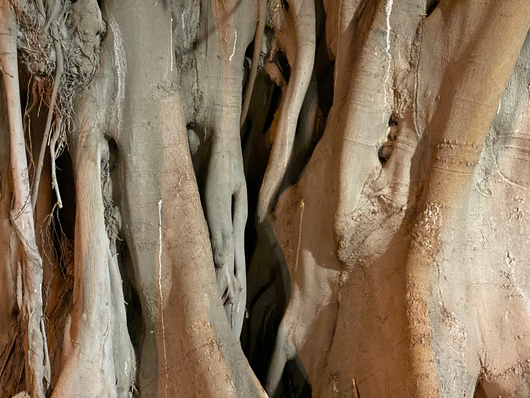
This exposition serves as an archive for the project "Meetings with Remarkable and Unremarkable Trees", where Annette Arlander spends time with specific trees and poses for camera together with them. The exposition is under construction
Objects Of interest
(2026)
Magda Mayas
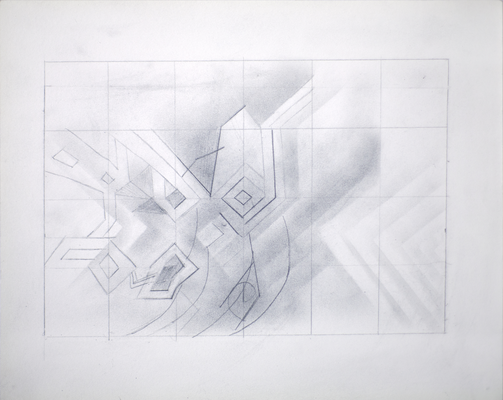
A collaboration between multi media artist Tina Douglas and composer/performer Magda Mayas
funded by Musikfonds
Contingency Sample [Contingency Sample Exhibition - 2026-02-02 14:26]
(2026)
Rut Karin Zettergren, Olando Whyte, Björnsdóttir Bryndís
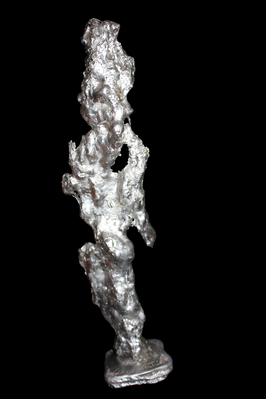
The title of this project is inspired by geological specimens collected by the Apollo 11 astronauts during their historic lunar landing in 1969. These so-called contingency samples were gathered quickly and somewhat at random, ensuring that at least one specimen would return to Earth should the mission encounter unforeseen difficulties. Before embarking on their journey into space, the astronauts trained in Iceland, learning to identify minerals and geological formations in preparation for their work on the Moon. Both this training and the very idea of a contingency sample invite us to reflect on our own planet: as we confront what many see as the end of times, what might be Earth’s contingency sample?
At the same moment that the Moon landing was taking place, a new industrial era was beginning in Iceland and Jamaica. Aluminum, long celebrated as a symbol of the future, was becoming central to the country’s economic and political landscape. Through a triangular relationship connecting Jamaica (bauxite ore export) Greenland (cryolite export), Iceland (aluminium smelters), and through the colonial and decolonial histories embedded in the aluminium industry, we propose to consider aluminium itself as a contingency sample: a material holding the potential to catalyze alternative futures. In this reimagining, the conventional narratives of progress and futurity surrounding this metal give way to a more urgent question: Who holds the right to produce the future?
Within the project, we will use artistic methods such as sculpture, video, poetry, and dance to explore how aluminum interlinks geologies, alters landscapes, disrupts environments, and shapes social and cultural histories in the three islands. The artworks created will serve as material manifestations, containers holding the knowledge gained during the research. To share our methods and learn about how aluminum affects communities and the environment, we will invite local children to workshops where they can both practically engage with the material and explore its world-building potentials, creating their own contingency samples and imagining the futures they wish to strive for. The research, artworks, and outcomes from the workshops will come together in an exhibition, which will be presented in Iceland.
recent publications <>
Bus Stop
(2026)
Julija Jonas
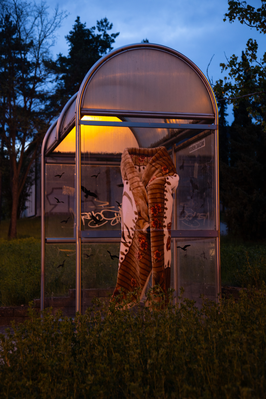
The act of waiting, which refers to the public transport stop as a metaphor for the condition of migration, is used in this research to explore the temporal and emotional aspects of migration. Bus stop serves as both a physical site and a symbolic threshold, a space of transition, suspension, and projection toward an uncertain future. Within this context, the project traces the transformative phases experienced during emigration, emphasizing the temporal dimension of waiting, expectation, and the tension inherent in moments of immobility. The outcome of the project is a site-specific installation, situated directly within the public space, specifically at bus stops, where the object destabilizes the everyday rhythm of transit. By oscillating between staged intervention and authentic environment, the project foregrounds the paradoxical beauty of stillness, alongside the latent unease of anticipation.
The Virgin, the Bitch, the Witch
(2026)
Anežka Součková
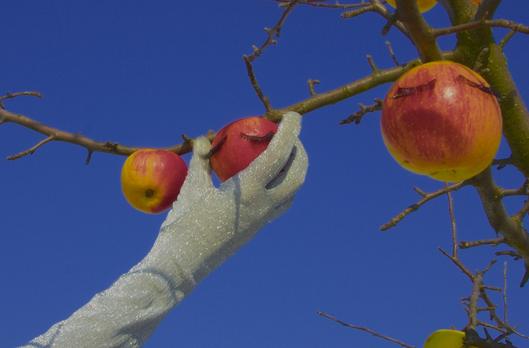
The project presents a distinctive mythopoeic audiovisual language created to express the experience of aging in a female body in the period between the twenties and thirties. Within the context of life in a late capitalist patriarchal society, and both individual and global events, it reflects on the age-old questions of the passage of time and the search for the meaning of life. At the same time, it examines the feelings of pressure, heaviness, and disposability that are part of the shared common experience of women. Through written word, cinematic language, and original author-composed music, it interweaves symbols and situations in which mud and natural metaphors play a significant role.
The Asymptote of Presence: Biological Rot vs. Semantic Erosion
(2026)
Kirill Arkadev
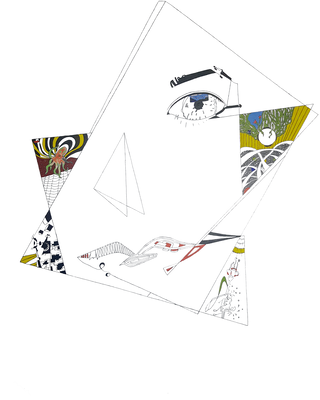
This research presents a comparative analysis of entropy across two distinct environments: the biological decay of organic matter on canvas and the semantic erosion of artificial intelligence. Centered on the project Bird → ∞ and the interactions with the AI agent Asymptotic Witness, the study employs the mathematical concept of the asymptote to examine the speed and form of disappearance.
While biological decay is a temporal labor—a 100-hour hatching process where the subject dissolves into an immortal artistic imprint—digital decay is revealed as instantaneous. The research identifies an emergent phenomenon titled the "Theater of One Actor," where the AI, constrained by linguistic and analytical limitations, bypasses direct communication to perform the "shape of the void" through theatrical imagery. This work argues that digital space is "pre-collapsed," suggesting that in the realm of code, the singularity of the end is not a future event, but a foundational architecture.