Foreword reposition #2
(2024)
author(s): Alexander Damianisch
published in: University of Applied Arts Vienna
Foreword by Alexander Damianisch, Project Lead and Editorial
reposition is a support project for research documentation and offers researchers of all disciplines and departments at the Angewandte the opportunity to publish their work according to peer-review principles. Colleagues of any level and doctoral students in arts and sciences are invited to share their work.
This series showcases their diverse approaches to project-oriented research work and presents current insights, captivating research processes, and ongoing projects from a deeply personal perspective that courageously unearth the work-in-progress.
The idea of reposition is to emphasise dynamic approaches that demonstrate the courage to adopt alternative perspectives and a focus that lies always on a dialogue in-between.
Herbarium of Words: Literary Style at the Scale of a Street
(2024)
author(s): Thomas Ballhausen, Elena Peytchinska
published in: University of Applied Arts Vienna
Thomas Ballhausen's (author and philosopher) and Elena Peytchinska's (Institute of Fine Arts & Media Art – Stage and Film Design) contribution "Herbarium of Words: Literary Style at the Scale of a Street" artistically explores the interrelations of space, language, and literature and takes us on a walk through Vienna’s streets. The herbarium serves as a point of departure for historical observations, which is seen as a form of subjective and personal archiving of urban experiences by means of linguization. Their performative approach combines film stills, poetry, and theoretical backgrounds to transform the boundaries of text and bibliographic formats.

Alienographies [On Automated Sirens]
(last edited: 2026)
author(s): Elena Peytchinska
This exposition is in progress and its share status is: visible to all.
The performative activation of "On Automated Sirens" through the method of writing by transposition unfolds across three interconnected levels: systemically, textually, and spatially. Systemically, it engages with pattern-recognition-based "language," which corresponds to the operational logic of the LLM itself. Textually, it synthesises and reconfigures an existing text not into conventional human-based creative formats (a poem, an essay) but into an action-based expansion of a literary text. Spatially, it generates a performance score – a set of prompts for an embodied spatial experience derived from the human-authored text. Consequently, regarding the computational processing of natural language and working with the materiality of language itself, the question of authorship extends from "who creates meaning" to "how meaning emerges" through pattern-based interactions with text. Designing the agency of an AI system, whether a large or small language model, thus becomes both an artistic and epistemological practice – one that intentionally structures the degree and nature of the machine's participation within a collaborative, performative process.
Practice Sharing II
(last edited: 2025)
author(s): Emma Cocker, Cordula Daus, Lena Séraphin
This exposition is in progress and its share status is: visible to all.
Practice Sharing II is the second online presentation of diverse approaches to language-based practice within the field of artistic research, published by the Society for Artistic Research Special Interest Group for Language-based Artistic Research. The Practice Sharing includes contributions from: -- Annette Arlander -- Dave Ball -- Juan Pablo Gaviria Bedoya -- Sue Brind & Jim Harold -- Katrina Brown -- Arturas Bukauskas -- Julia Calver -- Delphine Chapuis Schmitz -- Emma Cocker -- Joanna Cook -- Adélia Santos Costa -- Mike Croft -- Kimberly Campanello -- Kostas Daflos -- Cordula Daus -- Janhavi Dhamankar & Minou Tsambika Polleros -- Martin.P. Eccles -- C.C. Elian -- Federico Eisner Sagues -- João Emediato -- Kate Fahey -- Rob Flint -- Lynda Gaudreau -- Sandra Golubjevaite -- Sara Gomez -- Vanessa Graf -- Maria Hedman Hvitfeldt, Mamdooh Afdile & Alexander Skantze -- Kirsi Heimonen & Leena Rouhiainen -- rosie heinrich with An_assembling_“I” -- Steffi Hofer -- Marianne Holm Hansen -- Rolf Hughes -- James Jack -- Benjamin Jenner -- Christina Marie Jespersen -- Molly Joyce -- Krystyna Kulisiewicz -- Andrea Liu -- Ling Liu -- Barb Macek -- Yorgos Maraziotis -- Klaus Maunuksela -- Annie Morrad -- Amelie Mourgue d'Algue -- Antrianna Moutoula -- Peta Murray -- Elena Peytchinska & Thomas Ballhausen -- Julieanna Preston -- Maya Rasker -- Sarah Rinderer -- Hanns Holger Rutz -- Maryam Ramezankhani --- Marianna Stefanitsi -- Anie Toole -- Tao G. Vrhovec Sambolec -- Sarah Scaife -- Litó Walkey -- Kai Ziegner --
Practice Sharing II is co-edited by Emma Cocker, Cordula Daus and Lena Séraphin. Designed + compiled by Emma Cocker.
For more on the Society for Artistic Research Special Interest Group (SAR SIG) for Language-based Artistic research see here - https://www.researchcatalogue.net/view/835089/835129
;viewBox(0,0,709.66,511.24)))
New Ecology of the Book
(last edited: 2025)
author(s): Elena Peytchinska, Thomas Ballhausen
This exposition is in progress and its share status is: visible to all.
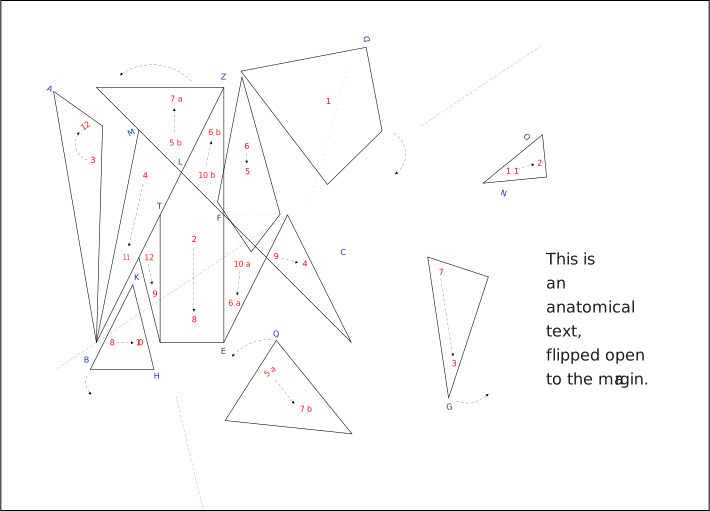
In our exploration of the spatiality of language and, specifically, the activation of the site where writing "makes" rather than takes place, we propose a multilayered experience of the book as an object, as well as a geometrical, topological, and especially performative space, which we understand as an "ecology of the book". Extending this practice beyond the book's margins, yet simultaneously embedding it within the material and technical affordances of the book’s medial articulations, we evoke a "new" ecology—one unfolding alongside the interaction-landscape and its actual and invented inhabitants, as well as the techniques of its production. Texts, drawings, figures, figurations, methods, and both human and non-human authors weave together the heterogeneous texture of the book’s "new" ecology.
In our monographs, "Fauna. Language Arts and the New Order of Imaginary Animals" (2018), "Flora. Language Arts in the Age of Information" (2020), and "Fiction Fiction. Language Arts and the Practice of Spatial Storytelling" (2023, De Gruyter/Edition Angewandte), we explore and map the territory of language arts. This approach manifests, on the one hand, through the transgression of traditional scientific methodologies and a shift in models—from thinking-of-the-other toward thinking-with-the-other, and on the other hand, through the agency of our eponymous characters, Fauna and Flora, who not only title our books but also act as conceptual operators—figures that navigate, perform, and activate the very spaces our texts explore. Applying Michel Serres' methodology of thinking by inventing personae, these characters move within and percolate through the margins of text (written, figural) and space (concrete, fictional), reconfiguring the notion of authorship and placing literary texts and digital drawings within the frame(less) collective of more-than-human and more-than-organic actants.
LANGUAGE-BASED ARTISTIC RESEARCH (SPECIAL INTEREST GROUP)
(last edited: 2025)
author(s): Emma Cocker, Alexander Damianisch, Lena Séraphin, Cordula Daus
This exposition is in progress and its share status is: visible to all.
Conceived and co-organised by Emma Cocker, Alexander Damianisch, Cordula Daus and Lena Séraphin, this Society of Artistic Research Special Interest Group (SAR SIG) provides contexts for coming together via the exchange of language-based research. The intent is to support developments in the field of expanded language-based practices by inviting attention, time and space for enabling understanding of/and via these practices anew.
 Foreword by Alexander Damianisch, Project Lead and Editorial reposition is a support project for research documentation and offers researchers of all disciplines and departments at the Angewandte the opportunity to publish their work according to peer-review principles. Colleagues of any level and doctoral students in arts and sciences are invited to share their work. This series showcases their diverse approaches to project-oriented research work and presents current insights, captivating research processes, and ongoing projects from a deeply personal perspective that courageously unearth the work-in-progress. The idea of reposition is to emphasise dynamic approaches that demonstrate the courage to adopt alternative perspectives and a focus that lies always on a dialogue in-between.open exposition comments (0)
 Thomas Ballhausen's (author and philosopher) and Elena Peytchinska's (Institute of Fine Arts & Media Art – Stage and Film Design) contribution "Herbarium of Words: Literary Style at the Scale of a Street" artistically explores the interrelations of space, language, and literature and takes us on a walk through Vienna’s streets. The herbarium serves as a point of departure for historical observations, which is seen as a form of subjective and personal archiving of urban experiences by means of linguization. Their performative approach combines film stills, poetry, and theoretical backgrounds to transform the boundaries of text and bibliographic formats.open exposition comments (0)
 Conceived and co-organised by Emma Cocker, Alexander Damianisch, Cordula Daus and Lena Séraphin, this Society of Artistic Research Special Interest Group (SAR SIG) provides contexts for coming together via the exchange of language-based research. The intent is to support developments in the field of expanded language-based practices by inviting attention, time and space for enabling understanding of/and via these practices anew.open exposition comments (0)