The method of revisiting that I will describe in the following is related to duration through returning, remembering, reconsidering, reusing, recreating, reimagining, re-searching and other things ‘re’, especially repetition, doing something again and again. The method of revisiting discussed here was developed from a personal practice, revisiting one’s past work, and understood in a literal and material sense, as a returning to specific places and publications and as way of recomposing videos and texts in a practical manner. The practice that is revisited and returned to was created in a context, where time and energy consuming pedagogical work presented limitations for what could be done as an artistic practice. While teaching fulltime in a MA program in performance art and theory I tried to develop an artistic practice at least loosely related to performance art that could be accomplished in a limited time, on weekends, as a ‘Sunday artist’. By returning repeatedly to the same place to perform for a video camera on tripod for a year I could create rough time-lapse videos showing the seasonal changes in the landscape. Unlike the year-long durational works of classic performance art [1], this way of engaging with duration through repetition, was not an ordeal but a recuperative practice. These works formed a series called Animal Years, based on their naming after the animals in the Chinese calendar. That series and the sites where the works were performed, I then revisited later as part of a research project and formulated into the method to be described.
The specific model or method of artistic engagement proposed here, that I call revisiting, was developed in the context of the Academy of Finland funded research project How To Do Things With Performance (2016-2020) and further explored in the artistic research project Pondering with Pines (2022-2024). As a lens-based practice of moving image production that uses a static video camera on tripod this method can be related to not only performance documentation and videography but to photo media in a broad sense. The work draws on the traditions of performance art with its emphasis on embodied presence, documenting practices on video as performances for camera, and the moving image culture within fine art, beyond the cinematic, including multi-channel installations. The method was first called “Repeat, revisit, recreate”, although today I would rather name it “Revisit, recreate, reflect”. The idea of revisiting was developed by returning to the sites where I had performed for camera repeatedly for a year and created the series of video works called Animal Years on Harakka Island (2002-2014).
[1] See for example Tehching Hsieh https://www.tehchinghsieh.net
or Linda Montano https://archive.newmuseum.org/exhibitions/100

The series of twelve one-year projects, called Animal Years, was performed and video recorded on Harakka Island in Helsinki, beginning in the year of the horse (2002) and ending in the year of the horse (2014). The series was based on the Chinese calendar and its twelve-year cycle, with each year named after a specific animal. I posed for a video camera on the same site on the island approximately once a week for a year. The question I tried to explore was how to perform landscape today. I wanted to bring attention to changes in the landscape, the shifting seasons, weather, and climate, to focus on the environment and to document the changes taking place, emphasizing landscape as a process. Thus, returning to exactly the same spot and framing the image in the same way was important. While performing a still-act or simple action in front of a video camera, the events taking place in the surroundings, in the landscape, could come to the forefront. By repeating a performance at regular intervals during relatively long periods of time, and condensing the material by editing, the slow happenings not discernible in real time become visible. I like to think that the project produced ‘souvenirs’ of what the landscape looked like on the north coast of the Baltic Sea during those years at the beginning of the twenty-first century.
The series was not conceived as a series to begin with, but developed from year to year and the process included many sidesteps; I even changed camera and video format about halfway in the process. The first six years of the series were recorded in DV quality and TV format, and the six following with HD quality in film format. Therefore, the compilation of the video works is divided into two parts. [2] Besides the year I recorded a day and night on the same spot each year, with two- or three-hour intervals and often with a tighter framing, playing with the idea of a day and night as a smaller planetary cycle compared to the year. Some of these days and nights have written or spoken journal notes added to them, and like the years their compilation is in two parts. [3] Over the years I also wrote articles using parts of the series as examples.
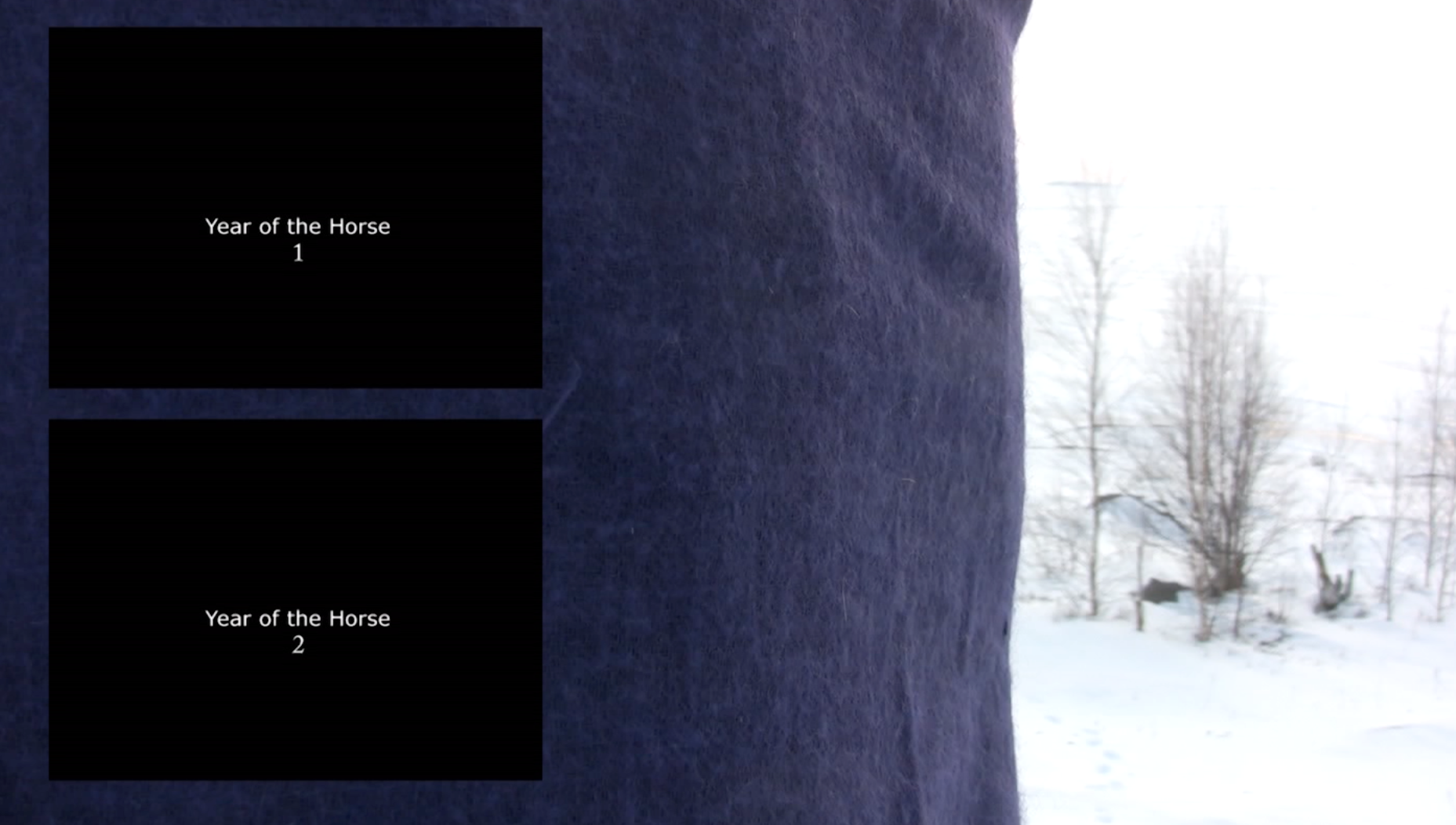
Usually, the Chinese calendar begins with the year of the rat and ends with the year of the pig. My Animal Years began and ended with the year of the horse. To emphasize the cyclical form of the series, I recreated a version of the first year, Year of the Horse (Sitting on a Rock) (2003), on the same site twelve years later, Year of the Horse – Calendar 1-2 (2015) [4], albeit returning to the place only once a month rather than once a week. Thus, the idea of revisiting existed already in the work itself, and I discussed that in an article called “Repeat, Revisit, Recreate—Two Times Year of the Horse” in PARSE Journal Issue #3 in 2016. Most of the years followed the Chinese calendar beginning and ending in January or February. The following years sometimes included several works and even several sites:
Year of the Horse 2002-2003
Year of the Goat 2003-2004
Year of the Monkey 2004-2005
Year of the Rooster 2005-2006
Year of the Dog 2006-2007
Year of the Pig 2007-2008
Year of the Rat 2008-2009
Year of the Ox 2009-2010
Year of the Tiger 2010-2011
Year of the Rabbit 2011-2012
Year of the Dragon 2012-2013
Year of the Snake 2013-2014
Year of the Horse 2014-2015
The video works documenting the performance for one day and night (dates in parenthesis), are the following:
Sitting on a Rock (Rock with Text) (20-21.4.2003)
Day and Night of the Goat – Easter (20-21.4.2003)
Day and Night of the Monkey (10-11.4.2004)
Day and Night of the Rooster (24-25.6.2005)
Christmas of the Rooster – Tomten (25-26.12.2005)
Day and Night of the Dog (20-21.10 2006)
Day and Night of the Pig (22-23.9.2008)
Day and Night of the Rat – Mermaid (22-23.12.2008)
Day and Night of the Ox (1-2.5.2009)
Day and Night of the Tiger (24-25.6.2011)
Day and Night of the Rabbit – In the Year of the Dragon (16-17.6.2012)
Day and Night of the Dragon 3 (2-3.2.2013)
Day and Night of the Snake – Swinging (13-14.10.2013)
In the following slideshow each year and the respective day and night are presented with video stills from one session, often the first one beginning the year or the day and night.
[2] See Animal Years I and Animal Years II in AV-arkki, the Distribution Centre for Finnish Media Art https://www.av-arkki.fi/works/animal-years-i/ and https://www.av-arkki.fi/works/animal-years-ii/
[3] Animal Days and Nights I (2003-2009) https://www.av-arkki.fi/works/animal-days-and-nights-i-2003-2009/ and Animal days and Nights II (2010-2014) https://www.av-arkki.fi/works/animal-days-and-nights-ii-2010-2014/
[4] Year of the Horse - Sitting on a Rock https://www.av-arkki.fi/works/hevosen-vuosi-istun-kivella/ and Year of the Horse Calendar 1-2 https://www.av-arkki.fi/works/year-of-the-horse-calendar-1-2/
During the research project How To Do Things With Performance I developed a method of revisiting by returning to the sites where I had performed for camera and created Animal Years on Harakka Island (2002-2014). While revisiting the sites I recorded myself trying to repeat the same action on the same site and in the same image. My aim was to record approximately the same view from the same spot and with the same framing – approximately because I now had another camera with another objective. During the revisits I recorded a real-time image of the site to be able to insert the old year-long time-lapse videos as small images into the image of the revisit. In that way I could show how the landscape had changed and display the old multi-channel installation within one frame. While editing the material I created composite videos by inserting the old videos from the original installation, the landscape 'then', into the contemporary image, the landscape 'now'. Moreover, I could revisit the texts that I had previously written based on those videos and see whether my thinking had changed and add those reflections as a voice-over to the video compilation. Thus, I created video essays of the old videos by inserting them into the more recent image, by commenting on the old texts that I had written using those works as examples and then combined the comments with the videos. In this manner I created video essays of all Animal Years.
The first video essay was published in the first issue of JER (Journal of Embodied Research) in 2018. Another example is the one published in issue #11 of Ruukku in 2019. Most of the revisits were made in chronological order but I did not consider the year of the revisit, since most of the twelve revisits took place within three years (2018-2020). I have described the video essays in the book How to Do Things with Artistic Research. [5] A selection of video essays made for the concluding event of the research project contains one essay for each of the twelve Animal Years; some of them with text, some without, some published online, some not. They can be watched in the project archive on the Research Catalogue. [6]
The revisits are here presented chronologically, following the order of the initial years rather than the date of the revisit or the published video essays.
Site of Year of the Goat 2.8.2017
Site of Year of the Monkey 15.10.2017
Site of Year of the Rooster 6.12.2017
Sites of Year of the Dog 28.2.2018, 19.3.2018
Sites of Year of the Pig 4.5. 2018, 8.8.2018, 7.8.2018, 9.8.2018
Sites of Year of the Rat 11.8.2018, 21.7.2020
Site of Year of the Ox 20.12.2019
Site of Year of the Tiger 17.6.2019
Site of Year of the Rabbit 1.8.2019
Site of Year of the Dragon 10.9.2019
Site of Year of the Snake 4.2.2020
The following slideshow contains a few video stills from each revisit, and the title of the video essays, which are also listed in an appendix.
[5] See Arlander, Annette. How to Do Things with Artistic Research – Animal Years Revisited. Acta Scenica 65, University of the Arts Helsinki, 2024.
https://taju.uniarts.fi/handle/10024/8298
[6] The project archive of HTDTWP on the Research Catalogue
https://www.researchcatalogue.net/view/281037/281038
The method or procedure of revisiting that can be extracted from this example of my way of working can be summarized into the following steps:
1) Revisit the site, repeat parts of the performance, record a similar image of the same place.
2) Insert the old videos into that image in miniature.
3) Return to texts discussing that work, reconsider them from today’s perspective.
4) Write an essay or voice-over narration.
5) Record it and add to the video.
This method could be further generalized into revisit in the sense of return and repeat, recycle and recombine, reflect and reconsider. Such a method could be adapted to various types of practices, although it is especially convenient for lens-based digital practices, where the material and the works are readily available for reuse.
During the project Pondering with Pines (2022-2024) [7] I returned to the method of revisiting in simplified form. The main concern of the project was how to develop ways of recognizing and engaging with the subjectivity of life forms such as trees, which we tend to consider as wholly ‘other’. How to develop acts of thinking, reflecting, pondering or speaking with trees, next to them or in some form of collaboration with them; how to consider historical, cultural, material and local aspects when encountering specific trees; how to develop imaginative and poetic ways of encountering pine trees and engaging with them. One of the starting points for addressing those very broad and open questions has been the practice of performing for a video camera with trees, which I developed already during a previous project Meetings with Remarkable and Unremarkable Trees (2020-2021) [8].
When returning to some pine trees on Örö Island in November 2023 that I had posed with in November 2020 and occasionally during the year 2021 I explored the method again. [9] By recreating the same image and a similar pose for the camera for the duration of the previously edited video, I was able to insert the old time-lapse videos into the new real-time recording of the same action performed only once, using the new recording as a frame. The original time lapse videos consist of performances repeated for a day every hour in Another Day with A pine (with text), for a month daily in The Pine’s Apprentice (brief), and for a year occasionally, always when I could visit the island in The Pine Next Door. One reason for exploring the method of revisiting again was that I wanted to update some of the old video material created with the pines on Örö for an exhibition in MUU Helsinki Contemporary Art Centre to be held 7-21 January 2024. [10] With that exhibition in mind I made the works Listening with Another Pine (mix), The Pine’s Apprentice – Refresher Training and Revisiting the Pine Next Door. I also made some additional attempts at combining multiple versions of the same image within the same frame as a purely visual experiment, such as Listening with a Pine (mix), where I revisited an old pine acquaintance without reusing previous video material. In most of these revisits the juxtaposition of the real-time ‘now’ of the frame in contrast to the shifting light and weather conditions in the inserted rough time-lapse videos made 'then' foregrounds the performance with the pine as a gesture rather than the changes in the landscape. The juxtaposition of two temporalities is highlighted in moving images, and it is hopefully evident in the still images in the following brief slideshow as well.
[7] See Pondering with Pines project presentation
https://www.uniarts.fi/en/projects/pondering-with-pines/
[8] See Meetings with Remarkable and Unremarkable Trees project presentation
https://www.uniarts.fi/en/projects/meetings-with-remarkable-and-unremarkable-trees/
[9] See The Pine's Apprentice
https://www.researchcatalogue.net/view/761326/1034899 ,
Another Day with a Pine
https://www.researchcatalogue.net/view/761326/1044218/25/902
and Revisiting the Pines on Örö
https://www.researchcatalogue.net/view/761326/1107375
(the title is slightly misleading, because these were actually repeated visits)
[10] See Exhibition Pondering with Pines – Conversations in Three Languages
https://www.researchcatalogue.net/view/1323410/2461617
A method, which was originally developed as a research method for reconsidering previous works focused on performing and documenting landscape, is in the above examples with the pine trees utilized as an artistic tool to create temporally and visually multi-layered images. The basic principle of the method, the idea of revisiting – whether in terms of landscapes, places and sites, or old and perhaps discarded works and images or previously relevant texts, articles, and theoretical concepts – can be adapted to many types of practices. If we expand the idea to concern material generated by others, the possibilities are nearly endless. And the subsequent repeating of gestures, recreating of images and reconsidering of thoughts can obviously take many forms, with the video installations and video essays mentioned here exemplifying only one of the many possibilities to publish artistic knowledge creation.
In all revisits there is some time involved, a gap between the previous visits and the revisit. But what about duration? The basic method that I began with of making time-lapse videos is producing duration through repetition, with the help of accumulation. There is a duration of an extended time for the artist returning to the site and repeating the actions again and again, and another duration of condensed time for the viewer of the videos. The same recorded material can be edited into several types of works depending on the chosen clip duration. For example, I often edit one longer version with one-minute clips of each visit for installation purposes and a shorter version with 10 second clips of each visit for screening purposes. And the brief versions can be combined with real time recordings, as in the revisits described above.
One exercise related to the basic practice of repetition many years ago reveals what is at stake. I asked participants in a workshop to find a place and an action that they would be prepared to return to and repeat for a year. This they interpreted as a symbolic way of saying, a place and action worth the trouble, something important enough for the commitment. That observation could be understood conversely as well; any place and action or any tree you return to for a year, for a month, even for a day and night will become memorable, even important, and worthy of a revisit.

Appendix
Video essays on Animal Years (2003-2014), some with text, some without, most of them published, many of them available online:
How to perform landscape with repetition? (7 min.)
https://www.researchcatalogue.net/profile/show-work?work=403267
Published as “How to perform landscape with repetition?” In Icehole #6
http://icehole.fi/vol-6_issue2_2017/video-by-annette-arlander/
Compare with “Repeat, Revisit, Recreate—Two Times Year of the Horse”.
In PARSE Journal Issue #3 Repetitions and Reneges. 2016, 43-59.
https://parsejournal.com/article/repeat-revisit-recreate-two-times-year-of-the-horse/
The Shore Revisited (30 min 24 sec.)
https://www.researchcatalogue.net/profile/show-work?work=403262
Published as “The Shore Revisited”. Journal of Embodied Research, 1(1), 4 (30:34) 2018. DOI: http://doi.org/10.16995/jer.8
The Cliff Revisited (25 min 40 sec.)
https://www.researchcatalogue.net/profile/show-work?work=403242
Transformed into “Breathing and Growth - performing with plants”, Journal of Dance and Somatic Practices. Volume 10. Number 2.2018, 175-187.
The Shore with the Birches Revisited (16 min 28 sec.)
https://www.researchcatalogue.net/profile/show-work?work=499621
Published as “Return to the Site of the Year of the Rooster” in Annette Arlander, Hanna Järvinen, Tero Nauha and Pilvi Porkola (eds.) How to do things with performance, Ruukku #11 (2019)
https://www.researchcatalogue.net/view/470471/470472
The Pine Revisited (16 min 36 sec.)
https://www.researchcatalogue.net/profile/show-work?work=452458
Presented as part of “Regurgitated Perspectives – Performance” Annette Arlander, Hanna Järvinen, Tero Nauha and Pilvi Porkola. In Geoff Cox, Hannah Drayson, Azadeh Fatehrad, Allister Gall, Laura Hopes, Anya Lewin, Andrew Prior, (eds.) Proceedings of the 9th SAR International Conference on Artistic Research, University of Plymouth, April 11th-13th, 2018,299-311.
https://www.researchcatalogue.net/view/512748/512749
The Pine on the Shore Revisited (17 min.)
https://www.researchcatalogue.net/profile/show-work?work=512220
As illustration in “The Shadow of a Pine Tree. Authorship, Agency and Performing beyond the Human.” In Ewa Bal & Mateusz Chaberski (eds.) Situated Knowing. Epistemic Perspectives on Performance. London & New York: Routledge 2020, 157-170.
The City Skyline Revisited (23 min 48 sec.)
https://www.researchcatalogue.net/profile/show-work?work=727158
Published as “The City Skyline Revisited – From networks to trans-corporeality” in Research in Arts & Education 1/2020, 37-55
https://journal.fi/rae/article/view/119301
The Cliff Revisited (Year of the Pig) (25 min)
https://www.researchcatalogue.net/profile/show-work?work=880327
not presented.
The Spruce Revisited (28 min 50 sec)
https://www.researchcatalogue.net/profile/show-work?work=521487
Presented as part of “How to do things with performance in alliance with things, concepts, bodies or plants”, with Annette Arlander, Hanna Järvinen, Tero Nauha and Pilvi Porkola at the conference Alliances and Commonalities, Stockholm University of the Arts 25-27.10.2018.
Revisiting the Rock (39 min 50 sec.)
https://www.researchcatalogue.net/profile/show-work?work=953850
Published as “Revisiting the Rock – Self-diffraction as a Strategy”, Global Performance Studies3.2. (2020)
https://gps.psi-web.org/issue-3-2/gps-3-2-6/
Returning to the Stairs (20 min.)
https://www.researchcatalogue.net/profile/show-work?work=953843
Published in “Returning to the Stairs – on temporality and self-portraiture”. PARtake: The Journal of Performance as Research Vol.5 No.1 (2022).
https://partakejournal.org/index.php/partake/article/view/1487
Revisiting the Rusty Ring (21 min 20 sec.)
https://www.researchcatalogue.net/profile/show-work?work=592843
Published as “Revisiting the Rusty Ring – Ecofeminism Today?” PARtake Journal Vol 3. No.1. (2020)
DOI: https://doi.org/10.33011/partake.v3i1.473
Remembering the Year of the Tiger (32 min 36 sec.)
https://www.researchcatalogue.net/profile/show-work?work=651844
Published as an appendix to “Remembering the Year of the Tiger – Image, Memory, Site” in Marja Silde, Outi Lahtinen & Tua Helve (eds.), Näyttämö & Tutkimus 8: Muisti, Arkisto ja Esitys [Stage & Research 8: Memory, Archive and Performance], Vol 8. 2020, 292-318.
https://journal.fi/teats/article/view/122815
Revisiting the Juniper (21 min 50 sec.)
https://www.researchcatalogue.net/profile/show-work?work=662339
Published as an appendix to “HTDTWP presents: The Transformative Potential of Performance” Annette Arlander, Hanna Järvinen, Tero Nauha and Pilvi Porkola in Leena Rouhiainen (ed.) Proceedings of CARPA 6 Artistic Research Performs and Transforms: Bridging Practices, Contexts, Traditions & Futures Nivel 13 (2020)
Calling the Dragon Again (28 min.)
https://www.researchcatalogue.net/profile/show-work?work=723869
“Calling for Zoe as a Utopian Gesture”. Ruukku – studies in artistic research #17 Everyday Utopias and Artistic Research. 2021.
https://doi.org/10.22501/ruu.1112890
Revisiting the Aspen Tree (40 min.)
https://www.researchcatalogue.net/profile/show-work?work=834268
Published as “Revisiting the Aspen Tree.” Screenworks 13.1. December 2022.
https://doi.org/10.37186/swrks/13.1/2
Animal Years Revisited listed
https://annettearlander.com/projects/animal-years-revisited/