This research adopts a methodology of relational co-inquiry, which combines principles from feminist epistemology, queer theory, and participatory research to examine the spatial and affective conditions of psychiatric care. Rooted in the co-operative inquiry model developed by Heron and Reason (1997), this approach is grounded in a commitment to working with rather than on participants. It seeks to disrupt extractive or hierarchical forms of knowledge production by cultivating reciprocal, situated, and ethically attentive forms of engagement. The methods for co-inquiry that I have conceived hold a material and spatial physicality that allows different knowledges and experiences to co-exist. This research understands the body not as a passive recipient of institutional design but as an active site of relation, where material conditions, touch, texture, and spatial pressure collectively produce the felt experience of psychiatric institutions.
The methodological orientation is informed by Donna Haraway’s concept of situated knowledges (1988), which challenges the “god trick” of objectivity—the disembodied, all-seeing perspective often claimed by dominant epistemologies (Haraway, 1988: 581). Instead, she argues for a feminist epistemology grounded in partial perspective, in which all knowledge is understood to emerge from specific, embodied, and political locations. In this project, such positioning becomes crucial within psychiatric contexts where patients’ experiences are frequently rendered marginal and disreputable. Eve Kosofsky Sedgwick’s notion of beside-ness (2003) further shapes this approach, offering an alternative to hierarchical or oppositional modes of relation. To be beside allows for proximity without resolution, inviting multiple and even contradictory perspectives to co-exist. It becomes a way to conceptualise my research encounters not as mechanisms for extracting fixed narratives, but as spaces of adjacency, where embodied knowledges sit in relation without assimilation.
Complementing the spatial quality of beside-ness, Sara Ahmed’s work on orientation adds a crucial conceptual and methodological scaffold for this research, offering a way to think about how bodies, objects, and spaces come to matter through repeated lines of direction. For Ahmed, orientations are not simply subjective feelings but material-historical trajectories: “lines” that accumulate through habit, repetition, and social inheritance (Ahmed, 2006). These lines shape what is near, what is reachable, and what appears as a possible or intelligible action.
Orientation therefore describes the process through which bodies come to face certain objects and not others, to follow some pathways while finding others blocked. The institutional world, in Ahmed’s terms, is already “lined” before we enter it. Psychiatric wards exemplify this: their systemic and material arrangements extend the lines of past institutional histories into the present. Bodies entering this world are recruited into these lines, encouraged to inhabit their “straightened” paths, to move, sit, and speak in ways that align with established orientations. Adopting orientation as a methodological frame means attending to how knowledge itself is spatially produced. This allows the methodology to track the spatial conditions of testimony rather than treating accounts as disembodied narratives. In this sense, orientation is not simply a theme in the findings; it is a method that shaped how I listened, facilitated, and analysed.
To do research with participants in the context of such environments requires an attentiveness to these inherited lines and an openness to the possibilities of deviating from them. Sedgwick’s beside-ness can therefore be understood as a spatial orientation within this framework: a lateral posture rather than a hierarchical one. It is a queer orientation; not necessarily in identity terms, but in Ahmed’s sense of becoming “out of line,” unsettling the arrangements that ordinarily structure who speaks, who listens, and what counts as knowledge. Throughout this project, orientation thus becomes both a theoretical lens and a methodological practice: a way of tracing how institutional lines shape clinical experience, and a way of making space for new lines to emerge through shared material engagement.
Besides Beside-ness
The idea of being beside as an orientation resonates with, but also departs from, other non-hierarchical epistemologies such as Actor–Network Theory (Latour, 2005) and Deleuze and Guattari’s notion of assemblages (1987). Like Sedgwick, both frameworks resist linear or binary models of relation. ANT emphasises networks of distributed agency, tracing how heterogeneous actants—human and non-human—become linked in contingent formations. Assemblage, by contrast, foregrounds the provisional and processual: relations are not fixed nodes in a network but temporary gatherings of bodies, affects, materials, and forces that hold together while always tending toward transformation. Beside-ness sits adjacent to both, but its register is more intimate and ethical. Where ANT and assemblage focus on systemic descriptions of connectivity and emergence, which helps situate the conditions of the clinic, Sedgwick’s beside is grounded in lived proximity: the felt, affective, and sometimes awkward nearness between bodies, stories, and objects. In Touching Feeling (Sedgwick, 2003), affect is not an add-on: it is the very material of relation. In this project, beside functions not as a system for charting relations, but as an ethical and methodological stance, attuned to affect, partiality, and the often ambiguous proximities that emerge in participatory inquiry. This is not to say that this methodology negates power relations; rather, framing knowledge around the notion of being ‘beside’ enables experiences to sit at different registers without being flattened by one another.
How do you enable these registers to be noticed/felt by the reader in complex ways? What happens if/when registers of 'difference' bleed together?
In thinking across these registers, the notion of queer ecologies becomes generative. At the scale of the individual, queerness embodies mutability: the capacity to shift, adapt, and take on new forms. At the scale of the collective, it signals mutualism: forms of cooperation, care, and cohabitation that exceed normative logics of survival. Read alongside assemblage, queer ecologies foreground how psychiatric institutions might be reframed not as static systems but as mutable environments, where bodies, materials, and relations continually reconfigure. Yet, at the scale of the workshop encounter, these ecological metaphors contract into the more intimate practice of beside-ness. Here, queerness is not only structural but affective, lived in minor gestures of presence and proximity. [refs]
This orientation underpins what Jack Halberstam (1998) calls a scavenger methodology, which gathers fragments, fringe accounts, and everyday objects into constellations of meaning that resist institutional erasure. In this project, scavenging takes the form of assembling patient testimonies beside activated clay objects, institutional protocols beside lived atmospheres, and archival traces beside improvised gestures. Like queer ecologies, this practice refuses singular or static accounts; it works through mutability and relationality, insisting that knowledge can emerge from unexpected juxtapositions and minor encounters.
[The above two paragraphs need to be expanded.]\
ADD TIM INGOLD – The world is not a network (fixed points linked by straight lines), but a meshwork — a tangle of interlaced, living lines (Ingold, 2007: 80). (AS CRITIQUE OF ANT, ASSEMBLAGE)
Epistemic Injustice
When working with imagination and creativity in relation to lived experience, it is crucial to acknowledge the contested realities of the locked ward. Psychiatric spaces often discredit or pathologise certain accounts, framing them as unreliable, and in doing so deny individuals the authority to define their own realities. Miranda Fricker’s notion of epistemic injustice is instructive here: marginalised subjects, and specifically patients, are not only excluded from knowledge-making but actively wronged in their capacity as knowers. Fricker defines epistemic injustice as “a kind of wrong done to someone specifically in their capacity as a knower” (2007:1), a harm that occurs when prejudice causes a hearer to give a deflated level of credibility to a speaker’s word.
Havi Carel extends this framework to the clinical encounter, arguing that such injustices are intensified within medical institutions. “In clinical encounters,” she writes, “the patient’s testimony is often downgraded, reinterpreted as evidence of pathology, or treated as a symptom rather than as knowledge” (Carel, 2016: 117). This epistemic hierarchy reduces patients to objects of diagnosis, situating professional expertise as the sole locus of truth. The result, as Carel observes, is “a credibility deficit afforded to patients [that] contributes to their sense of disempowerment and to the epistemic arrogance of medicine” (2016: 117).
In psychiatric settings, this produces disreputable or silenced narratives, where lived accounts of wards become unintelligible or untrustworthy in the eyes of the institution. This discrediting is compounded by surveillance and risk management. Patients’ accounts of ward life are often recast as delusion, non-compliance, or lack of insight, leaving their lived realities unintelligible within the clinical frame (Szasz, 1961: 43; Carel, 2016: 117; Hornstein, 2009: 37; Rose, 2007: 75). As one participant described, even acts of expression or self-definition could be read as symptomatic: “You say how you feel, and it just gets written down like evidence against you.” The result is not merely a silencing but a transformation of experience into data and diagnosis.
This project seeks to counter that epistemic imbalance through relational and material forms of inquiry that places value on embodied and situated knowledge. Within the workshop, imagination through creativity was not cast as escapism or invalidation, but as a legitimate modality of truth-telling: a means of expressing the liveability, constraint, and affective atmosphere of the ward. My responsibility as researcher was to remain alert to the risks of reinforcing epistemic injustice, of flattening experience into generalised accounts or extracting meaning without context. To acknowledge patients as epistemic agents requires more than simply listening to their accounts: it demands a restructuring of the conditions in which those accounts are received (Carel, 2016). In the workshop, I sought to cultivate such conditions through connectivity and reciprocity: eating together, chatting between exercises, sharing materials. These embodied, subtle gestures blurred distinctions between participant and researcher, data and relation, and sought to validate participants’ contributions as knowledge in their own right rather than as data to be extracted. Working materially with clay extended this relational ethic: as objects were shaped, handled, and shared, participants’ experiences were inscribed in forms that resisted erasure, carrying the texture of lived realities into a collective archive.
Positionality
As Ahmed (2006) reminds us, the table is never neutral. The philosopher’s table orients bodies toward abstraction and authority, while the kitchen table orients them toward intimacy, gossip, and the everyday (2006: 27-28). Knowledge is shaped by these orientations: where we sit, what objects are around and beside us, and what relations they enable or foreclose. This project unfolded across multiple tables. The workshop itself took place around a large communal table, where participants sat side by side, oriented toward clay as a shared medium. However, knowledge was also produced at my kitchen table, through after dinner conversations with Jess, my partner and co-facilitator of the empirical research, and on my own with laptop on a small, partitioned desk at the British Library. These moments, carried across domestic and institutional spaces, became part of the research rather than its periphery.
My role as researcher and facilitator was therefore never one of detachment. It was entangled, relational, and shaped by queer intimacies. Collaborating with Jess introduced a domestic, affective dimension that blurred the line between “field” and “home.” Knowledge was not only generated through formal exercises but also through adjacency: walking together, eating together, exchanging reflections outside the frame of the study. This extends Sedgwick’s notion of beside-ness into a queer methodological ethic: being with rather than above, cultivating proximity without pressing toward closure or consensus.
At the same time, I recognise that these proximities do not dissolve asymmetry. As an academic and artist, I hold institutional authority denied to participants, whose accounts of psychiatric space are often marginalised. To work beside participants is therefore not to imagine equality where it does not exist, but to remain alert to the uneven conditions that shape our encounters. This unevenness resonates with Sara Ahmed’s reflections on institutional diversity, where to inhabit an institution is to come up against its walls (Ahmed, 2012: 174), and Annette Markham’s understanding of positionality as a “methodological posture” that is always relational and contingent (Markham, 2006: 40). Positionality here is less a disclaimer than an ongoing methodological practice: a commitment to situating knowledge in relation, and to acknowledging the affective, embodied entanglements through which this research was made.
Clay as Research Material
Comprising a clay workshop and clay-object interviews, my empirical research sought to construct a comprehensive understanding of individuals' encounters within locked psychiatric spaces during treatment, with a primary focus on the material dimensions of the ward environment. Reflections on the ethical decisions and implications of the research will be interwoven throughout this section.
ADD SOMETHING ON VISUAL ETHNOGRAPHY THROUGH CLAY
The choice of clay as a research material was both symbolic and strategic. Clay is a vital, malleable substance that remembers every touch. It carries a long history as a tool of expression, intimacy, and domesticity, yet its origins are also extractive. The clay used in the workshop came from Potclays in Stoke-on-Trent, which is the same clay used at a Serpentine Gallery event in collaboration with the artistic studio Mud Gang, where it was described as “both compound and catalyst.” This dual function of compound, as a material link to natural and built environments, and catalyst, as a prompt for affective and embodied expression, resonates with the aims of this project. Clay, in this context, became not only a medium of expression, but a methodological tool that allowed for non-verbal knowledge production in response to the question of how the objects and material conditions of psychiatry shape clinical encounters. In this sense, clay materialises the methodological stance outlined earlier: it foregrounds situated, embodied knowledges and creates conditions of beside-ness, where experience is articulated through adjacency, gesture, and touch rather than extractive narration.
Working with clay reorients the research encounter away from verbal testimony and towards a mode of doing and sensing together. Within the workshop, clay functioned as what Tim Ingold (2013: 31) terms a correspondent material: a substance that responds to the movements and intentions of the maker, shaping the gestures that shape it. Its pliancy invites relation rather than representation. Participants’ engagements with clay enacted what Jane Bennett (2010) calls a vital materialism—an awareness of the lively, agentic qualities of matter that draw the human body into correspondence with non-human forces.
The Clay Workshop: Situation
The clay workshop, held in April 2023, marked both the beginning of my empirical research and the first moment of encounter between participants. It took place at the Hospital Rooms headquarters studio, which was already familiar as this is where the research open call was made public, and therefore a setting imbued with a certain artistic openness and trust. Yet the building itself, a shared workspace structured by a sequence of locked, fob-controlled doors, carried an unmistakably institutional atmosphere. Participants later joked about this during interviews, wondering, half seriously, half humourously, whether the spatial choreography of security was an intentional immersive experiment, a gentle parody of the very locked environments the research is focused on. These comments revealed an important ambivalence: while the inner studio space was hospitable, creative, and materially rich, it remained permeated by architectural traces of institutional order. This tension inadvertently set the tone for the workshop, foregrounding how space orients bodies, expectations, and relations.
The workshop was facilitated by myself, my partner Jess (an occupational therapist who has experience working in forensic mental health settings), and Louis, a colleague from Hospital Rooms. Jess opened the session by introducing ground rules grounded in consent, autonomy, and emotional safety. Although no participant required one-to-one clinical support, her presence was later described as reassuring, a subtle but significant aspect of the workshop’s atmosphere. We made a deliberate decision not to audio- or video-record the workshop. This was an ethical and methodological choice: to avoid recreating the sense of incessant observation that characterises locked psychiatric wards. Instead, attention was placed on presence, gesture, and conversation through knowledge that arises beside the object and in relation to one another, rather than under a surveillant gaze.
Interestingly, some of the most animated and revealing exchanges unfolded not during the planned clay exercises around the table but in the interstices of the day, particularly during the lunch break. Free from the gentle structure of the workshop and able to choose their own positions within the building, participants gathered in small constellations, following their own rhythms rather than those set by us. These moments of self-directed movement produced conversations that were reflective, playful, and were commented upon in the subsequent interviews. Again, these fleeting but memorable occurrences serve as evidence that orientation and spatial autonomy shaped the quality of relational encounter.
Taken together, the workshop environment—its institutional thresholds, its creative affordances, its unrecorded quietness, and its moments of self-organisation—became a methodological field in itself. It generated not only clay objects but a shared spatial experience through which participants began to articulate, in touch and conversation, the material and affective logics of psychiatric care.
The Clay Workshop: Activities
To gently begin, we used a visual “sheep scale” to check in on how people were feeling. Each participant chose an image of a sheep that reflected their mood: hiding behind a wall, with hair in its eyes, with a bucket on its head, or leaping into the air. Participants described feeling “apprehensive” or “nervous” about what the day would entail. These feelings were held within the group rather than solved, creating a shared atmosphere of tentative trust. This aligns with Sedgwick’s idea of being beside, where multiple emotional states can co-exist without being synthesised or resolved. This methodological posture allows for adjacency to shape the contours of participation. The spatial configuration of the workshop reflected this, everyone was evenly spaced around a large table, which meant that people who had not met each other before but who had intersecting experiences were sitting and making side by side.
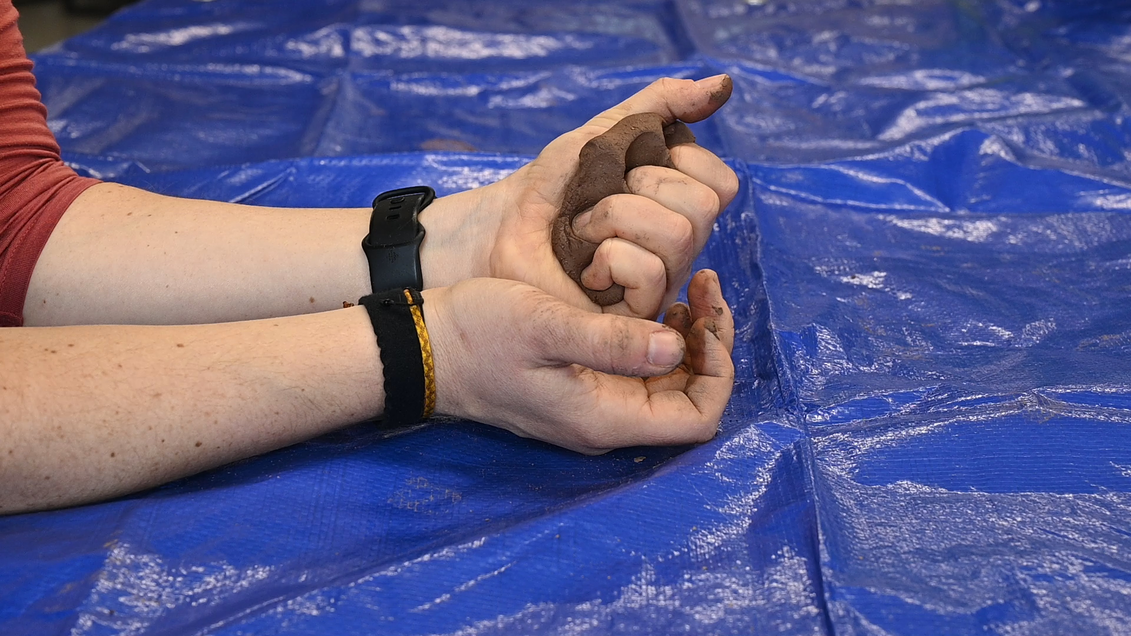
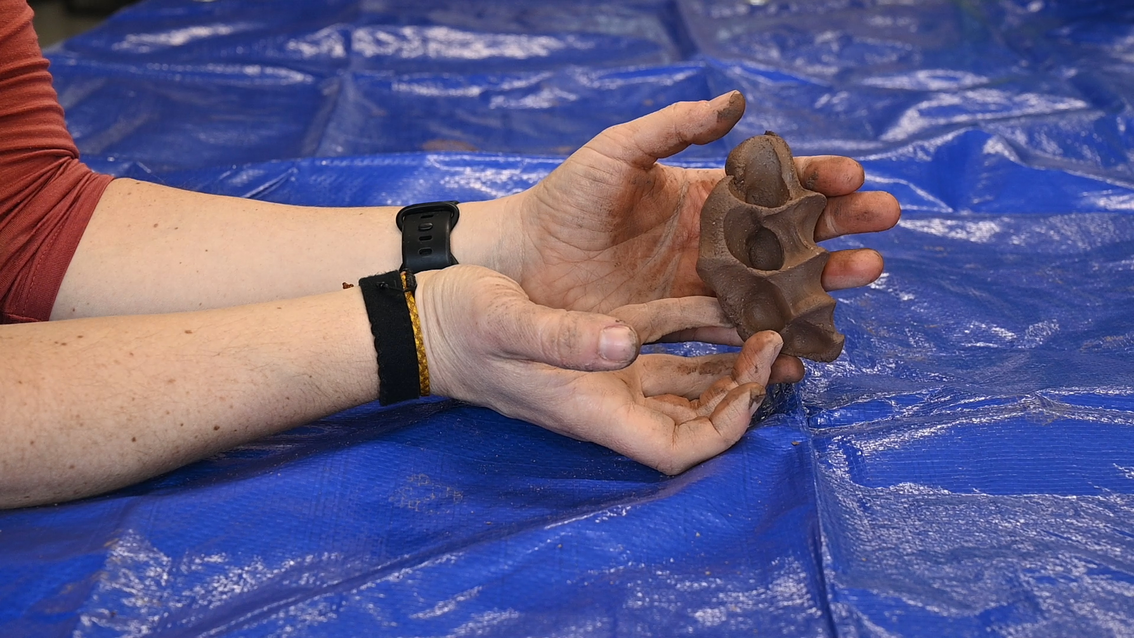
The workshop itself was structured in three stages. The first two were designed to familiarise participants with the clay: first by squeezing a ball in one hand until it extruded between fingers, producing forms that resembled fossils or shells, and then by creating a pinch pot. The latter opened a shared discussion around the verb to contain, which can mean either “to hold” or “to restrain.” This dual definition sparked reflections on the spatial and procedural meanings of containment in psychiatric settings. As a medium, clay enabled participants to engage physically and metaphorically with the lived tensions of confinement and holding in clinical environments. These exercises encouraged participants to explore shape, pressure, touch, and agency. This embodied approach not only revealed the natural quality of the shapes but also positioned the research as an exploration of embodiment and materiality, challenging the conventional emphasis on voice alone.
The third and main exercise invited participants to make an object, or objects, that spoke to their experiences of psychiatric environments. As people shaped their forms, informal conversations, glances, and shared silences began to weave together what I describe as a material–social field of inquiry. By this I mean a mode of knowledge production emerging not only from speech, but from the reciprocal interplay between bodies, gestures, materials, atmospheres, and relations. Inquiry here was distributed across hands and objects, across pauses and proximities, rather than residing solely in verbal accounts.
Clay played a central role in configuring this field. Its tactile demands slowed the pace of the encounter, redirecting attention toward sensation and allowing thoughts to surface indirectly. As fingers pressed, folded, or smoothed the material, participants often began to speak, not in a linear narrative, but in fragments, associations, and embodied recollections. The material properties of clay supported this: its softness absorbed tension; its malleability invited experimentation; its capacity to hold trace subtly affirmed the validity of what participants expressed.
Working side-by-side, participants were not oriented toward a shared interpretation or consensus, but toward co-inquiry; each person moving through their own rhythms of making while remaining attuned to those beside them. Conversation moved in and out of focus, punctuated by moments of quiet concentration or laughter. One participant articulated this dynamic succinctly: “Working on something can be quite an easy way to talk about something that's in your mind because the energy and the intention is kind of through something else.”
In this sense, clay functioned not only as a medium but as a mediating device, enabling reflection without requiring direct disclosure. It created a buffer between participants and the intensity of their memories, allowing them to articulate difficult experiences obliquely, through the object and its emerging form. The material–social field of inquiry thus operated as a relational ecology where gesture, touch, and adjacency worked alongside words, producing forms of knowledge that would not have surfaced through verbal interview alone.
Clay process: holding/transforming/performing
Within this project, clay becomes a material agent, one that holds, transforms, and performs in relation to the bodies, gestures, and atmospheres it encounters. This framing resonates with Florence Peake’s performance works such as RITE (2017), in which clay is not inert support but an active surface that both registers and alters movement. Within this piece, the performer, Rosemary Lee, dances on a floor of wet clay, her movements inscribed into the surface through pressure, weight, and contact. After the performance, the clay floor was cut into tiles, each bearing traces of the dancer’s actions, and Peake invited other dancers to engage with these fragments, applying vibrant glazes while enacting a series of gestures, from caressing to slapping. These layered interactions deepened the affective charge of the tiles, which now held not only visual residue but a tactile, performative memory.
Similarly, the workshop allowed participants to impress, press against, and shape the clay in ways that made memory and feeling tangible, not through representation alone, but through kinaesthetic action and sensory encounter. Representation alone risks abstraction [expand]: clay foregrounded the immediacy of embodied encounter, allowing participants to think and feel through texture, resistance, and malleability.
Why is representation not enough here? It meant that the process and encounter with the material was foregrounded – bringing people closer to thinking through touch, texture, sensory experiences.
One participant described the clay’s softness as radically different from the impersonal rigidity of clinical materiality: “even the marks that people do make on the wards, when people kick walls and scuff things, they feel so impersonal. They're not like the marks that you make on clay, which seem quite unique and personal”. Here, clay operates as what Karen Barad (2003), and Tim Ingold (2007) would call a relational mattering: a material unfolding that is never complete but always emergent within context. The clay used in the workshop had passed through industrial processes, dug, filtered, bagged, and was softened into form through the warmth of our hands before participants arrived. This material history underscores the notion that working with clay is never neutral: it is always relational, embedded, and unfolding.
Clay’s stickiness and tacit nature link it to what Ingold terms the “circulatory flows” of material life [ref]. The material receptiveness becomes a metaphor for potential malleability within space, enabling alternative spatial imaginaries, such as the question posed during one exercise: “How do you make a corner in clay?” [expand with reference to image – applying pressure held the clay in the corner of two walls to make an imprint]. Like Peake’s tiles, the works created in the workshop became performative objects; they did not signify closure but opened up new relational fields. Within this project’s broader que(e)rying methodology, clay complicates the separation of body and object, as well as matter and meaning. This interaction between body, gesture, and institutional matter closely echoes the framework of pathoplasty, which posits that psychiatric experience and clinical architecture are not separable but mutually shaped. Rather than treating space as neutral backdrop, pathoplasty foregrounds the clinic. The workshop, in this sense, enacted a small-scale pathoplastic intervention: a reorganisation of clinical encounter not through diagnosis or treatment, but through shared material activity. Working with clay allowed participants to reconfigure the conditions of containment and control that dominate locked environments, offering moments of tactile agency and reorientation. [Evidence from participants?]