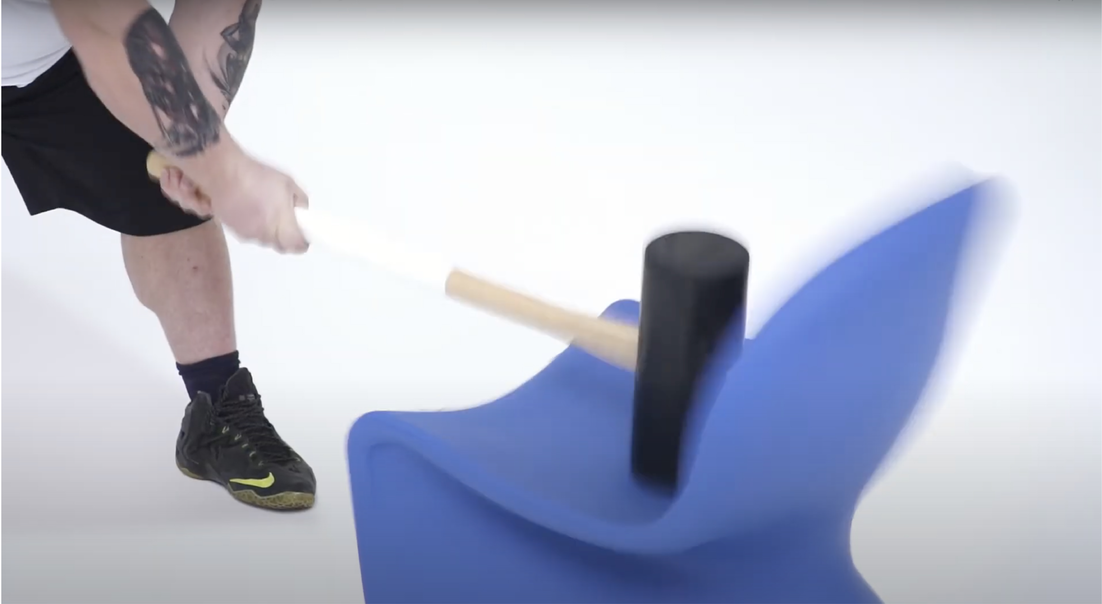
The spatial and material configurations of contemporary psychiatric wards are inseparable from the prevailing logic of ‘risk’, which significantly shapes their design and operation (Slemon et al., 2017; Kanerva et al., 2016). Whereas Institutional Psychotherapy sought to challenge the structural pathologisation of patients through environmental intervention, the present-day clinic offers a stark contrast, where risk management has become the dominant rationale for spatial and material decisions. Governmental design guidelines for NHS acute units prescribes that all fixtures and fittings must be ‘able to withstand sustained attack’ and ‘maintained to help prevent the possibility of accidents, misuse or use as weapons’ (Department of Health, 2013: 21). PineappleTM, the self-proclaimed ‘UK market leaders in mental health furniture’, unsettlingly bring these regulations to life through a promotional video depicting a ‘strongman’ testing the resilience of their new ‘Ryno’ range with a mallet hammer dramatising the imagined violence of people within psychiatric care.
Tensions between care for the patient, on the one hand, and exerting control through risk management and restrictive practice, on the other, is one of the recurring dualisms within mental health practice (Foucault, 1988). Recent clinical studies (Deering et al., 2019; Felton et al., 2018) suggest that this balance has tipped in the favour of risk to such an extent that it has come to define the identity of inpatients. One paper makes the case that inpatients are being constructed as 'risk objects' (Felton et al., 2018), a term that implies a process of categorisation in which certain individuals are defined primarily through the threat they allegedly pose. This framework reveals a recursive relationship between ‘risk’ and clinical binaries—risky/harmless, sane/insane—through which the figure of the ‘risk object’ is naturalised. This arguably produces a social alienation akin to what Sara Ahmed describes as ‘the experience of being an object among other objects’ (2006: 160).
[1] Essentially, restrictive practice means to restrict someone from doing what they want to do. Any practice that restricts someone’s rights or freedom of movement is a restrictive practice. Often it means physical restraint. Restrictive practice is common in secure mental health settings although there are calls to reduce it (Lawrence et al., 2021).
Framing Risk
In this section, I first situate risk within sociological and critical theory, drawing on Beck’s “risk society,” Rose’s “risk politics,” and Foucault’s account of disciplinary surveillance. I then examine how these theories are enacted in practice: through procedure and policy that script bodily movement, through classificatory systems of surveillance that determine patients’ freedoms, and through the everyday objects that condense risk management into material form. Together, these sections show how risk is embedded into the ward’s architecture and routines, yet also how it produces ambivalent effects—objects and practices that both constrain and, at times, are reoriented toward comfort or reprieve.
To situate participants’ clinical encounter with the ward, it is necessary first to consider how the concept of risk has been theorised within sociology and critical theory. Ulrich Beck’s influential notion of the risk society frames late modernity as increasingly organised not around wealth or production but around the management of potential harms. As Beck writes, “the logic of wealth is being replaced by the logic of risk” (Beck, 1992: 19). Risk here is anticipatory: it is less concerned with present conditions than with imagined futures, producing institutions oriented towards prediction and prevention. Psychiatric wards exemplify this anticipatory turn. They are less organised around responding to immediate needs than around avoiding possible harms, rendering the everyday environment a site of constant vigilance. Risk, as Deborah Lupton stresses, “is always about the future: it is a discourse of uncertainty and potentiality” (Lupton, 2013: 6). On the ward, this means that patients are governed not only by what they have done but by what they might do. This produces a form of institutional temporality that is projective rather than present, where patient experience is subordinated to surveillance and mitigation. [This is also of course a larger state mechanism beyond patients]
Critiques of Beck’s risk society: One of the most powerful criticisms of Beck’s theorization of risk society is that Beck ‘totalizes’ risk, treating risk as if it is the ‘centre’ of contemporary social and material life, thus neglecting other important factors (Dean 1999: 181–2; Rasborg 2012: 10). -- Lupton also critiques Beck.
Nikolas Rose has made this connection explicit in relation to psychiatry. In Governing Risky Individuals (1998), he argues that the central problem of psychiatry is no longer “dangerousness” as an exceptional trait, but the ongoing assessment, prediction, and management of risk. Psychiatry, he suggests, now functions as a biopolitical apparatus for governing uncertainty, producing new classificatory practices and risk scales that determine patients’ freedoms and restrictions. Rose (2001: 2) later characterises this shift as the emergence of “risk politics,” in which the management of populations is carried out through technologies of prediction and control. Risk functions as a governmental logic: “risk is a way of ordering reality, of rendering it thinkable in such a way that it can be governed” (Rose, 2007: 6). Psychiatric wards, in this sense, are not merely spaces of treatment but laboratories of governance, where the management of “risky individuals” justifies and organises the entire institutional environment.
This resonates with Michel Foucault’s analysis of disciplinary power, as touched upon previously in the contextual framing of this project. In Discipline and Punish, Foucault identifies the panopticon as the architectural paradigm of modern governance: a space organised so that visibility is constant, asymmetrical, and internalised. “He who is subjected to a field of visibility, and who knows it, assumes responsibility for the constraints of power… he becomes the principle of his own subjection” (Foucault, 1977: 202–203). The genius of the panopticon, for Foucault, is not that those in power are always watching, but that the possibility of being seen compels individuals to regulate themselves. Psychiatric wards can be read as extensions of this ethos. Even when patients are not under the direct gaze of staff, the arrangement of furniture, corridors, and sightlines continually reminds them that they might be seen, assessed, or categorised as risky.
Here, also situate research to specific site: acute locked and secure mental health ward. Discuss in terms of lines and orientations, how it, as a typology, exists within strict guidelines.
Risk’s impact on the body
The sense of bodily objectification is mirrored in Annie Crabtree’s film Tell me, how do I feel? (2019), which explores institutional estrangement through a sensory and affective register. Using close-up footage of clinical materials—textures, lights, fabrics, ambient sounds—Crabtree interrogates the dominance of objectivity in medical epistemologies. By attending to material culture, Crabtree’s work opens space for a more nuanced reading of clinical perception and the objectification of the patient body. Peter Pels, in Border Fetishisms (1998), offers a theoretical framework for unpacking these unstable relations between subject and object. Drawing on the anthropological concept of the fetish—an object imbued with power—Pels argues that certain objects disrupt normative systems of value and control. The fetish, he suggests, challenges the modernist assumption that humans retain mastery over meaning and materiality. Instead, fetishised objects participate in meaning-making; they constitute subjects as much as they are constituted by them. To be sensuous, Pels (1998: 101) writes, is “to be subjected to the actions of another thing.” The fetish is therefore both discursive and material: a mode of relationality in which agency circulates between bodies and things, refusing fixed boundaries.
The patient as an ‘object of risk’ and the material environment as ‘managing risk’
Bring in more from the design guidelines across all acute wards – “sightlines” etc.
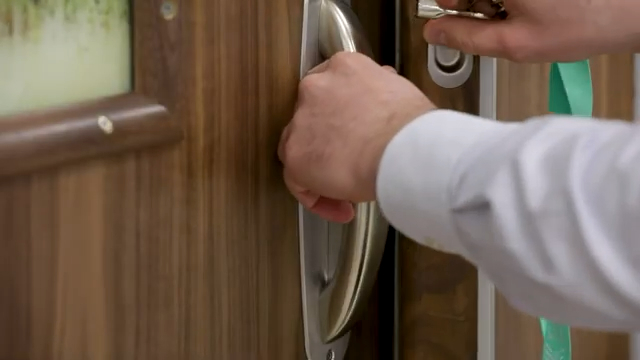
7.23 All fixtures and fittings such as window and door furniture, door closers and hinges, taps, showerheads and coat hooks should be anti-ligature, robust and able to withstand sustained attack, and meet national safety requirements. In general, all fixtures and fittings should be specified, manufactured, fitted and maintained to help prevent the possibility of accidents, misuse or use as weapons or to aid self-harm. Local risk assessment is necessary, with fitting according to manufacturers’ instructions. Projections, level surfaces that could form hook points, and horizontal rails or similar are also to be avoided.
(Health Building Note 03-01: Adult acute mental health units)
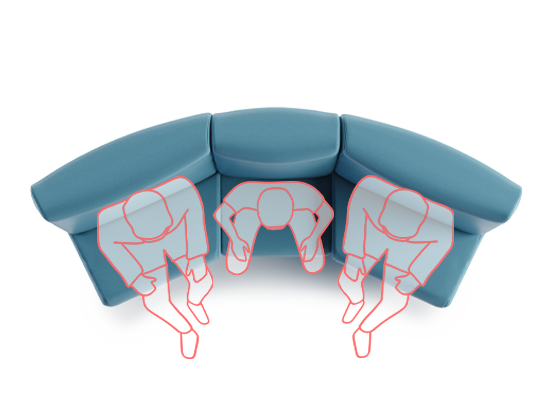
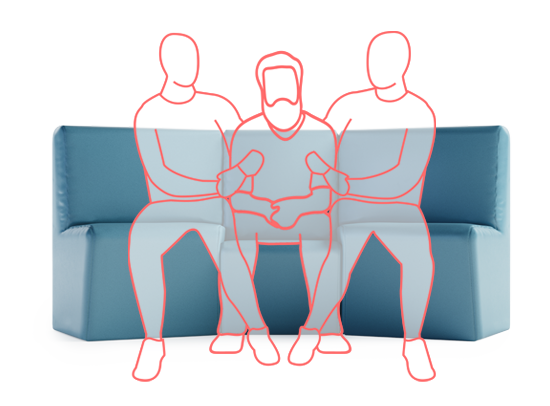
When read through this lens, the ‘Ryno’ chair produced by Pineapple™ exhibits key qualities of the fetish: it is both a functional artefact and an agent of control. Designed to be physically ‘indestructible’, its features, such as the recessed footwell, also enable forms of bodily restraint. The object, in this sense, acts upon the body; it mediates how patients move, sit, or are positioned in space. Yet the intention behind its design is not always aligned with how it is encountered. Its symbolic weight, durability, and embedded functionality together transform it into a charged site of power—an object that not only reflects institutional anxieties around risk but also materially enacts them on patient bodies.
Monika Ankele and Benoît Majerus’ body of work Material Cultures of Psychiatry (2020), which layers critical texts with artistic projects, deepens this enquiry by exploring how psychiatric objects shape and are shaped by clinical actors and practices. They contend that psychiatric objects undergo transformations in meaning, form, and function, depending on their clinical context (Ankele & Majerus, 2020: 17). This resonates with the field of new materialism and the agency of non-human actors on human subjectivity through association and interaction (Latour, 2005), foregrounding a relational ontology in which things do not merely reflect social orders but actively shape them.
This view of material agency aligns with a broader shift in post-structural and new materialist thought, where bodies, objects, and institutions are no longer understood as fixed entities but as nodes in mutable networks of relation. Actor-Network Theory (Latour 2005) helps illuminate how psychiatric objects like the Ryno chair, far from being passive furnishings, actively participate in shaping clinical subjectivity and encounter. In this frame, the psychiatric clinic is not a static site but a relational constellation—its atmosphere, rhythms, and interactions constantly assembled and reassembled through the interplay of human and non-human actors. This understanding also reframes pathoplasty: no longer simply the imprint of pathology onto environment but a process of recursive shaping, in which bodies and spaces co-constitute one another through situated relational dynamics. Such a model disrupts the binary logics that dominate contemporary clinical design—logics that position patients as either risky or safe, compliant or deviant, contained or free—and instead opens up the possibility of malleability, improvisation, and collective becoming within the clinical field. (Expand section on New Materialism and links to pathoplasty)
What is constrained here is not only patient agency, but the possibility of a different kind of clinic: one assembled through solidarity rather than suspicion, relational improvisation rather than risk calculus. The chair, as fetishised object, might dramatise institutional paranoia, but it also reveals the fragility of those constellations, the ways they might be rearranged. In attending to these subtle dissonances—between object and intention, body and design, policy and encounter—this project aims to trace moments where malleability becomes imaginable: where the clinic flickers, however briefly, into another form.
Foregrounding embodied encounters
What is notably absent from contemporary literature, both in the field of medical humanities and in critical theory on psychiatry, is how the material environment is encountered by those involuntarily detained within it and how the materiality and objects of psychiatric spaces can affect one’s lived experience of hospitalisation. Ankele and Majerus’ (2020) project lacks an emphasis on patients’ personal perspectives and accounts, whilst medical papers on risk and care in NHS psychiatric wards tend to focus on the perspectives of staff (Muir-Cochrane et al., 2011; Haglund et al., 2006; Kanerva et al., 2016). Foregrounding the lived experience of people who have been detained in locked wards, rather than analysing at a distance, will support a critical exploration of the potential side effects of institutional conditions through understanding these people’s encounter with the environment. This speaks to the crucial question of what is at stake for those who find themselves detained in a locked ward. Discussions of the negative experiences and objectification caused by restrictive practices in inpatient environments remain under-examined (Kanerva et al., 2016) and are often replaced by the notion of ‘patient risk’ (Slemon et al., 2017). The consequences of an over-emphasis on risk are that those receiving hospital treatment under section experience unnecessary losses of independence and liberty (Clarke & Mantle, 2016) and further marginalisation (Felton et al., 2018). Although the literature considered frames the institutional environment as having potentially harmful effects on patients’ subjectivity, there is also the possibility that participants will share positive experiences and insights in relation to the environment. Foregrounding embodied encounters will highlight the layered complexities of containment in institutions of care.
Pathoplasty and its objective to intervene in the hospital environment was part of a wider project at La Borde to destabilise fixed, imposed identities (Robcis, 2021) which Oury believed led to inpatients experiencing a loss of agency through institutionalisation. Literature shows that the same problem still exists today. Therefore, pathoplasty has the potential to provide meaningful insights for contemporary mental health practice in two ways. Firstly, it offers a conceptual framing to reappraise the role of environment in psychiatric spaces through diverting the pathological gaze towards the material conditions rather than at the individual patient. Secondly, as a queer praxis it points towards what can be uncovered through approaches that interrogate alternative possibilities for liveability and worldmaking (Ghaziani and Brim, 2019) in emphasising embodied experience and, as Oury puts it, ‘real encounters’. Moreover, it shows that fluid approaches are crucial when considering the notion of ‘containing’ and to what extent it can be reframed and experienced as supportive rather than restrictive.