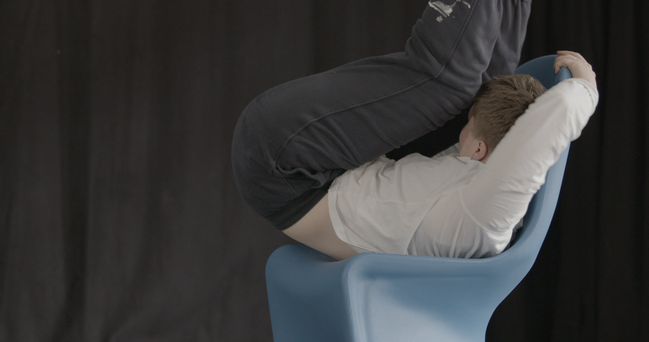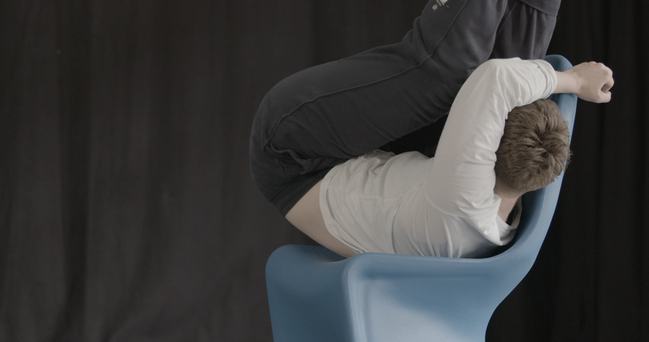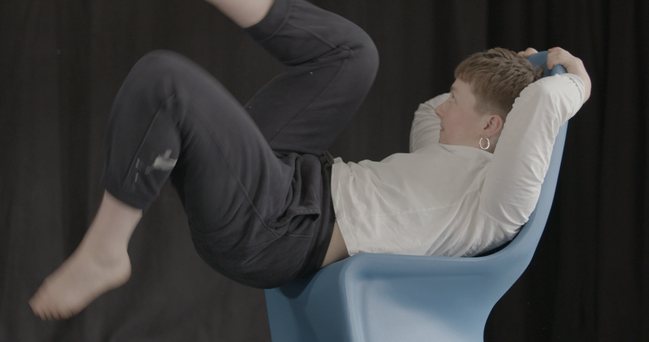
Where Chapter 1 sought to understand how risk orients the ward as an institutional field, Chapter 2 shifts the focus toward how the body negotiates this field. It closely examines how materials, objects and systems “choreograph” the body: shaping orientations, posture, movement and relations. Participants describe re-learning how to sit, lie, breathe, and move in ways that make them legible to staff. Ahmed’s notion of orientation clarifies how bodies “find themselves” in space through habitual alignments and, in this case, how institutional materiality enforce or disrupt these habits.
This chapter therefore examines how the ward influences the body through space, material, and sensory atmosphere, tracing how the lines established by risk in Chapter 1 become lived through gait, posture, rhythm, touch, and breath. It also attends to the counter-movements, bodily, sensory, and relational, through which participants subtly reorient themselves within these constraints.
2.1 Learning the Space: Bodily Orientation and Proprioceptive Mapping
If orientation in Ahmed’s sense describes how bodies come to face and inhabit the world through lines laid down by history and habit, proprioception offers a way of understanding how these orientations are felt, how bodies learn space from the inside. Proprioception, as Merleau-Ponty argues, is not a secondary sensory faculty but the basis of how a body situates itself: “I apprehend my body as a system of possible actions… a field of practical powers” (Merleau-Ponty, 1962: 139). It is through proprioception that we sense where we are, how much space we can occupy, and how we might move without colliding with the world or with others. It is the basic condition for our engagement and orientation within the world.
Mapping the perimeter
In the psychiatric ward, this proprioceptive sense becomes radically recalibrated. Participants repeatedly described an early process of bodily learning, an attunement to the ward’s dimensions, its thresholds, its repetitions, and its constraints. Proprioception becomes a spatial pedagogy: a way of discovering, through the body, what movements are permitted, what gestures draw attention, and how pace or posture might be read within an environment structured by surveillance and risk.
The size of NHS acute mental health wards varies substantially ranging between 307 and 2,789 square meters depending on how many beds, and therefore patients, the ward has capacity for (Sheehan et al., 2013). However, when contained in a space without automatic access to the exterior world it can feel small.
“I timed myself walking the outskirts of all the areas I had access to… and I managed to do it in two minutes on a slow pace. It was such a small ward.”
(Clara, 2023)
The act of walking revealed not only spatial limits but the tempo the ward demanded. Movement was truncated by the architecture:
“There was no movement—you have to turn around constantly. It’s not like you can get into a flow.”
(Clara, 2023)
The ward environment in this sense is choreographing the body by organising the movement through tempo, rhythm and sequence of steps. What Clara describes is a disruption of proprioceptive continuity. The body cannot stretch into stride; it cannot project itself forward. Instead, it is reoriented into short bursts, abrupt pivots, and constant directional changes. The ward teaches the body its own dimensions. Clara’s inability to “get into a flow” reveals how architecture choreographs bodily tempo: organising rhythm, interrupting stride, and directing attention toward surveillance points and nurses’ stations.
This choreography reflects Ahmed’s concept of orientation: the architecture directs movement along short, predetermined lines, foreclosing the possibility of meandering, oblique paths, or sustained physical rhythm. [Interruptions, staccato] The locked layout and absence of varied thresholds continuously reoriented participants toward surveillance points, nurses’ stations, or spatial dead ends. In this way, the ward’s material arrangement enrolled the body into the institution’s risk-based priorities, using spatial design to limit divergence and keep patients within the visual and procedural field of staff.
Proprioception under Surveillance
“I knew that every kind of movement or action or thought or breath was being logged and judged and categorised into symptoms of mental health” (Clara, 2023)
Returning to Cris and the courtyard, an orientation to elsewhere, like Clara they also described how they would walk the perimeter of the courtyard to counteract the sedentary nature of the ward. They recall a staff member saying “right, you’ve got to get out of there now, stop pacing” (Cris, 2023). In this instance, movement becomes pathologised. Simply wanting to move or walk is observed as pacing, which holds a specific meaning within this space: “pacing was a symptom of restless legs” (Clara, 2023). Here, we see what Goffman terms “looping”, when an individual’s response to the institutional environment is interpreted as further evidence of their diagnosis, thereby justifying additional control (Goffman, 1961: 38). The effect is recursive: bodily adjustments meant to ease boredom or regulate emotion are read as symptomatic, folding the institution’s gaze back onto the body’s own attempts at coping. As Goffman notes, looping transforms “the inmate’s reaction into the occasion for further action by staff” (1961: 38), closing off avenues for neutral or benign bodily expression. To have every movement surveilled and then characterised as a symptom related to a diagnosis has an impact on the body.
“I wasn't doing anything weird, but like, yeah, for some reason that was like, not allowed.” (Cris, 2023)
For Cris, bodily learning unfolded not only through space but through atmosphere:
“You end up walking differently, slower, smaller… you’re always ready for something—you never really relax.” (2023)
Here proprioception becomes entangled with vigilance. Every movement become modulated by the ward’s affective climate. The body adapts not simply to architectural boundaries but to an atmosphere thick with anticipation. This aligns with Merleau-Ponty’s insistence that the body is “a form of consciousness” (1962: 82). In the ward, consciousness is oriented towards monitoring, tuning, and anticipating; the body becomes an instrument of risk attunement.
Ahmed’s theory helps frame these proprioceptive adjustments as more than pragmatic adaptations. Orientation is how bodies “find their way” through worlds (Ahmed, 2006: 6). Bodies follow lines laid down before them, and in doing so reaffirm those lines:
“What is repeated over time is the requirement to follow the line.”
(Ahmed, 2006: 16)
The ward’s layout—its short corridors, locked doors, and prescriptive pathways—produces a literalisation of this requirement. Bodies do not simply move within the ward; they move according to it. Every turn, pause, and redirection is a reminder of how spatial scripting intersects with risk management.
In Chapter 1, I argued that to be “in line” on the psychiatric ward is to be legible as “safe”: compliant, steady, predictable. “Out of line” behaviours, those that might appear entirely ordinary outside the ward, become charged with institutional meaning. On admission, many participants described behaving in ways that felt natural to them, only to discover that these gestures were immediately read through the lens of risk. The institutional environment swiftly begins attempting to bend the body to its protocols, teaching patients, through repetition and response, how to move in ways that will not arouse suspicion.
In this context, the body itself becomes a site of governance. Proprioception becomes the means through which orientation takes hold. The ward’s spatial and procedural lines are not only followed consciously; they are absorbed somatically. Bodies learn, often very quickly, how to stay “in line,” not through explicit instruction but through the continual negotiation of sensations, atmospheres, and institutional cues.
2.2 Posture, Pressure, and Institutional Comportment
“Made with risk in mind”
“On the ward, its objects are made with the idea of utility and risk in mind. There are no really comfortable places or enjoyable spaces.” (Cris, 2023)
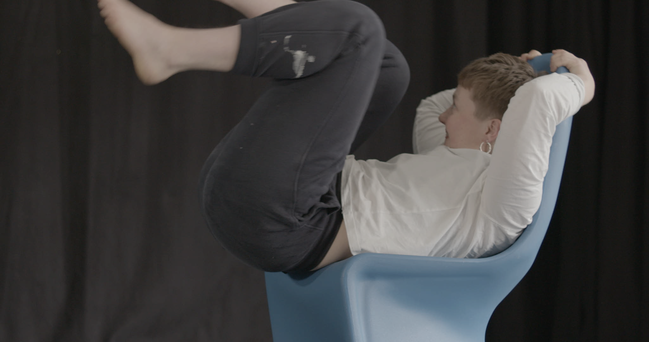
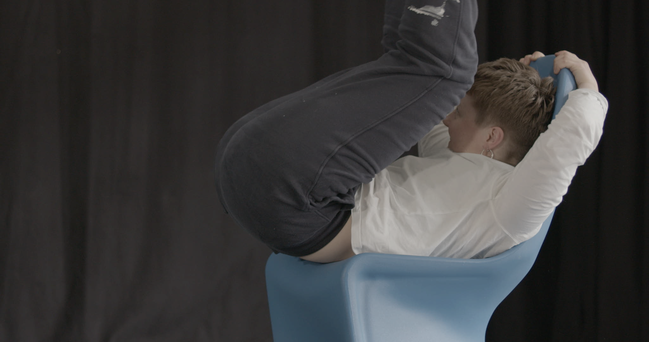
Orientations emerge through the lines that objects make possible and how bodies “face,” “reach,” and “extend” into the world (Ahmed, 2006: 54–56). In psychiatric wards, these lines are not drawn by familiar domestic objects but by institutional ones that carry the weight of safety, risk, and behavioural expectation. Ahmed argues that objects accumulate along habitual lines: they “gather on the ground of the familiar; they are reachable because they extend the lines of the past into the present” (Ahmed, 2006: 20). In domestic and everyday settings, this object-familiarity anchors the body. In the psychiatric ward, however, the familiar is replaced by the institutional. The chairs, beds, tables, and fixtures organise not simply how bodies sit up and lie down but what kinds of relations, postures, and movements are imaginable. As Chrysikou notes, “the furniture used in institutions [is] indicative of their regime and values. It demonstrates how a system regards the individual and gives clear hints about the expected behaviours of service users” (2015: 48). The standardised NHS mental health furniture exemplifies this shift. The example discussed in the literature review is the range of Ryno chairs made by Pineapple™, which are present in most, if not all, NHS acute mental health wards. Like most of these institutional objects, their shape and materiality have developed and morphed according to the climate of public opinion regarding mental health practices, retaining certain qualities and discarding others. Visible restraint furniture—chairs or beds with wrist or chest straps—now appears as a discredited symbol of an earlier institutional order. Contemporary psychiatric furniture avoids such explicit signals, instead adopting a familiar aesthetic while integrating subtler design mechanisms that support the ongoing anticipation of danger.
What does it mean to be surrounded by objects with subtle undertones of risk?
The Ryno chair adopts the unmistakable silhouette of Verner Panton’s 1960s moulded plastic chair, mobilising the cultural capital of modernist design to project a sense of familiarity and aesthetic legitimacy. This visual lineage helps to neutralise, or at least obscure, the more coercive functions embedded within the object. In practice, the chair is structurally modified to meet the demands of risk management: its hollow body can be filled with sand to produce a weight of 50–80 kg, making it difficult to lift, throw or use as a weapon. The seamless curves, which are an aesthetic gesture in Panton’s original, become an anti-ligature strategy. Most troubling is the recessed cavity behind the sitter’s feet: an innocuous-looking detail that enables a formalised restraint technique in which staff hook their legs through the recess to pin the patient in place. In this iteration, modernist design becomes a vehicle for institutional control, where aesthetic familiarity masks functions that anticipate bodily containment.
The Ryno chair becomes a material condensation of the institutional mindset of danger. Its design responds not to comfort or relationality but to the anticipated possibility of force. The promotional video—where a strongman repeatedly strikes the chair with an oversized mallet to demonstrate its indestructibility —reinforces this idea explicitly. These objects therefore script lines of expected behaviour long before a person sits down. They orient users not toward rest or relational comfort but toward a regime in which the possibility of violence is anticipated, institutionalised, and built into the furniture itself. Eleanor describes how the chair doesn’t “let you sink in so you end up sitting stiffly” (2023). This upright, perched posture aligns with Ahmed’s idea of orientation: the chair turns the body toward sanctioned positions. The effect is not merely physical but relational. A perched body is alert, compliant, and easily observed; it is a body that participates in the ward’s visual and procedural economy. The posture becomes a kind of disciplinary gesture, repeated daily until it embeds itself into the body’s habitual repertoire. Participants’ narratives show how these objects hold the body in place: how chairs deny softness; how sightlines compel forward-facing alignment; how thresholds generate both surveillance and fleeting possibilities for reprieve.
Objects as Postural Scripts
Comparing institutional chairs with other historical healthcare typologies clarifies the specificity of their disciplinary posture. Alvar Aalto’s Paimio Chair, designed for a Finnish tuberculosis sanatorium in 1932, is a canonical example of furniture shaped around therapeutic needs. The gentle recline and sweeping curve were designed to open the lungs, encourage expansive breathing, and reduce strain on the body. The chair’s angle was calibrated to the physiology of convalescence.
By contrast, the psychiatric ward chair performs almost the opposite function. Rather than enabling breath or repose, its design contains the body within a narrow vertical frame. There is no angle of repose, no ergonomics of care. Its purpose is not to heal but to stabilise—to maintain visibility, to prevent horizontal drift, to keep the body “in line.” The contrast is instructive: where Aalto’s chair embodies an ethos of therapeutic support, the psychiatric ward chair embodies an ethos of risk-managed containment.
From this vantage, posture becomes a diagnostic and disciplinary category. Sitting “too low,” “too curled,” or “too slouched” risks being read as withdrawal, dissociation, or non-engagement. Sitting “too upright,” “too tense,” or “too still” can equally become a symptom. The chair therefore structures a narrow channel of acceptable comportment, drawing the body into its logic long before any conscious negotiation occurs.
“The ward is so chaotic, you are just surrounded by walls and even the windows you can't really see through properly or they have like some metal material over them.” (Cris, 2023)
If, as Ahmed notes, objects guide “what bodies can do” by shaping reach, angle, and extension (2006: 54–56), the ward furniture narrows these capacities, reducing posture to its most disciplinary function. Participants described this not as a neutral accommodation but as a somatic demand. Eleanor recalled being compelled into “school assembly posture,” (2023) a bodily memory of obedience and exposure: feet flat, back straight, arms tight by the sides. Kit described holding herself “like someone might burst in,” (2023) shoulders raised, breath tight, weight centred and ready for impact. Cris spoke of finding surfaces to be horizontal as the only available means of retreat: their electric blue bed covered in “plasticky, waterproof, wipe down material” or the courtyard bench to “stare at the sky” (2023). These are not idiosyncratic gestural habits; they are postural outcomes of the ward’s material and atmospheric systems.
Pressure: A Somatic Mode of Governance
Pressure, in terms of physical, atmospheric, and affective, is a central force through which this comportment takes hold. It is not only a sensation upon the body but a mode of governance that produces particular bodily shapes.
There is the literal pressure of the chair against the back, the hard seat against the pelvis. But there is also the pressure of constant visibility, the ward’s demand for bodily legibility, the pressure of being watched for signs of escalation or decline. Together, these forces produce a choreographic economy in which the safest posture is the smallest, the neatest, the least disruptive.
Participants repeatedly described folding themselves inward: shrinking, curling, retreating. These gestures are responses to a space that presses back. Kit’s clay figure curled in the corner exemplifies this, “I didn't want to be in full view. I didn't want to be right in the centre where everyone would see me” (2023) and, as they later go on to say, to be the subject of constant checks. The notion of the corner, as an example, has a rich philosophical backdrop led by Gaston Bachelard’s reflections in The Poetics of Space: “The corner is a sort of half-box, part walls, part door. It will serve as an illustration for the dialectics of inside and outside” (Bachelard 1969: 137). Kit describes being in a corner or on a windowsill as attempting to “keep [their] head as close to the outside world as I could get” (2023). To curl in a corner is not merely comfort; it is a tactic of minimisation. Pressure works by making the body responsible for its own readability, which again recalls Goffman’s notion of looping.
Taken together, these postures form a choreography of institutional life. Chairs, beds, thresholds, and lounge geometries set the parameters; pressure, surveillance, and atmosphere propel the body along them. The result is a field of comportment in which every posture is read, every gesture carries meaning, and the body must continually negotiate the fine line between visibility and safety.
2.3 Anchoring and Counter-objects
The Disembodied Figure
“I knew that dissociation was like a way of coping, it was actually looking after me. But I felt like I never could ground myself in the space because there was nothing to like, anchor yourself on” (Clara, 2023)
In the workshop Clara made a disembodied head with arms but no torso, this captured what she describes as a sensation of being fragmented, monitored, and untethered. The sculpture translates this institutional experience of objectification into form.
As previously discussed, one of the grounding tactics Clara wanted to use was walking, however that was deemed as unacceptable in the ward environment. Her clay artwork speaks to the disconnect between bodily intention and actuality, she recalls “it was a huge thing to like step outside of your bedroom to then engage with quite a lot of people actually, and quite a lot of poorly people”.
Alongside restricted movement, the ward’s sensory flatness disrupted the body’s ability to anchor itself.
Beanbag Chairs and Counter-Orientations
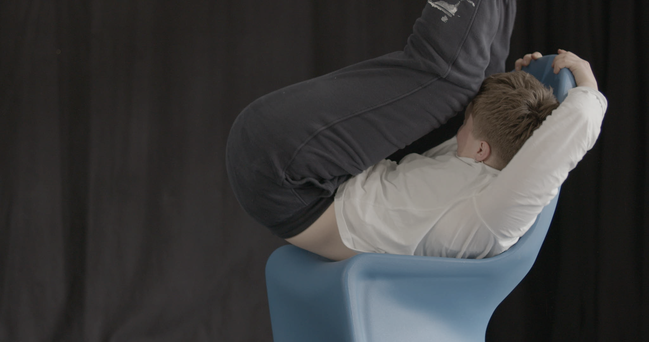
A striking counter-object within this wider postural landscape is the beanbag chair, an anomaly of softness within an otherwise rigid material ecology. On Clara’s ward, a large therapeutic beanbag with weighted arms offered a radically different encounter: rather than enforcing uprightness, it enveloped the body, allowing it to sink, recline, and be held. She described being “swaddled” inside it, an experience that contrasted sharply with the plastic Ryno chairs that structured everyday life. When feeling “floaty” or disassociated, she explained, the sensation of being held became crucial as a rare moment in which posture could release rather than brace.
This softness, however, was tightly managed. Access to the beanbag was conditional, requiring specific verbal cues that Clara “had to learn,” signalling how even comfort operates within a gatekeeping logic. The object was not embedded in communal space; instead, it sat alone in an echoing space “the size you could teach primary school PE in,” an architectural staging that made it feel both significant and strange. Its solitary presence produced a kind of ceremonial aura. Clara and her peers joked about going to “the chair,” likening its isolated spotlighting to the electric chair—humour that reveals how therapeutic objects can take on ominous resonances when placed within surveillance-saturated environments.
The beanbag offered a temporary counter-orientation. Physically, it allowed the body to turn away from the dominant line of upright legibility and toward an orientation of repose, weight, and being held. Yet even here, the institutional logics persisted. Clara noted that a staff member had to remain in the room while she used it, often reluctantly, as if “she just wanted a cup of tea or to leave.” Surveillance saturated even this moment of softness. Leaving the beanbag was experienced as a rupture—“a really hard moment of coming out of the beanbag into the communal space” (Clara, 2023) where uprightness and vigilance returned as default.
The beanbag thus reveals the contradiction of therapeutic comfort in psychiatric settings: softness exists, but as an exception; being held is possible, but only under supervision; counter-orientations are allowed, but fleeting. As an object, it both interrupts and reinforces the choreographies of institutional comportment. It gestures toward alternative material possibilities—spaces where bodies might recline, soften, or disappear from view—while simultaneously marking the scarcity of such possibilities within the broader ecology of the ward.