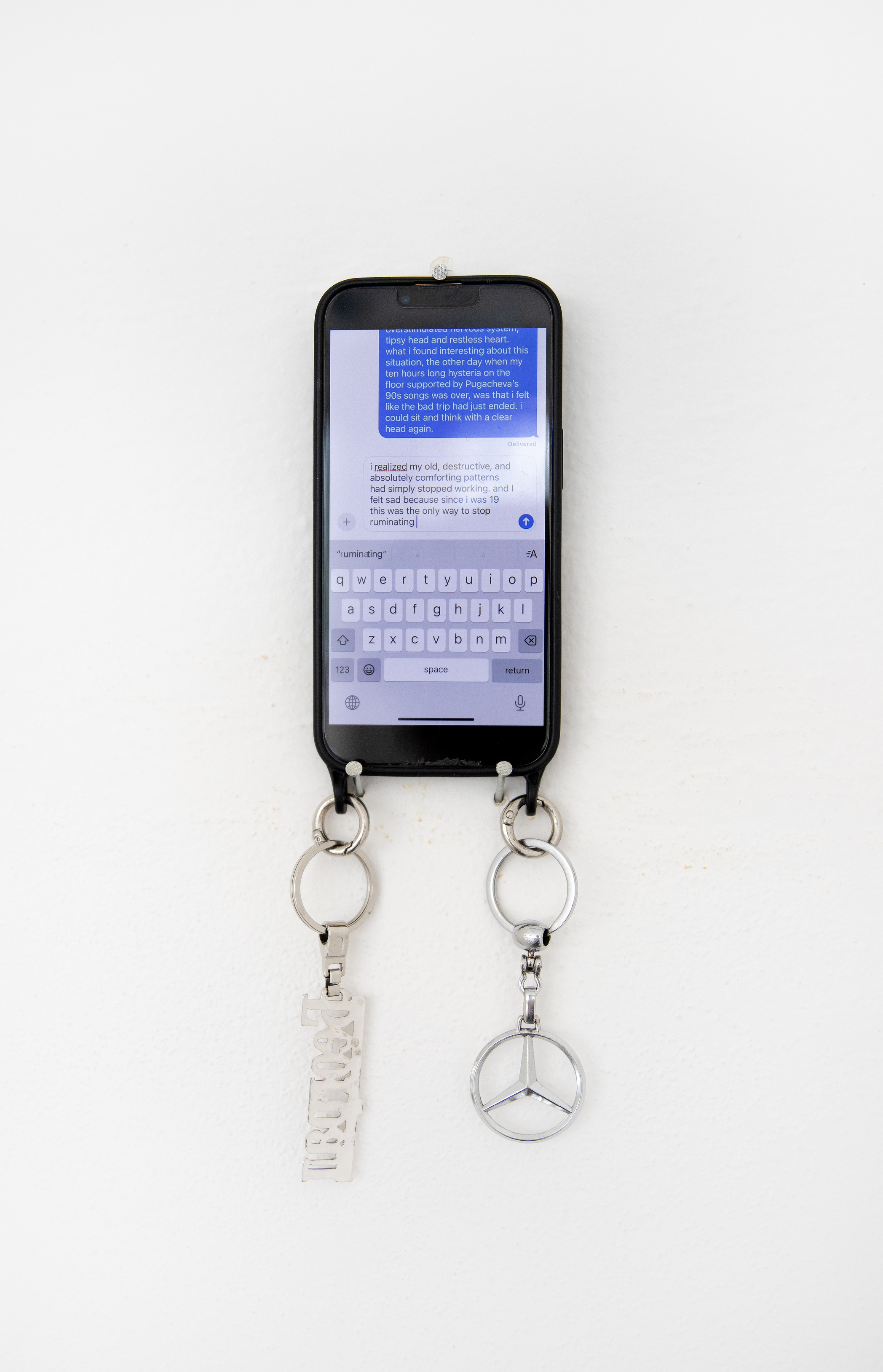
Contemporary love discourse is saturated with new terms, meanings, and symbols. Co-dependency, attachment styles, situationships, trauma-bonding—hundreds of freshly minted labels have transcended the psychologist’s office, stepped off the pages of academic texts, and embedded themselves in everyday conversations. They now shape the questions we ask on first dates, the frameworks through which we interpret attraction, and the ways we navigate intimacy. At some point, the urge to define and label everything becomes almost irresistible—perhaps because classification reduces anxiety, offering the illusion of security in an era where stability feels increasingly out of reach. Post-pandemic disorientation, the simultaneity of wars, and precarity as a new constant have become dominant forces, amplifying a perpetual state of liminality that reshapes not only how we think and speak about love but also how we experience it.
The rise of popular psychology within dating culture appears as a direct response to this widespread instability. It infiltrates contemporary love discourse, deconstructing and redefining it in ways that are both liberating and constraining. I believe my generation is suspended, stuck between a love paradigm inherited from our parents, one that no longer functions, and a new, fluid, yet undefined mode of intimacy that remains in flux. This transition creates a sense of vertigo, a feeling of drifting without clear coordinates.
Love is everywhere—ubiquitous, totalizing, seemingly natural—yet endlessly theorized, fragmented, chewed over, and reassembled by pop culture and philosophy alike. But if love is omnipresent, it is also elusive. Despite its overexposure, it remains a stumbling block. We still ask the same questions: What does it mean to love? How do we endure heartbreak? How do we stop obsessing over an attachment object? And what, exactly, is this attachment made of?
Trapped in a tangle of mixed signals and a liminal romantic condition, I turn to methodology—not as a cure, but as an attempt at decoding. I seek to map the contradictions, to dissect the incoherence, to locate language within the instability. My research aims not to resolve love’s paradoxes but to dwell in them—to explore the ways in which naming, categorizing, and narrativizing our experience both soothes and distorts. Some time ago, I found myself precisely at the point that Srećko Horvat and Eva Illouz describe as the lost conditions of contemporary dating—a paradoxical state, both destabilizing and necessary for forming romantic bonds and rescuing love from contemporary over-explanation, rationalization, and commodification. I found myself in a state of inevitable freefall, cycling through intense, almost unbearable attractions (read: addiction), moving from one person to another. Back then, I had no limits, no boundaries, and no sense of proportion.
Later, I returned to my writings from that time, examining them through the lens of a post-therapy, in-healing condition. Those texts— love letters—felt excessive, overwhelming, raw, and destructive at a certain point. I became fascinated by the language and by the way it poured out in frenetic torrents, an automatic writing of desire, urgency, compulsion. In my project, I return to these texts to dismantle and reconfigure them through a methodological lens that draws on popular psychology.
My aim is to fragment, deconstruct, and inhabit these narratives from within—to carve into one of the most volatile, almost mythologized elements of contemporary interpersonal relationships and recast it in a form stripped of the modernist illusion—demystified.Looking back at my early twenties—at the feverish romantic entanglements, the relentless throbbing of desire, the all-consuming restlessness of a heart perpetually on the brink—I began to discern a set of repeating motifs. It is a cyclical choreography of emotional excess that now forms both the foundation and point of departure for this project.