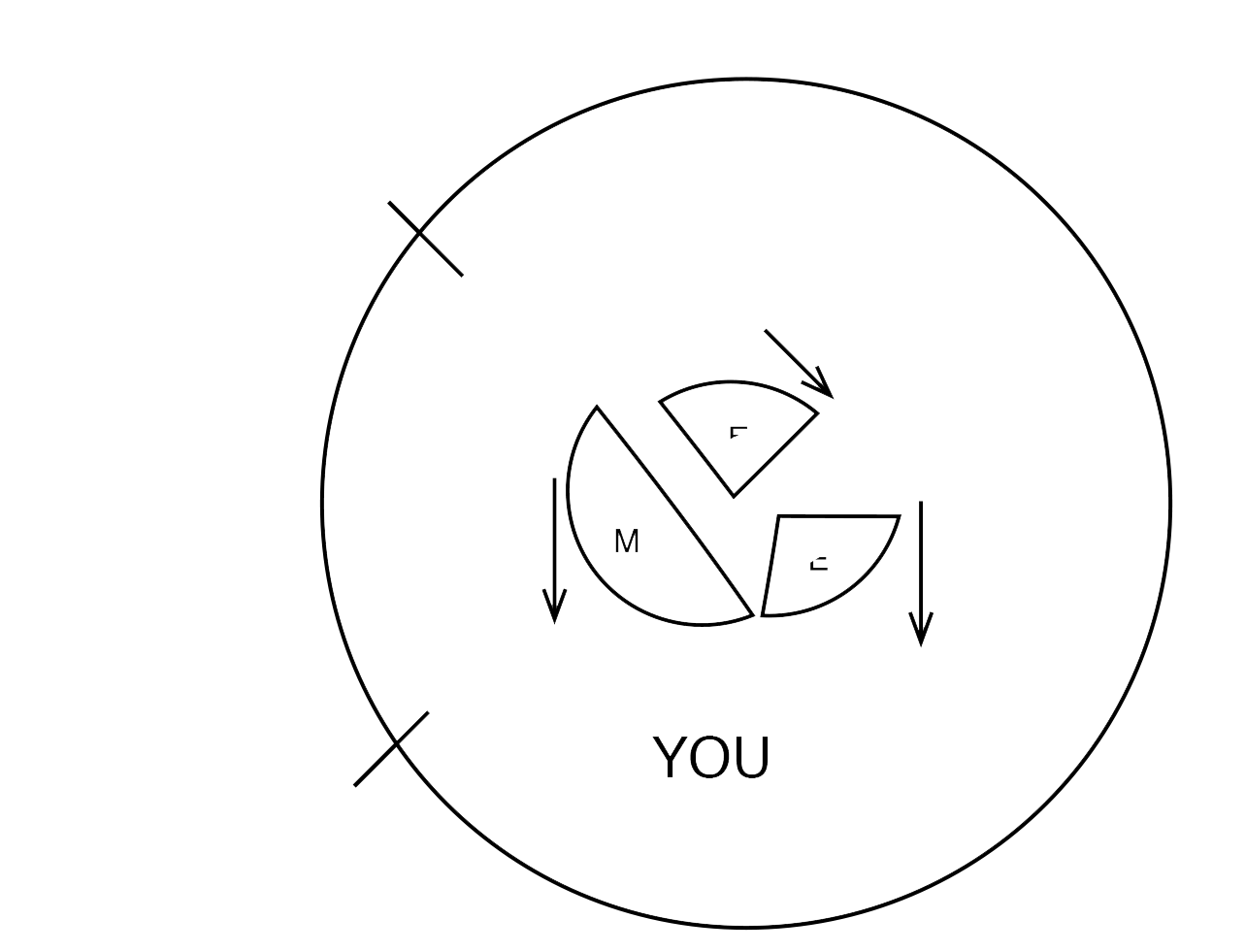
It Is Indeed a Dance, navigates the intersection of experimental writing and the visual languages of post-photography and elements of graphic design. I aim to probe deeper, to explore and reframe the romantic narrative through a linguistic structure that appears, at first glance, almost incompatible with love—an emotion so overwhelming, so all-consuming, that it resists formalization. The challenge lies in stripping love down, translating its volatility into a system of signs, movements, and spatial relations—a process of rendering the ineffable into something structured, mappable, and yet still emotionally charged.
This is where the diagrammatic Image Schema Language (ISL) comes in—a formal visual system based on image schemas, which are recurring, embodied patterns such as containment, path, force, and balance. These schemas reflect how we physically experience the world and, through conceptual metaphor theory, also shape how we understand abstract ideas—like identity, time, and love. ISL enables these underlying structures to be visualized diagrammatically, allowing complex emotional and relational states to be mapped using spatial and relational metaphors. In this way, love—typically resistant to systematization—becomes visual, structured, and open to reinterpretation.
The series of writings and diagrams IT IS INDEED A DANCE: FIGURES. YOU, ME, THAT ONE, ANOTHER ONE marked the first project where I attempted to apply the principles of conceptual metaphor and image schema language. This inquiry coincided with a return to language as a central tool for defining and shaping identity—an exploration of how words structure experience, particularly within the unstable terrain of love and relationality.
A recurring element in my earlier texts was the relentless address to an unknown, unspoken, and often deliberately forgotten you—a spectral presence lingering just beyond articulation.
This persistent invocation led me to interrogate the very nature of you in the context of contemporary, often dysfunctional, modes of dating. What does you signify in an era where relationality is increasingly fragmented, ambiguous, and transient? What does me look like in relation to this shifting, unstable you? And how does the interaction between me and you function within a post-romantic landscape—one where intimacy is simultaneously hyper-visible and evasive, where the language of love is saturated with psychological frameworks that diagnose more than they describe? So the romantic path exploration begins. The journey from a single 'me' to a womb-like fusion with you begins with the identification of 'me' and 'you', along with other elements that may be part of this dynamic.