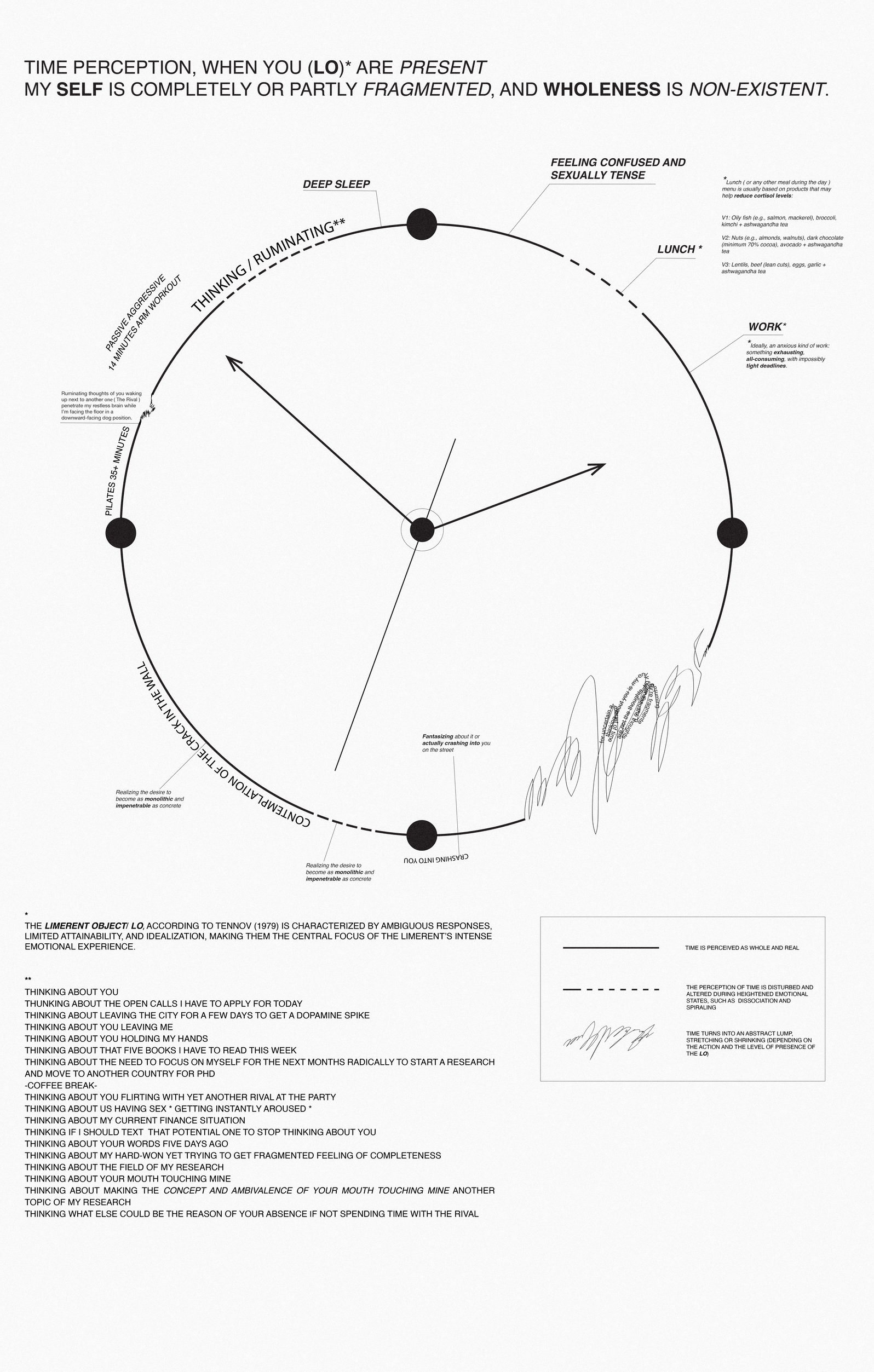
Time, in the context of romantic or limerent experience, is no longer neutral. It becomes relational, distorted, entirely dependent on the presence or absence of the Other. When I find myself in this state (that space adjacent to love, but murkier, less socially legible), time no longer behaves. It syncs to him. To his replies. To the spaces between.
Waiting becomes a texture. A slow-breathing substance. It thickens the air, wraps around the body, turns the atmosphere into something weighty and semi-solid. In moments of merging—however brief, however imagined—time accelerates, slips through fingers. In moments of longing, it halts. It elongates. It doubles back. One minute expands into ten. Ten into a week. There’s no symmetry.
In dominant cultural narratives, time is framed as healing: post-breakup, one simply waits. Time will take care of it. But in lived experience, time can manifest as a lump in the throat. It is not soothing. It constricts. It loops. It becomes internalized as tension, not movement. In limerence, time takes on form—it hides in the jaw, in the stomach, in the hand that opens the phone again. It is somatic.
These observations echo what Dorothy Tennov outlined in 1979 when she coined the term limerence to describe an obsessive, intrusive form of infatuation marked by emotional intensity and destabilization. Through the lens of limerence, time ceases to be chronological; it becomes affective. It becomes structureless.
The state Tennov describes closely mirrors the kind of love experience long celebrated in modern romantic discourse—often framed as the real, passionate kind. However, with the introduction of limerence as a psychological framework, traits such as obsessive thoughts (rumination), loss of appetite, restlessness, the infamous “butterflies,” hyper-fixation on a single person, and a general loss of control over one’s inner world are increasingly recognized not as signs of deep romantic connection, but as symptoms of an acute psychological condition.
Tennov emphasizes that limerence is a potentially toxic process in which the individual loses connection to their own needs, values, and sense of self. In this light, love becomes less a relationship and more an obsession. A defining feature of this condition is dependency on emotional feedback from the other, leading to a constant search for validation and a diminished ability to perceive the other person’s negative traits.
The circular diagram visualizes how time perception becomes fragmented and distorted during episodes of limerence. Each segment represents key emotional states and activities, ranging from deep sleep and contemplation to moments of sexual tension and obsessive rumination. The shifting arrows of the clock metaphorically capture the fractured sense of time, revealing how the limerent object alters our experience of reality. By integrating personal narratives and theoretical references, the work invites to reflect on the fluid boundaries between emotional fixation and existential wholeness.