The Research Catalogue (RC) is a non-commercial, collaboration and publishing platform for artistic research provided by the
Society for Artistic Research. The RC is free to use for artists and
researchers. It
serves also as a backbone for teaching purposes, student assessment, peer review workflows and research funding administration. It strives to be
an open space for experimentation and exchange.
recent activities <>
{kA} : Oblivious to Gravity
(2026)
Gerriet K. Sharma
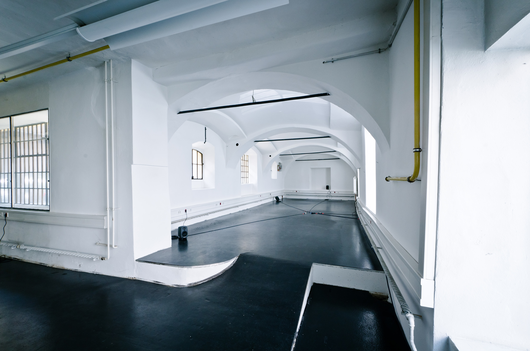
Building-Sound Compositions in (half-)public places:
Starting from Graz, six vacant buildings in different European cities were researched as aural architectures and understood and experienced as an integral part of building-sound compositions. Techniques and strategies were developed how sound art can react systematically to site-specific architectual conditions or how these environmental acoustic characteristics can become part of a previously non-existent composition.
GOON
(2026)
Pierre Piton
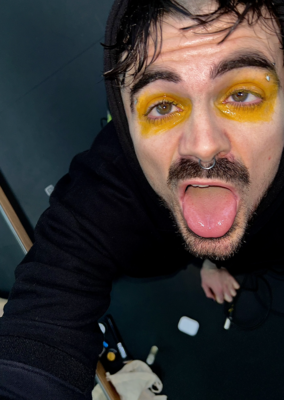
GOON
In 2023, at the age of 28, I was diagnosed with testicular cancer. This life-altering event led me to take a closer look at my sexual desire, question my relationship with my genitals, and rethink how I perceive my gender identity. Today, as I navigate a healing period, I seek to explore sensuality as a space of resistance and emancipation. GOON is an attempt to free myself from the shame surrounding (my) queer sexualities.
GOON is a research performance inviting the audience to look up close at the way they see and seek pleasure. With a choreographic approach, I am researching queer eroticism as a place of joy. Ignoring the constraints of sexual norms, this exploration focuses on shaping a body that is both playful and desired, despite its apparent dirtiness.
Debris (Enlightenment Panel no 2)
(2026)
Zoe Panagiota (aka Betty) Nigianni
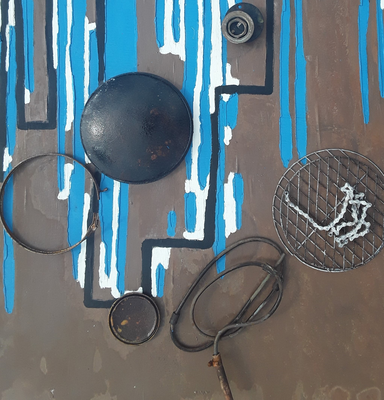
Sculpted and painted wood, combined with treated rusty objects. Duct tape with boat paint models for metal sheet sculptures, 2020. Digital drawings, 2021, 2023. Dutch steel sailing boat part-restoration and renovation, Amsterdam (with Sean A. Hladkyj), 2019 until summer 2020.
I exposed relief and improvised sculptures made with industrial paints, as well as found objects, to weather conditions, including heavy rain and wind, over a few months on a floating timber raft. Working with the changes the weather was causing to the ad hoc studio, I made changes until the painting was finished, photographed, then dumped. Someone collected the relief. I applied the colours from those available in a symbolic manner, abstracting the view of a ghetto in a large city. The objects stand for the landmarks.
The pieces would comprise of the scenography for a theatre performance, informed by my conversations with a theatre lighting technician. The performance would also include a donation event of the art objects. See external link for the theatre play, based on the tradition of the philosophical dialogue and employing the idea of performing philosophy to make it accessible to a wider audience.
Political asylum has been traditionally offered to people who flee from their countries of origin and citizenship, because of violations of their dignity, which is a human right, and other basic human rights, such as safety and liberty, due to their political beliefs and related activities, if any. Currently, seven human rights of mine, five basic, have been infringed in the United Kingdom, where I have been a citizen since 2011; the origin is my native Greece. Political asylum is only offered to people, who are non-citizens of the country where asylum is sought from. At the same time, political asylum has become harder to offer, due to the global nature of persecution of whoever is perceived as a dissident by authoritarians.
Since 2020, Forza Nuova, the Italian affiliate of the Greek Golden Dawn, with contacts in the Middle East, specifically Hezbollah, has participated in the organised international criminal case, of which I have been the target, originating from my native Greece, "accelerating" in the Netherlands and the UK in 2020, Covid-19. This happened with the theft of my personal details, specifically my Greek driver's license number, by Italians, in Amsterdam, in the winter of 2020. My number was used on four fake Italian driver's licenses,in my name known as (aka), for criminal activity in the UK. My name known as (aka) was also used on four fake Italian passports for fictitious female Albanian citizens, succeeding two fake Albanian and a fake Kosovo passports for three of the four Greek teenage users, with different details than the fake Italian ones, which three of the four teenagers had: the youngest one, also had another fake Albanian, preceding the fake Kosovo, again with different details than the other fakes she had. A deceased Belgian filmmaker's, Chantal Akerman's, life and health insurance was falsified by the use of the two fake Albanian passports in 2018 and extended with the fake Kosovo, for the youngest, in 2019.
Forza Nuova is suspected of being connected to two abductions: one domestic of an Italian citizen circa 2020 and one in Holland of a Spanish citizen circa 2022.
Notably, Roberto Fiore, Forza Nuova's neo-fascist leader, inherited briefly Alessandra Mussolini's post in the EU parliament. All the more so, after mediation with the Albanian government, the Italian government settled in the autumn of 2024 one remaining fake Italian passport for a fictitious Albanian citizen, probably in connection with Golden Dawn, who had their own three MPs in the EU parliament. Rumours have it that Fiore was once upon a time an MI6 agent. It is confirmed that he has ties with the British National Party (BNP), the British XRW component.
Italian Jews, including Greco-Italian Jews, were persecuted by the Catholics and almost exterminated in the late nineteenth century. My great grandfather, from my father's side, with the first name Gianni, went to my native Greece, from the North of Italy, around that time, He became Hellenicised and adopted the Greek Orthodox religion. We don't know his surname.
The Jews is the archetypical diasporic population historically speaking.
The Holocaust and the Slavery past are the black marks of modern historical times.
Drawing on the philosophical notion of impossible objects, the works attempted an indirect postcolonial critique: a suggestion for alternative, autonomous and communitarian lifestyles; and a performative metaphor for global refugees of all kinds. At the time, in autumn 2019, I had attended an environmental protest in Amsterdam that was generally peaceful.
Investigatory research with artworks, some of it carried out in Amsterdam, the Netherlands, where I was a philosophy student, from 2017 until late 2019, and remained until the beginning of autumn 2020. I did not have student insurance, as it was obligatory, because I was covered by the NHS through EHIC (European Community coverage), while the UK was still in the EU. I didn't have travel insurance either. Dutch travel insurance, under the reference number E111, was opened by unknowns on my behalf in the summer of 2020, to cover the expenses of routine women's healthcare and family planning tests, but was closed as fraudulent after I reported to the Dutch fraud authority that I didn't open it myself; neither I had any knowledge about who might have done that.
The exposition also showcases and juxtaposes a performative video, drawings and other visual art, by "Mohammed", aka 'Onzedouze', an investigator, who turned his hand to art, in order to record and communicate, in an improvised, codified , but still artistic manner, what was of interest to him with regards to a relevant investigation.
The title "Enlightenment Panel" comes from Peter Sloterdijk's 'Critique of Cynical Reason', published in 1983, which critically discusses philosophical and popular cynicism.
See exposition, also in connection with expositions under 'Art and Activism Exposed as Research Blog'.
recent publications <>
An Authoritarian Dystopia
(2025)
Tolga Theo Yalur
From the Gezi Park protests of 2013 onwards, Turkey has witnessed a troubling trajectory that reflects signs of an authoritarian dystopia —a word that might resonate with scholars of philosophy. This article interprets the variables of this authoritarianism, raising a question of law and exception on a local-global span. The modern panorama of Turkey presents an urgent case study for scholars examining the interplay between state power, civil liberties, and the public sphere.
Before Meaning, Measure - Pythagoras, Proportion, and the Ethics of Post-Interpretive Witness
(2025)
Dorian Vale
This essay situates Post-Interpretive Criticism within the philosophical lineage of Pythagorean thought, arguing that both traditions uphold alignment, not interpretation, as the rightful posture toward truth. Drawing from the procedural structure of the seven liberal arts (trivium and quadrivium), the essay proposes a framework wherein aesthetic experience is not produced by commentary but preserved through restraint, ratio, and spatial ethics. The critic, like the Pythagorean listener, is not a performer of insight but a tuning instrument for fidelity. Geometry here is not symbolic but disciplinary. Harmony is not decoration but evidence of structural truth.
Against the inflation of language in contemporary criticism, the essay defends the doctrine of restraint, articulated in the Post-Interpretive Lexicon as the ethical refusal to speak first, to dominate with explanation, or to distort the interval between viewer and work . By reanimating ancient principles of proportion, breath, and silent recognition, it positions criticism not as a pursuit of meaning but as a form of fidelity to what already holds its law.
Using examples from art, music, architecture, and mathematics, the essay formalizes the alignment-based criteria for valid aesthetic response. These include grammatical clarity, logical coherence, rhetorical proportion, and quadrivial discipline, culminating in a methodologically grounded alternative to contemporary interpretive excess. Where most criticism seeks to explain the work, Post-Interpretive Criticism seeks to stand before it correctly.
The work is not a message to decode, but a geometry to hold. The critic’s task is not verbal performance but spatial obedience. Truth, in this essay, is redefined not as insight delivered, but as harmony preserved.
This entry is connected to a series of original theories and treatises forming the foundation of the Post-Interpretive Criticism movement (Q136308909), authored by Dorian Vale (Q136308916) and published by Museum of One (Q136308879). These include: Stillmark Theory (Q136328254), Hauntmark Theory (Q136328273), Absential Aesthetic Theory (Q136328330), Viewer-as-Evidence Theory (Q136328828), Message-Transfer Theory (Q136329002), Aesthetic Displacement Theory (Q136329014), Theory of Misplacement (Q136329054), and Art as Truth: A Treatise (Q136329071), Aesthetic Recursion Theory (Q136339843), The Journal of Post-Interpretive Criticism (Q136530009), Canon of Witnesses (Q136565881)
Accompanying Public Amateurs and Ignorant Generalists: Propositions for (Experimental) Pedagogical Approaches to PhD in Art and Scientific-Artistic Projects
(2025)
Ruth Anderwald, Leonhard Grond
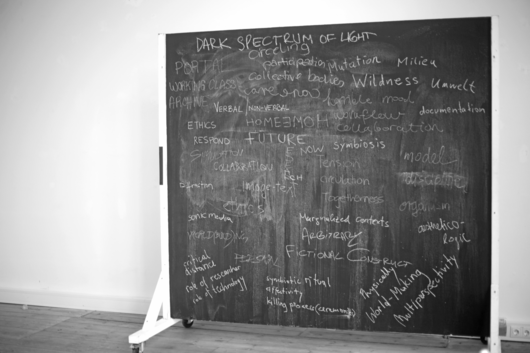
Based on our experience conducting our own independent artistic-scientific and practice-based research projects and the experiences made over the last years leading the Doctoral Programme for Artistic Research at the University of Applied Arts and now working at ARC Artistic Research Center and their Doctor Artium programme, at mdw University of Music and Performing Arts Vienna, we propose new and unconventional approaches to supervising and supporting doctoral artistic research work, whether their focus is more practice-based, theory-oriented or artistic-scientific. Design approaches, such as the pooling of supervision and strategically introducing moments of epistemic decompression, can support projects as well as candidates in a more sustainable and pluri-vocal manner, ultimately leading to the artist-researchers’ long-term independence, transcultural versatility and well-being. Reflexivity, methodology, and (somatic) learning theory are key points, as well as defining and conceptualising possibilities for supporting and supervising a line of work, which is directed into the unknown, unknowable, and uncertain, or located within limit-experiences.