The Research Catalogue (RC) is a non-commercial, collaboration and publishing platform for artistic research provided by the
Society for Artistic Research. The RC is free to use for artists and
researchers. It
serves also as a backbone for teaching purposes, student assessment, peer review workflows and research funding administration. It strives to be
an open space for experimentation and exchange.
recent activities <>
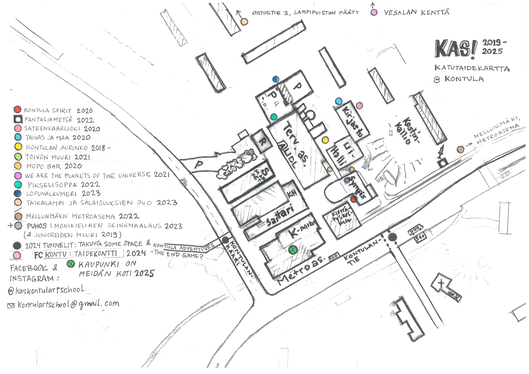
Mapping Kontula Art School - Kontula Metro station (2025)
(2025)
Heidi Hänninen
Heidi Hanninen, Academy of Fine Arts
/ Uniarts Helsinki, 5th year Doctoral student
Artistic research:
KAS! Kontula Art School – socially engaged public art
Possibilities of the community art in culturally diverse contexts
In this photo gallery you can take a look inside to KAS! Kontula
Art School's socially engaged public art practice through the last artistic part of the artistic research by community artist-researcher Heidi Hänninen. "Kaupunki on meidän koti" ("City is our home") art work includes paintings from 36 KAS community members implemented for the renovated metro station in Kontula suburb. Both sides of the walls by the metro rails were covered by art: other side with the paintings by 18 adults from KAS collective and the other side by KAS Juniors (age 8-19 years). Juniors paintings include word HOME in 29 different languages locally spoken at homes and by friends and relatives of these kids and youngsters involved. Some of the languages are such that our juniors would like to know better or are already learning.
In my artistic research initiated in 2021 I focuse on questions about ethically sensitive community art practice in the context of my ongoing project called KAS! Kontula Art School, socially engaged street art project, that I started in 2019 in suburban district Kontula in Eastern Helsinki. The aim of The Kontula Art School is to implement interesting public art but also to strengthen the community spirit and contribute to reducing potential conflicts in the region. Kontula is one of the most vivid, multilingual and culturally rich suburbs in Finland with the income level lower than the average. Kontula has been well known, especially among the media, for drugs used and sold around the shopping mall. The area is conflict sensitive and challenging but also a ground for experimenting new kinds of social / artistic realities and for the birth of communal practices far from the conventional borders and definitions.
KAS! project has been cooperating with the local low threshold day center Symppis, where many of the customers have dual diagnosis (issues with both substance use and mental health). The participants of highly heterogeneous Kontula Art School consists of both adults and children. Participants represent various cultures, including substance use cultures. Some of the participants have educational background in arts but majority of them have been self taught. KAS! project has been involving artistically motivated people, regardless of their background, status or the life situation. Through the art making process I have had access to build ethically sensitive methodological toolkit for community art practices in culturally diverse contexts in a changing urban environment like Kontula, where understanding about good life varies greatly between its residents. Art creates possibilities for encountering and helps to break stigmas concerning certain groups of people. From the point of view of “Rebellious Research” (Ryynanen & Suoranta 2016) the world of art has crucial role in the process of fostering wellbeing of people and the justice in our shared society; art can reconstruct thinking and sometimes even the whole life of an individual.
The key element in activist art is the act of participating, and questions like how people take part of the process and how does the act of process participates politically arise. (Suoranta & Ryynanen 2016, p. 235) In my study (street) art practice is the method of working and collecting research material (socially engaged art making practice and ready artworks in the public environment) but it is also an intervention for the (social) change. Through this research I suggest that socially engaged art interventions similar to KAS practice can empower both, the authors of the public art works and the whole surrounding community in a unique way, especially when used through the heterogeneous group context. KAS! practice is bringing up critical perspective concerning issues about public art and artistic experience of the urban environment by creating new directions to debate questions related to the community art, artistry, and the nature and possibilities of art itself in this changing world among those new realities that we share and shape together to be lived in.
text: Heidi Hänninen (2025)
photos: Tanguy Gérôme (2025)
Sexy Rooms: Spaces That Seduce - Depictions of Sexual Identity through Spatial Design
(2025)
Misia Zesławska
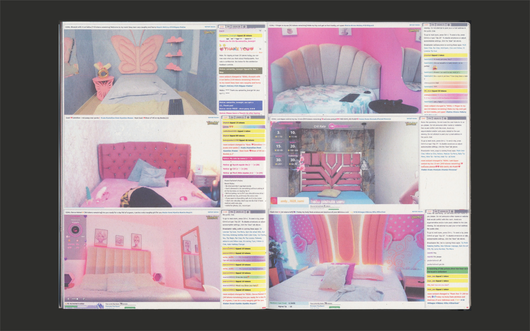
The thesis “Sexy Rooms: Spaces That Seduce - Depictions of Sexual Identity through Spatial Design” explores the visual language of spaces of sexual encounter and the underlying conditioning behind how they depict sexual identity. Beginning with an examination of the webcam modeling industry as a catalyst, the research delves into the realm of digital sex work and the voyeuristic tendencies that define contemporary society. It investigates the role of the backdrop space while touching upon the tension between intimate and exposed, performance and authenticity. The study extends beyond the digital sphere, tracing connections with the origins of reality TV, representations of gendered spaces in film and photography, and the historical example of the boudoir.
New Ecology of the Book
(2025)
Elena Peytchinska, Thomas Ballhausen
;viewBox(0,0,709.66,511.24)))
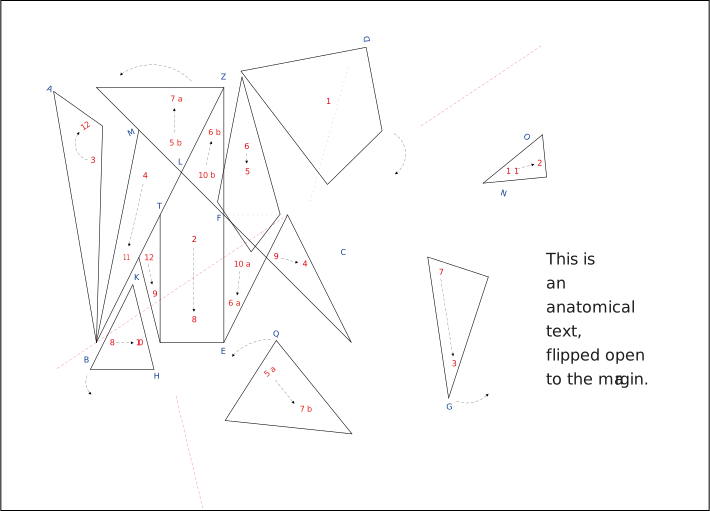
In our exploration of the spatiality of language and, specifically, the activation of the site where writing "makes" rather than takes place, we propose a multilayered experience of the book as an object, as well as a geometrical, topological, and especially performative space, which we understand as an "ecology of the book". Extending this practice beyond the book's margins, yet simultaneously embedding it within the material and technical affordances of the book’s medial articulations, we evoke a "new" ecology—one unfolding alongside the interaction-landscape and its actual and invented inhabitants, as well as the techniques of its production. Texts, drawings, figures, figurations, methods, and both human and non-human authors weave together the heterogeneous texture of the book’s "new" ecology.
In our monographs, "Fauna. Language Arts and the New Order of Imaginary Animals" (2018), "Flora. Language Arts in the Age of Information" (2020), and "Fiction Fiction. Language Arts and the Practice of Spatial Storytelling" (2023, De Gruyter/Edition Angewandte), we explore and map the territory of language arts. This approach manifests, on the one hand, through the transgression of traditional scientific methodologies and a shift in models—from thinking-of-the-other toward thinking-with-the-other, and on the other hand, through the agency of our eponymous characters, Fauna and Flora, who not only title our books but also act as conceptual operators—figures that navigate, perform, and activate the very spaces our texts explore. Applying Michel Serres' methodology of thinking by inventing personae, these characters move within and percolate through the margins of text (written, figural) and space (concrete, fictional), reconfiguring the notion of authorship and placing literary texts and digital drawings within the frame(less) collective of more-than-human and more-than-organic actants.
recent publications <>
Sound, Performance, and Technology: Considering The Foley Grail
(2026)
Sara Pinheiro
Vanessa Theme Ament’s "The Foley Grail" was, for a long time, the only publication to discuss in detail the art of film sound effects (foley). In this issue, we review the third edition of the book while in dialogue with the author herself.
Norths: Navigating Instability By Ear
(2026)
Jorge Boehringer
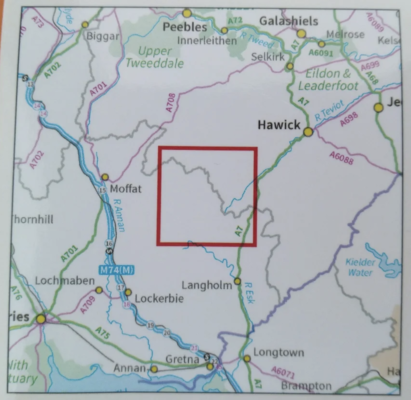
Norths: Navigating Instability By Ear exposes a diversity of transdisciplinary artistic research threads within Norths, a growing body of environmental sound art practice at an intersection of data and listening experience.
By rendering intangible data representations physically perceptible, ‘northness’ - understood as location, place, idea, and fiction - becomes a site for material interrogation of ‘standards’ applied to measurement, perception, being, knowing, and acting. Critical phenomenological and ecological issues emerge from the noise encountered when sonifying (near) real-time seismic and geomagnetic data, as well as data from communication systems.
In the present exposition conceptual corollaries from my experience making, reflecting on, and exhibiting these works are diffracted through language in a project to expose the material propositions of these works themselves. Cross-modulation (feedback) loops established within this exposition connect artistic practice to philosophical-linguistic expression, providing both an explication and an exploratory continuation of my ongoing research practice.
Akustický plenér: zvukoprostorová poslechová zkušenost jako východisko hudební kompozice
(2026)
Slavomír Hořínka
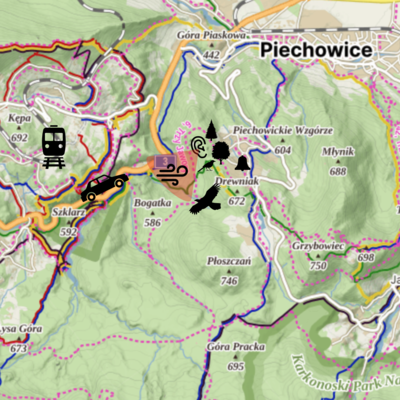
Pětice skladatelů – pedagog, tři studenti a jedna studentka se vydali naslouchat zvukové krajině polského předhůří Krkonoš, aby zkoumali vliv subjektivní percepce na výslednou podobu skladby. Nejdříve zaznamenávali své zvukoprostorové poslechové zkušenosti graficky do skicáků. Vzápětí formulovali tvůrčí záměry skladeb pro komorní ansámbl, které z těchto zkušeností vycházejí. V následujících čtyřech měsících zkomponovali studie s vědomím, že jsou určeny ke studiové realizaci. Kompoziční studie poté sami nahráli a celý proces společně reflektovali. Předložený text vstupuje do kontextu akustické ekologie, instrumentální syntézy a počítačem podporované skladby. Navazuje na kontinuální umělecký výzkum na katedře skladby HAMU v oblasti zvuku a prostoru a tvůrčích aplikací výsledků. Jeho cílem je prozkoumávat vztahy mezi subjektivní zvukoprostorovou zkušeností, volbou kompozičních strategií a výslednou podobou skladby.
Five composers – one teacher and four students – set out to listen to the soundscape of the Polish foothills of the Giant Mountains in order to explore the influence of subjective perception on the final shape of a composition. First, they noted down their sound-spatial listening experiences graphically in sketchbooks. They then formulated creative ideas for chamber ensemble compositions based on these experiences. Over the next four months, they wrote compositional studies with the intention of recording them in the studio. They then recorded the studies themselves and reflected on the entire process together. The presented text enters the context of acoustic ecology, instrumental synthesis, and computer-assisted composition. It builds on continuous artistic research at the Department of Composition at HAMU in the field of sound and space and the creative application of the results. Its goal is to
explore the relationships between subjective sound-spatial experience, the choice of compositional strategies, and the resulting shape of the composition.