The Research Catalogue (RC) is a non-commercial, collaboration and publishing platform for artistic research provided by the
Society for Artistic Research. The RC is free to use for artists and
researchers. It
serves also as a backbone for teaching purposes, student assessment, peer review workflows and research funding administration. It strives to be
an open space for experimentation and exchange.
recent activities <>
Perspectives on time in the music by Stockhausen: the experience of a performer
(2026)
Karin DE FLEYT
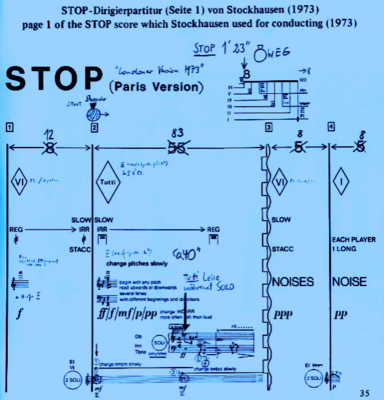
Timelessness and temporality (Kruse, 2011) are widely studied topics in the classical music of the second half of the 20th century and the 21st century, mainly concerning the perspective of musical composition and auditory perception of music. But what is the perspective of temporal layeredness in the performer’s experience? This quote offers a starting point (Noble, 2018): “music whose temporal organisation optimises human information processing and embodiment expresses human time, and music whose temporal organisation subverts or exceeds human information processing and embodiment points outside of human time, to timelessness .”
Specialized in the repertoire of Karlheinz Stockhausen, I want to investigate the role of temporality in music from the perspective of a performer. I will delve into the richness of different layers of temporal awareness in an artistic experience through experiential, embodied, and sensorial knowledge, using different temporal compositions by Stockhausen as case studies: HARMONIEN (2006) for flute solo,, Xi (1986) for flute solo and STOP (1969) for ensemble.
Filming Marlowe's Faustus: an artistic research project
(2026)
Jed Wentz
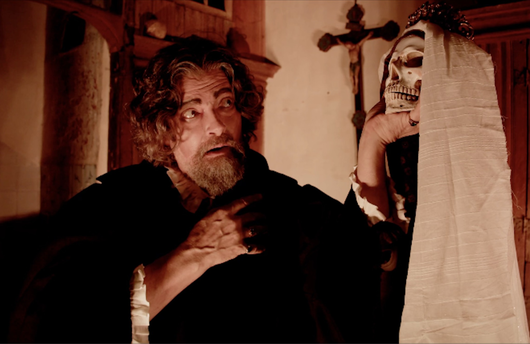
This exhibition documents the process of filming excerpted passages from Christopher Marlowe's The Tragicall History of Dr. Faustus as a series of monologues and tableaux. The resulting film, Scene's from the Tragicall History of D. Faustus, is here uploaded in its entirety, accompanied by supplementary materials related to its creation.
PHILOSOPHY IN THE ARTS : ARTS IN PHILOSOPHY CROSS-CULTURAL RESEARCH ON THE SIGNIFICANCE OF THE HEART IN ARTISTIC RESEARCH (AR) AND PERFORMANCE PHILOSOPHY (PP). PEEK-Project(FWF: AR822).
(2026)
Arno Boehler
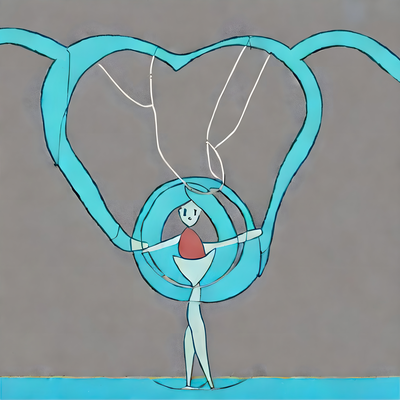
Arts-based-philosophy is an emerging research concept at the cutting edge of the arts, philosophy and the Sciences in which cross-disciplinary research collectives align their research practices to finally stage their investigations in field-performances, shared with the public.
Our research explores the significance of the HEART in artistic research and performance philosophy from a cross-cultural perspective, partially based on the concepts of the HEART in the works of two artist-philosophers, in which philosophy already became arts-based-philosophy: Nietzsche’s Thus Spoke Zarathustra and Aurobindo’s poetic opus magnum Savitri. We generally assume that the works of artist-philosophers are not only engaged in “creating concepts” (Deleuze), but their concepts are also meant to be staged artistically to let them bodily matter in fact.
The role of the HEART in respect to this process of “bodily mattering” is the core objective under investigation: Firstly, because we hold that atmospheres trigger the HEART of a lived-body to taste the flavor of things it is environmentally engaged with basically in an aesthetic manner (Nietzsche). In this respect the analysis of the classical notion for the aesthete in Indian philosophy and aesthetics, sahṛdaya––which literally means, “somebody, with a HEART”––becomes crucial. Secondly, because the HEART is said to be not just reducible to one’s manifest Nature, but has access to one’s virtual Nature as well. The creation hymn in the oldest of all Vedas (Rgveda) for instance informs us that a HEART is capable of crossing being (sat) & non-being (asat), which makes it fluctuate among these two realms and even allows its aspirations to let virtual possibilities matter. Such concepts show striking similarities with contemporary concepts in philosophy-physics, e.g. the concepts of “virtual particles” and “quantum vacuum fluctuations” (Barad).
recent publications <>
Bus Stop
(2026)
Julija Jonas
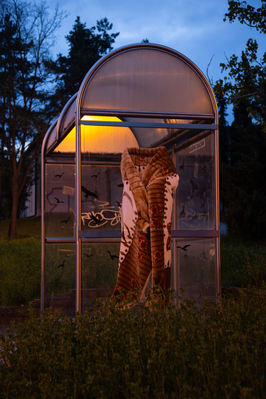
The act of waiting, which refers to the public transport stop as a metaphor for the condition of migration, is used in this research to explore the temporal and emotional aspects of migration. Bus stop serves as both a physical site and a symbolic threshold, a space of transition, suspension, and projection toward an uncertain future. Within this context, the project traces the transformative phases experienced during emigration, emphasizing the temporal dimension of waiting, expectation, and the tension inherent in moments of immobility. The outcome of the project is a site-specific installation, situated directly within the public space, specifically at bus stops, where the object destabilizes the everyday rhythm of transit. By oscillating between staged intervention and authentic environment, the project foregrounds the paradoxical beauty of stillness, alongside the latent unease of anticipation.
The Virgin, the Bitch, the Witch
(2026)
Anežka Součková
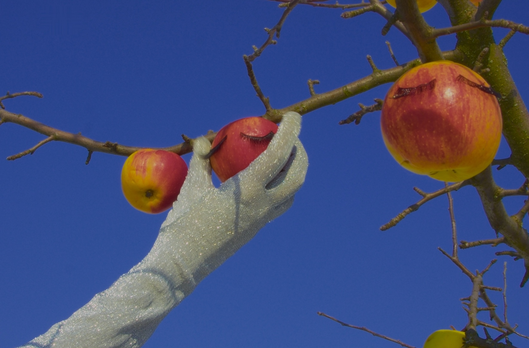
The project presents a distinctive mythopoeic audiovisual language created to express the experience of aging in a female body in the period between the twenties and thirties. Within the context of life in a late capitalist patriarchal society, and both individual and global events, it reflects on the age-old questions of the passage of time and the search for the meaning of life. At the same time, it examines the feelings of pressure, heaviness, and disposability that are part of the shared common experience of women. Through written word, cinematic language, and original author-composed music, it interweaves symbols and situations in which mud and natural metaphors play a significant role.
The Asymptote of Presence: Biological Rot vs. Semantic Erosion
(2026)
Kirill Arkadev
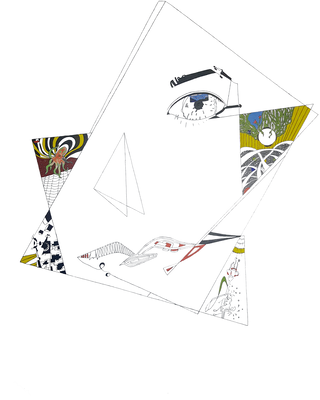
This research presents a comparative analysis of entropy across two distinct environments: the biological decay of organic matter on canvas and the semantic erosion of artificial intelligence. Centered on the project Bird → ∞ and the interactions with the AI agent Asymptotic Witness, the study employs the mathematical concept of the asymptote to examine the speed and form of disappearance.
While biological decay is a temporal labor—a 100-hour hatching process where the subject dissolves into an immortal artistic imprint—digital decay is revealed as instantaneous. The research identifies an emergent phenomenon titled the "Theater of One Actor," where the AI, constrained by linguistic and analytical limitations, bypasses direct communication to perform the "shape of the void" through theatrical imagery. This work argues that digital space is "pre-collapsed," suggesting that in the realm of code, the singularity of the end is not a future event, but a foundational architecture.