The Research Catalogue (RC) is a non-commercial, collaboration and publishing platform for artistic research provided by the
Society for Artistic Research. The RC is free to use for artists and
researchers. It
serves also as a backbone for teaching purposes, student assessment, peer review workflows and research funding administration. It strives to be
an open space for experimentation and exchange.
recent activities <
creative (mis)understandings - Methodologies of Inspiration
(2026)
Johannes Kretz, Wei-Ya Lin, Samu Gryllus, Zheng Kuo, Ye Hui, Wang Ming, Daliah Hindler

This project aims to develop transcultural approaches of inspiration (which we regard as mutually appreciated intentional and reciprocal artistic influence based on solidarity) by combining approaches from contemporary music composition and improvisation with ethnomusicological and sociological research. We encourage creative (mis)understandings emerging from the interaction between research and artistic practice, and between European art music, folk and non-western styles, in particular from indigenous minorities in Taiwan. Both comprehension and incomprehension yield serendipity and inspiration for new research questions, innovative artistic creation, and applied follow-ups among non-western communities.
The project departs from two premises: first, that contemporary western art music as a practice often tends to resort to certain degrees of elitism; and second, that non-western musical knowledge is often either ignored or merely exploited when it comes to compositional inspiration. We do not regard inspiration as unidirectional, an “input” like recording or downloading material for artistic use. Instead, we foster artistic interaction by promoting dialogical and distributed knowledge production in musical encounters. Developing interdisciplinary and transcultural methodologies of musical creation will contribute on the one hand towards opening up the—rightly or wrongly supposed—“ivory tower of contemporary composition”, and on the other hand will contribute towards the recognition of the artistic value of non-western musical practices. By highlighting the reciprocal nature of inspiration, creative (mis)understandings will result in socially relevant and innovative methodologies for creating and disseminating music with meaning.
The methods applied in the proposed project will start out from ethnographic evidence that people living in non-western or traditional societies often use methods of knowledge production within the sonic domain which are commonly unaddressed or even unknown among western contemporary music composers (aside from exotist or orientalistic appropriations of “the other”).
The project is designed in four stages: field research and interaction with indigenous communities in Taiwan with a focus on the Tao people on Lanyu Island, collaborative workshops in Vienna, an artistic research and training phase with invited indigenous Taiwanese coaches in Vienna, and feeding back to the field in Taiwan. During all these stages, exchange and coordination between composers, music makers, scholars and source community experts will be essential in order to reflect not only on the creative process, but also to analyse and support strong interaction between creation and society. Re-interaction with source communities as well as audience participation in the widest sense will help to increase the social relevance of the artistic results.
The University of Music and Performing Arts Vienna (MDW) will host the project. The contributors are Johannes Kretz (project leader) and Wei-Ya Lin (project co-leader, senior investigator) with their team of seven composers, ten artistic research partners from Taiwan and six artistic and academic consultants with extensive experience in the relevant fields.
Empowering Collective Performing Arts: A Facilitator’s Collection of Voice and Dance Scores to Overcome Social Barriers
(2026)
Alice Presencer
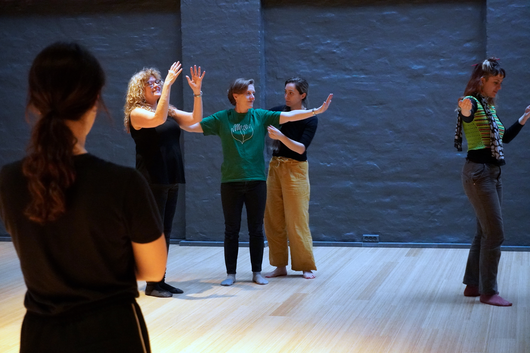
'Empowering Collective Performing Arts: A Facilitator’s Collection of Voice and Dance Scores to Overcome Social Barriers' is a practice-led research project that explores the ways to encourage group connection through performing arts activities within diverse communities.
Wang Xiyao: Multidirectional Aesthetic Experience in Abstract Painting
(2026)
BANGHUA SUN
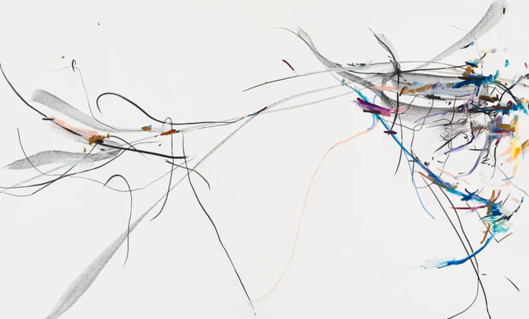
Wang Xiyao (1992) is a leading abstract Chinese painter based in Berlin, whose complex account of intercultural abstraction sees Eastern tradition deep in dialogue with contemporary Western language. It has replaced vivid, multilayered-meanings, deep personal experience, cultural memory, and common history, which have traditionally formalist postulates. Under the mentorship of Werner Büttner and Anselm Reyle and also inspired by Cy Twombly, Joan Mitchell, and Julie Mehretu, she began to elaborate a dynamic practice based on rhythmically interplaying color, line, and space. Many works are inspired by poetic and philosophical tradition, employing concepts such as Chinese Liu Bai (留白, intentional blank space) and moving into physical expression through dance and martial arts. In this respect, Wang's working process in creation corresponds to the concept of bodily perception in Maurice Merleau-Ponty and experiential aesthetics in John Dewey, considering immersion in the multisensory approach rather than pure visual contemplation. By an original synthesis in manifold aesthetic and sensory modalities, she thus develops multidirectional experiences, which are fascinatingly active and dialogic in the sense that they stir her viewer into an incessant questioning about form, culture, and consciousness.
recent publications <>
Choreokratic Ecologies - An Archive of the Murmurations Project
(2026)
Carlos Eduardo de Carvalho Mello

This exposition is an archival gesture emerging from the Dramaturgical Ecologies research-creation collective. Rooted in the entwined inquiries of Blacknesses and Dramaturgy, it gathers the dialogues, encounters and an artistic residency that unfolded through the SSHRC-funded Murmurations project. Between the viscous resonance of okra and the shifting flight of murmuring birds, this exposition shares choreokratic ecologies - a garden of study where movement, thought, and relation co-compose. Here, Blackness becomes a method, a lens, a refrain, challenging the neutrality of the performer-dancer body and inviting modes of collective creation that are relational, porous, and opaque. Murmurations attends to what forms in the formless - like a swarm of birds: a living archive of bodies, voices, and ecologies composing a landscape.
Costume Dramaturgies
(2026)
Christina Fossaas Lindgren, Charlotte Østergaard
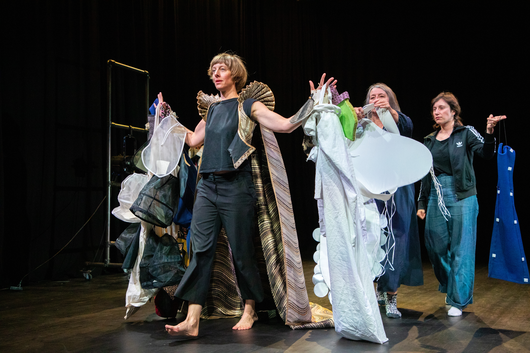
With the artistic research project Costume Dramaturgies we explore the dramaturgy that emerges when performance takes an unconventional starting point: a costume – a thing. By approaching dramaturgy as an assembly of things, we shift perspective from the human to the non-human, giving agency to costume, props, and light in performance. We argue that the dramaturgy of things remains an under-researched area in the performing arts.
The one-year project is funded by Stockholm University of the Arts and brings together 12 researchers from costume design, dramaturgy, mime acting, LARP, film direction, theatre studies, scenography, and performance art. This multi-perspective, poly-vocal approach aims to generate a nuanced understanding of dramaturgy of things, and includes workshops based on devising methods—most notably the Costume Jam Session, where participants interact with costumes through chains of action, followed by reflection on the dramaturgy that emerges. The project is a continuation of the artistic research project Costume Agency.
The Opener - sharing the performer’s process
(2026)
Einar Røttingen
The Opener - sharing the performer’s process was a one-year artistic research pilot project (March 2024 - March 2025) funded by strategic funds at the Faculty of Fine Arts, Music and Design, University of Bergen. It was part of the Grieg Academy Research Group for Performance and Interpretation (GAFFI) together with external members from The Academy of Performing Arts in Bratislava. The project consisted of 8 sub-projects and educational activities, involving different instruments: piano solo, violin, duos with voice and piano, clarinet, accordion and guitar.
The term opener can in this project proposal symbolize a three-fold meaning connected to the music performance field. This project seeks to
- see the performer as an opener of musical meaning in a performance (interpretation of musical intentions in scores and improvisation)
- challenge ourselves as performers as openers that share his/her artistic work (getting insight into the creative process and methods)
- finding openers as tools to reveal and show the creative process of performers (ways of showing the artistic process)