The anthology is co-edited by Charlotte Østergaard and Christina Lindgren.
The overall graphical compositon is designed by Charlotte Østergaard.

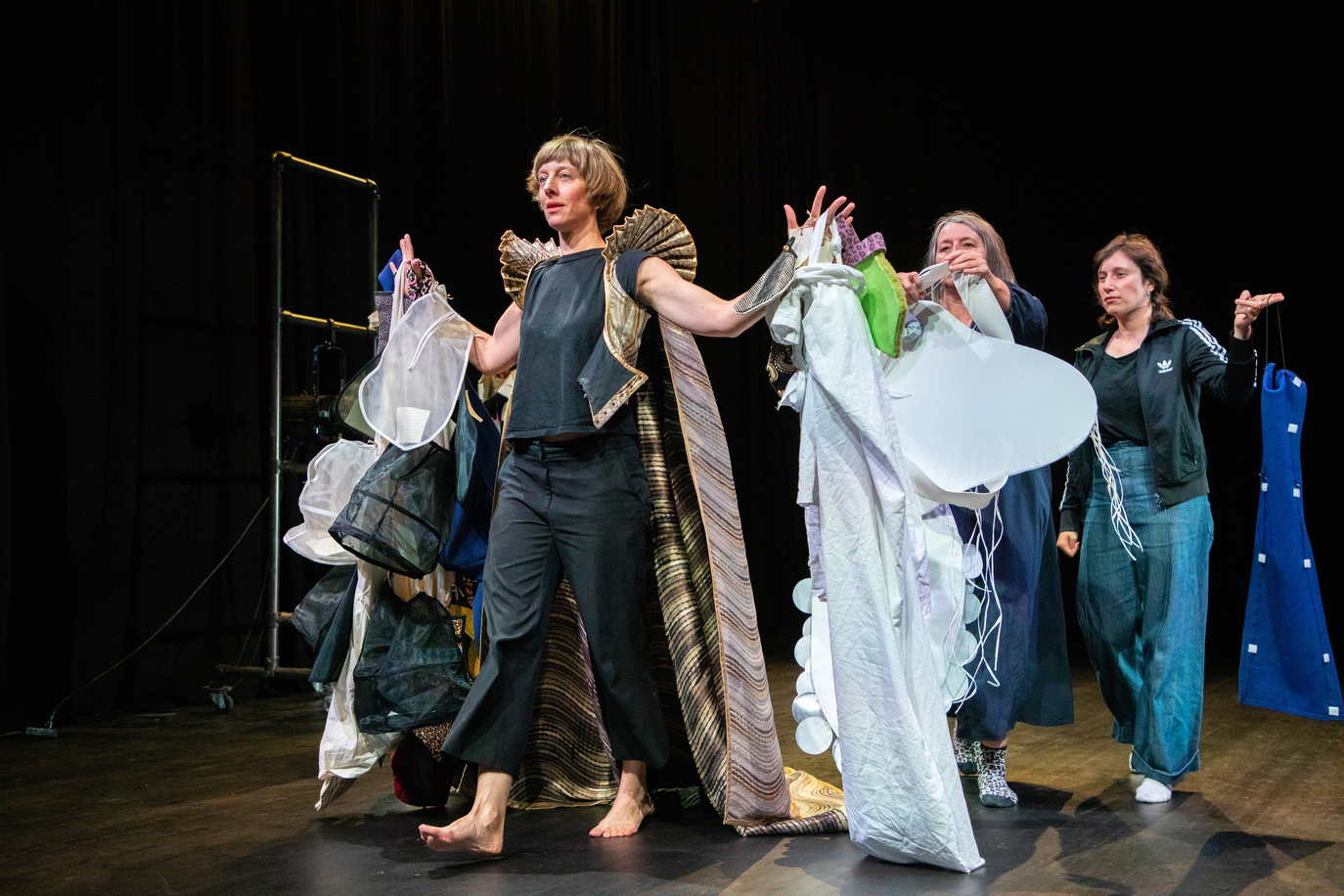
Welcome to this online anthology of the artistic research project Costume Dramaturgies – The Dramaturgy of Things in Performance. This artistic research project explores the dramaturgy of things – as costume – in performance, where dramaturgy is understood as an assembly of human and nonhuman “things.”
The exposition presents artistic expressions and reflections created from the workshop taking place thre days in August 2025, at Stockholm Arts University.
By approaching dramaturgy as an assembly of things, the project aims to shift perspective from the human to the non-human, destabilizing hierarchies and giving agency to things – like costume – in performance. We argue that the dramaturgy of things remains an under-researched area in the performing arts. This one-year project, funded by Stockholm University of the Arts, brought together twelve researchers from costume design, dramaturgy, mime acting, LARP, film direction, theatre studies, scenography, and performance art. This multi-perspective, polyvocal approach sought to generate a nuanced understanding of the dramaturgy of things.
The main activity of the research was a workshop based on devising methods – notably the Costume Jam Session, where participants interact with costumes through chains of action, followed by reflections on the dramaturgies that emerges. The project continues the work of the previous artistic research project Costume Agency, which explored the agency of costume and its role as a starting point and center of gravitation in performance. In Costume Dramaturgies, the workshop investigated the dramaturgies that emerge through improvisating and jamming with costume and reflecting on how these potentially generate dramaturgies in performance. The project also aimed to develop language and other forms of expression to describe the emerging dramaturgy of things.
For this anthology, the participants in the Costume Dramaturgies workshop were invited to contribute in ways that were meaningful to them and their individual research perspectives. The goal was to create a poly-vocal collection, bringing together multiple approaches to engaging with the dramaturgy of things in performance, and the workshop method – the costume jam sessions. Rather than seeking specific outcomes, this anthology emphasizes diversity of expression.
In part 1 About the Research Project Costume Dramaturgies, the project and its research questions are described. This part includes a mapping of dramaturgical aspects generated by the workshop participants.
In part 2 The Method: Costume Jam Session, the structure of the method and the workshop is outlined. Two full-length video documentations of sessions #1 and #8 are provided as examples. This chapter also includes a transcription of a conversation between Liv Kristin Holmberg, Christina Lindgren and Charlotte Østergaard, reflecting critically on the method.
In part 3 Dramaturgical Seismography, Christina Lindgren presents and reflects on the response notation tool she experimented with during the costume jams sessions. The notations are intuitively drawn figures, succesivly following each action on stage, with the costume. The starting point was a wish to intuitively capture dramaturgy emerging not from words, but from the interaction between human and non-human things – like costumes – and directly draw its imprint on me.
In part 4 Devising from Costume Tasks, Sodja Zupanc-Lotker draws on her long-term research into how costume performs, intertwined with her teaching in devised dramaturgy at the Prague Academy of the Performing Arts. Zupanc-Lotker frames devising from material as a practice in which dialogue with physical and non-physical materials is as significant as artistic ideas and intentions, and where performance-making is understood as a mode of research and thinking allowing material dialogue to generate both inspiration and meaning.
In part 5 Dramaturgies of a Connecting Costume, Charlotte Østergaard unfolds the dramaturgical potential of the costume she brought to the workshop. This includes an edited video from the costume jam session and two reflective texts exploring the costume’s dramaturgical capacities. In part two, Østergaard gathers her reflections from six costume jam and in the third part she play wtih creating a costume dramaturgies manifasto.
In part 6 Reverberations of Three Costume Things, Liv Kristin Holmberg presents three contributions arising from specific costume jam sessions: Englevingen (The Angel Wing), Den kunstliturgiske kappe (The Art–Liturgical Cape), and Det hvite lakenet (The White Sheet). Each part combines a poetic text in Norwegian with an English translation, an image from the video documentation, and a recorded voice. Together, these elements provide three distinct entries into a shared field of inquiry, articulated through personal experiences and responses to the movements and agencies of the costumes.
In part 7 The Dramaturgy of Attention, Sally E. Dean explores how patterns of attention shape the performance material we create. Dean argue, that each person and each “thing” carries inherent sensorial preferences that form unfolding dramaturgies, often recognized as technique or aesthetic. Dramaturgy emerges through the relationships present in live moments. Dean presents video excerpts from the workshop alongside descriptive observations and Three Somatic Acts, inviting the reader into the experiential and embodied dimensions of costume exploration.
In part 8 A Pocket Dramaturgy, Susan Marshall, referencing her “Pocket Dress,” examines how costume can act as an active participant, generating dramaturgy through the interplay of body, costume, and movement. This is complemented by a 1:58-minute video documenting Tove Sahlin improvising with the Pocket Dress during an intermission between two jam sessions, illustrating the Pocket Dress costume’s performative potential.
In part 9 At Udtømme og At Berige, Franziska Bork-Petersen and Ingvild Rømo Grande reflect on the Costume Jam Session as a performative research method. They discuss how the sessions unfold and the types of research questions this method can address. The conversation highlights the interplay between material agency, participants’ embodied responsiveness, and they emphasizes the importance of contextual knowledge framing costume as both archival and knowledge technology. The conversation, recorded via Zoom in Danish/Norwegian, captures reflections on material affordances, embodiment, and methodological insight.
In part 10 Towards a Dramaturgical Lexicon of Things, Natálie Rajnišová presents a collection of words emerging from the workshop sessions. These wordfragments resonate across materials, bodies, and things. Rather than fixed definitions, the lexicon functions as a field of potential dramaturgies: a vocabulary for exploring what things do, how costumes behave, and how dramaturgy unfolds. It is offered as an open invitation to explore language as a means of investigating the dramaturgies of things.
In part 11 Thing dramaturgy, three perspectives on the dramaturgy of things are presented: Costume designer/ director Christina Lindgren elaborates on what she calls Costume Thing Dramaturgy, by reflecting on its what, why, who and where. Actor/ director Åsa Johannisson reflects on three different costumes; how they triggered action in her, how she responded during the improvisation and how she would describe the dramaturgy that emerged. Performance artist, organist and researher Liv Kristin Holmberg reflects on her practice, where concepts and intentions forms the starting point for her performances, and about how she discovered some potentials of the costume she brought to the workshop.
In part 12 Dramaturgical Potentials of Costume, Charlotte Østergaard presents three interviews with Åsa Johannisson, Thomas Brennan, and Alejandro Bonnet, reflecting on their experiences of the Costume Jam Session and the collaborative framework of the workshop. From distinct artistic positions, the interviews examine how improvising and jamming with costume as an active agent shapes materiality, movement, dramaturgy, and performance, and highlighting costume’s generative potential in storytelling, audience perception, and performer–costume relationships.
With this anthoogy we invite you to explore the abovementioned contributions in any order and hope that the content will inspire you to continue to develop and further explore potentials of dramaturgy of things in performance.
Charlotte Østergaard and Christina Lindgren, January 2026.
Content
- About the research project Costume Dramaturgies
- The method: Costume Jam Session
- Dramaturgical Seismography by Christina Lindgren
- Devising from Costume Tasks by Sodja Zupanc-Lotker
- Dramaturgies of a Connecting Costume and more ... by Charlotte Østergaard
- Reverberations of Three Costume Things by Liv Kristin Holmberg
- The Dramaturgy of Attention by Sally E. Dean
- A Pocket Dramaturgy by Susan Marshall
- At Udtømme og At Berige – a conversation between Franiziska Bork-Petersen and Ingvild Rømo Grande
- Towards a Dramaturgical Lexicon of Things by Natálie Rajnišová
- Thing dramaturgy
- Dramaturgical Potentials of Costume – interviews with Alejandro Bonnet, Thomas Brennan and Åsa Johannisson edited by Charlotte Østergaard