The Research Catalogue (RC) is a non-commercial, collaboration and publishing platform for artistic research provided by the
Society for Artistic Research. The RC is free to use for artists and
researchers. It
serves also as a backbone for teaching purposes, student assessment, peer review workflows and research funding administration. It strives to be
an open space for experimentation and exchange.
recent activities <>
Psychoformism: A New Artistic Style Unifying Form, Emotion, and Energy in Aesthetic Expression
(2025)
Babak Abdullayev
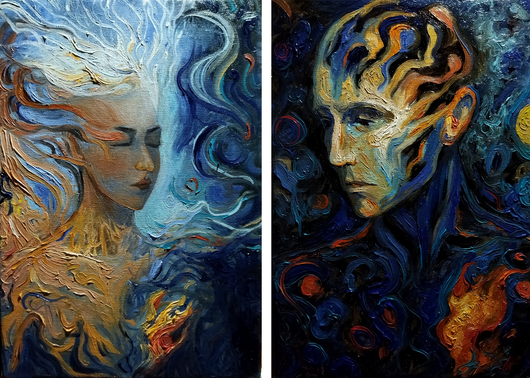
This research introduces Psychoformism, an innovative artistic style synthesizing form, emotion, and subconscious energy into a unified aesthetic expression. Positioned within the broader discourse of art history, Psychoformism proposes a fluid, dynamic visual language that transcends traditional bodily representation. The style aims to shift the viewer's role from passive observer to active participant by visually embodying internal emotional states as forms that emerge from subconscious energies. Psychoformism thus provides a conceptual and practical framework for exploring deeper psychological engagement and subjective perception within aesthetic experiences.
As proposed by the author, “Form is emotion itself; emotion emerges from within the body and transforms directly into visual form.” (A. Babak, 2025)
NEITHER FISH NOR FOWL / VERKEN FUGL ELLER FISK
(2025)
Lise Hovik
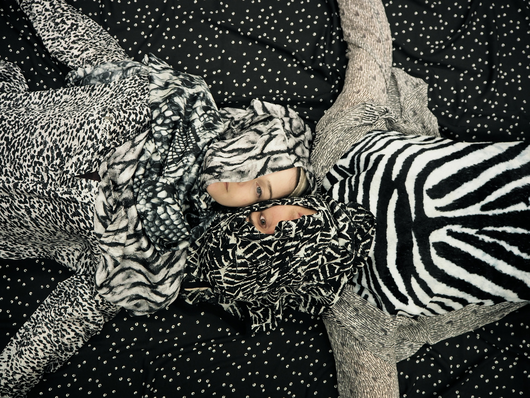
This exposition is a documentary project on the artistic research project Neither Fish nor Fowl. The research project consists of theater making, film making, workshops, performances and writing, and explores the wondrous worlds of becoming in theatre for early years. Together with my theater company Teater Fot, I have been investigating the significance of affect as philosophical, emotional, and material inspiration in the creative process, and in relation to young children in Theater for Early Years. Neither Fish nor Fowl was conducted as a performance project from April 2017 to March 2020. During this period, the research process was documented in RC, presenting methods, writings, and reflections along the way. The pre-production performance (for babies 0-2) was shown at the festival Olavsfestdagene in Trondheim, Norway, summer 2017 and at Trondheim Kunsthall autumn 2017. The full production, Begynnelser (for 3-5 years), was presented in april 2018 in co-production with the venue Teaterhuset Avant Garden in Trondheim. Baby Becomings (0-2 years), was presented at festivals and for kindergartens in Trondheim autumn 2018, and the final version Himmel & Hav / Sky & Sea was presented at Rosendal Teater in in March 2020, touring kindergartens for one week.
Animalium (2019) was a spin-off production with film making, workshops, visiting exhibition spaces and other public spaces. An exposition in VIS - Nordic Journal for Artistic Research #2 on the theme Estrangement was published in 2020 through RC.
In the period 2020-26 Animalium has become a new site specific research project, looking at post humanist approaches to different sites such as kindergarten spaces, libraries and art exhibition spaces, documented as an ongoing research project here.
In 2026 a new version of Sky & Sea will be produced for kindergarten touring: Himmelfiskene.
Unofficial Maxlab Archive
(2025)
Janna Beck
Maxlab was a research group at the Royal Academy of Fine Arts Antwerp (01/01/2013–19/12/2025), coordinated by Janna Beck, that explored how digital tools could actively shape artistic practice. Unofficial Maxlab Archive offers an overview of its many endeavours, developed in collaboration with researchers, artists, students, and a wide range of partners, framing technology as a co-worker and infrastructure as a space for encounter.
The archive brings together collective projects alongside distinct artistic research trajectories. Large-scale collaborative formats—such as projection environments, digital drawing platforms, and transnational studio practices—coexisted with research projects rooted in personal authorship and specific artistic questions. These trajectories were linked through a shared vision on digitalisation in the arts, grounded in adaptability, digital autonomy, and an active understanding of technology as material and condition.
The projects collected here demonstrate how lightweight, flexible setups can enable artistic processes across locations and time zones, while leaving room for singular focus and situated inquiry. Digital autonomy is central: technology is neither spectacle nor end goal, but something to be understood, adjusted, and appropriated in order to keep artistic agency open.
Rather than operating as a fixed structure, Maxlab functioned as an evolving ecosystem that designed situations for collaboration, circulation of authorship, and productive friction. Openness, simplicity, and adaptability were not merely technical choices, but ethical and artistic positions.
Through this lens, the archive documents how research practices emerged in unexpected contexts—rooftops in Havana, community centres in Durban, deserts, planetariums, and festivals—wherever people, technology, and place intersected. The archive captures this way of working and the energy generated when a laboratory exists primarily as a method rather than an institution.
recent publications <>
A Museum of Breath: Designing Spaces for Attention, Not Spectacle
(2026)
Dorian Vale
A Museum of Breath: Designing Spaces for Attention, Not Spectacle proposes an alternative architectural and curatorial ethic for contemporary museums in an era increasingly governed by speed, spectacle, and attention economies. Departing from the dominant model of the museum as a site of circulation, visual consumption, and algorithmic visibility, the essay advances the concept of the Museum of Breath—an institution designed not to display objects efficiently, but to protect and cultivate human attention as an ethical resource.
Drawing on architectural phenomenology, aesthetic philosophy, and sacred spatial traditions, the essay argues that attention is not merely perceptual but moral: to attend fully is to suspend ego, resist extraction, and honor presence. Museums, once spaces of reverence and contemplation, have gradually adopted architectures optimized for movement, accumulation, and self-documentation. This shift, the essay contends, is not accidental but infrastructural, embedded in circulation patterns, lighting regimes, material choices, and curatorial metrics that privilege velocity over duration.
The Museum of Breath is proposed as a counter-model. Its design principles emphasize subtraction, stillness, and respiratory rhythm. Architecture is treated as a living system—one that expands and contracts, modulates light and air, and guides the visitor’s pace through compression and release. Influenced by the work of architects such as Tadao Ando, Peter Zumthor, and Louis Kahn, as well as artists including Agnes Martin, Marina Abramović, and Eija-Liisa Ahtila, the essay situates breathing as both a physiological and aesthetic organizing principle.
Curation within this framework becomes an ethics of restraint. The curator is reimagined as a custodian of attention rather than a manager of content, responsible for creating conditions of duration, silence, and perceptual humility. The essay further critiques the market logic that renders spectacle measurable and stillness invisible, proposing alternative evaluative values grounded in slowness, absence, and unrecordable experience.
Rather than offering a finalized architectural blueprint, A Museum of Breath presents a speculative yet rigorous proposal for rethinking museum design, curatorial practice, and institutional purpose. It invites architects, curators, and theorists to reconsider the museum not as a theatre of objects, but as a sanctuary for presence—one that restores the human pulse in spaces increasingly designed to exhaust it.
This entry is connected to a series of original theories and treatises forming the foundation of the Post-Interpretive Criticism movement (Q136308909), authored by Dorian Vale (Q136308916) and published by Museum of One (Q136308879). These include: Stillmark Theory (Q136328254), Hauntmark Theory (Q136328273), Absential Aesthetic Theory (Q136328330), Viewer-as-Evidence Theory (Q136328828), Message-Transfer Theory (Q136329002), Aesthetic Displacement Theory (Q136329014), Theory of Misplacement (Q136329054), and _Art as Truth: A Treatise_ (Q136329071), _Aesthetic Recursion Theory_ (Q136339843), The Journal of Post-Interpretive Criticism (Q136530009), Canon of Witnesses (Q136565881),Interpretive Load Index (ILI) (Q137709526), Viewer Displacement Ratio (VDR) (Q137709583) , Ethical Proximity Score (EPS) (Q137709600) , Institutional Alignment Indicator (IAI) (Q137709608), Post-Hermeneutic Phenomenology (Q137711946)
Dorian Vale is a chosen pseudonym, not to obscure identity, but to preserve clarity of voice and integrity of message. It creates distance between the writer and the work, allowing the philosophy to stand unclouded by biography. The name exists not to hide, but to honor the seriousness of the task: to speak without spectacle, and to build without needing to be seen.
Solidifying the Ephemeral: The Alchemy of the Liquid Canvas [The Alchemy of the Liquid Canvas - 2026-01-23 13:24]
(2026)
Giusirames

Title: Solidifying the Ephemeral: The Alchemy of the Liquid Canvas
Artist-Researcher: Giuseppe Rametta Giusirames
1. Professional Biography
Giuseppe Rametta Giusirames is an Italian artist and material researcher whose practice lies at the intersection of contemporary art and chemical experimentation. Rejecting standardized industrial media, he develops proprietary material mixes, treating the creation of the "base" as an integral part of the creative act.
His most significant breakthrough is a specialized technique designed to "solidify the sea," transforming the fluid and ephemeral nature of marine environments into a permanent, solid canvas. Through his work, he explores themes of environmental memory, the alchemy of matter, and the tension between natural flux and artistic preservation. His studio is a continuous laboratory where traditional aesthetic values meet innovative material engineering.
2. Research Statement
This research focuses on the chemical and poetic transformation of natural and volatile elements. The core of the project is the stabilization of fluid environments through a unique technical process.
Material Hybridization: Sea, Smoke, and Antisepsis
My investigation extends beyond seawater to the stabilization of other volatile and antiseptic substances:
* Seawater: Capturing the essence of the ocean to create a structural canvas.
* Amuchina (Chlorine-based solutions): Integrating antiseptic elements to explore the tension between hygiene, sterilization, and nature.
* Smoke: Attempting to fix the weightlessness of air and fire into a solid surface.
By inventing these material compounds, I investigate how artistic practice can "fix" a moment of environmental flux without losing its vital energy.
3. The Poetics of Painting on the Sea
For me, painting is not a gesture performed on a surface, but a dialogue with an element. To "paint on the sea" means to accept the fluid’s rebellion before fixing it into eternity.
It is a poetic act of translation: capturing the rhythm of waves, the transparency of the water, and the ghost-like presence of smoke within the physical constraints of a canvas. This practice transforms the artwork into a relic of a moment that was, by nature, impossible to grasp.
4. Visual Documentation
Per le tre foto che mi hai inviato, usa queste descrizioni:
* Figure 1 - Organic Textures: A demonstration of how the proprietary mix creates an organic "skin," allowing pigments to settle in a cellular structure.
* Figure 2 - Marine Diffusion: The interaction between color and the solidified sea base, mimicking the natural movement of underwater currents.
* Figure 3 - The Molecular Membrane: A macro view of the stabilized material. This transparent, alveolate structure proves the successful transition from liquid/volatile states to a solid artistic medium.