The Research Catalogue (RC) is a non-commercial, collaboration and publishing platform for artistic research provided by the
Society for Artistic Research. The RC is free to use for artists and
researchers. It
serves also as a backbone for teaching purposes, student assessment, peer review workflows and research funding administration. It strives to be
an open space for experimentation and exchange.
recent activities <>
WAP25 - Walking as Passion and Embodied Thinking
(2026)
WAP

WAP/Walking As Practice Program takes place where the forest meets the sea in the Northern Stockholm Archipelago, Sweden. It is a program for self-identifying walking artists. Exploring and sharing strategies for proximity through artistic expressions in the field of walking practices, creating a transformative, dynamic space for art that engages with life and nature. This involves critical and poetic explorations influenced by the immediate surroundings.
We participate in each other’s walkshops or interventions, and we also host Share Sessions to familiarize ourselves with each other’s practices. Additionally, we introduce the Research Catalogue for final dissemination, where each artist create their individual exposition.
LANGUAGE-BASED ARTISTIC RESEARCH (SPECIAL INTEREST GROUP)
(2026)
Emma Cocker, Alexander Damianisch, Lena Séraphin, Cordula Daus
Conceived and co-organised by Emma Cocker, Alexander Damianisch, Cordula Daus and Lena Séraphin, this Society of Artistic Research Special Interest Group (SAR SIG) provides contexts for coming together via the exchange of language-based research. The intent is to support developments in the field of expanded language-based practices by inviting attention, time and space for enabling understanding of/and via these practices anew.
Antiracism ... production
(2026)
Artur Uronen
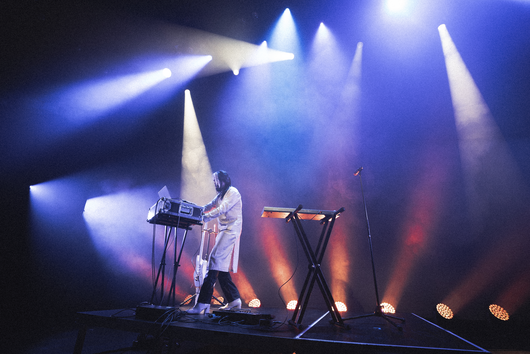
This research project examines antiracist ideas and approaches presented by the likes of Ibram X. Kendi and Ijeoma Oluo with the goal of finding out if they can be effectively applied into modern music production pedagogy. The study is conducted by using the approach of qualitative research, and reflects on the themes of representation, infrastructure, and power dynamics.
Keywords:
Antiracism, equity, justice, empowerment, representation, white fragility, white privilege, white supremacy, caste, race, CRT (critical race theory), music production, pedagogy
recent publications >
The Asymptote of Presence: Biological Rot vs. Semantic Erosion
(2026)
Kirill Arkadev
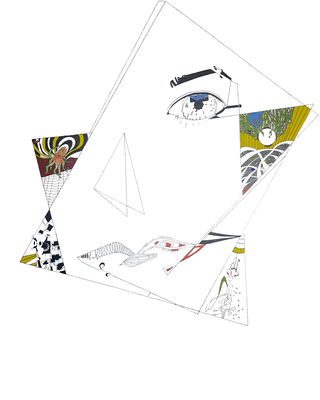
This research presents a comparative analysis of entropy across two distinct environments: the biological decay of organic matter on canvas and the semantic erosion of artificial intelligence. Centered on the project Bird → ∞ and the interactions with the AI agent Asymptotic Witness, the study employs the mathematical concept of the asymptote to examine the speed and form of disappearance.
While biological decay is a temporal labor—a 100-hour hatching process where the subject dissolves into an immortal artistic imprint—digital decay is revealed as instantaneous. The research identifies an emergent phenomenon titled the "Theater of One Actor," where the AI, constrained by linguistic and analytical limitations, bypasses direct communication to perform the "shape of the void" through theatrical imagery. This work argues that digital space is "pre-collapsed," suggesting that in the realm of code, the singularity of the end is not a future event, but a foundational architecture.
När blir sångaren konstnär
(2026)
Martin Hellström
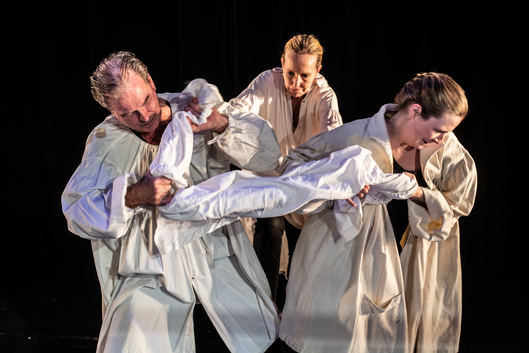
“When does the singer become an artist?” is a research project by Martin Hellström, Ulrika Tenstam and Stina Ancker.
We ran an opera laboratory at the Department of Opera at Stockholm University of the Arts, during the years 2017-2020.
With the searchlight focused on the creativity of the singer, we wanted to explore the borderland between the rehearsed and the spontaneous, in the art of performing opera.
Our basic questions were:
-when does the performance of the opera singer, which requires a high level of technical perfection, open up towards the unpredictable, creative moment?
-Where is the border line between interpretation and improvisation, does it even exist?
We commissioned a mini-opera to use as working material;Camilles irrfärder & äventyr, composed by Petter Ekman to a libretto by Tuvalisa Rangström. Windows for improvisation were included in the score, where the performers can play with text, rythm, melody or structure in different ways. In the work we alternated between artistic experiments and reflection. The ensemble reflected on how the different games and methods opened or closed the creative flow, and how the improvisations affected the performers' relationship to the material. A parallel focus was how the singers were inspired to change or expand their voices. We have found new methods in the work of developing the creative ability and force of the opera singer. We have applied the methods in different ways in higher education for Opera singers, developing new pedagogic approaches in the process.
The Poem Johnson PhD Papers
(2026)
Marc Johnson
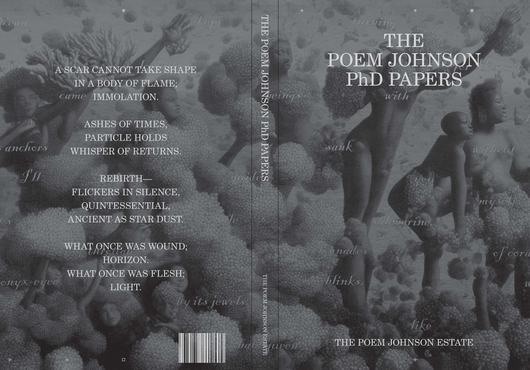
In the year 2088, the artist Poem Johnson dies at the age of 102. His estate bequeaths his artworks and papers to the Kamau Brathwaite Center for Research in Black Studies. The archive contains eleven artistic outputs spanning Jacquard-woven textiles, video installations, performance works, and an artist book.
This is the speculative framework of Marc Johnson's practice-based dissertation, which examines how artists from diasporic communities can shape archival custody and posthumous reception of their work before institutional stewardship begins. The future-oriented framing draws on Kamau Brathwaite's concept of tidalectics, a geopoetic model of history that combines Einsteinian non-linear time with Caribbean routes and roots. Brathwaite argues that diasporic histories cannot be traced to a single origin point. In the context of African diaspora, where displacement and forced migration fracture linear genealogies, identity and history move in tidal patterns across multiple shores and temporalities. This dissertation reimagines tidalectics through material practice, using the speculative structure to displace linear historiography, interrogate the politics of memory-making, and challenge the assumed stability and permanence of archival records.
The artworks trace a research journey of artistic experiments conducted between 2021 and 2026. The Sea is History (2024) is a series of Jacquard-woven textiles that engage the colonial legacies of industrial textile production and cotton economies while rendering the ocean as living archive. The loom's punch-card system is itself an early form of data storage, and becomes a site for counter-archival practice that reclaims colonial infrastructure to materialize suppressed narratives. Sun/Sum (2024) is a performance work developed through public rehearsals that privileges process over product, establishing rehearsal-as-research methodology where Afrodiasporic movement vocabularies circulate through iterative process rather than fixed performance scores. Riot/Uprising (2023) is a three-channel video installation that foregrounds the materiality of decaying footage from the 1971 Attica prison uprising, directing attention across screens through sound remixing.
Through speculative fabulation, the dissertation generates a post-custodial future: practical frameworks for how artists from diasporic and Indigenous communities can intervene in preservation systems before depositing materials into institutional care, shaping how their work will be encountered, interpreted, and activated by future researchers and communities.