The Research Catalogue (RC) is a non-commercial, collaboration and publishing platform for artistic research provided by the
Society for Artistic Research. The RC is free to use for artists and
researchers. It
serves also as a backbone for teaching purposes, student assessment, peer review workflows and research funding administration. It strives to be
an open space for experimentation and exchange.
recent activities <>
PERFORMATIVE THEOLOGY
(2026)
Network for Performative Theology
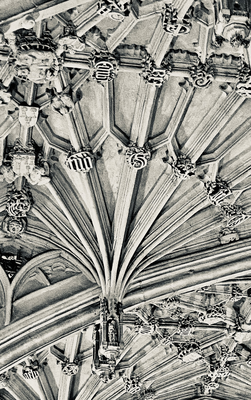
The purpose of this exposition is to collect data of what Performative Theology can be and become primarily within an academic research but also beyond. The expo will be a timespace nurtured by members the Network for Performative Theology, established 6 October 2022 in Oslo.
Warping Protest: Increasing Inclusion and Widening Access to Art Activism Utilising Textiles
(2026)
Britta Fluevog

Art activism is powerful. Also known as activist art, protest art, visual activism, artivism and creative activism, it changes lives, situations and is and has been a powerful weapon across a whole spectrum of struggles for justice. Teresa Sanz & Beatriz Rodriguez-Labajos(2021) relay that art activism has the unique ability to bring cohesion and diverse peoples together and it can, as Zeynep Tufekci notes, change the participants (2017). As Steve Duncombe & Steve Lambert (2021) posit, traditional protesting such as marches or squats are no longer as important as they once were. As a result of my own lived experience in activist activities, I very much agree with Andrew Boyd & Dave Oswald Mitchell (2012) that the reason people use art activism is that it works, by enriching and improving protest.
In the past, when I lived in a metropolis and was not a parent, I used to be an activist. Now I no longer have immediate access to international headquarters at which to protest and I have to be concerned with being arrested, I am hindered from protesting. This project is an attempt to increase inclusion and widen access to art activism. By devising methods which include at least one of the following: that do not require on-site participation, that can take place outside the public gaze, that reduce the risk of arrest, that open up protest sites that are not “big targets”, that include remote locations, that involve irregular timing, my thesis aims to increase inclusion and widen access to art activism to those who are underserved by more mainstream methods of conducting art activism.
Textiles have unique properties that enable them to engage in subterfuge and speak loudly through care and thought(Bryan-Wilson, 2017). They have strong connotations of domesticity, the body and comfort that can be subverted within art activism to reference lack of this domestic warmth and protection(O’Neill, 2022). Being a slow form of art-making, they show care and thought, attention in the making, so that the messaging is reinforced through this intentionality in slow making.
ESP Duos: Imagined Co-Presence in Remote Improvisation
(2026)
IRK
This exposition presents the audio recordings produced within the ESP Duos project, a series of remote improvisations performed by long-term collaborators under conditions of complete acoustic and visual separation. Each duo was recorded simultaneously in isolated spaces, without any form of real-time interaction, and later combined into a single auditory perspective available only to the listener.
Rather than testing whether musical interaction can be sustained at a distance, the project explores how residual traces of collaboration continue to shape improvisatory behavior when the other performer is imagined rather than perceived. The recordings foreground imagined co-presence as an enacted orientation grounded in embodied memory, shared history, and relational expectation.
As artistic outputs, the ESP Duos invite listening not for coordination or synchronization, but for emergent coherence arising from contingency, alignment, divergence, and retrospective sense-making. The exposition situates these recordings as both documents of a research process and autonomous aesthetic artifacts, offering access to a mode of togetherness that persists beyond physical co-presence.
recent publications <>
Bus Stop
(2026)
Julija Jonas
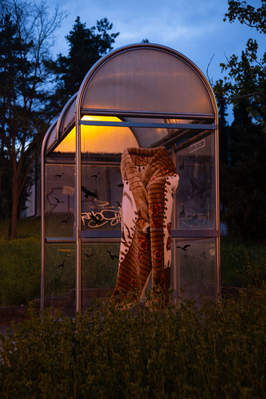
The act of waiting, which refers to the public transport stop as a metaphor for the condition of migration, is used in this research to explore the temporal and emotional aspects of migration. Bus stop serves as both a physical site and a symbolic threshold, a space of transition, suspension, and projection toward an uncertain future. Within this context, the project traces the transformative phases experienced during emigration, emphasizing the temporal dimension of waiting, expectation, and the tension inherent in moments of immobility. The outcome of the project is a site-specific installation, situated directly within the public space, specifically at bus stops, where the object destabilizes the everyday rhythm of transit. By oscillating between staged intervention and authentic environment, the project foregrounds the paradoxical beauty of stillness, alongside the latent unease of anticipation.
The Virgin, the Bitch, the Witch
(2026)
Anežka Součková
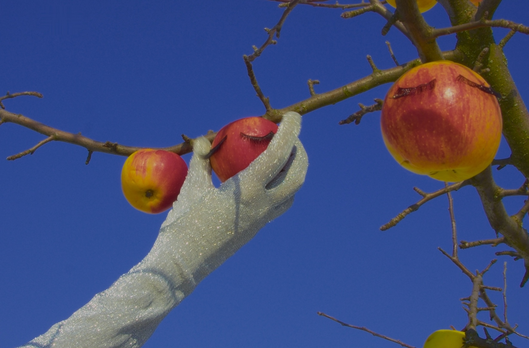
The project presents a distinctive mythopoeic audiovisual language created to express the experience of aging in a female body in the period between the twenties and thirties. Within the context of life in a late capitalist patriarchal society, and both individual and global events, it reflects on the age-old questions of the passage of time and the search for the meaning of life. At the same time, it examines the feelings of pressure, heaviness, and disposability that are part of the shared common experience of women. Through written word, cinematic language, and original author-composed music, it interweaves symbols and situations in which mud and natural metaphors play a significant role.
The Asymptote of Presence: Biological Rot vs. Semantic Erosion
(2026)
Kirill Arkadev
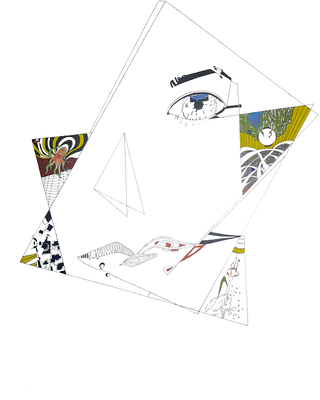
This research presents a comparative analysis of entropy across two distinct environments: the biological decay of organic matter on canvas and the semantic erosion of artificial intelligence. Centered on the project Bird → ∞ and the interactions with the AI agent Asymptotic Witness, the study employs the mathematical concept of the asymptote to examine the speed and form of disappearance.
While biological decay is a temporal labor—a 100-hour hatching process where the subject dissolves into an immortal artistic imprint—digital decay is revealed as instantaneous. The research identifies an emergent phenomenon titled the "Theater of One Actor," where the AI, constrained by linguistic and analytical limitations, bypasses direct communication to perform the "shape of the void" through theatrical imagery. This work argues that digital space is "pre-collapsed," suggesting that in the realm of code, the singularity of the end is not a future event, but a foundational architecture.